Alaska
Hydroponics provide year-round growing for Alaska farmers


On a recent December afternoon, Soldotna farmer Taylor Lewis preps for a day of harvesting crops. She walks to a tray filled with ripe lettuce and snips a head of it by the stem.
It’s just one of about 900 plants that Taylor and her mother-in-law Jayme Lewis will harvest and process this week – despite freezing temperatures and slushy snow outside. That’s because the duo works for Edgy Veggie, an indoor farm that grows produce year round.
“In the summer, a lot of our business drops off because folks are gardening at home. But in the winter, they’re not, because it costs money to heat your greenhouse,” Jayme said. “It costs a lot of money to heat your greenhouse.”
The company is a hydroponic farm, meaning they grow plants without soil. Hydroponic systems recycle and reuse nutrient-filled water, which minimizes waste. Specially made lighting and climate controlled conditions make it possible for Edgy Veggie to grow indoors during the winter months.
Around Thanksgiving, the company harvested 150 pounds of lettuce, enough to make about 800 salads. That took two days and was one of their biggest hauls of the year. Although not a typical harvest for the company, Jayme says she does see an uptick in business during the winter when Alaska’s produce is almost exclusively shipped up from the Lower 48.
“If you go to the grocery store and pick up a head of lettuce right now, by the time you get it home it will be wilted,” Jayme said. “That’s sad. Literally, that’s sad.”
Jayme says some local restaurants have sourced their vegetables from Edgy Veggie because they last longer and are fresher than grocery store produce.
Nestled between two train cars-turned-restaurants on the other side of town, Henry Krull walks inside his shipping container farm. He points to a wall that’s growing hundreds of bunches of butter lettuce.
Krull is the owner of fresh365, another Kenai Peninsula based hydroponic farm. Just like Edgy Veggie, the farm operates entirely indoors.
“The advantage of growing indoors, in a container like we have, is that we can control the environment,” Krull said. “We can grow no matter what’s going on outside. It can be 30 below outside, but it’s always 70 degrees or so inside.”
fresh365 also sees an uptick in direct-to-consumer sales in the winter. Otherwise, most of their sales go to other businesses, like local restaurants.

And while indoor farming means fresh, local produce year-round for Alaskans, it faces a number of challenges. Krull says growing in a hydroponic setting is much more expensive than traditional farming methods. So, to offset his farm’s energy costs, he installed solar panels, which were partially funded by the U.S. Department of Agriculture’s Rural Energy for America Program, or REAP.
But, Krull says the property doesn’t get much sunlight in the winter.
“The sun is a very valuable commodity, it’s valuable for not only producing electricity, but it helps to lower the energy costs,” he said. “And the energy costs of the farm containers we have is actually very, very high, because we can’t take advantage of the sun.”
Edgy Veggie, on the other hand, doesn’t even have solar panels. Jayme says their energy costs are high year round.
“Electricity, especially, is outrageous,” she said. “I wish that the state had some sort of option with the electric companies to help support farming. We’re providing a service to the community, honestly. We’re trying to, but it might run us out of business.”
Other challenges to hydroponics include faulty pumps and timers, ventilation issues and water leaks. Like traditional farming, hydroponic farmers say it’s backbreaking work.

But, for farmers like Taylor Lewis, offering fresh and local produce year round is a labor of love.
“Being able to supply our community with anything fresh is great,” Taylor said. “What we have as options in the grocery store – it’s not cutting it.”
“These belong in every community,” Krull said. “We’ve been able to prove that as a business model, it works. You can make a profit doing it, you can provide a good service to your community, and I think we can really do good for our community by providing something that is not readily available on a year-round basis.”
According to the U.S Department of Agriculture, only 5% of food Alaskans consume is grown locally. The state also has very short growing seasons.

Alaska
Man with same name as Alaska Sen. Dan Sullivan can appear on GOP primary ballot, state’s Supreme Court rules

The battle of the Dan Sullivans is on.
The Alaska Supreme Court ruled Monday that a man with the same name as Republican Sen. Dan Sullivan can challenge the sitting lawmaker in the state’s GOP Senate primary in August. The high court upheld a ruling from a lower court judge that cleared the way for Daniel J. Sullivan to appear on the primary ballot, reversing a decision by state officials earlier this month that he was ineligible because he was allegedly trying to confuse voters.
The state Supreme Court directed Alaska’s Division of Elections to decide how Daniel J. Sullivan should be listed on the ballot “within the confines of existing Alaska ballot design law.”
The conflict is taking place in one of the country’s most closely watched Senate elections. The sitting Sen. Sullivan is running for a third term, but former Democratic Rep. Mary Peltola is vying to challenge him, setting up what could be an unusually competitive race in a deep-red state that hasn’t elected a Democrat to the Senate in almost 20 years.
The senator has called his same-name competitor a “sham candidate” and accused him of trying to trick voters and help Democrats flip the seat. Daniel J. Sullivan — a retired teacher and former U.S. Forest Service employee from Petersburg, Alaska — has denied those allegations and insisted he is both qualified and genuinely interested in running for Senate.
About two weeks ago, the Alaska Division of Elections determined that the challenger Sullivan could not appear on the ballot, arguing his paperwork “was not filed in order to declare an actual good-faith candidacy, but was instead filed with a purpose to confuse or mislead.”
In a letter to the candidate, Director Carol Beecher pointed to the fact that Daniel J. Sullivan had initially requested to appear on the ballot as “Dan Sullivan,” the same name format as the senator. She also wrote that he hadn’t previously been affiliated with the state Republican Party, had a website design that “appears to be deliberate[ly]” similar to the senator’s campaign site and had worked with a political consultant with links to Democratic candidates.
Daniel J. Sullivan asked a state court to reverse the decision. On Friday, Judge Thomas Matthews ruled in his favor, finding the non-senator Sullivan met the requirements to run for U.S. Senate and the state didn’t have the authority to exclude him based on “good faith.”
“The court does not minimize the Division’s concern that voters should not be misled,” the judge wrote. But he added that “Alaska election law gives the Division tools to address that concern,” including regulating how candidates appear on the ballot.
With ballots set to be printed this week, the issue was appealed to the Alaska Supreme Court on an expedited basis, with both sides filing court papers over the weekend.
The state Division of Elections asked the high court to overturn Matthews’ ruling, arguing it would “leave Alaska constitutionally required to permit bad-faith ballot access.” The agency said it reached its conclusion about Daniel J. Sullivan after it received a complaint from the National Republican Senatorial Committee “credibly alleging” he was seeking to “cause voter confusion” and made a “bewildering” request to appear on the ballot with the senator’s middle initial.
If Daniel J. Sullivan is permitted to remain on the ballot, the state asked the Alaska Supreme Court to allow it to print his full name and list his party affiliation as “nonpartisan” to “ensure voters are not forced to guess between two nearly identical names.”
The Alaska Republican Party and several GOP-led states filed amicus briefs siding with Alaska.
Daniel J. Sullivan’s lawyers, meanwhile, argued the state “lacked any basis in Alaska law to exclude Mr. Sullivan from the ballot” and didn’t have the power to look into his “private motivations.” They wrote that state law doesn’t give officials the power to keep qualified candidates off the ballot due to potential confusion.
“[All] that Mr. Sullivan asks here is to be listed on the ballot, and the Division is obviously empowered to do so in a non-confusing manner,” his lawyers wrote.
Following oral arguments, the high court sided with Daniel J. Sullivan in a two-page order late Monday, and said it would issue a fuller opinion at a later date.
Jeffrey Robinson, an attorney for Daniel J. Sullivan, told CBS News his legal team is “grateful” for the Alaska Supreme Court’s decision to “affirm Judge Matthews’ well-reasoned, thorough order vacating the Division’s unlawful decision to exclude Mr. Sullivan as a candidate.”
“We expect that the Division will act in full compliance with existing Alaska ballot design law in its preparation of the ballots,” Robinson said in an email.
The senator’s campaign spokesperson, Nate Adams, said: “We’re disappointed in the court’s decision because as the sham candidate Dan J. Sullivan’s lawyers made clear in their legal arguments, the only reason he is running is to deceive voters and manipulate Alaska’s election system.”
“However, we are encouraged by the fact that the Director of the Division of Elections will be able to use her expertise to differentiate between the Petersburg fraud and the incumbent — Senator Dan Sullivan — to the benefit of Alaska voters,” Adams said.

The first Jesuit missionaries in Alaska sailed up the Yukon River in 1887. By the turn of the 20th century, the religious order of the Catholic Church had as many as 50 Jesuits in the state.
Now, only two remain. And by the end of June, there will be none.
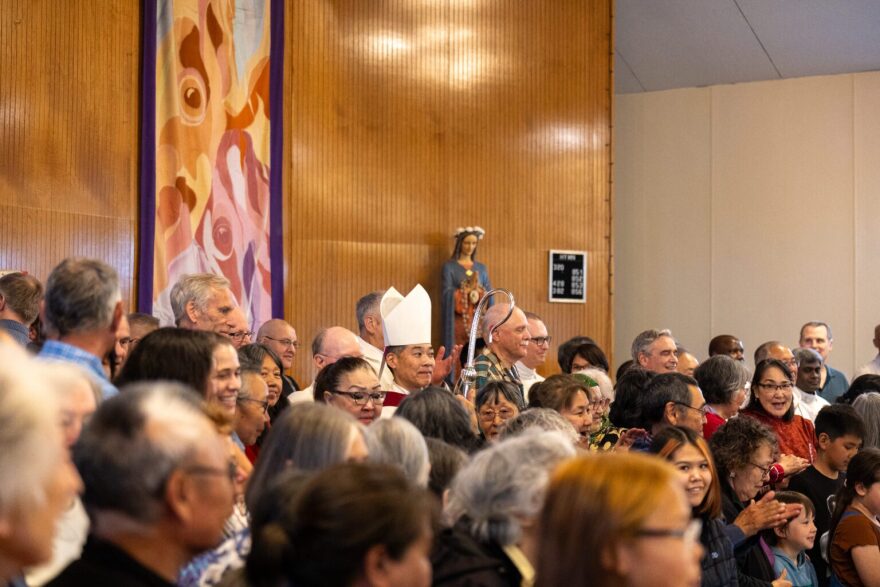
The Jesuits’ nearly 140 years in the state was honored at an event at Bethel’s Immaculate Conception Church on June 16. A procession of priests wearing long white gowns with red hems walked down the aisle to open the event. The Bishop of the Diocese of Fairbanks, Stephen Maekawa, thumped the ground with a shimmering silver staff known as a clozier as he approached the altar.
“My brothers and sisters, we gather together to celebrate this wonderful and blessed occasion to acknowledge the love of God and the work of God through the 139 year mission of the Society of Jesus of the Jesuit fathers,” Maekawa said to open the event.
A traditional Catholic mass followed, with readings in both English and Yup’ik. During the sermon, Maekawa acknowledged the vastness of the Fairbanks diocese, and the tremendous amount of work done by the Jesuits to establish it.
“All of the 46 churches of the Diocese of Fairbanks that we currently have were established by either the Jesuit fathers or by direction of a Jesuit bishop,” Maekawa said. “We have a long history of the Society of Jesus’ presence and ministry here in all of Alaska.”
The Jesuits are an order within the Catholic Church, akin to the Dominicans or Franciscans. They have a reputation for taking on some of the Catholic Church’s most remote assignments.
That missionary spirit brought the Jesuits to the Yukon River in 1887, where they built churches, schools, and ministries. Without their work, Catholicism may not have taken root in huge swaths of Alaska, particularly among Alaska Native communities.

But the Jesuits leave a complicated legacy. Their methods of converting Native people to the religion, particularly in the first half of the 20th century, created generational traumas still felt to this day.
Fr. Sean Carroll is the provincial of the Jesuits West Province, which oversees Alaska and nine other states.

“Thank you for all that you have taught us about who Jesus is and how to love and serve Him wholeheartedly,” Carroll said. “I also thank you for your patience with us. For there have been times when we have sinned and when we have hurt you.”
Missionaries, including the Jesuits, forcefully converted and assimilated Alaska Native people into Western culture and religion. Students at Jesuit-run boarding schools were forced to abandon their Native languages and physically punished when caught speaking languages other than English. Native dancing and drumming were also banned.
The Jesuits West Province maintains a list of 150 Jesuits with credible claims of sexual abuse against minors or vulnerable adults. A quarter of the accused Jesuits served in Alaska at some point in time.
“I ask for your forgiveness for all that we have done that was not rooted in Christ and love for Him, and for when we did not value your culture nor recognize the presence of God in you,” Carroll said.
Carroll gave the order to withdraw from the state last spring. A big issue was the recruitment of Jesuits willing to travel and serve in remote villages. He told the congregation that the Jesuits’ work would continue, just without a permanent presence.
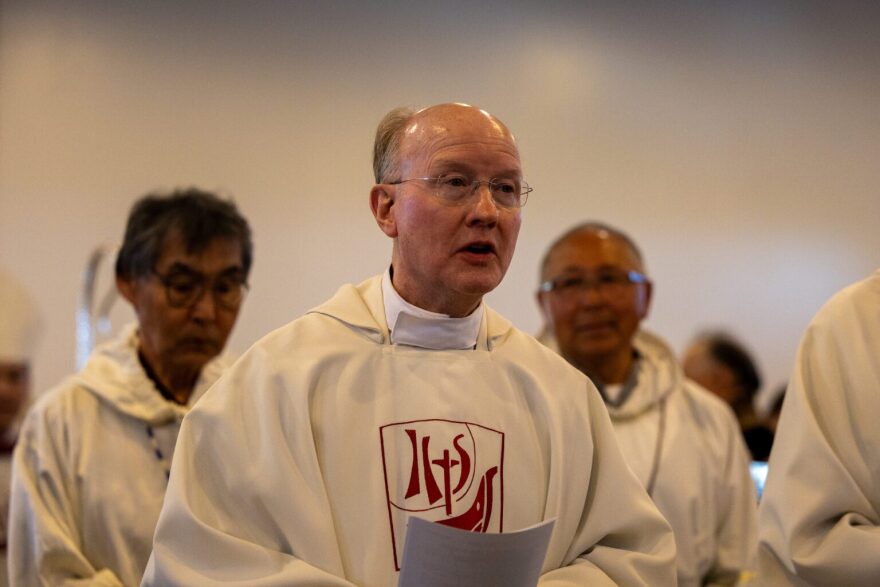
Fr. Rich Magner is one of the two remaining Jesuit priests in Alaska. His last day serving Chevak, Hooper Bay, and Scammon Bay is June 30.
“We all always knew coming in, or should have known, that we’re not going to be here forever. It’s going to be mission accomplished at some point,” Magner said. “And then we hand it off to the diocese that we’ve helped create, and so that’s a good feeling.”
Magner’s next stop is a Clinical Pastoral Education residency in Tacoma, Washington.
The other remaining priest, Fr. Tom Provinsal, first came to Alaska in 1968 to teach. A fond memory, he said, was meeting Elders that practiced traditional subsistence lifestyles.
“Some of the grandmothers, their fingers were just all bent with arthritis and stuff like that, you know, their whole lives they’ve been working out in the cold and the wet, doing food, sewing, all that kind of stuff,” Provinsal said. “I’d say I just feel very privileged to have come when I did come and to see that.”
Provinsal returned in 1975 as a priest and has served in the region ever since. After moving away, he plans to take a five month sabbatical. What happens next, he said, is in God’s hands.
Two lines formed in the aisle for communion at the end of the mass. After taking communion, Bethel’s Parish Administrator Susan Murphy gave a final thank you.
“It’s difficult to say goodbye to people who have been a part of our lives for so long,” Murphy said. “We know that you have done what was yours to do, and have taught us to do what is ours to do. We are grateful.”

Dominic Hunt, a Yup’ik deacon that flew in from Emmonak for the event, led the congregation through a final prayer.
“Bless them with your wisdom, that they may be a word of hope, a world in need. We ask this through Christ, our Lord. Amen,” Hunt said.
About 70 people posed for a photo on the altar – priests, deacons, parishioners, Elders and children — many of them smiling, some standing quietly.
The photo doesn’t tell the whole story. But it’s a moment when gratitude, grief, and memory all shared the same room.

JUNEAU, Alaska (KTUU) – The Supreme Court of Alaska will be taking up the case of the State of Alaska, Division of Elections v. Daniel J. Sullivan, Jr.
The oral arguments will be held Monday at 10 a.m. via Zoom, according to an order and opening notice.
The document also specifies that a decision is expected to be made before noon on Tuesday.
According to documents from the Division of Elections, the state must start printing ballots at noon on the same day.
This comes after an Anchorage Superior Court Judge ordered Dan J. Sullivan on to the ballot Friday.
See a spelling or grammar error? Report it to web@ktuu.com
Copyright 2026 KTUU. All rights reserved.
-
 Entertainment5 minutes ago
Alannah Keyser is latest fired ‘Love Island USA’ contestant to apologize for using a racist slur
-

 Lifestyle12 minutes ago
Chanel’s Bruno Pavlovsky on Reengineering an Iconic Brand
-
 Politics15 minutes ago
Supreme Court limits police use of cellphone data to find crime suspects
-
 Sports27 minutes ago
Teoscar Hernández returns, and Dodgers unleash 17-hit barrage in win over Athletics
-

 World35 minutes ago
DR Congo says 1,307 Ebola cases confirmed, including 377 deaths
-
 News60 minutes ago
Michigan governor threatens to pull troops from D.C. if used for Trump task force
-

 New York2 hours ago
Metropolitan Diary Challenge Day 2: How to Write Your N.Y. Story
-

 Los Angeles, Ca2 hours ago
Company has weeks to complete cleanup of Boyle Heights warehouse fire, officials announce

