Business
Opinion: The Consumer Financial Protection Bureau has irked billionaires, but it serves the public well


The billionaire Elon Musk and the California venture capitalist Marc Andreessen have started a debate about the role of government that we should be having — but it might not go the way they would hope. They don’t like government agencies that stop corporations like theirs from ripping off consumers.
They especially hate the 14-year-old Consumer Financial Protection Bureau. But most voters in both major parties support its work.
Musk and Andreessen recently made their case publicly. “Delete CFPB,” was Musk’s pithy policy position on X. Andreessen spun a conspiratorial tale on “The Joe Rogan Show” about how Sen. Elizabeth Warren (D-Mass.) uses the bureau to take away the bank accounts — “debank” — of anyone who doesn’t agree with her, especially Silicon Valley entrepreneurs.
Attacks by the two men resemble what Wall Street banks and predatory lenders have said since before the bureau came into existence in 2010. JPMorgan Chase CEO Jamie Dimon tried to strangle it in the crib during the congressional debate over its creation and now audaciously paints his $4-trillion, very profitable bank as a victim of regulation. Payday lenders took a case to the Supreme Court in an attempt to defund the agency (they lost). Most financial institutions belong to lobby groups that have sought to eviscerate the bureau.
These industries dislike the Consumer Financial Protection Bureau intensely because, bluntly, it does its job. Congress gave the bureau enforcement powers to stand up for consumers, and companies run or influenced by Musk and Andreessen have been on the receiving end. In one example from 2016, the agency sued a startup backed by Andreessen, Oakland-based LendUp, after it flouted federal law. Ultimately the bureau shut the company down in 2021 following repeated violations that included changing the terms of existing loans.
Andreessen is also an investor in San Francisco-based Synapse, a bank-like company that wiped out people’s life savings, as reported last month. No charges have been filed — yet.
PayPal, with which Musk was closely involved, has also faced sanction by the bureau.
Tech moguls might hold a grudge when justice is done, but the 118,101 LendUp customers who received more than $40 million of their money back thanks to the Consumer Financial Protection Bureau surely feel differently. Those people are not alone.
Since its creation, the agency has recovered more than $21 billion in restitution and canceled debts for tens of millions of consumers. Recently, in just one week, the bureau returned $1.8 billion to 4 million consumers who had been scammed by a group of credit repair companies scattered across the western United States. Bureau-created protections barring unfair fees, charges and terms for financial products have saved billions more.
So yes, Andreessen might have felt a little salty after the Consumer Financial Protection Bureau shuttered LendUp. And yes, companies that defraud clients are justifiably more likely to be shut down or “debanked,” if Andreessen wants to use that term. But the bureau also stands up for consumers who actually are debanked, like people who are suddenly cut off from their accounts because of race or ethnicity.
Not every case involves, as with “Black Panther” director Ryan Coogler, a call to the cops for banking while Black. The bureau works the much more insidious cases, like when companies systematically close accounts for discriminatory reasons, with no outward evidence of misdeeds. In fact, after the agency received numerous complaints about account closures and freezes, it created a rule — which will go into effect soon — to oversee digital payment apps and stop illegal debanking.
Indeed, the bureau’s director, Rohit Chopra, has explicitly called for a banking system that does not penalize identity or speech. On the podcast Organized Money, Chopra recently said: “We have to do more to stop debanking and make sure that people really have a right for all of their law-abiding activities to freely flow through the banking system.”
Musk’s attack on the Consumer Financial Protection Bureau hinges on his new role as one of President-elect Donald Trump’s go-to guys for shrinking government. In theory, that agenda appeals to an anti-bureaucratic, libertarian strain in American politics — a sentiment that has ebbed considerably since its high point in the Reagan years, given what Americans have learned from the savings-and-loan debacle, the predatory practices of credit card companies, payday lenders, and of course, the 2008 financial crisis and Great Recession. Voters like government agencies that work well and work for them. There’s a reason proposals to change Social Security are known as the third rail of American politics; the public relies on this program just as we rely on consumer protection rules.
My organization has researched what voters think of the Consumer Financial Protection Bureau’s mission and found support among Republicans, independents and Democrats. Standing up to Wall Street and predatory lenders and wrangling back ill-gotten gains on behalf of the little people is very popular. Other surveys confirm this finding.
In the coming months and years, the new president, his appointees and congressional Republicans are likely to try to kneecap a government institution that has done remarkable things for millions of families.
Musk and Andreessen are the leading edge of a false populism that hides an agenda that will unfold over the next four years designed to benefit the wealthy at everyone else’s expense. They can launch a campaign against the Consumer Financial Protection Bureau, but they can’t change the facts or draw the battle lines: On one side are a handful of Wall Street bankers, payday lenders and Silicon Valley billionaires, who make money by breaking the rules. On the other side are the vast majority of Americans, who benefit from and value the bureau’s crucial work — but don’t have a billionaire’s megaphone.
Christine Chen Zinner is senior policy counsel at Americans for Financial Reform.


The luxury shopping center in Pacific Palisades will reopen next month after more than $100 million in renovations forced by the January 2025 wildfire that devastated the Los Angeles neighborhood.
Palisades Village will reopen Aug. 15, owner Rick Caruso announced Wednesday. The outdoor center survived the blaze that destroyed homes and other businesses but needed refurbishment to eliminate contaminants that the fire could have spread.
Crews are putting finishing touches on mall buildings after tearing them down to the studs, treating the wood and rebuilding the walls, Caruso said.
“Everybody’s working, and stores are moving their products in,” he said. “It’s a really cool feeling that people have really locked arms and are working together.”
An electrician installs lighting for a restaurant at Rick Caruso’s Palisades Village on Thursday. The shopping center is scheduled to reopen mid-August.
(Myung J. Chun / Los Angeles Times)
Pacific Palisades resident Allison Polhill, who is rebuilding the home of 30 years that her family lost in the blaze, said she is “thrilled” at the prospect of returning to the mall she used to frequent. Its comeback is a boost for the community, she said.
“Every single step that we make to reopen our commercial corridors is going to bring more people back into the Palisades,” said Polhill, who expects to move back into her home at the end of August.
A total of 6,822 structures were destroyed in the Palisades fire, including more than 5,500 residences and 100 commercial businesses, according to the California Department of Forestry and Fire Protection.
Caruso previously attributed the mall’s survival to the hard work of private firefighters and the fire-resistant materials used in the mall’s construction.
The $200-million shopping and dining center opened in 2018 with a movie theater and a roster of upmarket tenants, including Erewhon, which may be the only grocer in the heart of the fire-ravaged neighborhood when it opens.
Caruso’s company was able to fill the mall with tenants despite the long shutdown.
Palisades Village is 99% leased, with the majority of tenants returning, said Jackie Levy, chief financial and revenue officer. Nearly one-third of the shops and restaurants are new to the property.
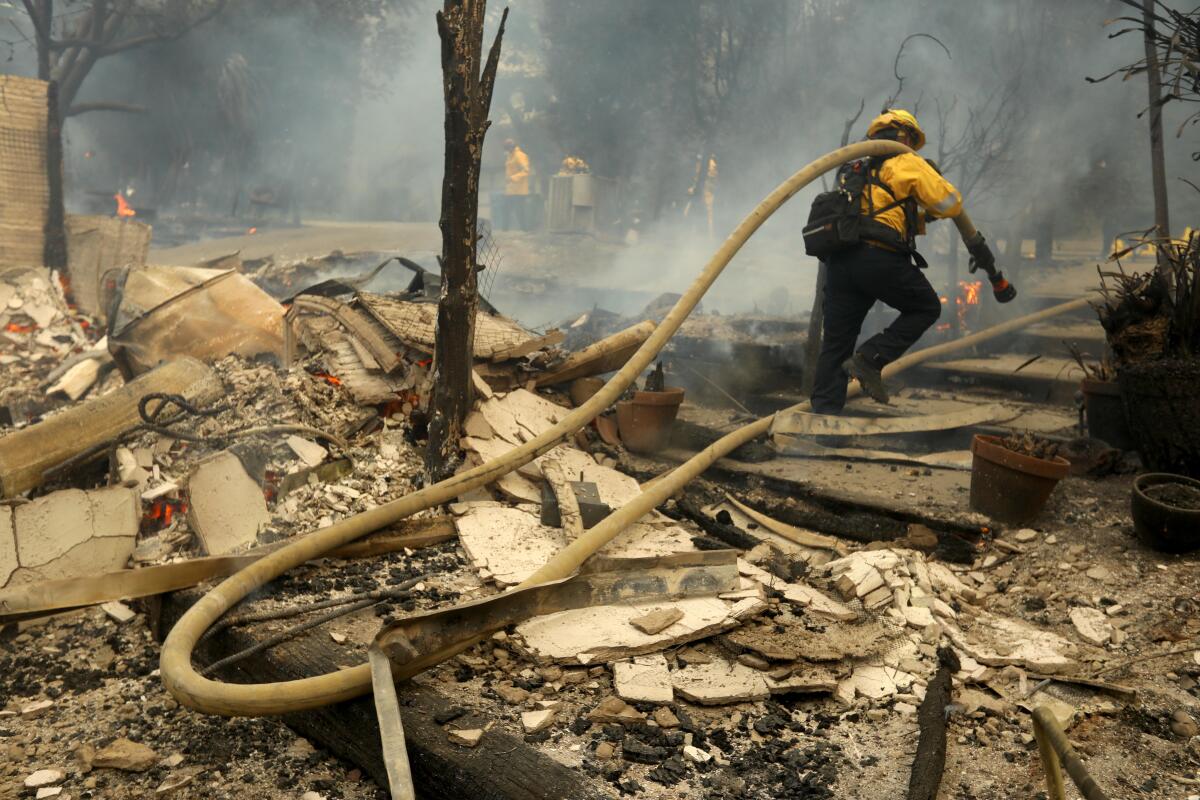
A firefighter carries a hose back to his rig while walking through a destroyed home from the Palisades fire in Pacific Palisades on Jan. 7, 2025.
(Genaro Molina / Los Angeles Times)
Last year, Pacific Palisades-based fashion designer Elyse Walker said she would reopen her eponymous store in Palisades Village after losing her 25-year flagship location on Antioch Street to the inferno.
Other neighborhood shops destroyed in the fire that are reopening at the mall include K Bakery and Loomey’s Toys, which caters to children up to age 12 and used to be across the street from Palisades Elementary Charter School.
“It’s been a journey and I’m excited because I wasn’t sure that there was going to be a place to come back to,” said toy store owner Amanda Rastegar. “Hopefully we can bring some of that magic back.”
Rastegar’s home in the Palisades survived but was damaged by the fire. The family returned about eight weeks ago. Her last memory of the fire was a burning supermarket.
“I just couldn’t wrap my brain around what was happening,” she said. “By the time I left, Gelson’s was on fire.”
Among the returning tenants is Angelini Ristorante & Bar. Well-known Los Angeles chef Gino Angelini said he will be in the kitchen next month for a return of the Italian restaurant.
“We won’t do a big celebrity open,” he said. “We want to have a very soft opening and see our customers come back.”

Construction takes place at Rick Caruso’s Palisades Village on Thursday. The shopping center is scheduled to reopen mid-August.
(Myung J. Chun / Los Angeles Times)
An elaborate celebration would not feel “correct for me,” Angelini said, because the devastation has been “very sad” for so many.
Other new tenants include local chef Nancy Silverton, who has agreed to move in with a new Italian steakhouse called Spacca Tutto. Women’s activewear retailer LESET will open its first West Coast location.
Caruso said he is optimistic that customers will return to the center, even though many Pacific Palisades residents are still dispersed. One tracking system estimated that about 30% of the Village’s customer base was impacted by the fire, he said.
“That means 70% did not get impacted, so there’s a lot of customers still left out there,” Caruso said. Historically, the center drew customers from as far away as Beverly Hills and Calabasas, as well as Malibu, Brentwood and Santa Monica.
He also hopes many will be inspired to visit the revived mall.
“I believe in the goodness of people and I believe that people are going to want to support the Palisades,” he said. “They’re going to want to be there and support the businesses that have had the courage and the heart to reopen.”

Walmart is rapidly expanding its network of electric vehicle chargers designed for customers to use while they shop.
The network could help fill gaps in EV infrastructure in states with greater need for chargers. Walmart, which has more than 5,000 locations in the U.S. and hundreds in California, says more than 90% of Americans live within 10 miles of one of its stores.
The chargers also offer an incentive for customers to choose Walmart — Walmart Plus members will receive a 10% discount off an average price of $0.46 per kilowatt-hour of energy at the company’s chargers.
Walmart chargers are already available at more than 75 locations in 17 states, with Texas boasting the most charging stations, followed by Florida and Arizona.
Matthew Nelson, Walmart’s director of energy policy, said last week on LinkedIn that the network will soon reach 29 states, including California.
“We are delivering on the promise of affordable, reliable and convenient charging,” Nelson said in his post.
According to Walmart’s website, six charging stations are coming to California soon, though the company did not offer a specific timeline.
The chargers will be installed at stores in Antelope, Brea, Fresno, Stockton, Suisun City and Vallejo.
Most charging sites in California will include eight to 16 fast-charging stalls, said Walmart spokesperson Kelsey Bohl.
The company first announced plans in April 2023 to install its own EV chargers at Walmart and Sam’s Club stores, with a goal of installing thousands of chargers by 2030. Partnering with ABB E-Mobility and Alpitronic, it added 25 new charging sites this past May and six more in June.
“Walmart is building a leading retail-integrated EV fast-charging network, focused on delivering an affordable, reliable and convenient charging experience where customers already shop,” Bohl said in an emailed statement. “Customers can charge while they shop, access stations through the Walmart app they already use, and benefit from affordable pricing.”
The charging stations already available include 612 individual charging stalls using 400-kilowatt chargers. Each stall has a dual charging cord with both Combined Charging System and North American Charging Standard connectors. The standard connectors, designed by Tesla, are smaller and lighter than the combined systems.
The primary way to pay for the chargers is through the Walmart app, but the company is also experimenting with built-in credit card readers to allow those without the app to use the stations.
Customers can check charger availability on the Walmart app. The company said the chargers will be available 24 hours a day.

Robotaxis could be turning into robocops.
A self-driving Waymo reported two teens to San Mateo, Calif., police on Monday after they were found drinking alcohol and shooting toy guns in the back of the vehicle.
According to a social media post from the San Mateo Police Department, officers detained two 15-year-olds after the Waymo they were riding in contacted the department and stopped in a parking lot until law enforcement arrived.
“Parents do you know where your teens are?” the San Mateo Police Department wrote on Facebook following the incident. “Waymo does!”
Officers removed both teens from the vehicle and determined they were using toy guns to shoot Orbeez out the windows. Orbeez are small, water-absorbing beads sold at toy stores.
“Toy guns, water guns, and BB guns all pose real dangers, especially to an untrained eye,” the Police Department said. “The simple handling of them can cause fear in [passersby].” “
A video posted on Facebook shows at least five officers and a police dog responding to the scene and approaching the Waymo with their weapons raised.
Waymo did not immediately respond to a request for comment.
Waymo vehicles have internal cameras and microphones that may be used in an emergency or to “promote safety and security,” according to Waymo’s online support page.
The cameras are also used to ensure the vehicles are clean and to help find lost items, according to the support page.
The company said it does not use facial recognition or other biometric identification technologies to identify individuals.
“In more urgent circumstances, support may access live video during a trip,” the Waymo page said.
The San Mateo Police Department’s Facebook post has garnered nearly 60 comments, with one user accusing Waymo of “snitching.”
“At least they got a designated driver?!” one user commented.
-

 West Virginia3 minutes ago
West Virginia coach Rich Rodriguez wants to save college football. Here’s his pitch:
-

 Wyoming10 minutes ago
Cathy Holman named 2026 Mick & Susie McMurry Cowboy Code Try Award recipient
-

 Crypto13 minutes ago
LAB Token Crashes 80% to $1.25 as $5B Market Cap Vanishes in 48 Hours
-

 Finance18 minutes ago
Intact Financial provides update on Q2 catastrophe and large losses
-

 Fitness25 minutes ago
Wellness Wednesday: Exercise & heart disease
-

 Movie Reviews33 minutes ago
‘The Guest’ Review: Trine Dyrholm Gives a Scorcher of a Performance in a Gutsy Danish Party-Gone-Wrong Drama
-
World43 minutes ago
Le Pen, France’s Far-Right Leader, Launches Her Presidential Campaign
-
 Lifestyle1 hour ago
We unpack the 2026 Emmy nominations : Pop Culture Happy Hour

