Washington
Ramsey, Washington and Dakota counties all seek property tax levy hikes


Ramsey, Washington and Dakota counties all are seeking property tax levy increases this year, as they deal with higher costs in areas such as construction, labor and healthcare as well as the end of federal pandemic money.
Homeowners and other property owners in the east metro have seen the proposed hikes on their property tax statements. There is a distinction between the levies imposed by counties and those from their city, county, school district and other special taxing jurisdictions. Up to a dozen different taxing authorities — including mosquito control districts — contribute to the total payment due at the bottom of a tax statement.
“They’re looking at a tax statement that comes from us, but it includes the city, the school district,” said Ramsey County Commissioner Rafael Ortega, who said he, too, has shouldered years of sizable property tax increases.
Ortega noted home prices have soared in recent years in higher-end neighborhoods like St. Paul’s Highland Park, while many long-undervalued properties in poorer neighborhoods are effectively playing catch-up as their estimated market values spike. Values also have shifted, leveled off or dropped for commercial office buildings, apartment buildings, industrial properties and small businesses in St. Paul while rising for St. Paul homeowners.
“I’ve been paying 15% increases on both mine and my mother’s properties for the last five years,” Ortega said. “You take a place like the East Side that has such low values, but their taxes jump higher because of the increase in assessed value. They’ve been undervalued for so long.”
Beyond growing home values, Ramsey and several other counties experienced deep cuts to state County Program Aid over time, and between 2006 and 2018 in particular.
Increased costs
Construction costs that soared during the pandemic as prices rose for materials and equipment have yet to abate, and a labor shortage continues. Meanwhile, counties are facing rising costs for everyday labor and healthcare. In surveys conducted by the Association of Minnesota Counties, one county reported its health insurance costs ballooning by almost 18% next year.
“That’s a 6.8% tax levy increase alone,” said Matt Hilgart, the government relations manager for the association.
For most counties, “the amount of their budget that is financed with property taxes has grown,” Hilgart said. “There isn’t one single reason why. While some state local government aid has grown very recently after decades of lack of funding or incremental increases, general expenditure spending has also grown.”
Counties “carry out the majority of core social services delivery for most of Minnesota, and I think it’s fair to say some of those mandates have grown over time,” Hilgart said. “Counties across the state, and including Ramsey County, are having to hire more social workers, case managers, and more child protection workers to fulfill both new mandates and increased community needs. These costs show up as wage increases, but in reality, it’s driven by the state mandate to provide certain services.”
Here’s a round-up of proposed property tax levy increases in Washington, Dakota and Ramsey counties as well as how their budgets have grown in the past 10 years.
Ramsey County
In St. Paul, a median-value single-family home had an estimated market value of $267,400 for taxes payable this year. That value will go up 3% to $275,300 for taxes payable in 2025. That owner would see overall property taxes — city, county, school district, Met Council and more — go up $337, an 8.8% increase.
Nearly 46% of the county’s proposed 2025 budget is funded by property tax, an increase of less than 1%, or $17.6 million, compared to the current fiscal year. The rest comes from intergovernmental revenues, charges for services and other sources.
The proposed county budget for 2025 is $848.6 million.
Ramsey County’s public truth-in-taxation hearing will be held at 6 p.m. Dec. 11 at the Hallie Q. Brown Community Center, 270 N. Kent St. in St. Paul. Doors open at 5:30 p.m. and interpreters will be available. County commissioners plan to approve the 2025 supplemental budget and property tax levy at their Dec. 17 board meeting.
The Ramsey County Board set next year’s maximum tax levy increase at 4.75% in September, though it could be altered up to the final vote.
Ramsey County budget
• 2015: $622.8 million.
• 2016: $645 million.
• 2017: $660.8 million.
• 2018: $714 million.
• 2019: $738 million.
• 2020: $741.7 million.
• 2021: $763.1 million.
• 2022: $774 million.
• 2023: $785.7 million.
• 2024: $808.5 million.
• 2025: $848.6 million (proposed).
Washington County
Washington County’s 2025 budget is $361.6 million, or $9.65 million less than in 2024. The proposed tax levy increase is 5.9%.
Of the total county budget, property taxes cover $140.48 million, or 38.8%.
There was a decrease in Washington County in the estimated median-value single-family home’s market value from $422,400 in 2024 to $411,400 in 2025. The median increase from 2024 to 2025 for the county portion of taxes is approximately $24, or 2.6%.
The county’s truth-in-taxation hearing was Nov. 26. The county board will vote on the final tax levy and budget at the Dec. 17 board meeting at the Washington County Government Center in Stillwater.
Washington County budget
• 2015: $228.7 million.
• 2016: $219.2 million.
• 2017: $211.2 million.
• 2018: $224.3 million.
• 2019: $288.1 million.
• 2020: $282.2 million.
• 2021: $288.5 million.
• 2022: $316 million.
• 2023: $378.9 million.
• 2024: $371.3 million.
• 2025: $361.6 million (proposed).
Dakota County
The recommended 2025 maximum levy of $167.7 million for Dakota County represents a 9.9% increase from the amount levied in 2024, according to officials with Dakota County Finance.
A median-value single-family home in Dakota County carried an estimated market value of $372,000 in 2025 and 2024. Per the proposed levy, the owner would see their taxes go up 5.87%, or $39.62, to total $714.35 next year as compared to $675 in 2024.
“In 2024, the county maintained the lowest levy per capita in the state of Minnesota and the lowest property tax rate among the seven metropolitan counties,” reads the staff report in county budget documents.
Nearly 30% of the county’s 2024 budget was funded by property tax, which according to the county, “is the largest and most stable source of funding.” The proposed budget for 2025 is $532.9 million, with an operating budget of $377.5 million.
The county’s truth-in-taxation hearing was Tuesday night. The county board is expected to vote Dec. 17 on the final budget and levy.
Dakota County budget
• 2015: $245 million.
• 2016: $269 million.
• 2017: $246 million.
• 2018: $249 million.
• 2019: $262 million.
• 2020: $278 million.
• 2021: $294 million.
• 2022: $290 million.
• 2023: $306 million.
• 2024: $336 million.
• 2025 $377.5 million (proposed).



The Catholic archbishop of Washington DC on Wednesday removed a well-known priest as an exorcist of the archdiocese after he made public comments suggesting that UFO sightings were the work of demons.
Cardinal Robert McElroy said the archdiocese also was cutting ties with the St Michael Center for Spiritual Renewal, a Washington-based non-profit headed by the priest, Monsignor Stephen Rossetti.
The archbishop said Rossetti’s statements “linking UFOs to demonic presence and the Center’s recent use of social media gravely undermine the Church’s very precise teaching on the devil, demons and exorcism”.
“There’s a danger here,” Rossetti said in a 29 May video posted on his Facebook page addressing UFO sightings and the existence of aliens. “As an exorcist I wanted to raise that danger. And that is that demons like to hide … They don’t want us to know what they’re doing because they’re more effective when we don’t realize it.
“They can kind of get into your head, you know, and manipulate things in the world to influence us to do evil.
“It’s my personal belief that probably many if not most of these UFO sightings are in fact demons,” Rossetti added.
Rossetti also said that people can be good Catholics and believe there’s life on other planets, though he does not personally believe life exists elsewhere.
In a statement posted on the St Michael Center website, Rossetti said he was saddened by the action of the archdiocese.
“I ask forgiveness for any ways that I have not been faithful to the teachings of the Church’s Magisterium, particularly in the cited video on ‘aliens and the demonic’,” he said. “I believe it is of the utmost importance to be obedient to the Church and I will continue to endeavor to subject all that I do and the Center to be thus obedient.”
Rossetti, who has more than 148,000 followers on Instagram, is a prominent psychologist as well as an exorcist. His center has specialized in offering spiritual healing for priests troubled by various difficulties.
In 2023, he told the Associated Press there was increasing and renewed appetite for information about demonic possession and exorcism.

PITTSBURGH — The Pittsburgh Steelers are keeping Darnell Washington around for another four years, signing the former third-round tight end to a contract extension, according to NFL insider Jordan Schultz.
Washington is the team’s third contract extension this spring, joining kicker Chris Boswell and edge rusher Nick Herbig. He’s the second member of the 2023 draft class after he and Herbig signed in back-to-back days.
Washington’s deal is worth $42 million and includes $21 million in guaranteed money.
Sources: The #Steelers and TE Darnell Washington have agreed to a 4-year, $42m extension.
The massive tight end has developed into a key piece of Pittsburgh’s offense and has been everything the Steelers hoped for when they drafted him. pic.twitter.com/PVLVF5Qh8S
— Jordan Schultz (@Schultz_Report) June 4, 2026
The 6-foot-7 tight end out of Georgia found a nice groove for himself on the offensive side of the ball last season and became a reliable target for Aaron Rodgers while being used as a key piece to the running game. Under new head coach Mike McCarthy, Washington’s role is expected to grow even more.
“Love Darnell, he’s been here every day, in the classroom, good student, he’s a pro’s pro,” McCarthy said about Washington during minicamp. “I’ve been veryimpressed with him. He’s done everything we’ve asked. I know I keep saying this, it’s year one that you get to know your players, go to certain schemes, you may tilt one way or the other variations of schemes, and definitely we’ve been doing that with our tight ends, and he’s a big part of that reason.”
With Washington under contract for the next five years and Pat Freiermuth having three more years on his deal, the Steelers solidify their tight end room for the future. Both players will be heavily involved, as Freiermuth remains the top pass-catching option and Washington grows into an all-around weapon.
Steelers Moves Aren’t Done Yet
The Steelers aren’t done with their offseason extensions, either. Outside of Washington, Herbig and Boswell, Joey Porter Jr., Keeanu Benton and Spencer Anderson could all ink deals before the season.
Porter Jr. was the talk of the town heading into the offseason, but with a contract that is likely top five in the NFL at his position, it may take longer than hoped for the two sides to sign a deal. Both sides remain optimistic, but also realistic that it may take time.
As for Benton, the team is currently negotiating with him and he could be the next domino to fall in the signings. Don’t rule out Anderson getting a deal done as well.
Make sure to bookmark Steelers On SI, and find our podcast All Steelers Talk on YouTube or anywhere you listen!
Follow

WASHINGTON COUNTY, Ore. (KPTV) – The Washington County Sheriff’s Office released video of deputies using a drone to track down a man wanted for damaging a car.
On Saturday, May 30, a 911 caller reported a man damaging a car outside their home on Southwest 179th Avenue in Aloha. The sheriff’s office said it was reported the suspect, 21-year-old Santos Paulino Castro-Ramirez, was punching the car.
Deputies used a drone to follow the suspect as he ran toward Southwest Barcelona Lane. The sheriff’s office said Castro-Ramirez then entered a white SUV that did not belong to him on SW Barcelona.
Deputies arrested Castro-Ramirez. He was booked into the Washington County Jail for first-degree burglary and attempt to commit a crime – second-degree theft.
Copyright 2026 KPTV-KPDX. All rights reserved.
-

 News23 seconds ago
Trump’s name must come off the Kennedy Center by June 12
-

 Los Angeles, Ca1 hour ago
Overnight military training brings loud flash bangs, simulated gunfire to quiet Pasadena neighborhood
-

 Detroit, MI2 hours ago
Detroit Lions add UDFA rookie WR during OTAs
-

 San Francisco, CA2 hours ago
How to watch San Francisco Giants vs. Milwaukee Brewers
-

 Dallas, TX2 hours ago
3 different Cowboys 53-man roster projections pinpoint contested roster spots
-

 Miami, FL2 hours ago
Jeff Hafley suggests Miami Dolphins entertain Malik Willis Tush Push
-

 Boston, MA2 hours ago
Karen Read sues the police agencies that investigated her Boston police boyfriend’s death
-
 Denver, CO2 hours ago
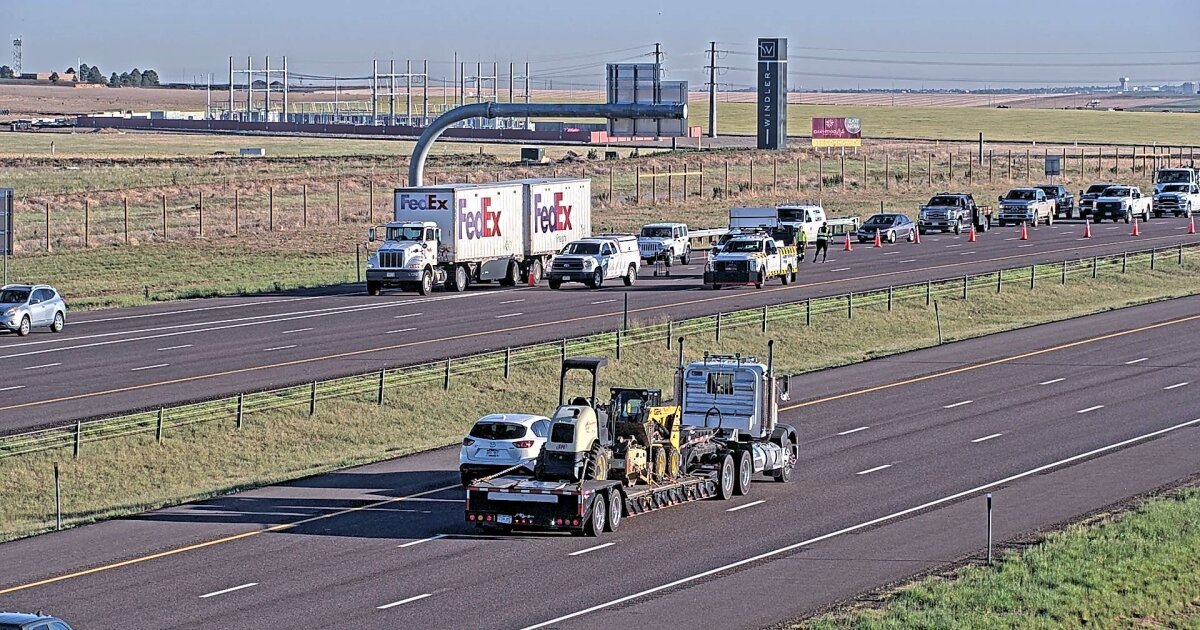
Pedestrian dies after hit by car on southbound E-470, Aurora police say

