Business
On a Crenshaw Boulevard corner, old gives way to new, but it stays in the family

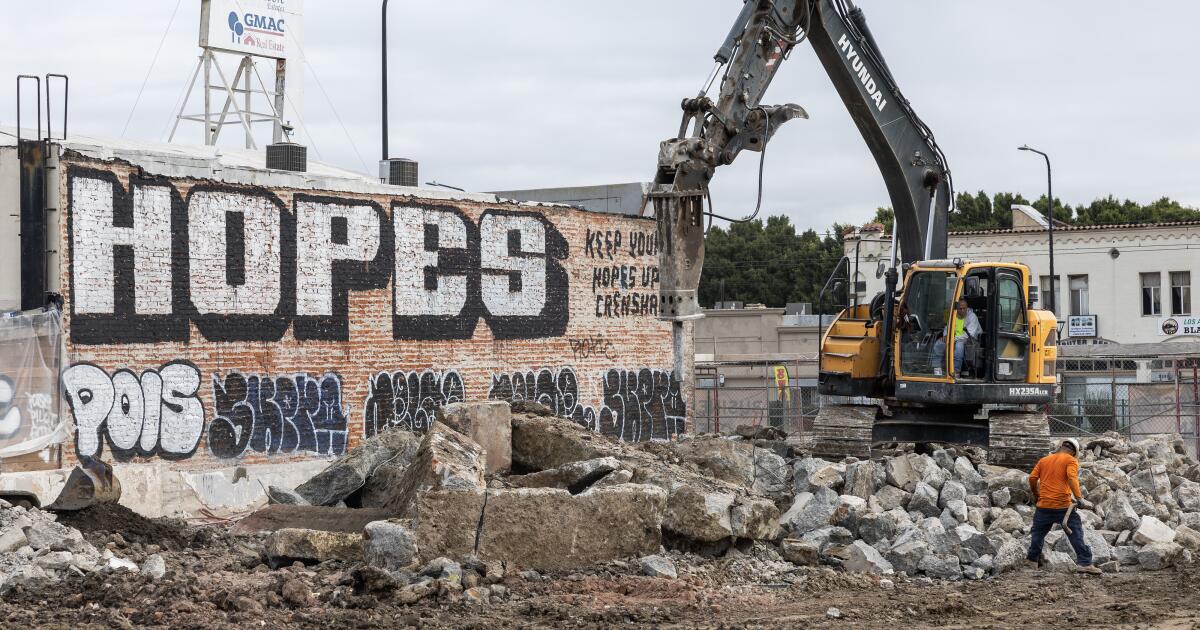
The corner lot on Crenshaw Boulevard and 54th Street looks like any other construction site. Inside the chain-link fence encircling the property, an excavator last week was moving a pile of rubble — the last remains of an old building that had been demolished to make room for something new.
But the mundane scene belied an unusual story in Los Angeles real estate: Instead of selling it, a Black family with deep roots in South L.A. chose to hold on to a property they’ve owned for decades and develop it themselves into a $24-million apartment and retail building.
They’ll mark their progress with a formal groundbreaking ceremony Thursday, a rare instance of a local, minority property owner participating in the redevelopment of their neighborhood, which had long been overlooked by conventional developers. In keeping a seat at the table, they are bucking the norms for how development in L.A. typically is done, in which owners sell to outside developers looking to capitalize on the rising fortunes of once-neglected historic neighborhoods.
But even with a train stop for Metro’s new light rail K line nearby, funding for the project was hard to come by. It took years of effort before siblings Jamial Clark and Bridgette Reed, who inherited the property from their parents, could start turning their mother’s former hair salon and wig shop property into a six-story building with 48 apartments and perhaps a small grocery store in the first-floor retail space.
The grind, they said, has been worth it. Their parents, Henry and Lucretia Clark, scraped together money in 1995 to buy the building and the siblings didn’t want to let go of it. Perhaps, they said, they will provide a road map to others who own properties in evolving neighborhoods near the many new transit lines being built and planned by Metro.
Co-developer Kacy Keys, left, and Clark family members Bridgette Reed and brother Jamial Clark at the site.
(Myung J. Chun / Los Angeles Times)
“There are a lot of Black-owned properties up and down Crenshaw,” Reed said. “We just want to encourage other families to do the same thing and not sell out to these developers who are coming in and actually pricing us out of our own communities.”
Key to getting their project underway was teaming with developer Kacy Keys, who has spent nearly three decades building commercial projects including apartments, offices and stores. She heads Praxis Development Group, which will have an equity stake in the project, which is named Clark on 54th.
“We were responsible for playing the developer role,” Keys said of her company, such as getting city construction approvals, overseeing the design, hiring contractors and finding financing. The Clarks “agreed to contribute their land into a joint venture with us.”
Both Praxis and the Clarks had to put up cash for the last few years to make sure the project didn’t falter, which was worrying, Jamial Clark said.

A 48-unit apartment building with ground-floor retail will be built at Crenshaw Boulevard and 54th Street in Los Angeles near the Metro K line.
(Myung J. Chun / Los Angeles Times)
“I invested over $100,000 of my money just to keep things going,” he said, “and to keep bills paid and the mortgage paid,” but he and his sister didn’t want to let go of the property their parents toiled over and where they spent many hours of their young lives.
“Selling was never going to be an option, even though we got to a point where we had to think about it” as rising interest rates and inflation drove the potential cost of the project so high it looked out of reach, Clark said.
The pair attended nearby 54th Street Elementary School and after classes they walked to their mother’s salon, where they pitched in answering the phone.
“It was like our second home,” Clark said, a place with a nurturing vibe that encouraged customers to linger and chat.
“Mom was old-school press-and-curl,” he said, referring to a popular hairstyle in the 1990s. “My mom was taking out those weaves and regrowing their hair.”
The salon had a private area where women with thinning hair could get scalp treatments that included massages from their late beautician sister Carla Taylor and oils formulated by their mother.
“It was almost like a counseling session,” he said. “The ladies would stay after they got their hair done and order lunch.”

Members of the Clark family have owned the property for decades.
(Myung J. Chun / Los Angeles Times)
On Saturdays their mom played such “old” music as the Temptations, Al Green and the Whispers, he said. “The ladies would just love to come and sit.”
Her tenants in the building included the wig shop with a celebrity clientele, a shoe repair shop, a frame shop and a social services provider, all of which relocated in the neighborhood, he said.
Some neighbors were apprehensive about the plan to knock down a building infused with emotions and memories for so many, but Clark saw an opportunity to be part of potential economic changes coming to the area. In West Adams, another historically black community, development of new apartments, restaurants and shops was already taking place on Adams Boulevard.
“I was like, ‘Wow, Crenshaw should be comparable to that, at least.’”
In the 1920s and 1930s, Central Avenue was the center of L.A.’s black community. Later, the center shifted to the Crenshaw Corridor, particularly between Adams and Slauson Avenue, said real estate developer Philip Hart, who is familiar with the plans for Clark at 54th but not involved in the project.
Lately, the multibillion-dollar public investments in Metro’s Crenshaw line and the Expo line that intersects it “have had a ripple effect in terms of the communities they serve becoming desirable,” Hart said.
That economic shift puts pressure on local residents, he said. “Can they continue to pay their rent or their property taxes? The question of gentrification and displacement has become a very important question in the Crenshaw District over the past 10 years or so.”
If redevelopment doesn’t bring with it affordable housing and good-paying jobs, residents will be priced out of their neighborhoods and join a long-running exodus to Palmdale, Lancaster and the Inland Empire, where the cost of living is cheaper, he said.
The Crenshaw community, Hart said, “should retain its historic African American cultural cachet.”
Keys and the Clarks hope their project will play a small part in keeping the neighborhood intact. The building will include 10 units considered “deeply affordable” because they are reserved for tenants earning 50% of the median income in the area when they become available in late 2026.
The apartments will be bigger than average, including two- and three-bedroom units to accommodate families, said Keys, who is working on the project with her partner Charles Wise.

Work has begun on a 48-unit apartment building with ground-floor retail at Crenshaw Boulevard and 54th Street in Los Angeles near the Metro K line.
(Myung J. Chun / Los Angeles Times)
One of the biggest challenges to getting the project underway was finding financing. A building that size typically would be funded with a loan or two, but Keys had to assemble a complicated package from seven entities including philanthropic nonprofits after approaching about 100 financing sources.
“Even though I’ve built over a billion dollars’ worth of projects over the course of my career, this was my first time as a small woman-led business that I was raising money on my own,” Keys said. “It was incredibly challenging.”
Praxis put up more than $200,000 of its own funds and worked without compensation to prove that partnering with legacy landowners to create new housing can work, she said.
Among the financiers was MSquared, a women-owned real estate development and investment firm that will retain an equity share, as will New York investment and development firm Six Peak Capital.
The need to securing financing from multiple sources dragged out the process, but the effort was worth it, Hart said.
“What they’ve done was challenging, but they’ve done it and they’re having a groundbreaking,” he said. “That’s a good thing.”

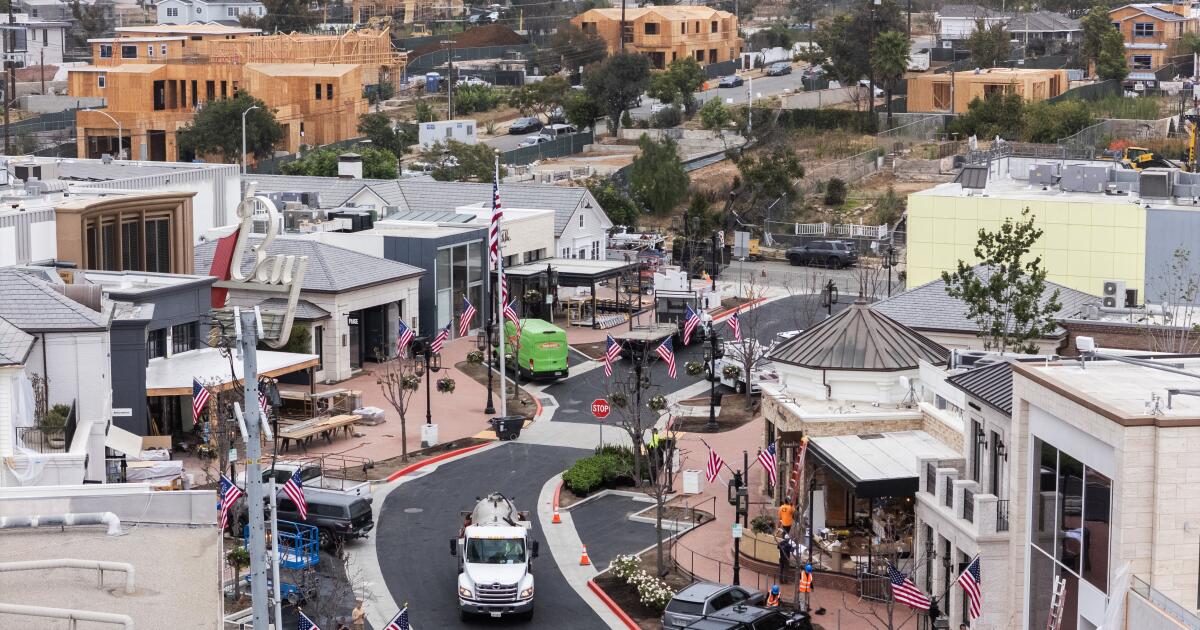
The luxury shopping center in Pacific Palisades will reopen next month after more than $100 million in renovations forced by the January 2025 wildfire that devastated the Los Angeles neighborhood.
Palisades Village will reopen Aug. 15, owner Rick Caruso announced Wednesday. The outdoor center survived the blaze that destroyed homes and other businesses but needed refurbishment to eliminate contaminants that the fire could have spread.
Crews are putting finishing touches on mall buildings after tearing them down to the studs, treating the wood and rebuilding the walls, Caruso said.
“Everybody’s working, and stores are moving their products in,” he said. “It’s a really cool feeling that people have really locked arms and are working together.”
An electrician installs lighting for a restaurant at Rick Caruso’s Palisades Village on Thursday. The shopping center is scheduled to reopen mid-August.
(Myung J. Chun / Los Angeles Times)
Pacific Palisades resident Allison Polhill, who is rebuilding the home of 30 years that her family lost in the blaze, said she is “thrilled” at the prospect of returning to the mall she used to frequent. Its comeback is a boost for the community, she said.
“Every single step that we make to reopen our commercial corridors is going to bring more people back into the Palisades,” said Polhill, who expects to move back into her home at the end of August.
A total of 6,822 structures were destroyed in the Palisades fire, including more than 5,500 residences and 100 commercial businesses, according to the California Department of Forestry and Fire Protection.
Caruso previously attributed the mall’s survival to the hard work of private firefighters and the fire-resistant materials used in the mall’s construction.
The $200-million shopping and dining center opened in 2018 with a movie theater and a roster of upmarket tenants, including Erewhon, which may be the only grocer in the heart of the fire-ravaged neighborhood when it opens.
Caruso’s company was able to fill the mall with tenants despite the long shutdown.
Palisades Village is 99% leased, with the majority of tenants returning, said Jackie Levy, chief financial and revenue officer. Nearly one-third of the shops and restaurants are new to the property.

A firefighter carries a hose back to his rig while walking through a destroyed home from the Palisades fire in Pacific Palisades on Jan. 7, 2025.
(Genaro Molina / Los Angeles Times)
Last year, Pacific Palisades-based fashion designer Elyse Walker said she would reopen her eponymous store in Palisades Village after losing her 25-year flagship location on Antioch Street to the inferno.
Other neighborhood shops destroyed in the fire that are reopening at the mall include K Bakery and Loomey’s Toys, which caters to children up to age 12 and used to be across the street from Palisades Elementary Charter School.
“It’s been a journey and I’m excited because I wasn’t sure that there was going to be a place to come back to,” said toy store owner Amanda Rastegar. “Hopefully we can bring some of that magic back.”
Rastegar’s home in the Palisades survived but was damaged by the fire. The family returned about eight weeks ago. Her last memory of the fire was a burning supermarket.
“I just couldn’t wrap my brain around what was happening,” she said. “By the time I left, Gelson’s was on fire.”
Among the returning tenants is Angelini Ristorante & Bar. Well-known Los Angeles chef Gino Angelini said he will be in the kitchen next month for a return of the Italian restaurant.
“We won’t do a big celebrity open,” he said. “We want to have a very soft opening and see our customers come back.”

Construction takes place at Rick Caruso’s Palisades Village on Thursday. The shopping center is scheduled to reopen mid-August.
(Myung J. Chun / Los Angeles Times)
An elaborate celebration would not feel “correct for me,” Angelini said, because the devastation has been “very sad” for so many.
Other new tenants include local chef Nancy Silverton, who has agreed to move in with a new Italian steakhouse called Spacca Tutto. Women’s activewear retailer LESET will open its first West Coast location.
Caruso said he is optimistic that customers will return to the center, even though many Pacific Palisades residents are still dispersed. One tracking system estimated that about 30% of the Village’s customer base was impacted by the fire, he said.
“That means 70% did not get impacted, so there’s a lot of customers still left out there,” Caruso said. Historically, the center drew customers from as far away as Beverly Hills and Calabasas, as well as Malibu, Brentwood and Santa Monica.
He also hopes many will be inspired to visit the revived mall.
“I believe in the goodness of people and I believe that people are going to want to support the Palisades,” he said. “They’re going to want to be there and support the businesses that have had the courage and the heart to reopen.”

Walmart is rapidly expanding its network of electric vehicle chargers designed for customers to use while they shop.
The network could help fill gaps in EV infrastructure in states with greater need for chargers. Walmart, which has more than 5,000 locations in the U.S. and hundreds in California, says more than 90% of Americans live within 10 miles of one of its stores.
The chargers also offer an incentive for customers to choose Walmart — Walmart Plus members will receive a 10% discount off an average price of $0.46 per kilowatt-hour of energy at the company’s chargers.
Walmart chargers are already available at more than 75 locations in 17 states, with Texas boasting the most charging stations, followed by Florida and Arizona.
Matthew Nelson, Walmart’s director of energy policy, said last week on LinkedIn that the network will soon reach 29 states, including California.
“We are delivering on the promise of affordable, reliable and convenient charging,” Nelson said in his post.
According to Walmart’s website, six charging stations are coming to California soon, though the company did not offer a specific timeline.
The chargers will be installed at stores in Antelope, Brea, Fresno, Stockton, Suisun City and Vallejo.
Most charging sites in California will include eight to 16 fast-charging stalls, said Walmart spokesperson Kelsey Bohl.
The company first announced plans in April 2023 to install its own EV chargers at Walmart and Sam’s Club stores, with a goal of installing thousands of chargers by 2030. Partnering with ABB E-Mobility and Alpitronic, it added 25 new charging sites this past May and six more in June.
“Walmart is building a leading retail-integrated EV fast-charging network, focused on delivering an affordable, reliable and convenient charging experience where customers already shop,” Bohl said in an emailed statement. “Customers can charge while they shop, access stations through the Walmart app they already use, and benefit from affordable pricing.”
The charging stations already available include 612 individual charging stalls using 400-kilowatt chargers. Each stall has a dual charging cord with both Combined Charging System and North American Charging Standard connectors. The standard connectors, designed by Tesla, are smaller and lighter than the combined systems.
The primary way to pay for the chargers is through the Walmart app, but the company is also experimenting with built-in credit card readers to allow those without the app to use the stations.
Customers can check charger availability on the Walmart app. The company said the chargers will be available 24 hours a day.

Robotaxis could be turning into robocops.
A self-driving Waymo reported two teens to San Mateo, Calif., police on Monday after they were found drinking alcohol and shooting toy guns in the back of the vehicle.
According to a social media post from the San Mateo Police Department, officers detained two 15-year-olds after the Waymo they were riding in contacted the department and stopped in a parking lot until law enforcement arrived.
“Parents do you know where your teens are?” the San Mateo Police Department wrote on Facebook following the incident. “Waymo does!”
Officers removed both teens from the vehicle and determined they were using toy guns to shoot Orbeez out the windows. Orbeez are small, water-absorbing beads sold at toy stores.
“Toy guns, water guns, and BB guns all pose real dangers, especially to an untrained eye,” the Police Department said. “The simple handling of them can cause fear in [passersby].” “
A video posted on Facebook shows at least five officers and a police dog responding to the scene and approaching the Waymo with their weapons raised.
Waymo did not immediately respond to a request for comment.
Waymo vehicles have internal cameras and microphones that may be used in an emergency or to “promote safety and security,” according to Waymo’s online support page.
The cameras are also used to ensure the vehicles are clean and to help find lost items, according to the support page.
The company said it does not use facial recognition or other biometric identification technologies to identify individuals.
“In more urgent circumstances, support may access live video during a trip,” the Waymo page said.
The San Mateo Police Department’s Facebook post has garnered nearly 60 comments, with one user accusing Waymo of “snitching.”
“At least they got a designated driver?!” one user commented.
-

 Fitness2 minutes ago
Wellness Wednesday: Exercise & heart disease
-

 Movie Reviews10 minutes ago
‘The Guest’ Review: Trine Dyrholm Gives a Scorcher of a Performance in a Gutsy Danish Party-Gone-Wrong Drama
-
World20 minutes ago
Le Pen, France’s Far-Right Leader, Launches Her Presidential Campaign
-
 Lifestyle1 hour ago
We unpack the 2026 Emmy nominations : Pop Culture Happy Hour
-

 Technology1 hour ago
Get a $30 credit when you reserve Samsung’s upcoming Galaxy phones
-

 World1 hour ago
Critics say Turkey’s verbal attacks on Israel have crossed into antisemitism
-

 Politics1 hour ago
WATCH: Dana White drops 2028 hints while raving about his favorite Trump cabinet secretary
-

 Health1 hour ago
Katie Couric couldn’t remember the year or the president during frightening brain episode

