News
With talks teetering, climate negotiators struck a controversial $300 billion deal


Activists demanding that rich countries pay up for climate finance for developing countries at the COP29 climate conference in Baku, Azerbaijan.
Sean Gallup/Getty Images/Getty Images Europe
hide caption
toggle caption
Sean Gallup/Getty Images/Getty Images Europe
Negotiators at a global climate conference in Baku, Azerbaijan, struck a last-minute deal for wealthy countries to help their poorer neighbors deal with global warming, saving the annual meeting as it verged on collapse.
From the outset, the focus of the United Nations’ COP29 climate conference was raising money to help developing nations cut their climate pollution and prepare for threats they face from extreme weather. Developing nations have contributed far less of the pollution heating the planet, but suffer the harms of extreme weather disproportionately.
Those countries had pushed for climate funding of $1.3 trillion a year. But the final agreement set a goal of $300 billion annually. Some representatives of developing countries were furious at the outcome, saying $300 billion a year from industrialized countries is far short of what vulnerable nations need.
“It’s a paltry sum,” said Chandni Raina, a member of India’s delegation, during the conference’s closing meeting. “It is not something that will enable conducive climate action that is necessary for the survival of our country and for the growth of our people, their livelihoods.”
Announced more than a day after the talks were scheduled to end, the funding deal was brokered after world leaders and climate activists leveled sharp criticism at industrialized nations, as well as the Azerbaijani officials who hosted the two-week meeting.
Raina criticized the meeting’s president, Mukhtar Babayev, for passing the financing agreement before he gave countries a chance to comment.
“Trust is the basis for all action, and this incident is indicative of a lack of trust, a lack of collaboration on an issue which is a global challenge, which is faced by all of us, and most of all by the developing countries that are not responsible for it,” Raina said. “But, we’ve seen what you have done.”
Mohamed Adow, director of the Kenyan think tank Power Shift Africa, said at a press conference on Friday that this was “the worst COP in recent memory.”
Taking aim at wealthy countries that built their economies over centuries using fossil fuels, Adow added, “You can’t have a negotiation if only one side is actually engaging in good faith and putting forward proposals that [respond] to the needs on the ground.”
The climate talks were held at the end of what will almost certainly be the hottest year on record. Global temperatures are rising mainly because of heat-trapping pollution that’s created when people burn fossil fuels like coal and oil. Global emissions rose to a new record in 2023, and the world is nowhere close to meeting a goal countries set to limit warming in order to reduce the risks of worsening disasters from extreme weather like floods and heat waves.
The leaders of some developing countries briefly walked out of negotiations on Saturday. Cedric Schuster, Samoa’s minister of natural resources and environment, said in a statement that developing countries were treated with “contempt.”
“What is happening here is highlighting what a different boat our vulnerable countries are in, compared to the developed countries,” said Schuster, who chairs the Alliance of Small Island States, which represents dozens of low-lying nations from the Caribbean to the South China Sea. “After this COP29 ends, we cannot just sail off into the sunset. We are literally sinking.”
President Biden said in a statement that the COP29 climate-funding agreement was “ambitious.” “It will help mobilize the level of finance – from all sources – that developing countries need to accelerate the transition to clean, sustainable economies, while opening up new markets for American-made electric vehicles, batteries, and other products,” Biden said.
However, the recent U.S. presidential election hung over the conference. Voters’ decision to send Donald Trump back to the White House raises questions about whether the country will continue working on global climate initiatives. Trump, who has promised to pursue policies in his second term to support the country’s oil and gas industry, is expected to again pull the U.S. out of the landmark 2015 Paris climate agreement.
Here’s what else did — and didn’t — happen at COP29.

A sign displays an unofficial temperature as jets taxi at Sky Harbor International Airport at dusk, July 12, 2023, in Phoenix.
Matt York/AP
hide caption
toggle caption
Matt York/AP
Deal calls for at least $300 billion annually for developing countries
Negotiators agreed that wealthy countries will provide developing nations at least $300 billion a year in climate funding by 2035.
That’s triple what poorer nations were promised under a previous commitment, but it’s a fraction of what researchers say is required. A report released during the conference shows developing nations other than China — which boasts the world’s second-largest economy and is the second-biggest contributor of climate pollution historically — will need about $1.3 trillion in climate funding annually.
The final COP29 agreement includes a vague goal for “all actors to work together” to provide $1.3 trillion to developing nations by 2035.
“The poorest and most vulnerable nations are rightfully disappointed that wealthier countries didn’t put more money on the table when billions of people’s lives are at stake,” Ani Dasgupta, chief executive of the World Resources Institute, said in a statement.
The debate over climate funding traces back more than a decade. In 2009, industrialized countries set a goal to give developing nations $100 billion a year by 2020 to help them deal with climate change. In 2015, countries extended the pledge to 2025. They also said they’d set a new goal that reflects the “needs and priorities of developing countries” before the old one expires. That’s what negotiators fought over in Azerbaijan.
Heading into this year’s meeting, it was clear developing countries are in a bind. They need help, but whatever money wealthy nations pledged was certain to be just a portion of what’s required to cope with climate change. And industrialized countries were slow to deliver on their original commitment, so poorer nations are relying on unreliable neighbors.
The dollar figure wasn’t the only point of contention. Leaders of vulnerable states say they need a lot more assistance to come in the form of grants — not loans — in order to avoid increasing the debt burden on poorer countries.
The final agreement doesn’t guarantee poorer countries the grant funding they say they need. The document says the $300 billion annually from wealthy countries can come from “a wide variety of sources,” including private investors.
Developing countries have also pushed for compensation for the damages from climate-related disasters, like more intense storms and droughts. Last year, richer countries agreed to create a “loss and damage” fund to fill that need, housed at the World Bank. So far, more than $720 million has been pledged and at COP29, countries officially opened the fund for donations.
A small number of countries have received payments already, part of pilot projects organized by Scotland.
A call to phase out fossil fuels faces pushback
At last year’s meeting in Dubai, negotiators for the first time agreed countries should transition away from fossil fuels. This time, calls to reiterate that agreement faced pushback.
The world’s largest oil exporter, Saudi Arabia, was identified as a primary force behind that effort.
“Their blatant obstruction has ensured there’s no clear commitment to phase out fossil fuels — an outrageous betrayal of humanity and the urgent fight against climate catastrophe,” Maria Ron Balsera, executive director of the Center for Economic and Social Rights said in a statement.
The host country for COP29 also came in for criticism.
Oil and gas dominate Azerbaijan’s economy, representing 90% of the country’s exports and finance about 60% of the government’s budget. An official with the COP29 host country, Azerbaijan, was recorded by the human rights group Global Witness arranging a meeting to discuss potential fossil fuel deals.
At COP29, Azerbaijan’s president, Ilham Aliyev, said natural resources like oil and gas are a “gift of the god.”
“And countries should not be blamed for having them, and should not be blamed for bringing these resources to the market,” Aliyev said. “Because the market needs them. The people need them.”

A portion of Amazon rainforest deforested by illegal fire in Brazil this August.
Evaristo Sa/AFP via Getty
hide caption
toggle caption
Evaristo Sa/AFP via Getty
Some countries unveiled new climate targets
As part of the Paris climate treaty, countries have to announce plans to make deeper cuts to their own climate pollution by 2035. The hope is that all the pollution cuts combined will limit the world’s warming to 1.5 degrees Celsius, 2.7 degrees Fahrenheit, compared to temperatures from the 1800s.
Targets are due in February, and with a looming deadline, some countries announced their targets in Baku.
United Kingdom Prime Minister Keir Starmer made a speech early in the summit, announcing the country would slash emissions 81% by 2035, compared with 1990 levels. “It’s very important to establish ambition, and that’s exactly what the UK [target] did,” says Ani Dasgupta, president of the World Resources Institute.
Brazil, whose climate emissions come mostly from rampant deforestation in the Amazon, also announced its target. It plans to cut climate pollution by as much as two-thirds by 2035 compared to 2005 levels. While Brazil says its cuts align with the 1.5 degree goal, climate policy experts say that’s still unclear.
Deal over carbon markets draws criticism
One of the goals at this year’s summit was to finally agree on rules for a global system for trading carbon offsets, or carbon credits.
Carbon credits are basically a promise. A promise that when a country or business purchases a credit, that money is going toward an action that reduces or removes planet-heating pollution.
At the summit, negotiators concluded negotiations over parts of “Article 6”, a part of the Paris Agreement that allows countries to cooperate to reach their climate targets, including by trading carbon credits.
A leading company in the carbon credit sector, Verra, called it “a historic step.”
But many carbon market researchers voiced concerns. Research has repeatedly shown that many carbon credits don’t reduce emissions. In fact, a new research paper looking at thousands of carbon credit projects found less than 16% of the carbon credits are actually reducing climate pollution.
The new rules “could end up undermining our efforts to rein in emissions rather than advancing them,” said the nonprofit Carbon Market Watch in a statement.
Funding for health initiatives falls short
At last year’s COP28 in Dubai, advocacy organizations made the case that future climate negotiations should include a new priority: protecting human health. Climate change, they said, is now one of the biggest threats to health worldwide. It is amplifying health risks from extreme weather, such as dangerous heat waves like those in Europe or India that killed tens of thousands of people in recent years. It also spurs the spread of infectious disease, worsens air quality, and stresses people’s mental well-being.
“Climate change itself is an overarching issue that influences health,” said Florence Ngala, chief environmental officer at the Ministry of Health in Zambia, at the meeting this year.
In her country this year, a climate-worsened flood lasted for two months and led to thousands of cases of cholera and 800 deaths. But the impacts didn’t end when the flood receded: the disruption to health services lasted for months, and some health facilities postponed upgrades that might have helped them become more resilient.
Advocates hoped at COP29, developed countries would commit to increasing the amount of money flowing to threatened countries like Zambia. Those would be critical to shoring up health services that protect people from climate-worsened risks and to developing climate-resilient health facilities. But the final commitments fall short of what many developing countries were demanding—and what organizations like the World Bank have suggested is needed.
“It is deeply discouraging to yet again see governments of wealthy countries that claim to be leaders kick the can on climate down the road, at the cost of the lives and health of their populations, and of everyone around the world” says Jeni Miller, executive director of the Global Climate and Health Alliance.


Members of the group Patriot Front ride the subway as a commuter looks on, in Washington, D.C., on July 4.
Cheney Orr/Reuters
hide caption
toggle caption
Cheney Orr/Reuters
The sight of hundreds of masked men roaming the streets of Washington, D.C., on July Fourth weekend, wearing khakis, blue shirts and uniform patches, was chilling to some of the city’s residents.
For many Americans, it was the first they heard about Patriot Front, a white nationalist organization that was born out of the deadly 2017 Unite the Right rally in Charlottesville, Va. A now-viral Reuters photo prompted reflections on the experience of a lone African American woman who was photographed in a Metro subway car, surrounded by white supremacists.
The planned demonstration of force was timed to bring a fringe group of extremists into public view as the nation marked 250 years of its independence. Indeed, the stunt succeeded in earning the group media coverage across mainstream outlets, amplifying its brand and potential to reach new recruits. On this occasion, the members refrained from engaging in violence and property damage, projecting an image of law-abiding, orderly activism.
But those who are closely familiar with Patriot Front’s history and operations warn: Don’t believe what you see.
“That is not who they are in private,” said Len Kamdang, director of the Criminal Justice Project at the Lawyers’ Committee for Civil Rights Under Law. “Although they were on their best behavior [last] weekend, this is a dangerous group that commits acts of violence all over the country.”
Patriot Front’s history of violence and property damage
Kamdang’s organization sued members of Patriot Front for vandalizing a public mural dedicated to the tennis legend and Black activist Arthur Ashe in Richmond, Va., in 2021. Ashe, who was inducted into the International Tennis Hall of Fame in 1985, was born in Richmond and his legacy is a continuing source of pride to members of that community.
“A couple of Patriot Front members showed up under cover of night and vandalized the mural,” Kamdang said. “They painted white stencils all over. … They literally tried to whitewash him and they put their symbols of hate all over — their stencils, their slogans. And all the while they were caught on video. And that video leaked using some of the most horrible language that you can imagine.”
In many jurisdictions, law enforcement can seek additional hate crime charges or sentencing enhancements in cases where illegal acts appear to have been motivated by racial bias. But in this case, Kamdang said, Patriot Front members faced no criminal charges and their identities were only revealed when online activists later infiltrated the group and leaked internal records.

In another civil case, Patriot Front was ordered to pay almost $2.76 million to an African American musician whom they assaulted in Boston in 2022, at another July flash rally they staged. Despite a police detective concluding that the attack “appeared to be more likely than not motivated in whole or in part by Anti-Black bias,” nobody was criminally prosecuted.
Neo-Nazi ideology in patriotic colors
In 2020, Kristofer Goldsmith said that a fellow veteran invited him to partner up on infiltrating Patriot Front. Goldsmith, who later established the Task Force Butler Institute to recruit Army veterans to counter fascist groups through open source online research, was not closely familiar with the group at the time.
“Frankly, when my friend used the term ‘neo-Nazi,’ I thought he was using hyperbole,” Goldsmith said. “It wasn’t until I saw them doing things like debating the merits of national socialism versus fascism versus monarchy that I truly understood that neo-Nazi was not hyperbole, that these people actually praise Hitler. … These people have dedicated their lives to promoting white nationalist, fascist and genocidal ideology.”
Patriot Front’s founder, Thomas Rousseau, was formerly a leader of a group called Vanguard America, which was prominent in planning and a presence at the 2017 Unite the Right rally. That gathering, the largest public white nationalist event in generations, turned fatal when one extremist drove a car through a crowd of counterprotesters, killing Heather Heyer. Ultimately, Goldsmith said that rally further smeared public perception of the white nationalist movement as violent and un-American — lessons that Rousseau took to heart.
“Rousseau needed to rebrand Vanguard America,” Goldsmith said. “So he basically stole all of its assets, its digital assets … and made it into Patriot Front and literally painted everything in red, white and blue so that it would be more attractive.”
The group has also shown up at natural disaster sites, namely in Central Texas last summer, ostensibly to assist local residents. Goldsmith said these missions and the group’s outward aesthetic are meant to project an idea of patriotism and service. He said the group maintains a strict code of conduct. Among other things, they do not display swastikas or give Hitler salutes in public.
“The goal of their propaganda, of their public actions like this, is to beat MAGA and conservatives and Republicans into defending them and to saying, ‘I don’t see anything wrong with this group. They clearly love America,’” he said.
Patriot Front described as a “cult” and a “pyramid scheme”
The show of force in D.C. has raised questions about the group’s financing, and whether members’ travel was sponsored by outside individuals or groups. In fact, Goldsmith and Kamdang said that members of Patriot Front appear almost entirely to shoulder the cost of operations and Rousseau’s lifestyle. They said it’s most likely that those who traveled to D.C. had to cover their costs themselves.
“All of them funnel resources to the top,” Kamdang explained about the group’s general financial structure. “In order to be a Patriot Front member, you have to engage in acts of what they call ‘activism.’ And usually what that means is vandalism: putting up banners, spreading the slogans of hate all over the country. And in order to do that, they will have stickers, stencils, branding. All of that has to be approved from the top down, and all of it has to be purchased from the top down. So all the members who do this multiple times a month send cash to Thomas Rousseau for essentially stickers and stencils.”

Goldsmith said that from his time infiltrating the group, the costs could run up to hundreds of dollars a month per member. Kamdang, who said that attorneys are actively seeking to collect judgment in the settlement over the Arthur Ashe mural, noted that Rousseau appears not to hold any additional paying jobs.
“This seems to be what he’s doing full time,” Kamdang said. “So he appears to be being propped up full time by his members.”
Goldsmith likened the financial operation to a pyramid scheme. But he said even more substantial than the financial investment that Patriot Front members are required to make to retain membership is the control they give up over their time and personal choices.
“I describe it as a cult, not to be offensive, but because it is like Rousseau needs to have complete control of all of his members,” Goldsmith said. “[The group] requires its members to give up all of their lives, all of their relationships. All of their priorities in life need to be focused towards growing the organization or continuing the organization [and] enriching its leadership. So, it’s costly.”
NPR reached out to Patriot Front for comment. The group did not respond by deadline.
Goldsmith also noted that Rousseau often gives lengthy speeches that members are expected to listen to, via online platforms.
To Kamdang, the publicity that Patriot Front earned through the group’s D.C. stunt presents a danger: It amplified a presentation of the group that was deliberately crafted to make Patriot Front appear orderly and patriotic.
“I think the reason why it got a lot of attention is because Patriot Front was very careful in their language,” he said. “They try to mask their replacement theory, the white supremacy and in ‘Americana’ terms and patriotism. But that is not who these guys are.”
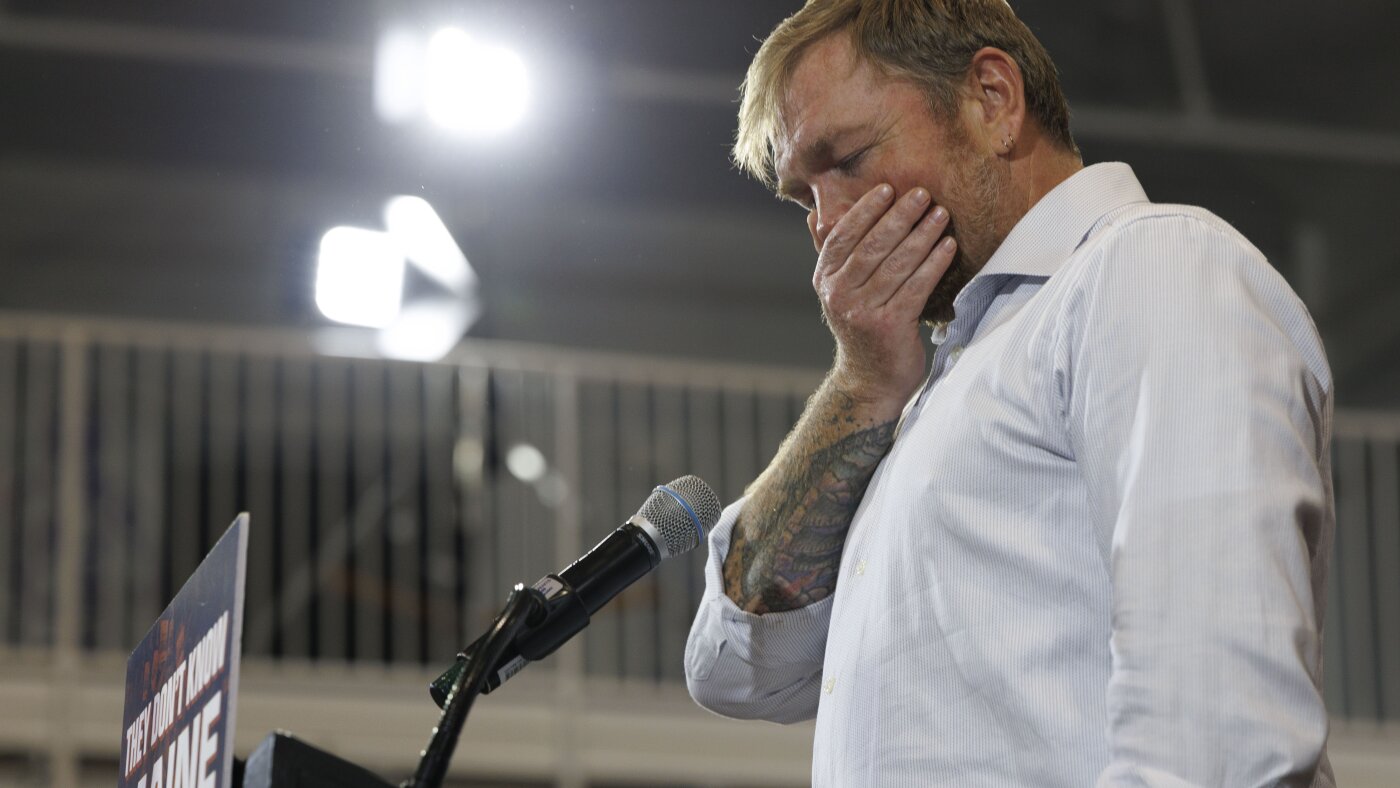
Now-former Democratic Senate candidate Graham Platner speaks at his primary election night event on June 9 in Blue Hill, Maine. Platner officially dropped out of the race July 10 following rape allegations from a former romantic partner that he denies.
CJ Gunther/Getty Images
hide caption
toggle caption
CJ Gunther/Getty Images
Graham Platner, Maine’s Democratic nominee for Senate, is officially out of the race.
The Maine Secretary of State said Platner filed the necessary paperwork to withdraw his candidacy two days after he announced he planned to do so following an accusation of rape by a former romantic partner. Platner denies the allegation.
The Maine Democratic Party has until July 27 to pick Platner’s replacement.
In his withdrawal notice, Platner said “people are desperate for change” and that’s why they voted “for a new kind of politics” by making him the Democratic nominee. He expressed gratitude for those who supported his campaign and said that he will continue to fight for “the movement we have built together and the future we believe in.”
He ended his notice with a strong statement aligned with the progressive platform.
“F*ck ICE. Free Palestine. Up the Hearts.”
Platner announced his plan to withdraw from the race in an 11-minute video he posted to social media on July 8. He said he had no choice but to suspend his campaign, citing it was no longer viable financially.
“We are going to lose our ability to fundraise. We are going to lose our ability to access voter data. We are going to lose all of the things that any campaign needs on the basic level simply to function,” he said.
Platner added that dropping out was not an admission of guilt. Rather, the decision, he said, is to keep the progressive movement in Maine alive to defeat Republican Sen. Susan Collins in November. Platner blamed the “political establishment” for his downfall and argued the goal was to force him out of the race.
“We built a campaign. We engaged in electoral politics. We motivated people. We banded together. We did it the way that we were told we are supposed to make change and we won. And now they are not going to let us have it. Not if it’s me,” he said.
Many powerful Democrats and progressives, including Sen. Bernie Sanders, an independent, urged Platner to step down.
Platner has had to answer to a waterfall of scandals since he launched his Senate bid. Despite those, he ran away with the nomination in the June 9 primary, securing more than 150,000 votes — more than any other Democratic Senate candidate in Maine’s history.
Platner ran on a progressive platform centered on affordability, universal health care and getting corporate money and influence out of politics. During his campaign, he generated an undeniable amount of enthusiasm, something the Maine Democratic Party will have to harness if it hopes to beat Collins in the general election.
Multiple people have already launched campaigns to replace Platner, including former state Sen. Troy Jackson and former CDC official Nirav Shah, who both ran unsuccessful bids for governor.
Platner called on the replacement process to reflect “the Mainers who on June 9 turned out and showed that they are desperate for a different kind of politics.”
“We were asking for real democracy, and we did it the right way. And we won. But now the ball is in the court of the Democratic establishment,” he added.
The Maine Democratic Party said that it intends to hold a new nominating convention where around 600 delegates will select Platner’s successor. Candidates have until July 15 to declare their intent to seek the nomination and gather signatures from at least 8 of Maine’s 16 counties. Party leadership added they will make the nomination process public and transparent.

A Waymo robotaxi drives in San Francisco’s North Beach neighborhood this week.
Heather Diehl/Getty Images
hide caption
toggle caption
Heather Diehl/Getty Images
Police in San Mateo, Calif., posted Monday on social media that they had apprehended a pair of teenagers from a Waymo driverless robotaxi after the company alerted authorities to suspected criminal activity. It’s the latest incident involving video surveillance of passengers and others by autonomous vehicles — raising questions about the limits of privacy in such vehicles.

The Facebook post by the San Mateo County Police said: “Parents do you know where your teens are? @waymo does!”
The 15-year-olds were allegedly drinking alcohol and shooting toy guns from the car, according to the police. They said Waymo’s systems detected behavior that then triggered a safety response, after which the company disabled the vehicle and contacted police.
Waymo’s cars, equipped with an array of cameras, microphones and other sensors to monitor passengers and other nearby vehicles, are becoming more common in cities across the United States. Experts say the detention of the two teens in San Mateo highlights a potential — but not inevitable — trade-off between privacy and convenience. It also questions the extent to which companies similar to Waymo are required to hand over private data, including audio and video of passengers, in situations where a crime is suspected.
NPR reached out to Waymo, which is owned by Alphabet, the parent company of Google, for comment on the details of the San Mateo incident and how the company responded, but did not hear back. But on its website, the company says that as many as 29 cameras in its autonomous cars provide an all-around view and “are designed with high dynamic range and thermal stability, to see in both daylight and low-light conditions, and tackle more complex environments.”
“There already exist laws that govern duty to report or even duty to protect” for carriers such as Waymo, according to Alessandro Acquisti, a professor of information technology at the MIT Sloan School of Management. “The privacy problems arise when and if driverless carrier companies used such laws or ethical obligations as a pretext for blanket, indiscriminate accumulation of identifiable data for unspecified future purposes.”
That includes not just monitoring people inside the cars, but outside too. Take, for example, a hit-and-run investigation last year in Los Angeles. Media reported that the police inquiry was aided by video captured by a Waymo taxi that had a clear view of the crime. Critics suggested at the time that authorities were using the company’s vehicles as a mobile surveillance platform. And during 2025 protests in Los Angeles against Immigration and Customs Enforcement crackdowns, demonstrators vandalized Waymos, apparently angry that video recorded by the vehicles could be used by police, although there is no evidence that happened.
In a transparency report, Google says it received nearly 290,000 requests from governments worldwide in the first six months of 2025 for disclosure of user information across all its platforms, including Waymo. The company says that in more than 80% of the requests in those six months, some information was disclosed. “Google carefully reviews each request to make sure it satisfies applicable laws. If a request asks for too much information, we try to narrow it, and in some cases we object to producing any information at all,” the company says.
In an email to NPR, San Mateo Police Department spokesperson Jeanine Luna said that detaining the teens in the Waymo on Monday was “wholly appropriate” under the circumstances. “We received the call of a ‘firearm’ being shot from a moving vehicle,” she said. “Furthermore, the occupants were described as being possibly ‘intoxicated.’” she said.
“Being that the vehicle was disabled (the occupants had every right to exit the vehicle before police arrival, but they did not), a high-risk traffic stop was conducted to ensure the safety of all involved,” Luna added. “They were not arrested and were released to their parents, however, potential charges are still pending dependent on what the video from inside the vehicle shows.”
Autonomous taxis represent an ethical gray area
Robotaxis began to roll out across the U.S. in December 2018, when Waymo launched in Phoenix. These services have been used for less than a decade — so the norms surrounding them aren’t settled, experts agree.
The Facebook post may make Waymo passengers wonder what triggers a police intervention, says Irina Raicu, director of the Internet Ethics program at Santa Clara University. She has used Waymo’s driverless taxis and says ethically, the privacy issues surrounding them sit in a gray area. “There’s something about being in a car without another person that makes you think it’s private.”
“With all these recording devices, we don’t see them, [and] they’re not these obvious things being stuck in our faces,” Raicu adds.
That brings up a key issue: informed consent, Acquisti says.
“It is not clear the extent to which passengers … are reminded that when they step into the car, that they are being monitored, and most likely they are not told in its entirety how the data will be used,” he says.
Bruce Schneier, a cybersecurity and privacy expert and professor at the Munk School at the University of Toronto, believes that Waymo does have a compelling interest in protecting its vehicles. He compares monitoring a robotaxi via cameras to a human taxi driver keeping an eye on passengers in the rearview mirror.
“Maybe the driverless car comes back … and it has all of its cushions slashed, and it’s like, ‘Who the hell did that? Let’s go and look at the tape,’” Schneier suggests. “You can’t have sex in the back of a taxi, right? Someone would say, ‘Stop it.’”
He concludes that some supervision makes sense. In an Uber rideshare, he notes, “most of the time there’s a camera recording the back seat.” (Uber says on its website that it allows drivers to install such cameras for the purpose of “fulfilling transportation services.”)
Waymo robotaxis, while a fairly common sight in the San Francisco Bay Area, are still a novelty in much of the country. And many people are hesitant to ride in one, according to a Pew Research Center poll published this month. The survey found that only 5% of Americans had ever ridden in a driverless car. Meanwhile, 71% of those polled said they would feel uncomfortable in one, with only 7% saying they would be “extremely or very comfortable” riding in one.
For that reason, experts who spoke with NPR said they were optimistic that it’s not too late to shift gears on privacy norms and policies surrounding these vehicles.
Acquisti doesn’t see why privacy measures can’t be built into driverless vehicles.
“I would immediately challenge the notion that people have to be monitored,” he says, noting that privacy-preserving technologies exist and can be installed.
“Driverless cars are coming, but they don’t have to come in this particular incarnation,” Raicu says. “They’re still being designed and redesigned. It’s early days.”
-

 Technology7 minutes ago
Are you filthy enough for a $700 portable shower?
-

 World9 minutes ago
Former British MP and reality TV star Ann Widdecombe found dead; man arrested for murder
-

 Politics15 minutes ago
Trump takes unusual step, lets bipartisan housing bill become law unsigned amid SAVE pressure campaign
-

 Health22 minutes ago
Eating common dairy food every day may slow biological aging, study suggests
-

 Sports25 minutes ago
CM Punk to defend Undisputed WWE Championship against Cody Rhodes at SummerSlam
-

 Technology30 minutes ago
Would you pay $8,000 for a robot to fold laundry?
-
 Business37 minutes ago
Legendary Television City may be be sold in further blow to Hollywood
-
 Entertainment40 minutes ago
‘Foreign Tongues’ is the funniest Rolling Stones album in decades

