Sports
Behind Comcast's big TV deal: a bleak picture for once mighty cable industry


When Comcast swallowed NBC and Universal Studios 14 years ago, the sibling cable channels USA Network, Bravo and CNBC were considered diamonds in the rough.
USA Network had gained traction with its “Blue Skies” programming strategy: sunny and upbeat TV programs infused with a buoyant energy and natural light. The cable channels were NBCUniversal’s equivalent of blue skies, routinely delivering three-quarters of the company’s profit. In 2012, cable networks threw off a robust $3.3 billion in cash flow.
Times have changed.
Comcast this week announced its plans to jettison all but one cable channel into a separate, stand-alone publicly traded company that will take shape over the next year.
“This is a reminder that the cable television network business is yesterday’s news,” analyst Craig Moffett said Wednesday in an interview. “If it feels like Comcast is shedding itself of an albatross — that’s because it is.”
For now, Comcast’s cable channels remain a viable business by generating $7 billion in annual revenue. But you have only to look at the properties the Philadelphia cable giant is keeping to see how the top brass has picked future winners and losers in a fast-changing media landscape.
Comcast will hold on to the NBC broadcast network, with its NBC News and NBC Sports units, along with its prolific Los Angeles-based Universal film and television studios, Universal Studios theme parks, local TV stations, including KNBC-TV in Los Angeles, and streaming service Peacock, which now has 36 million subscribers.
The lone cable outlet set to remain within NBCUniversal is Bravo, which has a bold brand, cultural cachet and the “Real Housewives” franchises. Company executives reviewed data that showed NBC and Bravo shows had strong viewership on Peacock, insiders said.
The spinoff company will be composed of the remainder of the cable channels, including MSNBC, CNBC, USA, Oxygen, Syfy, E! and the Golf Channel as well as digital properties, including Rotten Tomatoes, Fandango and SportsEngine.
Comcast’s move is the strongest sign yet of alarm reverberating throughout Hollywood’s traditional companies. Cable channels have long been a key economic pillar by generating billions of dollars in cable distribution fees that more than covered up the misses when big-budget movies flopped or during advertising recessions.
No more. Rampant cord-cutting has roiled the television business and linear cable channels — once a mighty draw for couch-potato viewing — have become endangered species.
Industry executives privately acknowledge that they unintentionally contributed to the erosion by making cable channels less appealing — stuffed with endless sitcom reruns, dated movies and extended commercial breaks, contributing to the rise of on-demand streaming services.
Millions of consumers have switched to streaming platforms that offer fewer commercials, or none at all, and lower subscription prices. In the first six months of the year, an additional 4 million customer homes dropped pay-TV, according to a recent MoffettNathanson report.
That’s a 30% decline since 2012, when there were more than 100 million pay-TV homes in the U.S.
Consumers also can cancel streaming services with a click of a button — without haggling with a customer service representative at a pay-TV company call center.
The toll has been enormous. Thousands of entertainment company workers have been laid off in the last four years in seemingly endless waves of restructuring. Traditional media companies have struggled to shore up their slumping stock prices.
In August, Warner Bros. Discovery took a $9-billion write-down on the value of its basic cable portfolio, which includes CNN, TBS, TNT and Cartoon Network. That same month, Paramount Global wrote down $6 billion in value for its cable channels, including MTV, Nickelodeon, VH-1 and Comedy Central.
Pay-TV channel blackouts have become more common. And pioneering satellite TV company DirecTV two months ago announced its plan to buy competing Dish Networks for $1. That merger is expected to face regulators’ scrutiny.
More separations and roll-ups may be coming.
Warner Bros. Discovery Chief Executive David Zaslav has telegraphed his desire to wheel or deal assets now that President-elect Donald Trump is preparing to take office. Zaslav’s company is desperate to pay down debt taken on two years ago when the smaller Discovery merged with WarnerMedia, relieving AT&T of its entertainment headache.
Although Comcast’s move is bold, the reckoning began seven years ago after Netflix had become the go-to destination for younger viewers. That’s also when Rupert Murdoch, the now 93-year-old media baron, decided to sell much of 21st Century Fox to Walt Disney Co. Some investors and analysts believe the $71-billion price for the Fox assets was wildly overvalued.
Since then, Disney has taken steps to de-emphasize cable distribution, and the Burbank powerhouse is planning to launch ESPN directly to consumers next year — a move that many in the industry believe will mark the tipping point for the cable channel business.
“Comcast is accelerating this pressure [in the cable business] with its success with Peacock, which makes the legacy pay-TV model with multi-channel bundling of cable networks a much more difficult prospect going forward,” Raymond James analyst Frank G. Louthan wrote in a note Wednesday.
Comcast executives say they are not entirely pulling the plug on their cable channel business, noting that the new company will have resources to buy additional channels or other properties to build scale..
“The company will have significant cash flow, a strong balance sheet, and the financial flexibility to pursue growth opportunities, both organically and potentially through acquisitions,” Comcast President Mike Cavanagh said in a note to employees.
The spinoff company, which doesn’t yet have a name, will continued to be controlled by Brian Roberts, chair of Comcast.
Mark Lazarus, who currently serves as chair of NBCUniversal Media Group, will shift to the new company as its chief executive.
Comcast shareholders will receive stock in the new company in tax-free transactions.
Moffett, the analyst, said the cable channel company will face considerable challenges maintaining the channels’ position in the pay-TV and advertising markets.
“This [spinoff] is good news for investors but it’s not a guaranteed success,” Moffett said. “We’ve seen this movie before with Viacom and CBS. Separating the broadcast network from the cable channels could leave the cable channels adrift.”
In 2006, the late mogul Sumner Redstone split his media empire consisting of the cable channels and the Paramount film studio. CBS forged forward with its broadcast network, television studio, Showtime and a book publishing house.
Five years ago, Redstone’s daughter, Shari, reunified the company. In July, she decided to unload the entire enterprise, now called Paramount Global, to the Larry Ellison family. That transaction also faces a regulatory review.
Moffett and other analysts say the spinoff company could struggle to maintain the size of distribution fees that Comcast was able to wrangle from pay-TV operators, thanks to the muscle of NBC and its marquee program, “Sunday Night Football.”
Some analysts wonder whether Comcast is preparing the cable channels to be absorbed by another company or a private equity firm.
“It looks like this is set up for [another] transaction,” Moffett said of the Comcast spin.
Wall Street seemed to endorse the spinoff news. Comcast shares gained 1.6% Wednesday to close at $42.99.

Sports
Golf star records lowest round in LPGA major history with astounding performance at Evian Championship

NEWYou can now listen to Fox News articles!
There are good days on the golf course, and then there is what Haeran Ryu just did on Saturday.
Ryu, 25, recorded the lowest round in LPGA major history on Saturday with an 11-under 60 at the Evian Championship. With the South Korean golfer’s historic round, she holds a three-stroke lead.
Ryu’s round comes just two weeks after winning her first major at the Women’s PGA Championship. On the 18th hole, Ryu left a 30-foot eagle putt a few inches short, and instead settled for a birdie.
CLICK HERE FOR MORE SPORTS COVERAGE ON FOXNEWS.COM
Haeran Ryu of South Korea reacts on the 18th green after the third round of The Amundi Evian Championship at Evian Resort Golf Club in Evian-les-Bains, France, on July 11, 2026. (Stuart Franklin/Getty Images)
She said after the round that she had no idea what she had done until she counted up her scorecard.
“But after the putt and I counted my score with my caddie,” she said. “Oh my God, it’s 11-under par today. It was so amazing. My caddie says, ‘Yep.’ I’m so happy right now.”
If Ryu had made the eagle putt on the 18th hole, she would have been just the second player to shoot a 59 in LPGA history.
ZERO BS. JUST DAKICH. TAKE THE DON’T @ ME PODCAST ON THE ROAD. DOWNLOAD NOW!
Haeran Ryu of South Korea celebrates a birdie on the 15th green during the third round of The Amundi Evian Championship at Evian Resort Golf Club on July 11, 2026, in Evian-les-Bains, France. (Stuart Franklin/Getty Images)
Her 60 broke the record for the lowest round in an LPGA major by one shot. Leona Maguire and Jeungeun Lee6 in 2021, and Hyo Joo Kim in 2014, each shot 61 at the Evian Championship, which was designated as an LPGA major in 2013.
The lowest round in a men’s major is 62, which is shared by four players — Branden Grace at Royal Birkdale in the 2017 British Open, Xander Schauffele and Rickie Fowler in the 2023 U.S. Open at Los Angeles Country Club, and Schauffele and Shane Lowry in the 2024 PGA Championship at Valhalla.
CLICK HERE TO DOWNLOAD THE FOX NEWS APP
Haeran Ryu of South Korea and Lottie Woad of England interact after their round on the 18th green during the third round of the Amundi Evian Championship at Evian Resort Golf Club in Evian-les-Bains, France, on July 11, 2026. (Stuart Franklin/Getty Images)
Ryu hopes her historic third round can help propel her to a second major win in three weeks.
“That is amazing, amazing dream,” Ryu said. “So I just want that one to come true, but we have one more day.”
The Associated Press contributed to this report.
Follow Fox News Digital’s sports coverage on X, and subscribe to the Fox News Sports Huddle newsletter.
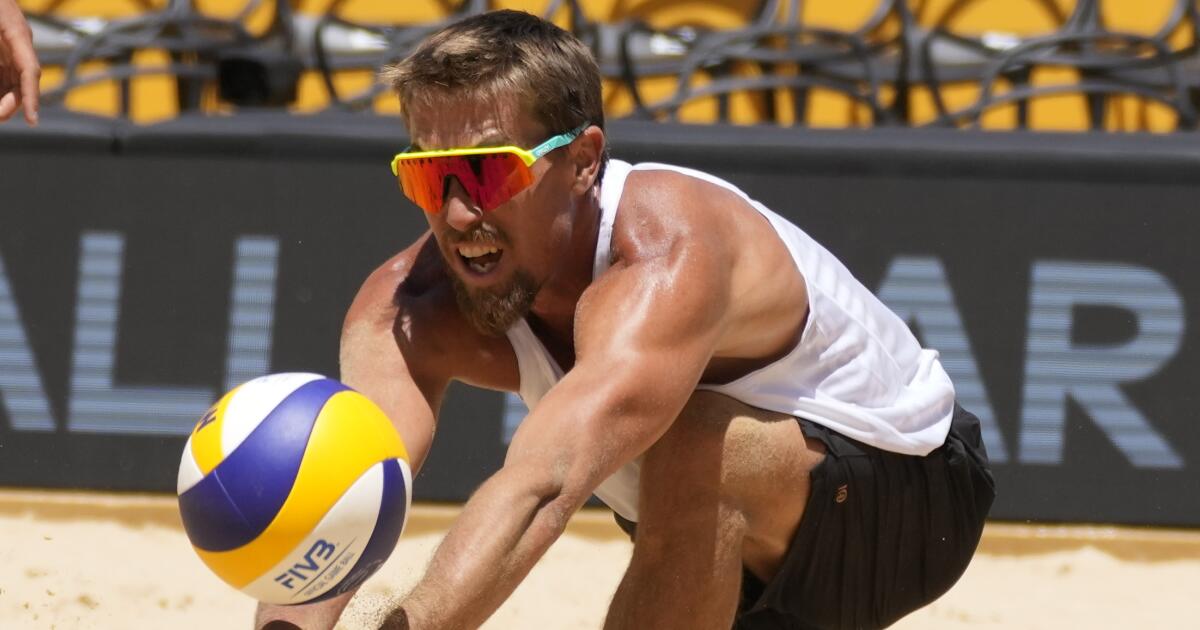
Taylor Crabb is no stranger to South California beaches. The Long Beach State alum returns home this weekend to compete in AVP League matches.
It marks the first time AVP will compete in Long Beach since 2020 and allows players to compete at the 2028 Olympics beach volleyball venue.
Crabb, 34, made his AVP debut in 2013 with his brother, Trevor, and advanced from the qualifier in Manhattan Beach before finishing 25th in his first tournament.
After years of competing with various different partners, Taylor Crabb and Andy Benesh have delivered the top performances this AVP season.
The following interview with Crabb has been edited for clarity and length.
Are you excited to compete in this weekend’s event at Long Beach?
Crabb: Very excited. A lot of my college teammates and part of the school have reached out, saying that they’re gonna come. So I’m excited to get a chance to play in front of them again.
When was the last time you were in Long Beach?
Crabb: I always try to go down there for alumni events or any big games they have. I went to UCLA against Long Beach last year, when it was No. 1 versus No. 2, so I always try to get down there and support them.
You missed out on the chance to compete in the 2020 Olympics because of COVID-19 restrictions and chose not to pursue a spot at the 2024 Olympics. Are you fired up to try to compete in the 2028 Olympics, knowing that Long Beach will host the competition?
Crabb: Yeah, it’s definitely an exciting time having the Olympics in Long Beach, and we kind of get to break it in this weekend. As you said, Tokyo didn’t go the way I wanted, but I’m going full force now. I have a great partner in Andy Benesh, who obviously went to the Paris Olympics, and if it weren’t for the Olympics being in Long Beach, and me getting a partner like Andy, I’m not even sure I’d be going for it, but because of those two things, I want to make the most of it.
You mentioned that if it wasn’t for a partner like Andy, you wouldn’t be going for it. What do you mean by that?
Crabb: I didn’t feel motivated by playing in all the international events, but now, I think, sitting out kind of lit the fire under me, and I’m really motivated now.
You’ve had different partners throughout your time. What other motivation does Andy give you?
Crabb: He’s been, in my mind, the top blocker for the U.S. the last four or five years. Seeing the professionalism he brings every day to practice, on and off the court, while traveling and when showing up to tournaments, it rubs off on you and that’s really motivating to see. And I just want to make him proud.
Why do you love volleyball?
Crabb: A lot of reasons, but it’s just a feeling I have when I’m out there on the court. It feels natural. It feels like home. I was born into a volleyball family. I had a volleyball in my hands my entire life, so I’ve always just enjoyed it.

NEWYou can now listen to Fox News articles!
CM Punk appeared on “Friday Night SmackDown” ready to take on any challenger that was ready to step to him after winning the Undisputed WWE Championship against Sami Zayn.
Punk entered the ring in Oklahoma City and called back to the “Monday Night Raw” after WrestleMania 42 when he told Cody Rhodes he’d be ready to deliver if a championship opportunity fell “out of the sky.”
COMPLETE PRO WRESTLING COVERAGE ON FOX NEWS DIGITAL
Cody Rhodes and CM Punk face off during SmackDown at Paycom Center in Oklahoma City, Okla. (Craig Ambrosio/WWE via Getty Images)
“When championship opportunities fall out of the sky, CM Punk catches them,” he said.
Punk named potential SmackDown superstars he’d think might come for the title, including Gunther, Finn Balor, Royce Keys, Damian Priest and Trick Williams. He even said that Zayn could come back around and get his rematch if he wanted. He didn’t mention Rhodes’ name, but the “American Nightmare” came out uncalled and marched his way down to the ring.
“I don’t think you and I can run away from each other anymore,” Punk told Rhodes.
Cody Rhodes looks on during SmackDown at Paycom Center in Oklahoma City, Okla., on July 10, 2026. (Craig Ambrosio/WWE via Getty Images)
Rhodes agreed and mentioned that Punk would want a match with him, just “say when.” It was a quick retort from Punk, who said, “when.” SmackDown general manager Nick Aldis, who was in the ring for the segment, booked the match for SummerSlam.
Punk will defend the Undisputed WWE Championship at SummerSlam, which takes place Aug. 1 and 2 at U.S. Bank Stadium in Minneapolis.
First, however, Punk and Rhodes will be involved in a tag team match at Saturday Night’s Main Event in New York City next week. Aldis made the match after Gunther demanded that Aldis put him in a match against Punk. Gunther was hoping it would be for the championship. Instead, Gunther will tag with Zayn.
Gunther didn’t take too kindly to that and attacked Aldis. Rhodes came back out to break up the calamity. He wanted to take on Gunther after the show went off air but Gunther walked away.
Gunther makes his entrance during SmackDown at Paycom Center in Oklahoma City, Okla., on July 10, 2026. (Rich Wade/WWE via Getty Images)
CLICK HERE TO DOWNLOAD THE FOX NEWS APP
Punk definitely has his hands full as he moves to SmackDown to become a fighting champion.
-

 Los Angeles, Ca56 minutes ago
19-year-old arrested, accused of distributing marijuana to minors across Riverside County
-

 Detroit, MI1 hour ago
Phillies end the Tigers’ winning streak at 6 with a 4-2 victory
-

 San Francisco, CA1 hour ago
Giants select Barry Bonds’ nephew Peyton in third round
-

 Dallas, TX2 hours ago
Mark Cuban takes legal action against the Dallas Mavericks ownership over proposed arena deal
-

 Miami, FL2 hours ago
South Florida businesses report economic boom, as FIFA officials estimate a billion dollar economic impact
-

 Boston, MA2 hours ago
Forecast: Looking ahead to toasty temps next week
-

 Denver, CO2 hours ago
Denver weather: Warming trend continues this weekend and into next week
-

 Seattle, WA2 hours ago
Tech Investor Vinod Khosla to Acquire the NFL’s Seattle Seahawks for $9.6 Billion

