Virginia
Round Robin: Evaluating Virginia Basketball’s 3-0 Start


With three games of data collected, we’ve learned quite a bit about the 2024-2025 Virginia basketball team, but many questions are still unanswered and there is still a great deal to learn about the Cavaliers, especially as they head to the Bahamas for a couple of tough non-conference matchups against ranked opponents.
As we evaluate what we’ve seen from UVA so far, four members of the Virginia Cavaliers On SI writing staff – William Smythe, Aidan Baller, Val Prochaska, and Matt Newton – are going to answer some questions and give their impressions of this year’s Virginia team through the first three games of the season.
What’s your impression of Virginia’s 3-0 start? What has surprised you so far?
William: It’s an encouraging start, and you should always be happy with a 3-0 record (unless you’re 2024-25 Syracuse) heading into a tough non-conference slate this weekend. I believe that Coach Ron Sanchez did a tremendous job against Villanova of tailoring the offense to Isaac McKneely and his sharpshooting ability even while keeping the tempo painstakingly slow. I’ve been most surprised, however, by the dual-package of Andrew Rohde and Dai Dai Ames on the court against the Wildcats. The former might get pushed more to a wing role if sophomore forward TJ Power fails to find his shot, yet Rohde’s ascendance could result in an extra ball-handler, distributor, and potential shot creator appearing alongside the Kansas State transfer.
Aidan: Cautiously optimistic is the best way to put it. Ron Sanchez has checked the boxes in earning three solid wins but the Cavaliers still need to be truly tested. The two biggest surprises this season are Virginia’s dominant three-point shooting, showcased best against Villanova, and Jacob Cofie, who has delivered double-digit scoring in all three games.
Val: Despite all the supposed change and newness this season was supposed to represent — the new coach, the three transfers (who were expected to immediately fill in at the top of the lineup) and the two freshmen (who were not redshirting,) the emphasis on getting into the offensive sets faster and a heavily tweaked offensive scheme — this team still looks very much like last year’s team. Last year the team averaged 60.1 possessions. This year the team is slower at 58.3 possessions. Every year the team has a game where the bucket looks as big a manhole cover, and those are exciting games to watch, but every team can hang around. Virginia shot an absurd 56% from beyond the arc, but only beat Villanova by 10 points.
Matt: I’ve been moderately impressed by Virginia’s 3-0 start. The wins over Campbell and Coppin State didn’t (and shouldn’t) move anyone, but the victory over Villanova was a good sign that the Cavaliers can compete and beat a talented, albeit poorly coached major conference foe. This week will tell us a great deal about who the Hoos actually are this season.
Virginia has shot the three-ball well so far, but where will the buckets come from if the threes aren’t falling?
William: We’re familiar with the mantra, “live by the three, die by the three.” While ‘Nova caught the brunt end of a Virginia shooting-spree, a 50+ 3PT% might not be sustainable. If Virginia can allow forward Elijah Saunders to outmuscle smaller defenders, it can unlock a safety valve for this offense. Saunders and sophomore center Blake Buchanan — a bit rusty to start his second-year campaign — shouldn’t face too many double teams on account of Virginia’s threats from outside. I’d lean towards Saunders as the more prolific scorer of the two, as he looked relatively comfortable operating in the paint through the first two games in particular. An offense capable of stretching the floor and creating one-on-one matchups in the frontcourt would be ideal.
Aidan: If the threes aren’t falling, I look to Elijah Saunders; the San Diego State transfer has shown he has a presence at and around the basket. His presence has the potential to open up points for Blake Buchanan and Jacob Cofie while helping them find their rhythm and confidence in the paint. Besides those three, the only other players who have shown glimmers of the midrange are Isaac McKneely, who has shown he can shoot from anywhere, and Taine Murray, who may not have played against Villanova but showed his ability to get to the basket in the first two games.
Val: If Virginia is going to be able to win games when the threes aren’t raining down, it will be because the Hoos are getting points at the rim. The team is never going to fast break so it will mean that Elijah Saunders has found his post game, that the Blake Buchanan – Jacob Cofie two-man high-low game is growing, and that Isaac McKneely is hunting his mid-range game. I’m not confident that these three things will happen per se, but the season is still young and the potential is there. The most notable tweak to the offense is entry pass into a big at the top of the key which leads to a host of new screening actions as well as the dribble hand off. Virginia’s continuity ball screen/Sides offense had long passed it’s expiration date, but this addition to the offensive arsenal seems much more sustainable than the brief fling Tony Bennett had with the Five-Out offensive set during the Sam Hauser/Trey Murphy year. Virginia has a higher ceiling than they’ve had in the past four-five years.
Matt: Elijah Saunders’ post game and hook shot will be the key, just as Anthony Gill’s paint production was a huge asset to the Malcolm Brogdon Virginia teams in 2015 and 2016. Blake Buchanan still needs a bit of help developing his touch on his hook shots, but UVA running the ball through Buchanan above the free throw line is an exciting new wrinkle to Virginia’s offense. With that said, I’m personally content with the Cavaliers living and dying by the three this season. They have the shooters for it and the resultant spacing should allow more opportunities to attack the rim when the threes aren’t falling.
What will TJ Power’s role be going forward?
William: Despite his ineffectiveness from a scoring standpoint, I think Coach Ron Sanchez keeps Power in the starting lineup and allows him to experience the thrill of a breakout game (it’ll come eventually, right?). He hasn’t been proactive on offense and hasn’t been completely exposed on defense, but it’s possible that — at the moment — Power serves more of a glue-guy role as one of the appointed leaders of this new-look Virginia team. There aren’t many immediate threats to his playing time outside of guard Andrew Rohde, and that’s only if he’s playing the wing alongside Ames. I don’t know if I can assign a certain label to Power’s role. I fear that the realistic comparison is Jacob Groves, yet I’m confident he’ll crawl closer to his five-star billing once he sees a few threes go through.
Aidan: The former Duke sharpshooter has lacked sharpness in his first three outings for the team in Charlottesville. Considering his three-point shooting ability is the only dominant part of his game, if that’s missing, it’s highly problematic. Despite this, everyone knows Power’s capability to shoot, so keep letting him fire away until he finds his rhythm. It’s way too early to stop giving him minutes.
Val: Power was the #21 recruit two years ago coming out of high school. His first three games of his Virginia career seem eerily similar to his first year at Duke. He’s a tall guy with a reputation for being a good shooter, but all it is rep at this point. Duke last year, and Virginia this year, play better when he is off the court. Which is about as damning a thing as you can say about someone. I think Power’s ceiling is that of Jacob Groves, but I don’t know if he’s going to reach it this year. For this year, I think Power will ultimately settle as the fourth big on the floor behind Buchanan, Saunders and Cofie. Power should be good for three or four games a year where he gets in a groove and has a 4/7 night from beyond the arc. Saunders and Cofie have each had a game where they’ve struggled with fouls so I think Power will get more minutes than he got at Duke, but at best he’ll be a super sub off the bench.
Matt: Even with his slow start, I’m hopeful that the UVA coaching staff will allow Power, who is still getting accustomated to this level of basketball after playing sparingly last season, time to get into a rhythm on both ends of the floor. I must admit that I’d hoped to see brighter signs of Power’s potential through these first few games, but it’s also too early to give up on the former five-star. Elijah Saunders said Power sometimes looks like the best three-point shooter on the team in practice. If we start to see evidence of that “possibly insulting to Isaac McKneely” statement in games, then Power could still be one of Virginia’s most important players this season. If not, then he’ll be relegated to spot bench minutes with his ceiling being the occasional three-point flurry in a handful of games. Power and the Hoos are certainly hoping the former is the case.
Have your expectations for this season changed after three games? More specifically, what’s your prediction for Virginia’s two games in the Bahamas?
William: Villanova doesn’t look like it has turned the corner in year three of Coach Kyle Neptune’s tenure, so it’s certainly not the litmus test we might’ve expected if we saw this scheduling four years ago. However, the expectations surrounding McKneely have ratcheted up, especially if Virginia works furiously to help him create his own three-point looks off of the dribble. This double-date in the Bahamas reminds me of the Main Event Classic in Vegas two years ago. Albeit under different leadership, an overlooked Virginia will take to a neutral court against No. 11 Tennessee. I predict a rock fight and late triumph over the Volunteers in a failed Igor Miličić Jr. Revenge Game. Now, I don’t know if the ‘Hoos have the talent to knock off one of the two other top-25 squads — Baylor and St. John’s — in the championship, even if Virginia is awfully familiar with two of the Bears’ starters. A win over Tennessee would be massive. Let’s just start there.
Aidan: My expectations have not changed much as this team has yet to be truly tested, although being 3-0 does feel good. Against Villanova, the Cavaliers comfortably cruised past the Wildcats without being tested in the clutch moments, which we will most certainly see this weekend. My predictions for the Bahamas are that the Volunteers will be too fast and teach Virginia a lot. Still, on night two, Virginia pulls itself together to leave the Continental Baha Mar Championship 1-1, with plenty of lessons learned.
Val: Not really. Reports out of training camp were that Dai Dai Ames would be a more effective back up point guard, presumably to the now-departed Jalen Warley, than Dante Harris was last year for Reece Beekman. I was never impressed with Warley at Florida State so I am much more excited to see how Ames grows. I had no idea what to think of Cofie before the season started, but I now think he has the potential to be the second banana to McKneely. His emergence is my biggest source of optimism for this season. I’m not much for predictions. If you are betting man, do just the opposite of what I say and you’ll be living in a nice house soon. I expect Virginia will go cold against Tennessee and get pounded by Tennessee and then bounce back for the second game.
Matt: I’m going to wait to give a real answer to that question about expectations until after this week. With a pair of games against ranked opponents ahead of them, the Cavaliers could come back from Bahamas with their first and second defeats of the season. I don’t need to see Virginia go 2-0 or even 1-1 in order to be encouraged about what this season could become, but Ron Sanchez and the Hoos must show they can at least compete with these talented and well-coached teams in order for me to be convinced that a successful season in the ACC is on the table for Virginia. As for a prediction, I agree with Val and Aidan that the most likely outcome is that the Cavaliers fall to Tennessee, but then win the second game against either Baylor or St. John’s.
ACC Basketball Weekly Roundup: Power Rankings and the Good, Bad, and Ugly
UVA Basketball Report Card: Evaluating Virginia Through Three Games
The Plus/Minus: Virginia Basketball Lights Up Villanova
Virginia Basketball Storms Past Villanova 70-60 | Key Takeaways
Why Did Tony Bennett Retire? UVA Basketball Coach Explains Decision


CLARKSBURG, W.Va. (WBOY) — West Virginia has plenty of state symbols, be it the black bear as the state animal, the cardinal as the state bird or the rhododendron as the state flower, but did you know that the Mountain State also has its own official gun?
The Hall Flintlock Model 1819 was first manufactured in Harpers Ferry by John H. Hall in 1811 and was adopted by the United States Army in 1819, making it the first breech-loading rifle ever adopted by a country’s military.
-

Model 1819 Hall Breechloading Rifle presented by Congress to Gustavous A. Bird for his participation in the Battle of Plattsburgh 9/11/1814 by John C. Bird via the Smithsonian Institution -
Model 1819 Hall Breechloading Rifle presented by Congress to Gustavous A. Bird for his participation in the Battle of Plattsburgh 9/11/1814 by John C. Bird via the Smithsonian Institution


All of this information is listed in Senate Concurrent Resolution 7, which was introduced and passed during the 2013 West Virginia Legislative session, and officially recognizes the Model 1819 as the official firearm of the State of West Virginia.
On top of being created in West Virginia, the resolution also points out that the rifle saw use during the Civil War, an event that directly led to West Virginia’s statehood.
While having an officially recognized state firearm may seem far-fetched, West Virginia is not the only state that has one. As a matter of fact, a fifth of the states in the country have officially designated a state firearm, including West Virginia’s neighbors in Kentucky and Pennsylvania.

CHARLOTTE, N.C. — In this world of college football, with the transfer portal and recruiting battles, bad blood is present more than ever before between head coaches.
That’s not the case between the Virginia Tech head coach and Clemson head coach Dabo Swinney, however. In fact, Franklin revealed at ACC Kickoff on Thursday that the two are actually close friends, dating back to their time at the Nike trip that various coaches take over the summer.
“Dabo’s my guy,” Franklin said on Thursday. “We go way back. We’ve been on the Nike trip for a long time. His wife and my wife are friends.”
The long-time Penn State head coach is making the move to the ACC after being fired from the Nittany Lions in October. 12 seasons of being with the program had Franklin hold a 44-21 record against top 10 opponents, an impressive record for a new conference foe of Swinney’s.
But when that trip comes around, there’s a camaraderie between Swinney and Franklin and both of their wives. In fact, the two hang out with each other instead of the other coaches at times. It simply comes to an “edgy” time in college athletics that raises tempers.
“I’m going to be honest, I wouldn’t say we’re necessarily like the type of people that love a lot of other coaches and a lot of other programs,” Franklin said. “It’s hard when you just compete year-round.”
On Swinney’s end, there are a few who could immediately come to mind among Clemson fans. Perhaps the most recent would be Ole Miss coach Pete Golding, who played the most significant role in the tampering of former linebacker Luke Ferrelli.
It’s a select list of coaches who make the good side of the Tigers’ head coach, and Franklin is certainly on that list. On the other hand, Hokies’ head coach has Swinney on his own shortlist.
“Obviously, tremendous respect for what he has built at Clemson and what he’s done at Clemson, and what he’s done for the ACC,” he said.
The two will see that close relationship face off at Memorial Stadium this upcoming season. Clemson will host the Hokies on Oct. 24 in what could be a potential title-eliminator for the ACC Championship.
Of course, the last game that we’ve seen the Tigers play in was against Franklin’s former team in Penn State at the Bad Boy Mowers Pinstripe Bowl. That game ended in a 22-10 contest that saw a foundation of Franklin players end Clemson’s season in disappointment.
Swinney will see many of those players once again in October, including starting quarterback Ethan Grunkemeyer, in that contest. The anticipated Hokie starter recorded 260 yards and two passing touchdowns on the Tigers in the Bronx that day.
Although friends become foes, another ACC coach has given Swinney his flowers for what he’s been able to do for the conference. In the upcoming moments, Franklin will look to prepare his team to prove itself on one of the biggest stages in the ACC, while Swinney looks to put his team back at the top of a conference he’s dominated for over 15 years.
Follow

MARTINSVILLE, Va. (WSET) — Extreme drought conditions in parts of Virginia have prompted an emergency drought warning for a wide swath of the region, including Bedford, Campbell, Charlotte, Franklin, Halifax, Henry, Mecklenburg, Patrick, Pittsylvania and Roanoke counties, along with the cities of Danville, Roanoke, Salem and Martinsville.
The governor has warned that if conditions worsen, she will activate mandatory nonessential water-use restrictions.
In Martinsville, city leaders have issued a voluntary water conservation notice and are urging residents and businesses to cut back where they can. The request comes as local businesses that rely heavily on water say the drought is already affecting day-to-day operations.
SEE ALSO: Botetourt County residents adjust daily routines as voluntary water restriction continues
John Hughes, owner of John’s Car Wash, said the dry conditions have hit his business hard in recent weeks. “For the last 3 weeks, it’s been hitting pretty hard. We done three yesterday and haven’t done anything today with the drought and hot weather. Yeah, I’m really concerned about it,” Hughes said.
Restaurants are also feeling the strain. David Kitzmiller, an owner of Be Wiched, said water is essential for routine tasks such as washing dishes and preparing some menu items.
“We use a lot of water for washing dishes and some of our recipes if they limit us in anyway defiently can’t produce and its a scary aspect,” Kitzmiller said.
Kitzmiller added that cutting back is not always realistic for businesses that must meet sanitation needs. “Not really feasible for a business that depends solely relies on water to wash their dishes, so that can’t definitely be an impact there,” he said.
City leaders emphasized that the conservation request is voluntary for now, but they are encouraging everyone to do their part by taking shorter showers, turning off the faucet when it is not in use, washing only full loads of laundry, and limiting outdoor watering whenever possible.
-

 Los Angeles, Ca1 hour ago
LADWP begins long-term repairs after West Hollywood water main rupture
-

 Detroit, MI2 hours ago
Livestream: Mayor Sheffield, Detroit health chief to address wildfire smoke threat
-
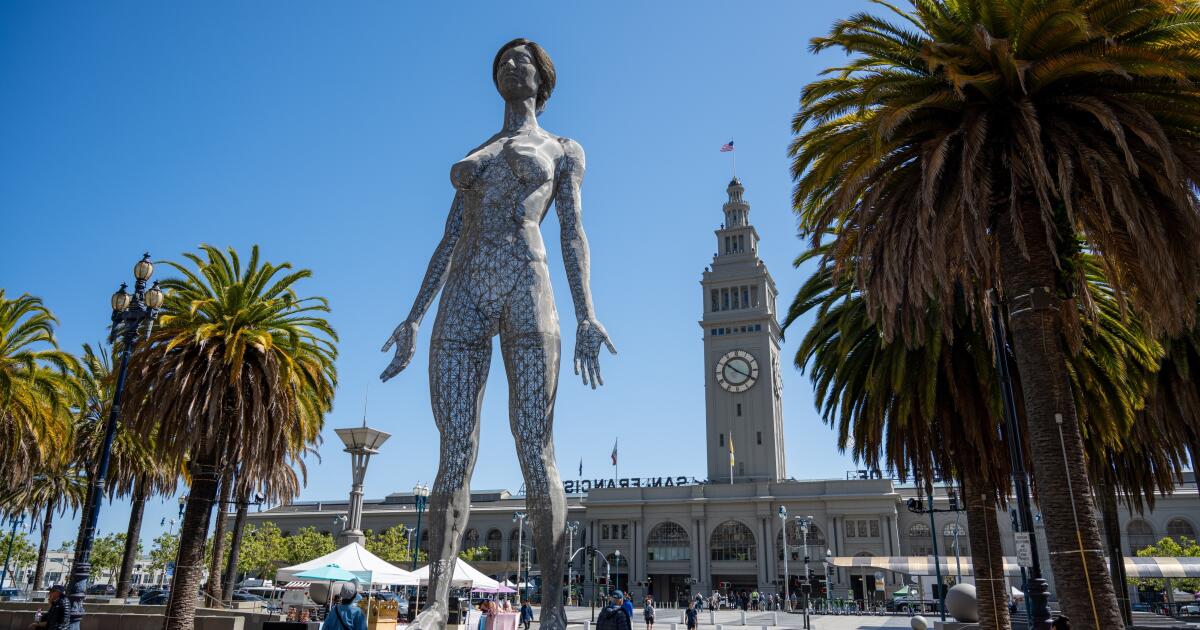 San Francisco, CA2 hours ago
A sculpture of a giant naked woman goes on sale in San Francisco. Bring a crane
-

 Dallas, TX2 hours ago
No ‘straight answer’: Why Pioneer Cemetery is the latest battleground at City Hall
-

 Miami, FL2 hours ago
TSA hosts news conference ahead of World Cup third place match at Miami Stadium
-

 Boston, MA2 hours ago
ICE Boston arrests Barbados national during targeted operations in Attleboro
-

 Denver, CO2 hours ago
Denver Broncos training camp is 2 weeks away
-

 San Diego, CA2 hours ago
Daily Business Report: July 17, 2026, San Diego Metro Magazine

