West
Bay Area city pays $1.5 million after years-long fight to take down cross

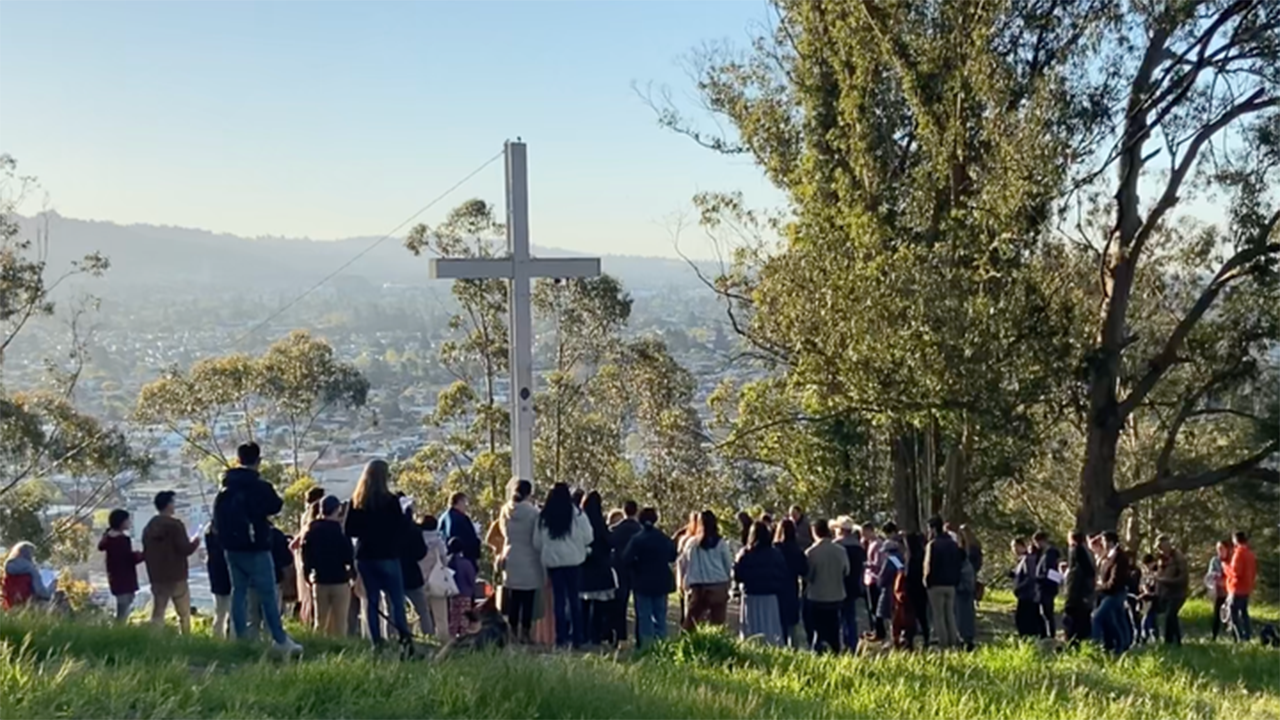
A years-long legal battle over a giant cross in a Bay Area city has finally been resolved, after the city agreed to pay over $1.5 million to settle the dispute.
The Albany Hill Cross, a 28-foot illuminated steel and plexiglass structure, stood overlooking the city of Albany and the East Bay of San Francisco for over 50 years. The cross had been installed on the original landowner’s private property for the benefit of the community, because Christians had been carrying crosses up the hill every Easter for years, according to local community service group, The Albany Lions Club. The surrounding land was later sold to the city and became part of a public park. Before selling, the original landowner created an easement granting maintenance of the cross to the Albany Lions Club.
After a local atheist group complained about the religious symbol in a public park, a federal judge ruled that the cross violated the First Amendment. The city council voted to acquire the easement by eminent domain, rather than sell it to the Albany Lions Club, and took down the cross in 2023. However, the Albany Lions Club continued to fight the city over the cross removal and easement dispute.
To end the ongoing litigation, the city announced in its October 7 city council meeting that it had agreed to settle the case, by paying over $1.5 million to the Albany Lions Club in exchange for the legal title to the entirety of the property.
BAY AREA ATHEISTS WHO FOUGHT FOR CROSS REMOVAL: CHRISTIANS SHOULDN’T HAVE ‘SPECIAL PRIVILEGE’
A past Easter service at the cross on Albany Hill. (Courtesy: Dorena Osborn) (Dorena Osborn)
“To end the ongoing litigation, the City stipulated to a judgment with the Lions Club to avoid additional litigation expenses. This judgment allows the City to condemn the easement, and remove the cross, which the City already did, that existed on Albany Hill Park for the benefit of the Lions Club. The judgment requires the City to pay the Lions Club $1,530,000 for acquisition of their property interest, $500,000 of which has already been set aside with the State Condemnation Fund,” the city of Albany announced.
“Additionally, the judgment fully resolves any and all claims the Lions Club may have had regarding the City’s removal of the cross and gives the City legal title to the entirety of the property, and completely clears title of the easement that previously existed on the Park.”
“This resolves the matter, and therefore, the Lions Club has no legal right to use the property for the easement or to maintain the cross on the property, which the City has already removed,” the statement continued.
Albany Lions Club President Kevin Pope told Fox News Digital that the city “exercised poor judgment” in how they handled the years-long dispute.
CLICK HERE FOR MORE COVERAGE OF MEDIA AND CULTURE
The city of Albany settled its dispute with the Albany Lions Club over its giant cross, which once overlooked the East Bay of San Francisco. (iStock)
“I’m sad and angry that the Albany City Council has exercised such poor judgment in spending public resources to force the permanent removal of the Christian cross from Albany Hill. It did not have to be this way,” he said.
Pope slammed the city for choosing “to pay over $1.5 million to tear down the cross,” instead of just selling a small portion of the land to The Albany Lions Club so the cross could remain on private property, and questioned if the decision was a wise use of the city’s “dwindling resources.”
“Albany is now viewed by many as a place of intolerance toward religious values. Data shows there is an ‘exodus’ of people from California for that and many other reasons,” Pope said.
Albany Lions Club President Kevin Pope criticized the Albany City Council for how they handled the easement dispute over the cross. (iStock)
“The cross means the world to those who worship Jesus Christ; it’s the symbol of the great love God has for all of us, not just Christians, all of humankind, every race, religion, ethnic group, sex, etc. All of us, whether we believe in God or not. He still loves us,” Pope said, quoting 1 Corinthians 1:18.
The Albany City Council referred to its public statement when reached for comment by Fox News Digital.
Read the full article from Here

Idaho
An Idaho mother who said her toddler twins died after vaccinations has been charged with murder

An Idaho woman who said her toddler twins died last year after being vaccinated faces murder charges connected to their deaths, authorities said.
A grand jury indicted Andrea Shaw, who is accused of suffocating her 18-month-old twins in May 2025, on two counts of first-degree murder on June 29, according to court records and a news release from the Payette Police Department.
While appearing last year on an internet show produced by Children’s Health Defense — an anti-vaccine group founded by Health and Human Services Secretary Robert F. Kennedy Jr. — Shaw said her twins died after getting vaccinated. Kennedy has not been affiliated with the group since December 2024, when he formally resigned as chairman to join President Donald Trump’s administration.
Shaw, 23, was arrested by Boise police officers Tuesday and arraigned Thursday. She is being held on a $2 million bond and could face life in prison or the death penalty if convicted or if she pleads guilty to first-degree murder. Her next court appearance is July 14.
An attorney representing Shaw did not immediately respond to a request for comment. The Payette Police Department and the Payette County prosecutor declined to comment Monday.
During her May 2025 appearance on the Children’s Health Defense show, Shaw said she found her twins dead in their room days after they got vaccinated for the flu and other diseases.
“They had got their shots at the same time by two nurses at the same time,” Shaw said. “And they got sick.”
Medical experts point out that the childhood vaccines at issue — hepatitis A, influenza and DTaP — are safe and effective for kids and recommended by various medical groups.
Shaw is also a plaintiff in a federal lawsuit brought by Children’s Health Defense and others against the American Academy of Pediatrics. The lawsuit, which was filed in January in federal court in Washington, accuses the American Academy of Pediatrics of racketeering for its “central role in an enterprise that has defrauded American families about the safety of the childhood vaccine schedule for several decades.” In the lawsuit, Shaw is described as a mother “whose children died following routine vaccinations administered according to AAP guidelines.”
The American Academy of Pediatrics has asked the court to dismiss the suit, asserting in an April court filing that it is the “latest missive in a campaign targeting” the academy and its “use of science-backed evidence in vaccine policy.”
In January, pediatricians and other experts became alarmed when U.S. health officials made broad changes to childhood vaccine guidance, dropping several universal recommendations. Kennedy, who helped lead the anti-vaccine movement for years, said the changes better align the U.S. with peer nations “while strengthening transparency and informed consent.”
In March, a federal judge blocked the changes and said Kennedy likely violated federal procedures in revamping a key vaccine advisory committee. But the judge’s order is not the final word; the blocks are temporary, pending either a trial or a decision for summary judgment.

BIGFORK, Mont. — Boaters on the Flathead River near Bigfork will face a temporary closure this week as crews continue work on the new Sportsman’s Bridge.
The Montana Department of Transportation and Sletten Construction will continue constructing the new bridge on Montana Highway 82 northwest of Bigfork by placing steel beams over the east side of the Flathead River. The beams will support the deck of the new bridge.
To safely complete the work, the river beneath the bridge will be temporarily closed from 7 a.m. Wednesday, July 8, to 6 p.m. Thursday, July 9.
No boat traffic will be allowed to travel under the bridge during that time.
The following was sent out by Montana Department of Transportation:
The Montana Department of Transportation (MDT) and Sletten Construction will continue constructing the new Sportsman’s Bridge on Montana Highway 82 (MT 82) northwest of Bigfork by placing steel beams over the east side of the Flathead River. These beams will support the deck of the new bridge.
To safely complete this work, the river beneath the bridge will be temporarily closed from 7 a.m. on Wednesday, July 8, to 6 p.m. on Thursday, July 9.
No boat traffic will be allowed to travel under the bridge during this time.
This closure area includes approximately 20 feet upstream and 300 feet downstream of the bridge and applies to all motorized and non-motorized watercraft, including kayaks, canoes, rafts, and paddleboards.
The Sportsman’s Bridge Fishing Access Site will remain open during this time for boaters traveling southbound (downstream) on the river toward Flathead Lake.
No traffic impacts are anticipated for motorists traveling on MT 82 during this work.
Nevada
U. Nevada Reno department merger will study social life via ‘intersectional, decolonial, humanistic’ lens | The College Fix

A ‘place where rigorous social research and critical, decolonial scholarship’ will occur
At the beginning of this month, the University of Nevada Reno merged its sociology department and Department of Gender, Race, and Identity to form the Department of Sociology and Cultural Analysis — dedicated to studying “social life” via “intersectional, decolonial and humanistic” methods.
According Nevada Today, the consolidation “reflects a long-recognized affinity between the two departments. Sociology and GRI share deep commitments to understanding social inequalities, the forces that produce and reproduce them, and the possibilities for transformation.”
The new department will be led by Professors Lydia Huerta (research interests include “critical communication pedagogy” and “feminist, gender and sexuality studies”) and Jared Bok (“globalization and transnationalism,” “religion, culture, organizations”) whom outgoing Dept. of Sociology Chair Marta Elliot (“prejudice, discrimination, stigma and well-being,” “sociology of mental health and illness”) said will “exceptionally well-position” the merger for the future.
The now-former Departments of Sociology and Gender, Race, and Identity taught students “to ask rigorous questions about race, gender, class, migration, health, labor, culture and power,” and the merger won’t change that, according to the report.
Huerta said the new department “will be a place where rigorous social research and critical, decolonial scholarship inform one another and where students graduate equipped to understand and change the world they inherit.”
The Department of Sociology and Cultural Analysis will offer “robust” selection of majors and minors including gender, race and identity, comparative ethnic studies, Indigenous studies, gender and queer studies, and social justice and conflict studies.
College of Liberal Arts Dean Casilde Isabelli said these programs “preserve [both former departments’] unique intellectual traditions while creating new opportunities for collaboration, innovation and student success.”
According to her faculty page, Huerta has written the journal articles “The Exigency of the Anti-Gender Agenda in Latin America: A Transnational Perspective” and “The Impacts of Anti-Genderism on Education in Brazil: Fear and Danger among Professors of Gender” among other publications.
Bok’s offerings include “Religious Exit Costs” and “The Arts in Sacred Spaces: How Religious Conservatism and Cultural Omnivorousness Influence Attitudes about Congregational Involvement in the Arts.”
MORE: U. Nevada Reno language guide warns against using ‘native Nevadan,’ offensive to indigenous people
-
Idaho5 minutes ago
An Idaho mother who said her toddler twins died after vaccinations has been charged with murder
-

 Illinois8 minutes ago
Severed arm in Illinois lake: Court records say body parts found in freezer, half-brother claimed self-defense
-

 Indiana13 minutes ago
Indiana Black Expo to present award to Mathew Knowles for health advocacy
-

 Iowa20 minutes ago
Iowa Democrats and Republicans gain voters, independent voters decrease
-
 Kansas23 minutes ago
Veterans Community Project opens expanded outreach center in Kansas City, expands nationally
-

 Kentucky28 minutes ago
Where Kentucky Basketball recruits stand in the latest round of 2027 recruiting rankings
-

 Louisiana35 minutes ago
Trump administration plans to open new Louisiana ICE facility
-

 Maine38 minutes ago
Maine Democratic Senate candidate Graham Platner denies new allegations of sexual assault


