Entertainment
30 films and countless Christmas trees: Alison Sweeney reflects on being one of Hallmark's MVPs


Seeing Alison Sweeney on a screen without a grove of festively-decorated Christmas trees or the glow of twinkly lights is disorienting — like finding out the truth about Santa. As one of the Hallmark Channel‘s most in-demand holiday heroines, she’s become a familiar presence to viewers. But now, in the glow of blue light, speaking over Zoom from her production trailer in Vancouver, where she’s filming her next movie, she’s framed by dark cabinets void of merriment.
“I know,” she says, acknowledging the lack of cozy cheer. “I’m used to walking around and just seeing trees and wreaths and Christmas lights everywhere.”
Before becoming MVP of the network’s Christmas movie industrial complex, Sweeney was best known for her time on “Days of Our Lives” as Samantha “Sami” Brady, the manipulative troublemaker daughter to Deidre Hall’s Marlena Evans. In the Hallmark chapter of her career, Sweeney’s been able to lean into lightness and portray different personas that viewers like to like.
“I loved playing Sami,” she says. “It’s a huge part of me and my character and who I am. However, playing part of that ongoing story for all of those years, it kind of never ends; you’re out of the frying pan, into the fire, back and forth, the whole time. Playing a story where you read the whole script and you know how it ends, it’s really satisfying.”
Her latest, “This Time Each Year,” premiering Thursday, marks her 30th film for Hallmark, many of which have been holiday-themed. Sweeney plays Lauren, who is nearly a year into her separation from her husband, Kevin (Niall Matter). He is determined to win his family back, but in the meantime, they are focused on co-parenting their young son, Charlie, as Christmas nears. The film, which Sweeney also executive produced, is one of 47 holiday movies Hallmark will release this season.
Sweeney spoke to The Times about how her new film brings some edge to the holiday space, discovering how seriously Hallmark thinks about Christmas, and what she’ll remember about her late “Days of Our Lives” co-star Drake Hogestyn. This conversation has been edited and condensed for clarity.
Alison Sweeney in “This Time Each Year,” her 30th film for Hallmark Channel.
(Robert Akester / Hallmark / Lighthouse Production)
I know you’ve done non-holiday movies for Hallmark, but what drew you to the holiday universe?
I had not realized how valuable these Christmas movies are to people in their own holiday traditions. People love these Christmas movies and set their calendar to like, “OK, now we can celebrate Christmas because Hallmark is playing Christmas movies.” I didn’t know what I was getting into when I did the first one. It was sort of stressful because they have really high expectations for Christmas. You’re sort of like, “Oh, let’s make a Christmas movie; that sounds fun.” Then you find out they’re not kidding around. This is serious business. Every shot has to have some hint of Christmas in it.
What do you remember about your first time on the set of your first holiday movie?
We were doing a shot where I am walking down a hallway, and it’s a hotel at the holidays [in “Christmas at Holly Lodge”], but there weren’t enough Christmas trees. I guess a Hallmark executive had contacted [producers] to say there’s not enough Christmas decorations in that hallway. I guess they didn’t have enough Christmas trees, so they were all lined up on one side of the wall for that shot, and then they all moved to the other side of the wall for the other shot. I had thought it was Christmas-y enough when I first walked in. But oh no, that’s not Christmas. It needs to be more Christmas. And they busted out more Christmas.
You hail from the world of soap operas, so you’re familiar with the way the genre is sometimes devalued by Hollywood or some viewers. And the holiday movie circuit confronts similar opinions. But we’re seeing more of them made than ever before because there is an audience for them. Are they still undervalued or are the tides shifting?
There was a time when it was classified a certain way, but obviously the fans did not feel that way. Now, here we are. The fans have spoken that it’s important to them and Hollywood had to follow and listen. It does ebb and flow, right? Some of my favorite movies are Christmas movies. “Miracle on 34th Street,” “A Christmas Carol” — those are movies that were just the epic, some of the most important movies of all time. Then I think they fell into a pattern or a formula or a habit and got shuffled to the side. The success we’ve had in this genre, not just that they’re about Christmas, but people really love that tradition of “oh, I decorate the tree, we have eggnog, we watch Christmas movies together.” Those are synonymous.
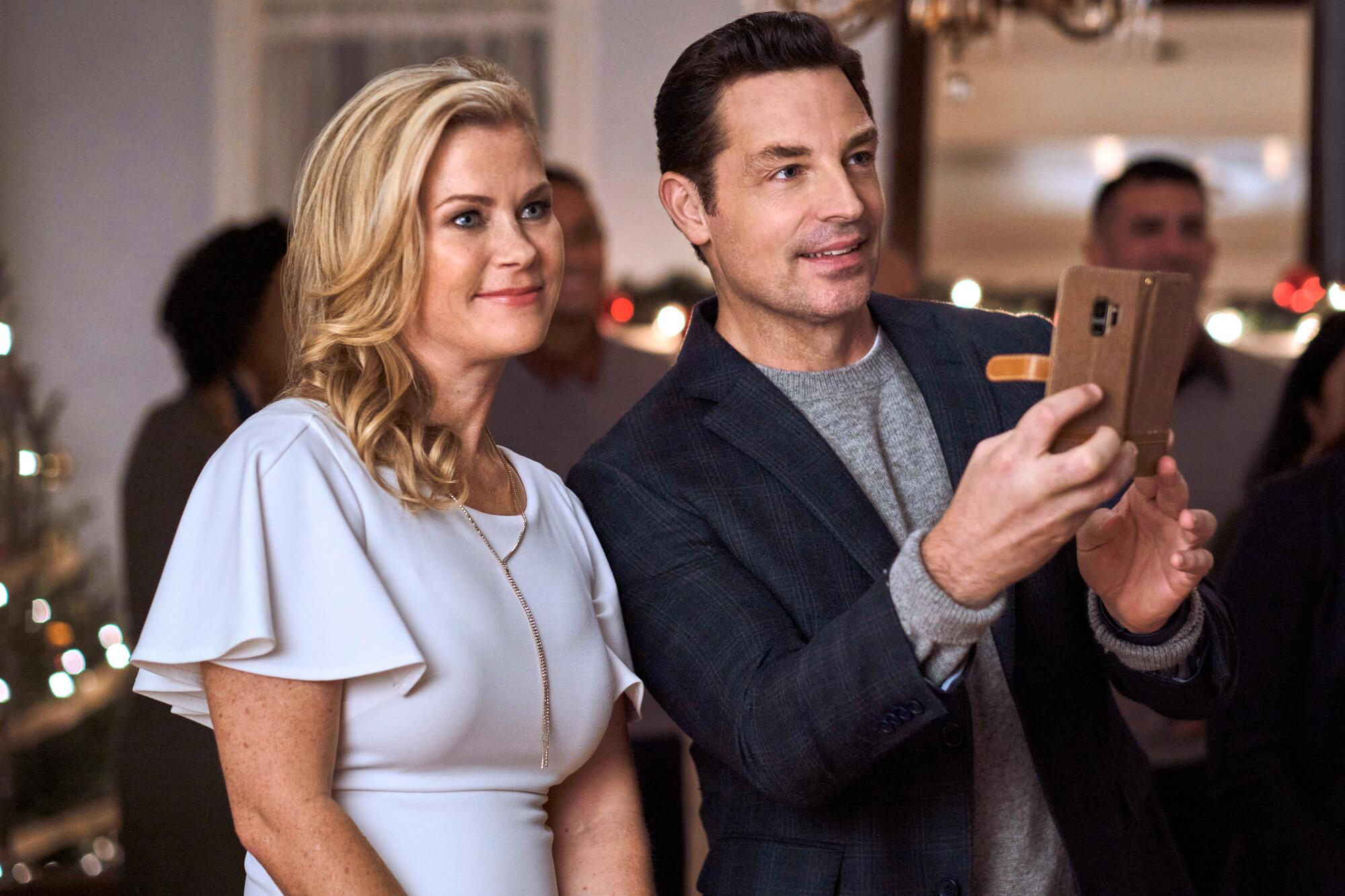
Alison Sweeney with Brennan Elliott in “Open By Christmas” in 2021.
(David Astorga / Hallmark)
How about for you as a performer, experiencing the stigma?
My mother is a violinist and when I was little, she performed with the Hollywood orchestra. She played in all the soundtracks for big movies. Some musicians looked down their nose at the musicians who played for Hollywood. But no one works harder than those musicians. I remember that my mom would always say to me, “What you do is beautiful. Being artistic is what you make of it. Just because it’s not Mozart or Shakespeare, it can still be so meaningful. What people take of it, you’re a part of that story.” Ever since I was little, I really admired that mentality of art for the masses and making music or performing in a way that people want to see. It doesn’t have to be so elevated that people don’t get it.
With the market for holiday movies increasing dramatically in recent years, how competitive is the space for you as an actor? Do you feel like there’s enough to go around?
No matter how many movies you do, or how much you’re working, you do have that moment of “Oh, she got a really good one. That role is so great.” There was one my friend Nikki [DeLoach] did where she rode horses in the movie. I love horses in real life. I did say to Hallmark, “When do I get to do a horse movie?” Nikki made that happen for herself. So I was like, “OK, I’ll get to work on that and develop my own story. I’ve got to work on that.”
The fun of these movies is that you know what you’re getting. How has that informed how you want to stretch those expectations as an actor and producer? “This Time Each Year” feels like a good example of bringing a different kind of depth to the holiday story; the central couple is going through challenges — they’re separated, and alcoholism is touched on.
What I admire and appreciate about what Hallmark is angling for, and what I would want as a fan, is to know it’s going to be OK. In terms of “formula,” the brand is that safe feeling that they’re not going to totally go off the rails. I know I can sit down and watch this whole thing and I’m going to be happy and satisfied at the end. For me, developing these stories, I love those moments. I love playing a character that’s falling in love. I love playing a character with the angst. Growing up on “Days of Our Lives,” I always loved scenes that I could really imagine the audience watching in my head. I always was aware of the fans and how they’re going to love this scene so much because I know how it feels to be that fan who put a tape in my VCR and recorded an episode and watched a scene again and again. I want to provide that for people.
Do you think we’ll ever get to a point where the happy ending for these films doesn’t need to be about romance?
What Hallmark has expressed interest in is widening the net, so to speak, of “what are other stories we can incorporate.” For example — and please, Julia Roberts, I love you dearly — but “My Best Friend’s Wedding” disappointed me. That was not satisfying. “La La Land” — I was mad. I watched that movie and I stopped it 10 minutes early because I want to pretend that’s how it ended. There are definitely ways to incorporate those stories and including other messages, and broadening the storylines, but at the heart of it, you do always have to have [romance]. I also try to tell stories where it’s a family or a mom and her daughter and their connection or best friends. With this movie, for example, I wanted them to know that this is a different story. The couple is already married. They’ve been married 10 years and, so, you’re going to see a little bit of a different story — they’re not falling in love for the first time; they’re falling in love again.
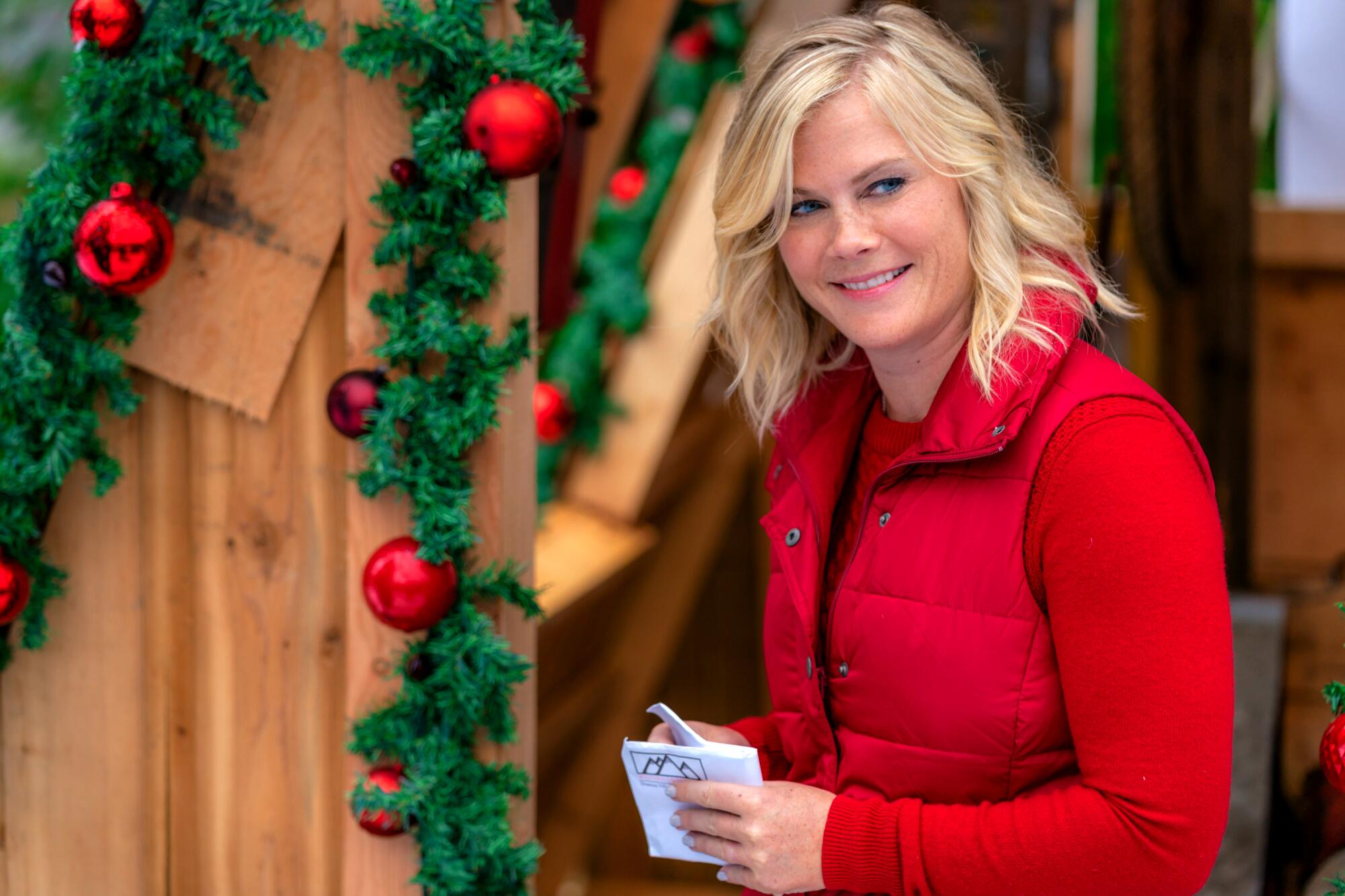
Alison Sweeney in “Christmas at Holly Lodge” on Hallmark in 2017.
(Ricardo Hubbs / Hallmark)
You’re not the network president, but as an actor, what is your response to the criticism that the very stories the network tells make some statement about the culture wars? By and large, the stories tend to feature a heroine fleeing the city to take refuge in conservative, if not expressly partisan, predominantly white small towns. How much are you thinking about how it fits with the kind of stories you want to tell?
I can only speak for the projects I’m a part of or the things that appeal to me. I do think, in some ways, it’s so much simpler. That fish out of water story is just classic. It’s not like some big statement. It’s just uniquely human to feel that feeling, no matter where you’re from, that when you go somewhere totally different, you’re like, “I’m not used to this. This is strange and new and different.”
When you have your producer hat on, are you’re thinking about the stories or the projects or the casting and how you can be more representative of the demographics?
Absolutely. I’m not trying to be preachy. I want to reflect what is happening in the world and what people are going through. If I can find a way to incorporate that in the story and be inclusive, and be telling those stories that people feel “that’s happening in my life,” that’s what I want. Of course, you have to wrap it up in a big bow at the end. For example, I think telling the story of a couple that separated — I know it sounds not edgy, but for us, it’s edgy.
You’ve produced many of the projects that you’ve done for Hallmark. You also write and direct. Do you feel like directing or writing a Christmas film is the next step?
Oh my gosh, yeah. I would love to. Christmas movie feels like a whole new level of challenge, but I wouldn’t be afraid of that. I think that could be really fun to tackle, but again, I do hold Christmas up on a pedestal. That would be a whole extra layer of expectation that would be scary to do.
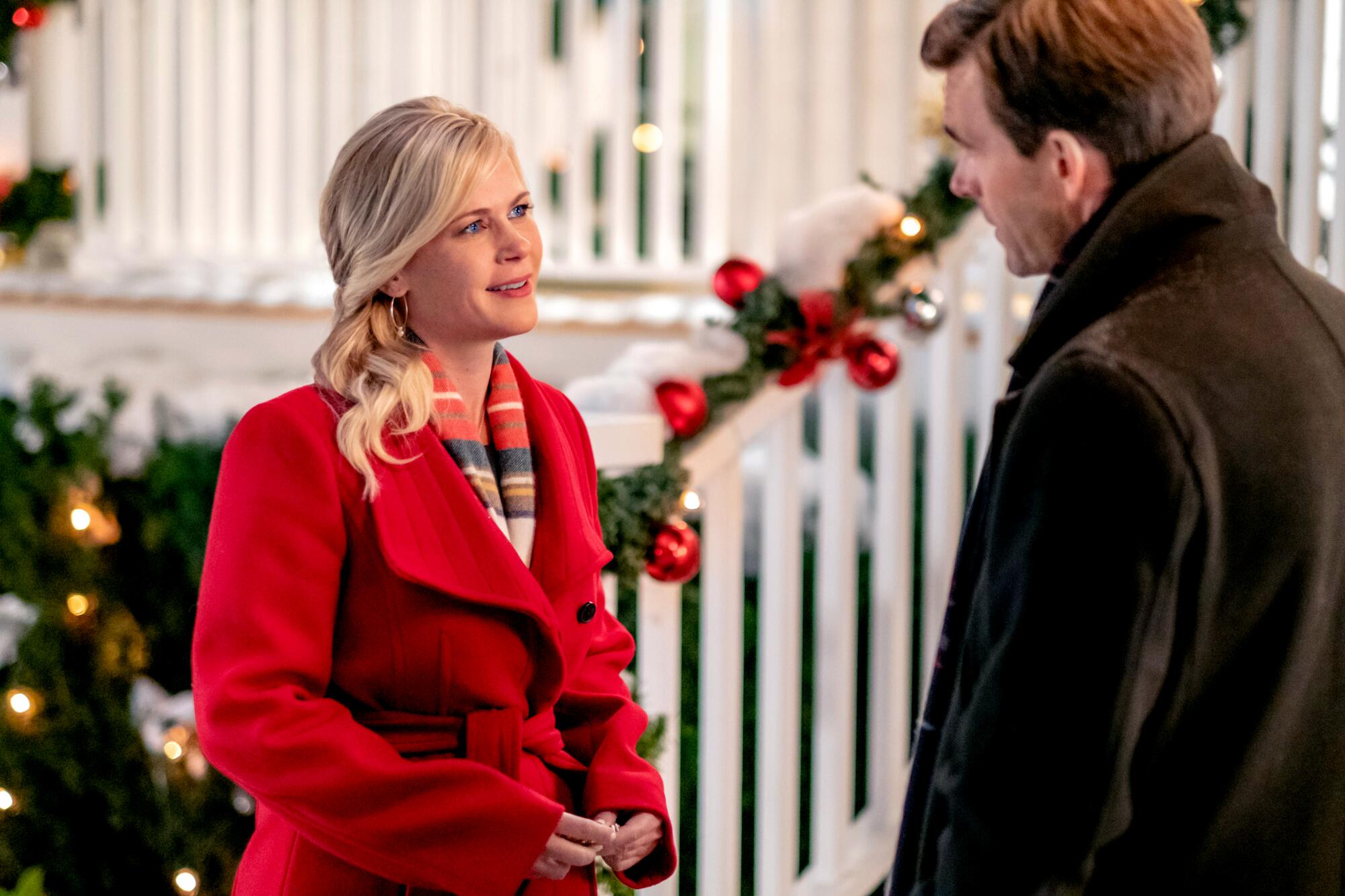
Alison Sweeney with Lucas Bryant in “Time for You to Come Home for Christmas” in 2019.
(David Strongman / Hallmark)
Not to do a hard pivot here, but the soap world was devastated by the recent loss of your longtime “Days of Our Lives” co-star and friend Drake Hogestyn. The outpouring from fans on social media was quite touching. What’s a favorite memory you have of Drake?
There was something so healing about reading all the fan reactions — sorry, this is emotional for me. It really helped me work through it because I knew that everyone felt the way I did. I can just imagine, with his last days, he made those people in the hospital feel the exact same way. He was beautiful.
I have a million great stories that I can tell you, but one that stands out for me is — I don’t know why this one, I can’t stop thinking about it — but one time we were in a scene where I [as Sami] was supposed to throw this vase that was like a breakaway vase. They call it candy glass or whatever, and it just sugar water. It’s meant to break and shatter on the wall. Well, I am a little aggressive, and I accidentally shattered it in my hand before I got a chance to throw it against the wall. He’s there and the shards are pretty sharp even though it’s sugar water. Because of the set of circumstances in the scene, I was barefoot, and he literally stopped the scene, told everyone to stop, and held me so that he could help pick the glass out of my feet. He was so kind and caring and such a dad. Helped me make sure it was all OK and safe. There’s a million stories like that. But that’s one that stands out for me. I hope we continue to talk about him. He deserves it forever.


Comedy is a matter of taste and preference — it’s a deeply personal thing. Which makes it hard for a critic to give a blanket assessment of a specific kind of comedy, especially if it didn’t work for them, but clearly worked for others (the laughter or lack thereof is the indication). “It’s not funny,” the critic says, “well I had fun,” someone else can reply, and then we’re at an impasse.
Which is the dilemma one finds oneself in with “Gail Daughtry and the Celebrity Sex Pass,” a very strange and shaggy Hollywood satire of sorts from David Wain and The State crew, still riding the goodwill of “Wet Hot American Summer” after all these years. If only this were as funny.
“Gail Daughtry” lives in the same world as that iconic summer camp spoof, as well as Wain’s 2014 rom-com parody, “They Came Together,” in that he’s playing with genre convention and expectation, taking well-known norms to the goofiest extremes. But those films hewed more closely to their respective genres, while “Gail Daughtry” is totally scattered, combining crime and spy movie tropes with a fish-out-of-water comedy and a Hollywood send-up. It has far too many ideas for its own good, and yet no ideas that are good enough to sustain this bizarre curio of a comedy.
What’s ironic is that one of the problems driving this wacky plot forward is the characters have to come up with a movie idea to pitch to star Jon Hamm (playing himself of course), leading them to do some pretty inane and shockingly violent things. It’s almost as if Wain and co-writer and co-star Ken Marino had no idea for a movie, then baked their search for an idea into their script, and then turned it into a madcap adventure about a woman on a quest to have sex with Jon Hamm. What an ouroboros!
OK, about the sex quest. Gail Daughtry (Zoey Deutch) is a chipper hairdresser from Kansas born without the part of the brain that recognizes sarcasm or irony. She’s a cheerful, Pollyanna-ish naïf whose literal-mindedness is almost as extreme as Amelia Bedelia. Her childhood sweetheart and fiancé Tom (Michael Cassidy) is the same. She tells him about the concept of the “celebrity sex pass” as a joke, and he promptly boinks Jennifer Aniston at local book reading.
(Nitpicky aside: why didn’t they use the common nomenclature “hall pass”? Is it copyrighted? “Celebrity sex pass” is clunky and sounds like an off-brand version of the well-known slang.)
That infidelity crisis is how Gail ends up in Los Angeles determined to bang Hamm, collecting a motley crew of similarly clueless helpers along the way. There’s her best friend Otto (Miles Guttierez-Riley), her salon bestie; Caleb (Ben Wang), an overly ambitious intern at Creative Artists Agency; Vince (Marino), a screenwriter turned paparazzo with a heart of gold; and John Slattery, as John Slattery, down on his luck. An accidental briefcase swap has a pair of thugs on their tail, in a forgettable and underdeveloped B-plot.
With a parade of celebrity cameos and collaborators in bit parts, “Gail Daughtry” at times feels like an excuse for Wain and co. to make something at home with all of their friends. Fair enough, it’s great to see all these people employed, but what about what we’re watching? Behold, the Los Angeles of the middle-aged working comedian: the CAA lobby, the Chateau Marmont, Griffith Park, etc. And the plot is as half-baked as the pitch they present to Hamm.
What’s actually interesting about this comedy is the distinct streak of despair and even resentment that reveals itself at the climax, a feeling of helplessness and uselessness. Everyone’s been striving to make it in this crazy town: the intern, the actor, the paparazzo. But not even Jon Hamm can help them get a movie made; even he feels inherently powerless. There’s an unexplored anxiety vibrating there that feels the most thematically fruitful, about what it means, some 25 years after bursting onto the scene with a generation-defining comedy, about maintaining the work, the drive, a sense of purpose, after years of strikes, and in the face of a constricting industry. Do they still have it? Is the dream still alive?
Maybe that’s why Wain and Marino need to invent a dreamer stand-in with Gail, a guileless eternal optimist who knows nothing of the craven Los Angeles and accepts everything at face value (though she is filled with a scary bit of rage too). She might behave like she has a head injury, but she’s going to achieve her goal, dammit. “Gail Daughtry and the Celebrity Sex Pass” might not be as funny as “Wet Hot American Summer” (for this critic), but reframed, it serves as a fascinating status update on life in La La Land for this troupe.
‘Gail Daughtry and the Celebrity Sex Pass’
2 stars (out of 4)
MPA rating: R (for sexual content, violence/bloody images and language)
Running time: 1:33
How to watch: In theaters July 10
Entertainment
Emily Ratajkowski’s viral essay on sex life as a single mom scores her a seven-figure book deal
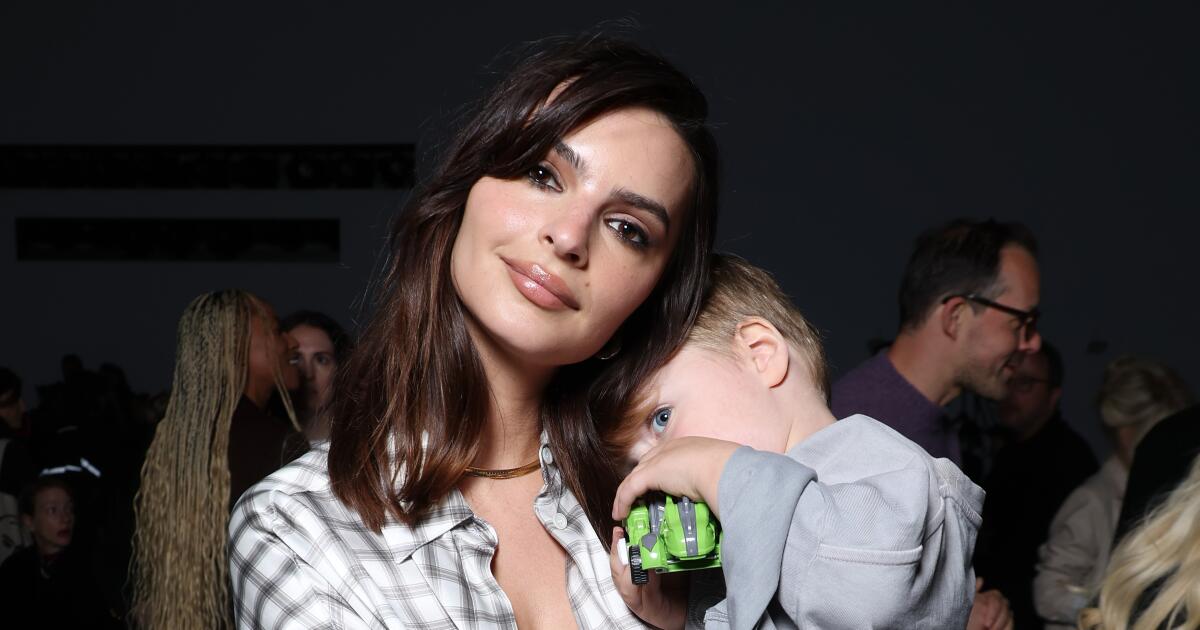
Emily Ratajkowski’s viral essay detailing her sex life as a single mom just landed her a seven-figure book deal.
According to Page Six, the model’s essay in the Cut had publishers champing at the bit in a 12-way bidding war that culminated in the hefty pay day. Editor Helen Rouner at Penguin Press — who also edited Lauren Christensen’s memoir “Firstborn” and Michael W. Clune’s novel “Pan” — reportedly landed the deal.
Penguin Press did not immediately respond to The Times’ request for comment Friday.
Publishers Marketplace announced the forthcoming memoir, describing it as “an examination of modern female identity through the story of the author’s own efforts as a newly single mother in New York City to discover what really constitutes a good life for a woman.”
The essay, which dropped a month ago and quickly broke the internet, drops the veil on EmRata’s sexual adventures (or maybe misadventures) since she and her former husband, Sebastian Bear-McClard, split in 2022.
“It was a violent transition into a new reality of screaming baby on my aching tit and ring on my swollen finger,” Ratajkowski writes of new motherhood. “And then, in a time period that felt both instant and excruciatingly slow, my marriage collapsed. Six months after my son was born, my husband and I stopped having sex. Less than a year later, we separated.”
In the missive, the model interrogates her sexuality — is she a Madonna or a whore? — while untangling bigger questions around gender, power and self-actualization. If Carrie Bradshaw wrote about “Sex and the City,” then Ratajkowski is writing about sex, the city and single motherhood. And naturally, her fleeting paramours have vague monikers: “Vegan Graffiti Artist,” “Spanish Gen-Zer” and “Son of a Billionaire.”
“And then there was the Elder Millennial: obsessed with dental hygiene, psychedelics, and dirty talk,” she writes. “He had approached the subject coyly at first, like it was something he was kind of embarrassed about — the way a kid will test you to see if you’ll talk to them about their dorky obsession of the moment. Do you like Godzilla? What about Star Wars?”
Would-be sleuths with Ratajkowski’s essay and a gossip rag handy will have their work cut out for them.
This will be Ratajkowski’s second book. The first, “My Body,” dropped in 2021 and was a bestselling collection of essays exploring gender, power dynamics, sexuality and the commodification of female beauty in the modeling and entertainment industries.
Ratajkowski’s foray into the spotlight came more than a decade ago when Robin Thicke’s controversial “Blurred Lines” music video made the model an overnight star. She was cast in David Fincher’s adaptation of “Gone Girl,” which hit theaters the following year, and catapulted to top fashion runways — Marc Jacobs, Versace, Victoria’s Secret and Dolce & Gabbana, to name a few. She she’s been romantically linked to Harry Styles, Eric Andre, Shaboozey, Brad Pitt and Pete Davidson, among others.
In 2023, she moonlighted as the host of the “High Low With EmRata” podcast, where she interviewed sex workers, investigated ethical nonmonogamy and pondered the etymology of the word “toxic.” The same year, she told The Times that she was coming into herself post-divorce, “Being able to assert what I want — that feels like it just started: My life as a creator and not as a muse.”

Wainheads will be delighted to see his alums in cameos: Kerri Kenney-Silver, Michael Ian Black, Thomas Lennon, and supporting roles for Zickel and Truglio. A large portion of the cast are his homies. But with Deutch, Gutierrez-Riley, Wang, Slattery, Impacciatore, and yes, Hamm, it’s as if they’re being inducted into a new mad family. Wain and Marino are basically catching Pokémon and hoping they can hold onto the roster (by that logic, yes, Paul Rudd is a legendary Pokémon). The film is anchored by Zoey — everything everywhere all this summer with Voicemails From Isabelle to Minions & Monsters — Deutch in the Dorothy Gale role, exuding a high level of perkiness consistent with the character’s can-do, wide-eyed, midwestern charm and heart.
A major standout, Ben Wang finally gets to show off his comedic abilities, portraying a self-assured, quick-witted agent who makes me laugh every time he reveals his sheltered upbringing in snappy whines at every inconvenience. Sabrina Impacciatore, who has proven to be a comedic juggernaut in The Paper, is having so much fun hamming it up as the mob boss-esque wicked witch counterpart, torturing her henchmen and deliciously chewing up the scenery whenever onscreen. I don’t think they use her to the height of her comedic prowess, but she’s a delight nonetheless. John Slattery is the film’s comedic MVP. The way the writers use his over-the-top character for comedy is downright hilarious every time. They use him as either a punchline or a force of nature, and he’s great. This movie is like Mad Men propaganda, and by God, it works. As someone who’s never seen it, Gail allowed me a better appreciation for Slattery and Hamm.
Man, we don’t deserve Jon Hamm. This is the second time I’ve seen him play a silly, fictionalized version of himself this year (the other being the SXSW crowd-pleasing rom-com Wishful Thinking, which Gail distributor Sony Pictures Classics acquired), and he also voice-acted in his comedic Mayor Jerry role in Hoppers. Maybe working with Wain in 2007’s The Ten was the canon event, but I consider his weird little sex scene with Kristen Wiig in Bridesmaids his awakening. Since then, I’ve only seen him as unserious, and it’s delightful. Oz-like in appearance, he’s funny and befitting the film’s overall light, joyful nature.
LAST STATEMENT
Ultimately, Gail Daughtry and the Celebrity Sex Pass is a campy, delightful romp that succeeds as both a distinctive Hollywood‑centric riff and a Wizard of Oz reimagining, retaining a loving, twisted, demented charm. It’s a weird description, but it’s so high‑spirited and light‑hearted despite being strangely ultraviolent. It might as well be a live‑action episode of Smiling Friends (RIP), yet it’s everything the theatrical market needs today. Ten years ago, this would’ve been a studio production rather than an indie Sundance acquisition, but thank God it exists for the big screen. More absurdist Gail Daughtrys for cinemas (not streaming), please, because this is the most fun to be had in a theater all summer, if not the year thus far.
-

 San Francisco, CA8 minutes ago
Classical music series helps reconnect downtown San Francisco community
-

 Dallas, TX12 minutes ago
Dallas police officers, paramedics recall saving woman stuck in a ravine for days;
-

 Boston, MA22 minutes ago
Red Sox win 7th straight game just hours after landing in New York
-
 Denver, CO28 minutes ago
One tree at a time: Denver nonprofit works to close shade gap as heat dome threatens neighborhoods
-

 Seattle, WA34 minutes ago
VIDEO: West Seattle Summer Fest 2026 day 1, evening report
-

 San Diego, CA38 minutes ago
The World’s Number One Wellness Retreat is Right in Our Backyard
-
 Milwaukee, WI43 minutes ago
Festivalgoers say Milwaukee’s summer events fill a gap in downtown entertainment
-

 Atlanta, GA50 minutes ago
Atlanta mentoring program brings ‘Save Our Sons Tour’ to Jacksonville’s Duval Day

