San Diego, CA
San Diego State gets bad news on the injury front


The euphoria of San Diego State’s short-handed win against preseason No. 22 UCLA in a closed-door scrimmage was greeted by a splash of cold water two days later.
The results of a CT scan revealed that senior guard Reese Waters, the Aztecs’ top returning scorer and only member on the preseason all-conference team, has a navicular stress fracture in his right foot and will miss six to eight weeks, and perhaps longer.
The 6-foot-6 Waters has been sidelined for more than a week with a foot issue and didn’t play against UCLA. An X-ray was negative, an MRI was inconclusive, and the CT scan finally showed the stress reaction in the navicular – a boat-shaped bone in the mid-foot that helps transfer force from the ankle to forefoot.
The plan now: Put it in a protective boot for five weeks, then re-evaluate.
Even if Waters is cleared to play then, it would probably take another week or so to get him game fit.
The good news: Doctors opted against surgery.
“If they thought surgery was the best course, I think they would have done it,” coach Brian Dutcher said. “They thought this is his best chance to heal up and get ready to go. But you can’t put a timeline on how fast he heals and how quickly he gets back to a point where he can play basketball. I never rush that process.”
Waters, SDSU’s most experienced returnee off a Sweet 16 team, averaged 9.6 points per game last season, including 22 in the win at Gonzaga and a career-high 24 against Cal. The USC transfer opened the season by making 43 straight free throws, best in the nation.
He was expected to start in the backcourt alongside redshirt sophomore Miles Byrd and Florida Atlantic transfer Nick Boyd, who’s had his own foot issues. Boyd spent two-plus months in a protective boot and only now is participating in limited practice drills.
Waters likely will miss all six games in November, which includes No. 6 Gonzaga, No. 15 Creighton, Oregon and one other in the blockbuster Players Era Festival in Las Vegas.
The Mountain West opener is at Fresno State on Dec. 4, or six weeks from now. That’s followed by home dates against USD (Dec. 7) and Cal Baptist (Dec. 11) before a 10-day break for finals.
Next up is a neutral-court game against Cal in San Jose on Dec. 21, which is 8½ weeks away. The conference home opener, Dec. 28 against Utah State, is 9½ weeks away.
“We scrimmaged UCLA without three or four guys and played pretty well,” Dutcher said of the 72-67 win Sunday at Pauley Pavilion. “Obviously we’re at our best when Reese is on the floor. But the encouraging thing is hopefully we’ll get him back on the floor.
“Over the years, of all the teams in our conference, we’ve been able to survive injury more than anyone. We’ve got good players in this program. We want to be at 100% and be healthy, but we can’t sit there and obsess if we’re not. We’ve got players. It’s the cliché: next man up.”
That likely means more minutes for sophomore BJ Davis, who appeared in only 12 games last season and scored 14 total points but exploded for 28 in the UCLA scrimmage with Waters, Boyd and USD transfer guard Wayne McKinney III all sidelined.
“BJ got an opportunity because all the other guys were hurt, and he made the most of his opportunity,” Dutcher said. “That’s what sports are all about. When given an opportunity, what do you do with that opportunity?”
McKinney III provides veteran relief, assuming he can shake the nagging hamstring problem that has twice sidelined him during the preseason. So does Brown grad transfer Kimo Ferrari, who can stretch defenses with his 3-point range. Freshman Taj DeGourville started against UCLA and played 34 minutes, finishing with five points and four rebounds (and only one turnover).
“It seems like it’s forever,” Dutcher said, “but most teams around the country would say, if we get one of our best players back by conference, that’s really good. … Now it’s the healing process. We’ll do another CT scan in five weeks and see what it looks like.”



San Diego, CA
Elite California city set for mass illegal street vendor expansion as judge issues stunning verdict

San Diego seems to have no solution to its illegal street vendor problem and it’s only getting worse in many areas including the popular Balboa Park and Gaslamp Quarter.
Local business leaders are frustrated following the January 2026 California appeals court ruling, which forced the city officials to entirely halt the crackdown on street vendors.
“It’s a disaster,” Denny Knox, executive director of the Ocean Beach Main Street Association, told the San Diego Union Tribune last week.
An increasing number of street vendors are exploiting the court’s ruling and many don’t even bother to get a permit.
Executive Director of Gaslamp Quarter Association, Michael Trimble, said that street vendors block the sidewalks, making it difficult for the businesses in the area to function.
“The lack of action has also led to an escalation of activity, including new vendors setting up tents and selling goods without permits, health approvals or accountability,” said Trimble, the Union-Tribune reports.
Organized groups of hot dog vendors have returned to the Gaslamp Quarter—bringing associated hazards like open fires, blocked walkways, and the dumping of grease into storm drains.
“It’s so much of a slap in the face to merchants that have done things the legal way, the right way,” said Ruth-Ann Thorn, owner of Native Star boutique and Exclusive Collections Gallery in the Gaslamp Quarter, reports inewsource.
Officers can no longer impound vending carts and law enforcement in Ballpark District is restricted, SDPD’s Ashley Nicholes said in a statement, according to the Union-Tribune.
“Recent court rulings involving the city’s street vending ordinance have limited what police officers can do to enforce street vending laws,” Nicholes said.
San Diego’s tug-of-war with street vendors started in 2018 when the state law decriminalized aspects of street vending. The task to draft a vendor law fell into the laps of then-Mayor Kevin Faulconer in 2019, then passed on to Mayor Todd Gloria in 2021 and then Councilmember Jennifer Campbell.
The law, approved by the City Council in May 2022, banned vendors in Balboa Park, Little Italy, Ocean Beach and some beach areas during summer months. But, the merchants kept complaining about the lack of law enforcement and that led to the revision of the law in 2024.
The revised law made it easier for officials to impound vendors’ carts, limited free-speech protections, which didn’t include yoga classes on the beach and selling food.
After an immediate backlash, a federal appeals court ruling in June 2025 said the city’s ban on beach yoga classes is unconstitutional as they are protected under the First Amendment.
A California appeals court in the case of Imhotep Mustaqeem earlier this year ruled that San Diego’s revised 2024 street vendor law violated state law by establishing “overly restrictive” geographic no-vendor zones and restricted operating hours.
Imhotep Mustaqeem, a licensed vendor who had sold snacks outside Petco Park since 2009, sued the city after police impounded his cart under San Diego’s revised 2024 ordinance. While a lower court initially ruled against him, the Fourth District Court of Appeal ultimately vindicated Mustaqeem and quashed the 2024 street vendor law.

A California yoga instructor known as “Namasteve” is leveling up his warrior pose as he battles San Diego’s efforts to end his popular beachfront classes.
Steven Hubbard recently filed his third lawsuit over a 2024 city ordinance that prohibits teaching yoga to four or more people at local beaches and parks.
Hubbard, who’s been teaching yoga by the Pacific Ocean shoreline for 17 years, contends the local law violates his right to free speech because he doesn’t charge his students and instead accepts voluntary donations.
“It does set a dangerous precedent for government to be passing bans on specific types of speech that, for whatever reason, it doesn’t like,” Hubbard’s lawyer, Bryan Pease, told The Independent. “We don’t know why they decided yoga is something they want to target. They’ve never explained it, but it is concerning from a First Amendment perspective.”
Neither the San Diego mayor’s office nor the city attorney’s office replied to inquiries from The Independent.

The yoga ban is buried in a subsection of the San Diego Municipal Code that defines the “services” that are regulated at beaches and parks.
“Examples include massage, yoga, dog training, fitness classes, equipment rental, and staging for picnics, bonfires or other activities,” it says, marking the only time yoga is mentioned.
At the time the ordinance was introduced, Pease said, it was “put on the city council agenda as a sidewalk vending ordinance.”
“There was no public notice that they would be targeting the free and donation-based teaching of yoga in parks and beaches,” the lawyer said. “ I don’t even know that the city council members themselves knew what they were voting on.”
Videos posted on Hubbard’s “Namasteve Yoga” page on YouTube show scores of students following his instructions as they face the water in the Southern California sunshine.
San Diego park rangers issued Hubbard a total of 10 citations under the 2024 law, Pease said.
Some were for leading classes from his backyard while livestreaming on YouTube as students apparently watched on their devices by the beach, Pease said.
After Hubbard first challenged the 2024 ordinance in federal court, the judge overseeing the case denied a motion to block its enforcement, saying the First Amendment didn’t protect the teaching of yoga.
But that decision was reversed last year by the U.S. Court of Appeals for the Ninth Circuit, which ruled that Hubbard and fellow yoga teacher Amy Baack were “likely to succeed” in challenging the legality of San Diego’s public yoga ban.

“Teaching yoga is protected speech. The City’s prohibition on teaching yoga in shoreline parks is content-based and fails strict scrutiny,” according to the unanimous decision written by U.S. Circuit Judge Holly Thomas.
Hubbard has also filed two lawsuits in state court, with the most recent on June 22. It was first reported by the Times of San Diego.
It seeks unspecified damages for three tickets he received in May 2025, all of which charged him with giving a lecture without a permit.
The accusation came despite a ruling in the federal case that said requiring a permit to give a lecture “substantially overburdens” the right to free speech, according to Hubbard’s lawsuit.
All the citations issued against Hubbard were dismissed in April when the city attorney’s office didn’t appear in court to prosecute, Pease said.
Meanwhile, city lawyers have issued a series of subpoenas that seek “detailed GPS tracking information, all social media posts from all time and complete financial records for all financial transactions” involving Hubbard and Baack, Pease said.
Pease characterized the move as “pure harassment,” saying it seemed “calculated to have a chilling effect on people’s participation if they think their personal information is going to be obtained through these channels.”
“All that the city attorney has said to me about it is that it’s to prove that this is commercial activity, and they’re going to hire a financial expert to go through all these records,” he said.
A hearing on a motion to quash the subpoenas is scheduled for July 17 in state court, and pretrial discovery in the federal case is pending, with a deadline of August 28.
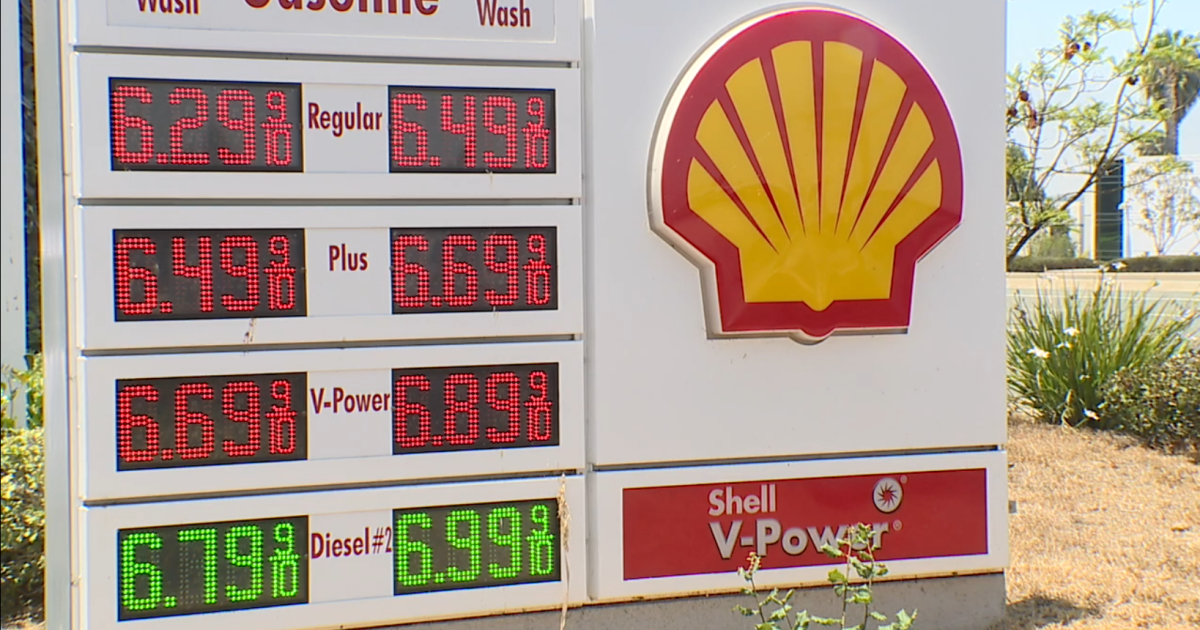
SAN DIEGO (CNS) — The average price of a gallon of self-serve regular gasoline in San Diego County dropped for the 44th time in 45 days today, falling eight-tenths of a cent to $5.42, its lowest amount since March 12. The average price has fallen 74.9 cents over the past 45 days, including eight-tenths of a cent Saturday, according to figures from the AAA and Oil Price Information Service. It is 9.8 cents less than one week ago and 53.2 cents less than one month ago, but 80 cents more than one year ago. The national average price dropped for the 43rd time in 45 days, falling six-tenths of a cent to $3.804, its lowest amount since March 17.
It has decreased 76 cents over the past 45 days, including 1.3 cents Saturday. The national average price is 6.3 cents less than one week ago and 41.6 cents less than one month ago, but 65.6 cents more than one year ago. “Crude oil prices have fallen to their lowest levels in months, dropping to the $60 a barrel range,” the AAA said Thursday. “Overall, gas prices remain the highest they’ve been in 4 years, but the downward trend since late May is welcome news during the busy summer driving season.”
Copyright 2026, City News Service, Inc.
-
Vermont4 seconds ago
VT Lottery Powerball, Gimme 5 results for July 6, 2026
-

 Virginia3 minutes ago
Virginia man charged with murder in crash that killed family of 4 on I-75 in Oakland County
-

 Wisconsin18 minutes ago
Wisconsin DOT begins $6.87M I-41 ramp deck overlay upgrades in Brown County Tuesday
-

 West Virginia23 minutes ago
11 Marshall student athletes suing NCAA over new rule – WV MetroNews
-

 Wyoming30 minutes ago
Election Q&A: Qwenton Eagle Oviatt for Wyoming secretary of state
-

 Crypto33 minutes ago
An Easy-to-Miss Radio Traffic Jam Is Behind Many Home WiFi Slowdowns
-

 Finance38 minutes ago
Fayette County Public Schools Board of Education approves audit contract, new finance director position
-

 Fitness45 minutes ago
Caroline Idiens and Jenni Falconer’s time-efficient 9-exercise workout builds full-body strength in 30 minutes

