Lifestyle
Are you good at knowing when something should end? Mark Duplass is still learning
Mark Duplass says he’s learning how to finish the creative process now he’s not in “lockstep” with his brother.
MICHAEL TRAN/AFP via Getty Images/AFP
hide caption
toggle caption
MICHAEL TRAN/AFP via Getty Images/AFP
A note from Wild Card host Rachel Martin: In the summer of 2012, I was overdue with my first child, and so I went to the movies to get my mind off the fact that, you know, everything was about to totally change. The movie was called Safety Not Guaranteed, and Mark Duplass plays this guy who is dead set on traveling through time.
He’s the kind of person who is dismissed and laughed at, and he is so vulnerable. Like, his heart’s just walking around in the world, exposed, and at any second it could be crushed into a million pieces. But it’s not. The script treats him with so much dignity, and he’s alright in the end. The credits rolled, and when the movie finished, people filed out, and I sat there and sobbed. Really sobbed.
The trailer for “Safety Not Guaranteed.”
YouTube
Having a baby is a bizarre thing. Maybe you’ve heard people say this: It’s like your heart is walking around outside your body. It’s so vulnerable, just like Duplass’s character in Safety Not Guaranteed. And I think when I watched that movie, I needed to be reassured that this baby I was going to bring into the world would encounter kindness. That his tender heart or his wild imagination would be nurtured, not cast off.
That vulnerability shows up in all of Duplass’s creative projects. He and his brother Jay have produced dozens of shows and movies together. Duplass goes back and forth between acting and writing and producing. He’s gotten two Emmy nominations for his role as Chip Black on The Morning Show.
He’s got two new projects out right now. One is a docuseries that he and his brother executive produced called Out There: Crimes of the Paranormal on Hulu. The other is a show he produced and co-wrote called Penelope. It’s about a teenage girl who runs away from home to try to survive in the woods by herself.
The trailer for “Penelope.”
YouTube
This Wild Card interview has been edited for length and clarity. Host Rachel Martin asks guests randomly-selected questions from a deck of cards. Tap play above to listen to the full podcast, or read an excerpt below.
Question 1: What period of your life do you often daydream about?
Mark Duplass: When I was 20 years old, I took a semester off of college at the University of Texas. This was 1997. And I was very inspired by independent artists, whether they were in the music scene or the film scene. And I used to work as a busboy at a restaurant — I’d saved up about $2,000. I decided, “I’m going to record my own record and I’m going to press a thousand CDs and I’m going to book my own tour and live out of my van.” And everybody thought it was crazy. But I just, I really felt compelled to do this.

So I booked a four-and-a-half-month tour. A lot of it was just, like, open mic nights or whatever I could get and a lot of unpaid gigs. But that time — no cell phone, traveling by a Rand McNally map, getting lost a bunch, showing up, not having anywhere to sleep, offering a free CD to anyone who would put me up — the vulnerability of exposing myself in that way, giving myself into the energy and the belief that if I just jump off of this cliff with a little bit of naivete and earnestness, the world will catch me and it will take care of me. And it did.
I would go two to three days sometimes without speaking to someone. I didn’t have a phone in order to escape. So I sat with myself in a way that no 20-year-old, I think, today is offered the luxury — I wanna call it a luxury — to be able to do. And some of that was the inspiration, honestly, behind making my show Penelope — you know, I want to put somebody out in the woods, which is very similar to some of the time that I had to just sit, and be, and just be quiet.
Question 2: How do you manage envy?
Duplass: This sounds maybe more reductive than it should, but the more successful I get, the less I have to face envy in my career. I had a lot of it early on. Like, I had a really hard time being able to enjoy, like, John Krasinski and Zach Braff because I was like, “They’re taking up my spots!” and it made me mad, you know?
It’s actually not really a big problem for me at this point. But it does rear its head every now and then. I talk a lot about my own journeys with mental health on social media and whatnot. So I have to go really to the source, which is what’s happening inside of me.

So it’s less about I’m feeling envious about this person because their independent film really knocked it out of the park and mine didn’t this year, and I’m feeling bad about myself. I really just have to go inward.
And for me, there’s a couple of just really simple solutions, which is, “Did you get your eight hours of sleep? Did you get at least 20 to 30 minutes of rigorous exercise to get your endorphins going? Have you done your meditation? Are you eating good foods?” And as long as I get those basic things in, I stay relatively centered.
Rachel Martin: So envy is just part of the cornucopia of emotions and mental health stuff you’re managing?
Duplass: Yes. The way I describe my life is like: if I wake up feeling something — whether it’s jealous, envy, sadness, overwhelm — I do something I call “the scan.” I look up at the ceiling and I throw all the elements of my life up on the ceiling, and I’m like, “OK, marriage, kids, work life, my jealousy, my envy, my this, my that,” and usually if there’s like one or two things wrong, that means there’s something wrong with those things. And I’ll pick those things out and I’ll solve them. But for me, usually what it is, is they all look wrong to me. And I realize: it’s not that overnight everything went wrong. It’s something going on inside of me that I need to retool so that I can then look at them with clearer eyes.
Question 3: Are you good at knowing when something should end?
Duplass: Wow. Here’s what I’ll say to that. My journey as an artist and a creative person for most of my life has been lockstep with my brother [Jay Duplass]. And what that has meant is that I have only had to learn how to do a certain amount of things well, because I had a partner who could do those other things.
For instance, I still cannot open a box and put anything together — vacuum cleaner, anything — because Jay was older, smarter and he always did that for me. So I have these weird gaps because I was in such close lockstep with someone for so long. One of those things is the finishing of art. I am not good at it.
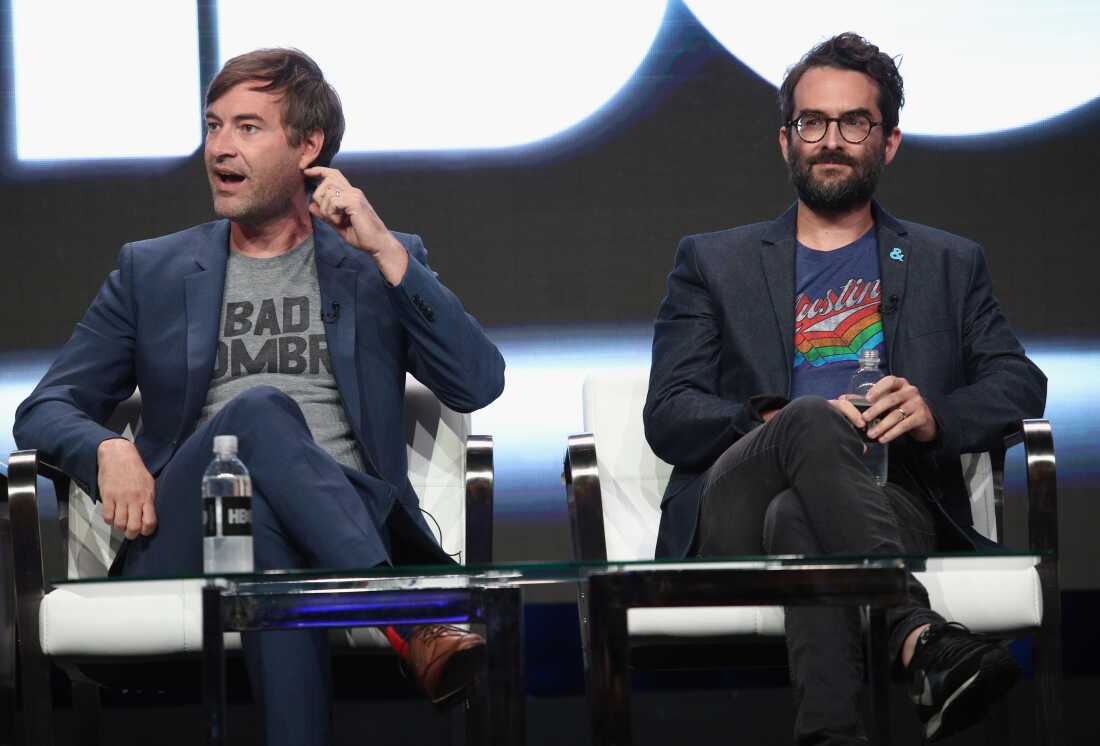
Mark Duplass (left) and Jay Duplass in 2017.
Frederick M. Brown/Getty Images
hide caption
toggle caption
Frederick M. Brown/Getty Images
Martin: What do you mean? Get specific.
Duplass: OK. You and I are hanging out and we’re like, “Let’s make a movie together,” and we come up with a concept. There’s almost no one better than me who will team build and begin this process better. I will look around and say, “This person should be our DP. We’re going to shoot it in this house. We’re going to make it for $50,000. There’s no way it’ll lose money.”
I take that concept, I go and write a pretty good B to B-minus first draft very quickly. So I have this power where I can just galvanize things and get them to the 85% completion mark extremely well.
And then, like a relay race, you’re watching me with the baton trying to pass it off and my legs just start giving out on me and I need a closer. And Jay has always been my closer and he is excellent at it.
But, you know, about five years ago, Jay really requested some creative space from being lockstep, making creativity together. So while we still produce together as a company, you know, I lost my closer and my partner.
So now I’m doing two things. I seek other partners who can fit that for me, because I truly believe you don’t have to do everything to be a good artist — you just got to do a couple of things really well and fit into the puzzle.
But I’m also challenging myself to grow as an artist and see if I can also learn how to close. And I may just discover, “Hey, it’s not what you do well, that’s OK. Leave it.” But it’s not in my natural DNA.
Martin: Were you OK with that ending though?
Duplass: Yeah. Things end. My feeling about that is, when you have these long-term relationships like I have with my brother, my wife, my children, the ending — like all great M. Night Shyamalan movies [laughs] — has something that rebirths itself, in some way. What has emerged from my brother and I ending our lockstep creative partnership has been unexpectedly quite incredible, where we’re now on the sidelines of each other’s artistic pieces, cheering each other on with zero competition, no fighting for breathing space. It’s quite beautiful, but it was very hard.

Lifestyle
‘Wait Wait’ for February 14, 2026: With Not My Job guest Arden Cho
Arden Cho attends Netflix’s “KPop Demon Hunters” Special Screening at Netflix Tudum Theater on June 16, 2025 in Los Angeles, California. (Photo by Alberto E. Rodriguez/Getty Images)
Alberto E. Rodriguez/Getty Images
hide caption
toggle caption
Alberto E. Rodriguez/Getty Images
This week’s show was recorded in Chicago with guest host Negin Farsad, judge and scorekeeper Bill Kurtis, Not My Job guest Arden Cho and panelists Tom Papa, Paula Poundstone, and Beth Stelling. Click the audio link above to hear the whole show.
Who’s Bill This Time
Laser Party in Texas; Olympic Cheating Scandal; Romance Advice for this Weekend
Panel Questions
Those Whippersnappers!
Bluff The Listener
Our panelists tell three stories about a news story inspired by a movie, only one of which is true.
Not My Job: KPop Demon Hunters’ Arden Cho answers three questions about K-Mart
Arden Cho, star of KPop Demon Hunters, plays our game called, “KPop Demon Hunters, meet K-Mart Bargain Hunters.” Three questions about K-Mart.
Panel Questions
Hot Airplane Etiquette Trend; Russia’s Pooping Spy Drones
Limericks
Bill Kurtis reads three news-related limericks: Who Rescued Ew!; A Double D Cup of Butter; Getting Fancy At McDonald’s
Lightning Fill In The Blank
All the news we couldn’t fit anywhere else
Predictions
Our panelists predict what will be the big story out of the final week of the Olympics.
Lifestyle
To be in love, in L.A and in Acne Studios on Valentine’s Day
Styled in Acne Studios’ Valentine’s Day edit, three L.A. creative couples brought us into their worlds as they reflected on their artistic journeys, relationships and personal styles as a tool for connection. The simple act of always having their partner’s go-to moisturizer in their bag for them, shopping together or making space for each other’s dreams can yield the kind of fruitful love that makes navigating this world all the better.
Hayley and Clyde
Hayley, left, wears Acne Studios top, belt, skirt and bag, Y Project earrings and model’s own socks. Clyde wears Acne Studios shirt and model’s own socks and Dickies pants.
Smooth jazz plays as the sun pours in over the mountains and into the heart of Hayley Ashton Corley and Clyde Nikolai Corley’s home, tucked away in the hills of Topanga Canyon. Hayley is an artist and model, and her husband Clyde is an artist and filmmaker. Though the two of them have not been professionally photographed together often, they are quite natural together on camera. As the shoot unfolds, Clyde can be found affectionately rubbing Hayley’s hand, gently playing with the wedding band on her ring finger. “I met Clyde when I was 20 and we’ve been together almost 10 years now,” Hayley says. The two got married in India, where Hayley’s family is from, during a three-day ceremony in November 2024. “The wedding was making what was already spiritual, physical,” Clyde says.
When you first met, what drew you to each other?
Hayley: His eyes. I saw him across the room and we both looked at each other. I crossed the room, walked up to him and sat down and wanted to just chat. Then Clyde DM’d me on Instagram and a few weeks later he asked me out to breakfast.
Clyde: We just clicked immediately; we were drawn to each other. We were kids, and she was just so positive and kept talking about all the good things about L.A., which is really refreshing when you’re from L.A., because everybody comes here and kind of hates on things.
What was most memorable about your first date?
Clyde: We went to Figaro Bistrot in Los Feliz. I order an eggs Benedict, and Hayley’s like, “I’ll do the same.” But then she swaps the bread for croissant, makes the egg scrambled, adds spinach, and ends up with this different story sliding around the plate. She was over it and didn’t even eat it.
Hayley: I honestly hate eggs Benedict so much.
Clyde: But we just kept looking at each other and I really liked being around her. Then I got back to my car and got a parking ticket, so it was great. About a $150 brunch that no one enjoyed and that was our first date.
What is your favorite thing about the way your partner styles themselves?
Hayley: Clyde dresses himself by his mood. Some days it’ll be all black or white, but he’s always pulling fits. I feel like I tend to go to Clyde when I want to be dressed a certain way, so he really helps style me.
Clyde: Hayley’s really natural. She wears anything and it’s fire, and I’m inspired by that. Maybe it informs my outlook on clothing. Hayley can play both worlds really well; she can dress up really beautifully and be an absolute stunner. She can tap into her Indian roots and express beautiful dynamic style. She’s also just my muse so I’m obsessed with her.
If you styled each other for the day, what do you think the end results would look like?
Clyde: Hayley loves funny fits I wear, maybe baggy sweatpants and a funny beanie. She loves a messy skater boy look. Or she likes when I’m really dressed up so she’d probably dress me in some fun whimsical stuff.
Hayley: If Clyde were to style me, it’d probably be skinny jeans that are tight on my butt or a really chic skirt. He likes to see my skin and my shape, where sometimes I tend to wear baggy pants.
If you were on a game show, and you had to accurately guess at least five things that you could find in your partner’s bag at any given moment, what would those items be?
Clyde: In her bag right now would be her phone, wallet, her little rose-brown colored lip gloss. She has this energy boosting key from a Chinese herbalist lady in New York, like a tonic. She’s known to bring a phone charger around.
Hayley: For Clyde, I think laptop, hard drive, computer charger, phone, wallet. That’s pretty much it.
You both are so creative. How has being in love enhanced your artistic practice?
Hayley: Clyde is just a really inspiring person to be around. Watching him and his craft inspires me to be a better artist, because he has such discipline, but also flow. The past 10 years of being together has helped me hone in on my own work and practice.
Clyde: I feel the same, in different ways. I’m coming from a place of feeling seen. I got the person who loves me for who I am and I don’t have to keep up with trends or anything. It allows me to focus on the actual feelings I’m trying to express rather than how it’s going to be seen by the outside world. It just allows me to stay inspired. We’re so lucky. I think if love can inspire you to hold on to the things you care about, that’s really advantageous in art.
Mo and Banoffee
It’s a picturesque afternoon in Echo Park. The sun is warm, the breeze is cool and the peaceful bustle feeds the atmosphere at Canyon Coffee. Mo Faulk and Banoffee Faulk, partners in love and creative pursuits, arrive for a late lunch. Both earth signs, the two laugh at the peculiarities they noticed within each other upon first meeting. Together for almost a year, they instantly clicked, which is quite apparent while observing them. They can’t help but smile at each other throughout the shoot, stealing forehead kisses between shots and laughing constantly. It is a connection so in sync it could have been written in the stars. And, as two people with heavy earth sign placements, it nearly was.
With Mo being a creative producer and manager, and Banoffee being a musician and producer, their jobs can be socially demanding. The self-proclaimed homebodies share that their ideal quality pastime is rewatching “Grey’s Anatomy” for the third time, sitting together in silence while enjoying cookie milkshakes, or spending a weekend away in nature.
When you first met, what drew you to each other?
Mo: We both understand the chaos of family dynamics in a way that’s really comforting.
Banoffee: Yeah, it’s nice when you find someone who’s not a nepo baby in L.A., because it’s rare. But the goofiness as well. I was drawn to Mo initially, because they’re attractive, but it was nice to meet someone who can be really silly.
What was the most memorable part about your first date?
Mo: We were coming to hang out as friends, but we left kind of obsessed with each other. Separately, we left and called our friends.
Banoffee: We met at 10 in the morning and left at 4 p.m.
Mo: We just didn’t want to leave each other.
Mo, right, wears Acne Studios jeans, top and bag and Martine Rose shoes. Banoffee wears Acne Studios jeans, top and belt, Martine Rose X Nike shoes and stylist’s own Acne Studios moto jacket.
What is your favorite thing about the way your partner styles themselves?
Mo: With Banoffee it’s always fun because everyday is like a new character. They’re down to put weird stuff together that actually is very cool. I like the playfulness with clothes and it also speaks to the playfulness of our relationship.
Banoffee: Mo’s style is sort of a recontextualized hick. They love a flannel and fishing caps. I like how rugged their style is, but somehow they make it look really high fashion.
If you styled each other for the day, what do you think the end results would look like?
Banoffee: Mo would put me in a baggy jean, with a belt and a little shirt, with some sort of leather jacket or a bomber and a cool sneaker. I feel like Mo’s ethos for dressing is “over-casual is always cooler.”
Mo: Maybe those new jeans you got me, I have no idea.
Banoffee: I’d put you in a vintage thermal.
Mo: Oh, yeah. Little tight thermal, big jeans.
Banoffee: Would we dress each other exactly the same?
If you were on a game show, and you had to accurately guess at least five things that you could find in your partner’s bag at any given moment, what would those items be?
Mo: A Juul, 17 empty Juul pods, a lipliner that’s broken without the top on it, one of those makeup brushes that’s been in there for far too long and maybe a mini hairbrush. And empty contact lens cases.
Banoffee: Mo’s bag is so full, so practical, it’s annoying. They’d have two Aquaphors. The big tube and the little tube. They’d have all of my things: ID, sometimes my passport, medications, my contact lenses. A mini natural mouth wash, gum, a charging cord, deodorant, there’s probably a spare pair of socks, and then those sniffy menthol things for your nose. And a lot of rings, chains, and things that they may or may not want to wear.
With both of you being in the creative industry with overlapping work, how do you think being together has influenced your artistic practice?
Banoffee: I feel like our relationship has re-energized my creative work. We’re each other’s cheerleaders but can also get our hands dirty. It feels cool to be a part of a team in that way. Before I met Mo, I was feeling kind of tired about my work, a little bit like the romance had gone from it, but I feel like since we’ve met, there’s a lot of possibility opening up because we’re in it together.
Mo: I agree. Being in the entertainment industry can feel really lonely. Everyone’s kind of stepping on each other intentionally or not to get to what they want to do, and if things aren’t going the way you want it to it can feel hopeless. But with Banoffee, they think everything I do is cool, every idea I have they’re excited about, and I feel the same way about them. The idea of being a team, it reignites the fire.
Lex and Petar
Petar, top, wears Acne Studios top, Calvin Klein underwear and model’s own socks, shoes and jewelry. Lex wears Acne Studios jeans, sweater and belt and model’s own jewelry.
Lex Orozco-Cabral and Petar Ilic are on their sunset-lit balcony, overlooking the Hollywood strip. Petar, a Bosnian model and creative, works at a creative agency in the fashion sector, while Lex, a Bay Area native, is a union costume designer and stylist. Both exude a level of comfortable confidence in front of the camera — like two sculptures come to life. Immersing themselves into the fun of it all, Lex jokes, “This is our normal.”
Crossing paths for the first time in New York, connecting over Instagram and finally meeting when Petar moved to L.A., the pair’s romance had been years in the making. Lex, a triple fire sign and Petar, a balance of fire, water and air, live together in WeHo where they love to spend time deep-diving into fashion and pop-culture references. Lex has a larger-than-life personality — he is sure, protective and affirming of Petar, while Petar is calm, grounding and nurturing of Lex. “Two years later and I’m still obsessed with him,” Lex shares lovingly. “He’s just getting better and better,” Petar offers, “and I’m here for where this is gonna take us.”
What about your partner were you most drawn to?
Petar: I have a lot. The list is long. He’s handsome, he’s tall, he’s funny. I love his fashion sense, just everything about him. This is my person. Everything we do from day to day, it’s never boring.
Lex: At first it was physical, he’s just so gorgeous. But then once I met him, I fell in love with his little -isms. He has these buzz words and phrases. And he is genuinely so caring, so kind. I’m like, “Where the f— did he come from?”
What is your favorite thing about the way your partner styles themselves?
Lex: I definitely help him and elevate his style but he had great style before. He’s very minimal, he likes to look refined and polished, like a proper boy, but then at home, he’s dressed really gay. Like, at home it’s sexy undies and a rocker shirt.
Petar: I never really cared too much about dressing up before I met him. One of my favorite things about him is that his style is so crazy. He’s wearing all these amazing pieces. I never really met anyone who cared so much about clothes, and it’s inspiring. I’m like, “this is hot.” He’s like an encyclopedia when it comes to fashion.
If you both had to style each other for the day, what do you think those end results would look like?
Petar: That’s really hard to say.
Lex: I would like him to dress gayer.
Petar: I’m just avoiding all the bullying I can. I get nervous sometimes holding hands.
Lex: But I try to tell him no one is bullying you here, this isn’t Bosnia.
Petar: And that’s true, I’ve never been bullied here in L.A., and he helps me get out of my comfort zone.
If you were on a game show, and you had to accurately guess at least five things that you could find in your partner’s bag at any given moment, what would those items be?
Petar: His phone, wallet, the microfiber cloth for glasses and phones, really just the essentials.
Lex: His crystal stone, his mouth tape. He always has some type of lip gloss, gum and edibles.
Lex holds Acne Studio bag.
You are both very creative. How do you think being together, being in love, has influenced your artistic practice?
Lex: I just have better days. I know that I have the best f—ing boyfriend at home waiting for me. I always say I get the best ideas [when I’m with] him.
Petar: I am just honestly happier from the moment I wake up. The world feels safe and everything is more aligned. Also the subjects we talk about, the things he shows me.
What is something about the way your partner sees the world that you really appreciate?
Lex: He’s so positive and optimistic, and I miss that because I can be jaded working in this industry where you don’t always get credit for your work. I’m more of a stresser, and he calms me down.
Petar: One of my favorite things about him is that he’s very confident, he’s a go-getter. You gotta act like you’re the main character in life and he brings that out of me.
Cierra Black is an Inland Empire-raised, L.A.-based writer and UCLA graduate. With bylines in several publications, Cierra writes about the interplay between art, style, and beauty, and social issues and behaviors.
Photography Kevin Amato
Couples Hayley Ashton Corley and Clyde Nikolai Corley, Banoffee Faulk and Mo Faulk, Lex Orozco-Cabral and Petar Ilic
Creative direction & styling Keyla Marquez
Makeup T’ai Rising-Moore
Hair Adrian Arredondo
Movement director Kate Wallich
Production Matzi
Styling assistant Ronben
Lifestyle
What Did Valentines Day Cards Look Like 200 Years Ago?
In the late 19th century, few things telegraphed yearning like a card adorned with paper lace, gold foil and a couple exchanging a coy glance.
Today, such a card would evoke an eye roll.
The evolution of cards from the treacly confections of Victorian England to the quippy missives of today reflect both shifting design aesthetics and broader cultural customs around romance. As the borders of socially accepted relationships have shifted, so have the cards. Where once there was poetry, now there are drawings of pizzas.
“Greeting cards are a reflection of society,” said Carlos Llansó, executive director of the Greeting Card Association, a trade organization that represents roughly 4,000 independent card makers.
Valentine’s Day cards today are less formal, precious and prescribed, Mr. Llansó said, because our understanding of love has become more expansive.
Lottery and lace
Historians struggle to trace the exact origins of Valentine’s Day — some pinpoint the holiday to a curiously unromantic Pagan festival in Rome that involved goat slaughter and nudity — but they tend to agree that its association with romance was most likely established in England.
Early Valentine’s Day celebrations, dating as far back as the 17th century, were only loosely associated with love and often revolved around a lottery, said Sally Holloway, a cultural historian at the University of Warwick whose research focuses on love, marriage and courtship in 18th century England.
People would pull names out of a hat and select someone to be their Valentine from February through Easter.
“Your Valentine could be your neighbor, it could be a colleague, it could be a member of your family,” Dr. Holloway said. “You’d pin the name of the person who you’d been given as your Valentine to your clothes.” Matched pairs would exchange gifts, dance together and maybe write funny riddles or poems for each other.
A confluence of rapid social changes in the late 1700s and early 1800s, including the idealization of marrying for love rather than for economic advantage, Dr. Holloway said, helped to transform Valentine’s Day into a commercialized celebration of romantic love with a partner of your choosing.
Click on an image to look at the details.
This period dovetailed with the advent of new printing technologies and mass production, as well as an expansion of postal services, making Valentine’s Day cards a popular component of courtship rituals.
They presented, in many ways, a rare opportunity to directly convey desire within the confines of an otherwise buttoned-up Victorian society, where bold romantic declarations could be both risky and risqué. At the time, the responsibility of pursuing a marriage partner fell to men, and women tended to avoid overtly signaling affection.
But on Valentine’s Day, those rules were flipped.
“For one day a year, the language of love became the preserve of women,” Dr. Holloway said. And because it was considered a daring and even racy act to send a Valentine’s Day card, women “couldn’t put their name to it,” Dr. Holloway said. It is why so many cards from that era contain only vague, brief greetings, sometimes with a question mark at the end, adding a whiff of mystique.
The custom arrived in the United States in the mid-1800s, and crafty, entrepreneurial women fueled its commercialization.
Esther Howland — often referred to as the “mother of the American valentine” — is said to have first received a Valentine’s Day card from someone in Britain in 1847 and was inspired to create her own version.
“It was her idea to essentially create an assembly line of women putting together these really complex Valentines,” said Jamie Kwan, an assistant curator at the Cooper Hewitt, Smithsonian Design Museum. The cards were handmade, and Howland “imported materials from the U.K. and Germany to incorporate into these cards.”
Estimates suggest she sold between $75,000 and $100,000 worth of cards a year, roughly the equivalent of $3 million today.
Embracing new ideas of love
Over time, innovation around the craftsmanship of cards slowed, and it was their imagery that began to reflect a rapidly changing culture.
In 1910, Hallmark entered the industry and quickly became one of the largest and most recognizable card makers. The brand’s earliest Valentine’s Day cards relied heavily on the Victorian symbols of love from the previous century: hearts, Cupids and lovebirds.
By the 1930s, Hallmark started printing cards with boundary-pushing images of couples embracing and, by 1945, dancing.
“It used to be that we used a lot more traditional forms of creative crafts, like engraving, calligraphy and lace,” said Jen Walker, a vice president of Hallmark’s creative studios. Eventually, consumers found those aesthetic details less enticing.
“We are a consumer led brand — so we followed the consumer and what their needs were,” she added.
But Hallmark cards did not display Black couples until 1970, and the company did not introduce Valentine’s Day cards for those in same-sex relationships until 2008.
‘There isn’t even a heart on it’
In the mid 2000s, Valentine’s Day cards went through another major shift.
In 2013, Emily McDowell, a writer, product consultant and business adviser, designed a Valentine’s Day card to better reflect some of the difficult-to-categorize situationships she had been in.
The card had no illustrations. It was plain and white with text on the front that read: “I know we’re not, like, together or anything but it felt weird to just not say anything so I got you this card. It’s not a big deal. It doesn’t really mean anything. There isn’t even a heart on it. So basically it’s a card saying hi. Forget it.”
She put it up on Etsy, anticipating that only a handful of people would buy it.
Within days, she sold thousands, she said, and had to stop accepting new orders. The success prompted her to quit her job in advertising and start her namesake brand. The next year, she released another card that also instantly became a hit. It read: “There’s no one I’d rather lie in bed and look at my phone next to.”
Over the past 13 years, the company has sold millions of similarly witty cards. (Ms. McDowell left the company in 2022, and it was acquired by Hachette Publishing last year.) While Ms. McDowell’s early designs feel commonplace now, they were among the first in an industrywide move away from the stilted, saccharine Valentine’s Day cards of previous decades.
Many independent card designers today, Mr. Llansó explained, continue to tap into a consumer demand for plain-speaking, authentic cards. As a result, some of the more popular designs feature references to the state of the world. Others nod to cultural iconography, like Labubus or the enduring appeal of sweatpants. Not all of them are intended for romantic partners, and many can be used in other kinds of relationships.
Mitzi Sampson, the founder of the card company Mitzi Bitsy Spider, said her best-selling card was one that featured a grinning raccoon holding up a sign reading “you are TRASH to me.”
Ms. Sampson said she designed that card in 2023 for her sister “because she loves raccoons and because I love her.”
That, she added, is exactly what consumers want now. Not frills or grand proclamations, but an intimate knowledge of the receiver and “the simple recognition that says I know you, I see you, I choose you.”
-
Politics1 week agoWhite House says murder rate plummeted to lowest level since 1900 under Trump administration
-
Alabama1 week agoGeneva’s Kiera Howell, 16, auditions for ‘American Idol’ season 24
-
Ohio1 week agoOhio town launching treasure hunt for $10K worth of gold, jewelry
-
News1 week agoThe Long Goodbye: A California Couple Self-Deports to Mexico
-
Culture1 week agoVideo: Farewell, Pocket Books
-
Science1 week agoVideo: Rare Giant Phantom Jelly Spotted in Deep Waters Near Argentina
-
News1 week agoVideo: Investigators Say Doorbell Camera Was Disconnected Before Nancy Guthrie’s Kidnapping
-
Technology1 week agoApple might let you use ChatGPT from CarPlay
