Connect with us

Lifestyle

L.A. Affairs: He brought paper bags on our date. ‘We may need these if we hyperventilate’

Published

on

L.A. Affairs: He brought paper bags on our date. ‘We may need these if we hyperventilate’
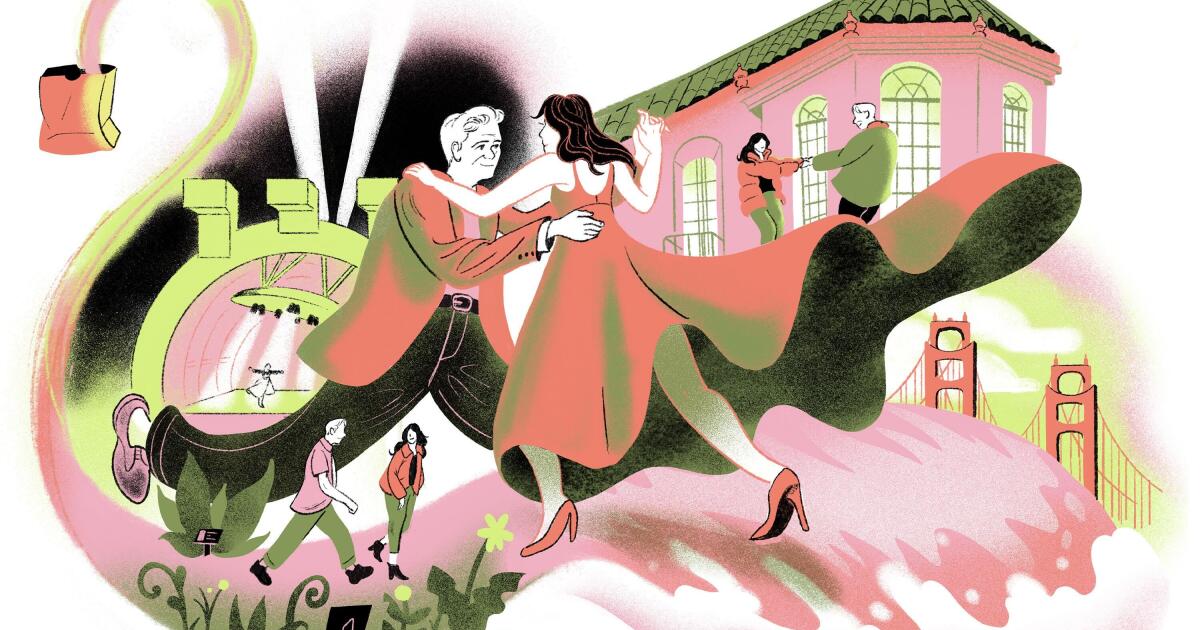
He handed me a brown paper bag — mind you, just a regular lunch-size kraft paper bag that was still flat and folded — and in all seriousness said, “Just in case you need it.”

Turning to look at him — an almost-stranger I was about to embark on a coffee date with — I asked, “Is this in case I get nauseated?”

“That too,” he grinned sheepishly. “But I was thinking something more like this …”

As his voice trailed off, I watched wide-eyed as he pulled out a paper bag, snapped it open, covered his mouth and forced it to open and closed with controlled breathing. “We’re both so nervous,” he explained matter-of-factly. “We may need these if we hyperventilate.”

Advertisement

Like a released champagne cork, laughter exploded and bubbled over, and the chemistry in the car changed from frigid temps to cozy and comfortable. We chatted like old friends as we hopped on the 57 freeway headed to the Orange Circle, where we talked over coffee at the Pie Hole, strolled with our hands stuffed in our pockets and planted the beginning seeds of friendship.

I had recently muddled through a marathon seven-year divorce that left me shattered and devastated, and my family, friends and children knew that I would never date again — and without a doubt, I’d never get married. I had only agreed to go to coffee because I knew of him through our 19-year-old boys. Their inseparable friendship during their junior high years had caused our paths to cross. We shared numerous drop-offs and pickups as I mustered through divorce paperwork and he navigated a grief-stricken home with the death of his wife.

But now, years later, as he walked me to the door, he asked, “Can I see you again?”

On our second date, he took me to “The Sound of Music” at La Mirada Theatre for the Performing Arts. Tears streamed down my face the whole night because of his cologne and my allergies. When we said goodbye at the door, I cautiously admitted, “I don’t think I can see you again. I’m terribly allergic to you.”

Surprised, he said, “I thought you were moved by the singing!” That night he texted me a photo of a hammer crushing his cologne bottle.

Advertisement

A few days later, we strolled by the Muckenthaler Cultural Center in Fullerton and heard live music floating through the park. Our curiosity got the best of us, and we rambled onto the grounds to find an intimate wedding reception taking place in the courtyard below. Suddenly, he grabbed my hand, and we were dancing under the moonlight while the trees twinkled with floating bulbs and antique street lamps lit up as if on cue. It was as if we were on the set of “La La Land” — something magical and unforgettable. This was the night he said he fell in love with me.

As partners in crime, we began planning surprise adventures for each other over the course of two years: an enchanted night walk through the botanical gardens of Palos Verdes; a day trip to San Francisco to eat at Red’s Java House and watch the Giants play ball; ice skating at the Hotel del Coronado in San Diego and a caroling trolley ride; “The Lion King” at the Pantages in Hollywood; dinner downtown at Perch prior to the closing performance of “Peter Pan Goes Wrong” with Neil Patrick Harris at the Ahmanson Theatre; a day at the Getty Villa in Pacific Palisades; and an enchanting dinner in a private cabana at the Firefly in Studio City.

So it was no surprise when he texted, “Are you available all day on Sept. 21?”

I wrote back, “It’s my day off. Absolutely!”

He arrived early and whisked me off to the Huntington Library, Art Museum, and Botanical Gardens in San Marino. We spent hours lingering in the Chinese gardens, eating in the glass tea house and gazing over the koi-filled pond. We strolled through rose gardens, exhibitions and the never-ending gift shop. By the time 3 p.m. came around, we collapsed satisfied and exhausted on a shaded park bench.

Advertisement

“We can call it a day if you like,” I said, yawning. “It’s already been amazing.”

According to my event coordinator, the day was just getting started. Our next stop was Culver City, where he gave me a music box that played “Edelweiss.” It was a clue to our next destination: the Hollywood Bowl for “Rodgers & Hammerstein’s The Sound of Music Sing-A-Long.” But first we had to eat at Lustig, an Austrian restaurant where we ordered schnitzel with noodles (otherwise known as spaetzle), sausages and a bowl of divine butternut squash soup recommended by our uber-friendly waiter.

At the Hollywood Bowl, we hissed at the Baroness, booed at the Nazis and shot off confetti poppers when Maria got her first kiss. When Captain von Trapp sang “Edelweiss” to his children, the whole amphitheater joined their voices together, flooding the Hollywood Hills with a surprisingly heartwarming sound of music.

I fell asleep contentedly on the drive home but awoke as we pulled into our favorite spot at the Muckenthaler.

“You want to take a walk?” he asked. Sleepily I followed him to a picnic bench glowing amber in the lantern light.

Advertisement

“I want to give you the same gift I gave you on our very first date ….”

Puzzled, I challenged him: “You didn’t give me a gift on our very first date.”

Slowly he handed me a brown paper bag — mind you, just a regular lunch-size kraft paper bag, still flat and folded. “Remember this?” he smiled nervously. “I’m guessing you’re going to need it right now.”

And he was right, because at that moment he dropped to one knee.

The author is a librarian for the Fullerton Public Library system. On her days off, she explores new places and embarks on all-day adventures with her partner in crime and newly acquired fiancé. In her spare time, she also enjoys reading, baking, writing, spending time with her family and her latest hobby — planning a wedding and honeymoon.

Advertisement

L.A. Affairs chronicles the search for romantic love in all its glorious expressions in the L.A. area, and we want to hear your true story. We pay $400 for a published essay. Email LAAffairs@latimes.com. You can find submission guidelines here. You can find past columns here.

Lifestyle

Keep an eye out for these new books from big names in January

Published

on

Keep an eye out for these new books from big names in January

The Ides of January are already upon us. Which means that by now, most of the sweetly misguided pollyannas who made New Year’s resolutions have already given up on that nonsense. Don’t beat yourself up about it! Travel and exercise would only have hogged your precious reading time anyway.

And boy, is there a lot of good stuff to read already. This week alone, a reader with an active imagination may pay visits to Norway and Chile, China and Pakistan. Later this month brings new releases from big names on either side of the Atlantic Ocean.

(By the way, this year the Book Ahead is transitioning from weekly posts to monthly, for a broader lens on the publishing calendar.)

The School of Night, by Karl Ove Knausgaard, translated by Martin Aitken

The School of Night, by Karl Ove Knausgaard, translated by Martin Aitken (Jan. 13)

Advertisement

Knausgaard is an alchemist. The prolific Norwegian consistently crafts page-turners out of the daily drudgery you’d usually find sedative rather than thrilling. The same inexplicable magic permeates his latest series, which began with The Morning Star and here gets its fourth installment. Only, unlike projects such as his autofictional My Struggle, Knausgaard here weaves his interlinked plots with actual magic – or supernatural horror, at least, as a vaguely apocalyptic event loosens the tenacious grip of his characters’ daily cares. The School of Night features Kristian Hadeland, an eerie figure in previous books, whose faustian bargain promises to illuminate this mystery’s darkest corners.

This Is Where the Serpent Lives, by Daniyal Mueenuddin

This Is Where the Serpent Lives, by Daniyal Mueenuddin (Jan. 13)

The setting in Mueenuddin’s debut novel — a modern Pakistan rife with corruption, feudalism and resilience — thrums with such vitality, it can feel like a character in its own right. But the home of this sweeping saga of class, violence and romance can also be seen as a “distorting mirror,” says Mueenuddin, whose short stories have earned him nods for the Pulitzer Prize and National Book Award. “Without a doubt,” he told NPR’s Weekend Edition, “I’ll have failed miserably if readers don’t see in this a great deal of themselves and of their communities.”

Advertisement

Pedro the Vast, by Simón López Trujillo, translated by Robin Myers

Pedro the Vast, by Simón López Trujillo, translated by Robin Myers (Jan. 13)

It won’t take long to finish this hallucinatory vision of ecological disaster. Getting over Trujillo’s disquieting novella, however, is another matter. The eponymous Pedro is a eucalyptus farmer who has worked the dangerous, degrading job all his life, so it’s to be expected when he’s among the workers who pick up a bad cough from a deadly fungus lurking in the grove. Less expected is the fact that, unlike his colleagues, Pedro does not die but wakes up changed, in ways both startling and difficult to comprehend. This is the Chilean author’s first book to be translated into English.

Advertisement

Fly, Wild Swans: My Mother, Myself and China, by Jung Chang

Fly, Wild Swans: My Mother, Myself and China, by Jung Chang (Jan. 13)

Chang began this story more than 34 years ago, with Wild Swans, a memoir that viewed 20th century Chinese history through the prism of three generations of women — and remains banned in China still. Now, Jung picks up the story where she left off, in the late 1970s when Chang’s departure set her family’s story on heartbreakingly separate paths — her own, unfolding in the West, and that of the family she left behind in China. Jung applies a characteristically wide lens, with half an eye on how the past half-century of geopolitical tumult has upturned her own intimate relationships.

Advertisement
Crux, by Gabriel Tallent

Crux, by Gabriel Tallent (Jan. 20)

It’s been the better part of a decade since Tallent published his debut novel, My Absolute Darling, a portrait of a barbed father-daughter relationship that NPR’s reviewer described as “devastating and powerful. In his follow-up, Tallent returns to that adolescent minefield we euphemistically call “coming of age,” this time focusing on a complicated bond between a pair of friends living in the rugged Mojave Desert. It’s an unlikely friendship, as sustaining as it is strained by their unforgiving circumstances, as the pair teeter precariously on the cusp of adulthood.

Departure(s), by Julian Barnes

Departure(s), by Julian Barnes (Jan. 20)

Advertisement

The winner of the 2011 Booker Prize (and finalist for several more) returns with a slim book that’s a bit tough to label. You’ll find it on the fiction shelf, sure, but also, it’s narrated by an aging British writer named Julian who is coping with a blood cancer diagnosis. The lines aren’t easy to find or pin down in this hybrid reflection on love, memory and mortality, which is as playful in its form as its themes are weighty.

Half His Age, by Jennette McCurdy

Half His Age, by Jennette McCurdy (Jan. 20)

“If I could have shown myself where I am now, I would not have believed it when I was little,” McCurdy told WBUR in 2023. The former child star certainly has undergone a dramatic transformation in recent years — from noted Nickelodeon alum to a writer whose best-selling memoir, I’m Glad My Mom Died, made a pretty compelling case why kid actors “should not be allowed to go anywhere near Hollywood.” Now she’s stepping into fiction, with a debut novel that features a provocative, at times puzzling, courtship and the same black humor that shot through her previous work.

Advertisement

Vigil, by George Saunders

Vigil, by George Saunders (Jan. 27)

One of America’s most inventive stylists returns with his first novel since the Booker Prize-winning Lincoln in the Bardo. It’s hard not to hear some echoes of A Christmas Carol in this one, which also finds a mean old magnate in need of some supernatural bedside attitude therapy. But don’t expect a smooth show from narrator Jill “Doll” Blaine, the comforting spirit assigned to dying oil baron K.J. Boone. For one thing, the unrepentant fossil fuel monger can expect more than just three visitors in this darkly funny portrait of a life ill-lived.

Advertisement

Continue Reading

Lifestyle

Members Only: Palm Beach Star Hilary Musser Lists Custom-Built $42M Estate

Published

on

Members Only: Palm Beach Star Hilary Musser Lists Custom-Built M Estate

‘Members Only: Palm Beach’
Hilary Musser’s $42M Waterfront Flex Hits the Market!!!

Published
|
Updated

Advertisement

Advertisement

Continue Reading

Lifestyle

‘My role was making movies that mattered,’ says Jodie Foster, as ‘Taxi Driver’ turns 50

Published

on

‘My role was making movies that mattered,’ says Jodie Foster, as ‘Taxi Driver’ turns 50

Jodie Foster, shown here in 2025, plays an American Freudian psychoanalyst in Paris in Vie Privée (A Private Life).

Gareth Cattermole/Getty Images


hide caption

toggle caption

Advertisement

Gareth Cattermole/Getty Images

Jodie Foster has been acting since she was 3, starting out in commercials, then appearing in TV shows and films. She still has scars from the time a lion mauled her on the set of a Disney film when she was 9.

“He picked me up by the hip and shook me,” she says. “I had no idea what was happening. … I remember thinking, ‘Oh this must be an earthquake.’”

Luckily, the lion responded promptly when a trainer said, “Drop it.” It was a scary moment, Foster says, but “the good news is I’m fine … and I’m not afraid of lions.”

Advertisement

“I think there’s a part of me that has been made resilient by what I’ve done for a living and has been able to control my emotions in order to do that in a role,” she says. “When you’re older, those survival skills get in the way, and you have to learn how to ditch them [when] they’re not serving you anymore.”

In 1976, at age 12, Foster starred opposite Robert De Niro and Harvey Keitel in Martin Scorsese’s film Taxi Driver. Foster’s portrayal of a teenage sex worker in the film sparked controversy because of her age, but also led to her first Academy Award nomination. She remains grateful for the experience on the film, which turns 50 this year.

“What luck to have been part of that, our golden age of cinema in the ’70s, some of the greatest movies that America ever made, the greatest filmmakers, auteur films,” she says. “I couldn’t be happier that [my mom] chose these roles for me.”

In the new film Vie Privée (A Private Life), she plays an American Freudian psychoanalyst in Paris. With the exception of a few lines, she speaks French throughout the film.

Interview highlights

On learning to speak French as a child

Advertisement

My mom, when I was about 9 years old, she had never traveled anywhere in her life and right before then, she took a trip to France and fell in love with it and said, “OK, you’re going to learn French. You are going to go to an immersion school, and someday maybe you’ll be a French actor.” And so they dropped me in where [there] was a school, Le Lycée Francais de Los Angeles, that does everything in French, so it was science and math and history, everything in French. And I cried for about six months and then I spoke fluently and got over it.

On being the family breadwinner at a young age

My mom was very aware that that was unusual, and that would put pressure on me. So she kind of sold it differently. She would say, “Well, you do one job, but then your sister does another job. And we all participate, we’re all doing a job, and this is all part of the family.” And I think that was her way of … making my brothers and sisters not feel like somehow they were beholden to me or to my brother who also was an actor. And not having pressure on me, but also helping her ego a bit, because I think that was hard for her to feel that she was being taken care of by a child. …

There’s two things that can happen as a child actor: One is you develop resilience, and you come up with a plan and a way to survive intact, and there are real advantages to that in life. And I really feel grateful for the advantages that that’s given me, the benefits that that has given me. Or the other is you totally fall apart and you can’t take it.

On her early immersion into art and film

Advertisement

My mom saw that I was interested in art and cinema and took me to every foreign film she could find, mostly because she wanted me to hear other languages. But we went to very dark, interesting German films that lasted eight hours long. And we saw all the French New Wave movies, and we had long conversations about movies and what they meant. I think that she respected me.

I did have a skill that was beyond my years and I had a strong sense of self … [and the] ability to understand emotions and character that was beyond my years. [Acting] gave me an outlet that I would not have had if I’d gone on a path to be what I was meant to be, which is really just to be an intellectual. … It was a sink or swim. I had to develop an emotional side. I had to cut off my brain sometimes to play characters in order to be good, and I wanted to be good. If I was gonna do something, I wanted it to be excellent. So in order to do that, I had to learn emotions and I had to learn, not only how to access them, but also how to control them so that I could give them intention.

Jodie Foster attends the Cannes Film Festival in 1976 to promote Taxi Driver.

Jodie Foster attends the Cannes Film Festival in 1976 to promote Taxi Driver.

Raph Gatti/AFP for Getty Images


hide caption

Advertisement

toggle caption

Raph Gatti/AFP for Getty Images

On sexual abuse in Hollywood

I’ve really had to examine that, like, how did I get saved? There were microaggressions, of course. Anybody who’s in the workplace has had misogynist microaggressions. That’s just a part of being a woman, right? But what kept me from having those bad experiences, those terrible experiences? And what I came to believe … is that I had a certain amount of power by the time I was, like, 12. So by the time I had my first Oscar nomination, I was part of a different category of people that had power and I was too dangerous to touch. I could’ve ruined people’s careers or I could’ve called “Uncle,” so I wasn’t on the block.

Advertisement

It also might be just my personality, that I am a head-first person and I approach the world in a head-first way. … It’s very difficult to emotionally manipulate me because I don’t operate with my emotions on the surface. Predators use whatever they can in order to manipulate and get people to do what they want them to do. And that’s much easier when the person is younger, when the person is weaker, when a person has no power. That’s precisely what predatory behavior is about: using power in order to diminish people, in order to dominate them.

On her decision to safeguard her personal life

I did not want to participate in celebrity culture. I wanted to make movies that I loved. I wanted to give everything of myself on-screen, and I wanted to survive intact by having a life and not handing that life over to the media and to people that wished me ill. …

What’s important to consider is that I grew up in a different time, where people couldn’t be who they were and we didn’t have the kinds of freedoms that we have now. And I look at my sons’ generation, and bless them, that they have a kind of justice that we just didn’t [have] access to. And I did the best I could and I had a big plan in mind of making films that could make people better. And that’s all I wanted to do was make movies. I didn’t want to be a public figure or a pioneer or any of those things. And I benefited from all of the pioneers that came before me that did that hard work of having tomatoes thrown at them and being unsafe. And they did that work and I have thanked them. I thank them.

We don’t all have to have the same role. And I think my role was making movies that mattered and creating female characters that were human characters and creating a huge body of work and then being able to look back at the pattern of that body of work and go like, “Oh wow, Jodie played a doctor. She played a mother. She played as a scientist. She played an astronaut. She killed all the bad guys. She did all of those things — and had a lesbian wife and had two kids and was a complete person that had a whole other life.” And I think that will be valuable someday down the line, that I was able to keep my life intact and leave a legacy. There’s lots of ways of being valuable.

Lauren Krenzel and Thea Chaloner produced and edited this interview for broadcast. Bridget Bentz, Molly Seavy-Nesper and Beth Novey adapted it for the web.

Advertisement

Continue Reading
Advertisement

Trending