Lifestyle
How to see the lost art of rebel Disney imagineer Rolly Crump in L.A.
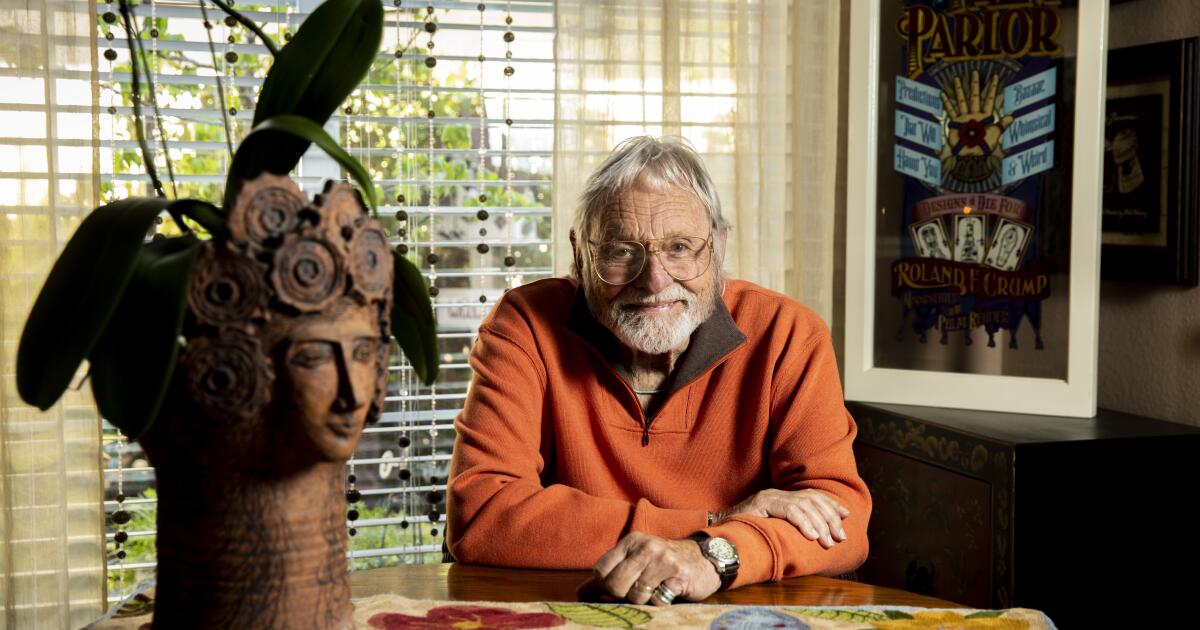
Rolly Crump had an outsized reputation. A rebel in the Disney fold. A beatnik. An unapologetic tell-it-like-it-is you-know-what.
Crump, who died last year at the age of 93, also forever changed the look of Disneyland. His art can be found in the Enchanted Tiki Room and, along with close friend and fellow artist Mary Blair, throughout It’s a Small World.
Crump’s style possessed a larger-than-life whimsy and circus-like loudness, and it caught the eye of Walt Disney, who plucked Crump from animation and one day assigned him what would become arguably the most recognizable clock in Southern California. The timepiece is the anchor of the façade of Disneyland’s It’s a Small World.
Rolly Crump designed a poster for West Hollywood folk club the Unicorn. The poster is part of a new exhibition dedicated to showing off Crump’s early work.
(From Christopher Crump)
This week, an assortment of Crump’s lesser-known personal work will be on display at West Hollywood gallery Song-Word Art House. The show, dubbed “Crump’s The Lost Exhibition,” is curated by Rolly’s son, Christopher, who followed in his father’s footsteps to work for Walt Disney Imagineering, the division of the company responsible for theme park design. “The Lost Exhibition” will draw heavily on Crump’s late-1950s and early-1960s work, specifically his series of folk-house-inspired, rock ’n’ roll-style posters.
The event is open to the public Friday through Sunday, and the gallery is near the original location of one of Crump’s old hangs, folk club the Unicorn. A poster Crump drew for the venue will be a centerpiece of the exhibit. Christopher cites the freewheeling nature of the ’50s folk scene as a large influence on his father’s art, which had the sort of bold colors and intricate, line-heavy work one sees in a tattoo parlor.
Other posters show off Crump’s acidic yet silly sense of humor, such as what he called his “dopers,” that is, art that humorously celebrated drugs in the style of Beat generation barroom posters (“Be a man who dreams for himself,” reads a painting cheerleading opium).
Outside of his work at Disney, Crump continued to work on eccentric Pop art throughout his career. A comic strip-inspired 1967 poster for psychedelic rock group the West Coast Pop Art Experimental Band belongs to the collection of New York’s Museum of Modern Art. A print will be shown at Song-Word.
Crump stayed with Disney through 1970, although he would return multiple times before retiring in 1996. He also designed an attraction for Knott’s Berry Farm, briefly ran his own design firm and had a short-lived store, Crump’s, dedicated to his art. In 2017, Crump had a postcareer exhibition at the Oceanside Museum of Art, but Christopher sees “The Lost Exhibition” as a chance to explore his father’s lesser-known early work, before Crump would work on such attractions as the Haunted Mansion and It’s a Small World, the latter of which had its premiere at the 1964 World’s Fair.
“This is a personal thing for me,” Christopher says. “This is the exhibition that never happened. He should have done this. He should have had more gallery shows. The only real gallery stuff was when he had the Crump’s shop on Ventura Boulevard, but he never had a formal gallery show.”
Christopher, who will be on hand all three days to share tales about his father, spoke to The Times about the show. This interview has been edited for length and clarity.
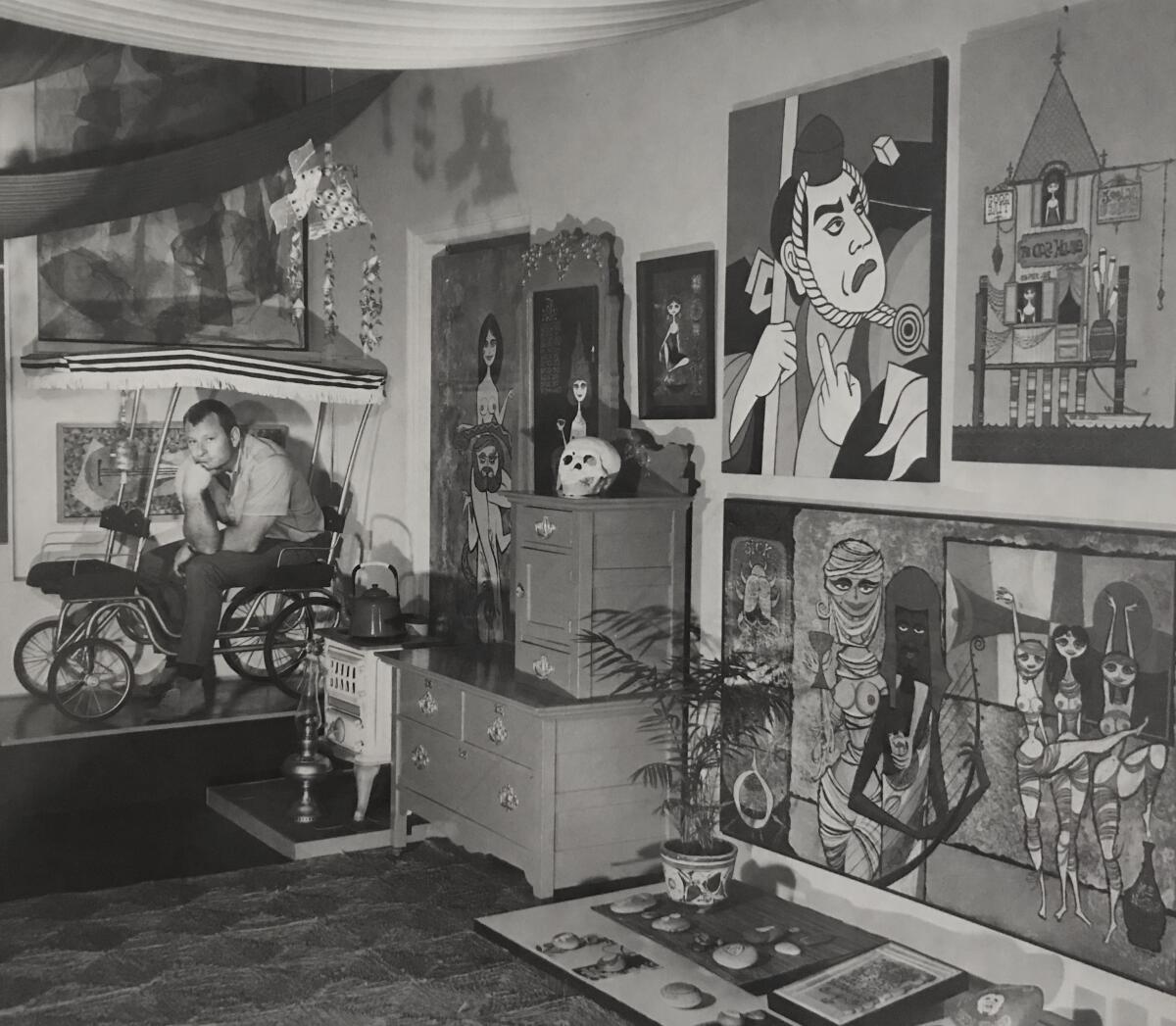
Rolly Crump in his shop, Crump’s, which son Christopher said was a short-lived operation on Ventura Boulevard.
(From Christopher Crump)
Your dad started working for the Walt Disney Co. in 1952. You were born in 1954. This exhibit places a particular emphasis on artwork from that era. When did you first become aware of your father’s work?
He was drawing all the time. He supported me as a model maker, and I had a desk and tools and he bought me kits. I started building models when I was 6 years old. I watched him draw. But later, I recognized that this huge body of work of his, he was doing all the time. He hung out with [animator-artist] Walter Peregoy a lot. Walter Peregoy would get up at 4 a.m. and draw and paint. And that started hitting me. Dad had two jobs — he was working in animation and he was working in construction on the weekends, and he was knocking out all this artwork and mobiles. When someone calls themselves an artist, they don’t have a choice. It is constant. It is all the time.
You have to also think about culture. Dad wasn’t changing diapers, cooking, cleaning and washing up and all that stuff. Men didn’t do that. It wasn’t like there was something wrong with him, but it wasn’t until later where it was like, “Hey, Dad, you have to help out with the chores.” Whatever the hell Dad wanted to do, he’d do it, so in Dad’s case, he would paint, draw, sculpt and make mobiles. He was going to keep satisfying that itch of having to do that stuff.
And everybody would help. My mom did a lot of painting on my dad’s stuff. He drew it, and said, “Paint that red. Paint that green.” I remember doing colors on paintings, and this was in the early to mid ’60s. We were all part of Dad’s little art machine.
In collecting this poster art, what impresses you today? What do you appreciate about the personal work he was doing while working in animation? I remember your dad saying he felt insecure as an animator.
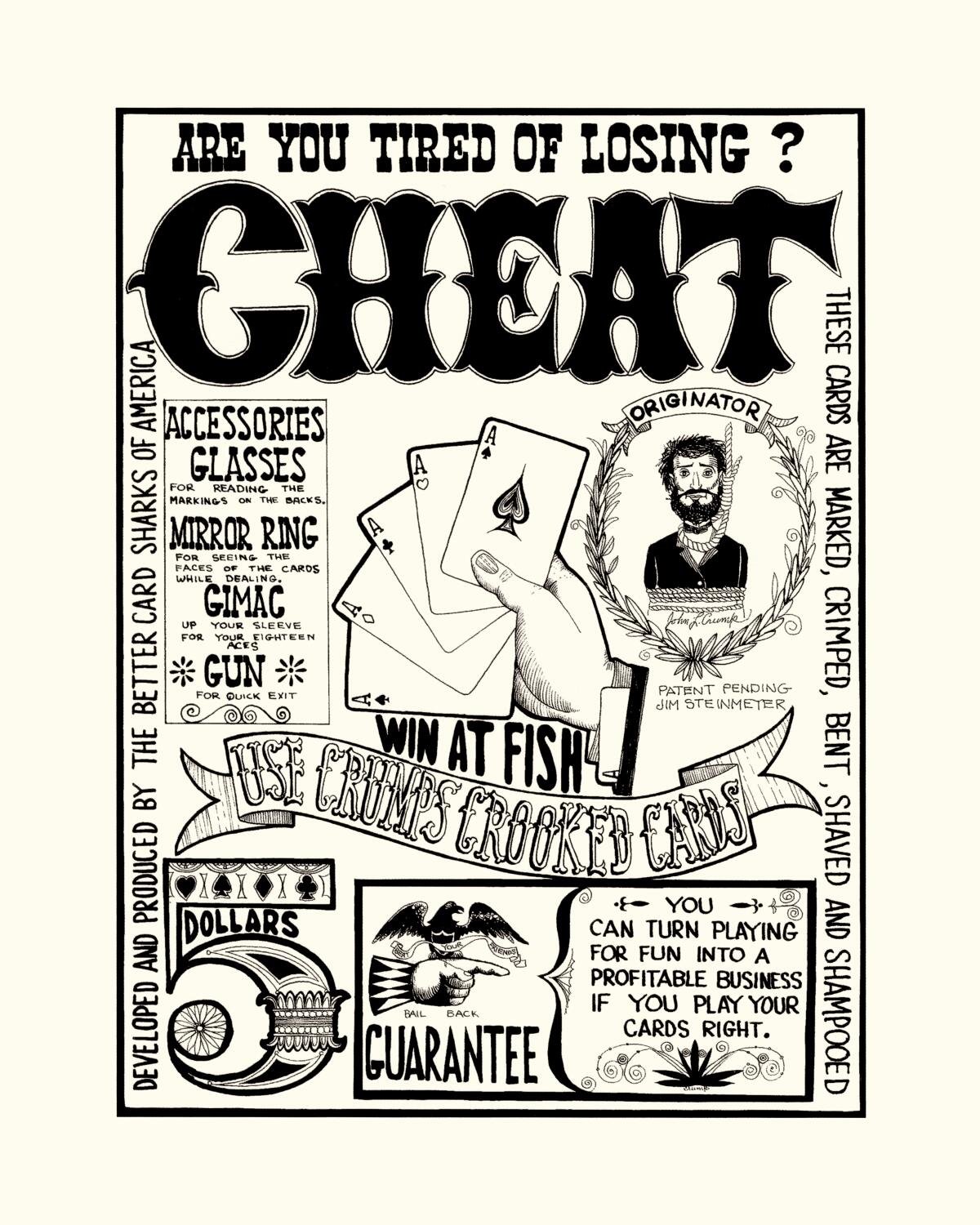
A Rolly Crump-designed poster that’s part of an exhibition of the artist’s early work.
(From Christopher Crump)
These [animation] artists — Walter Peregoy, Dale Barnhart, Frank Armitage, and of course, Ward Kimball and Marc Davis — these guys were all amazing. Dad would say, “I knew how to use a pencil.” He could draw, but he had no formal education in the arts. These guys influenced him and he learned from them, but he needed to find his voice. I captured an interview recently — somebody sent it to me — of him giving a talk, and Dad told this great story about wanting to learn how to paint, to become an artist. He was trying to mimic Walt Peregoy’s style, and it wasn’t working. He was getting really frustrated.
He talked about going to an art show at the studio, and he saw a piece of a bunch of gargoyles sitting on a log flying kites. And the light bulb went off. He said, “I can do that.” Dad’s got a funky sense of humor, and the animation world was all about getting people to laugh, so he went home and he painted lobsters drinking martinis. And that was the first painting he did where he took the idea of telling a little story and making sure it was funny. That kick-started him.
What I’ve always loved about your father’s personal work is that there’s a free-flowing nature to it. You see that even in the poster for the Unicorn. It feels improvised, jazzy.
And what I think, and I’ve heard him say this, he was always looking for something different, and then to put some twist on it. When you think about the folk era, when it was really hot — burning hot — it was hobos on freighters writing songs about social injustice. These were “stick it to the man” people. All these things influenced him — the idea of folk music and freedom of expression.
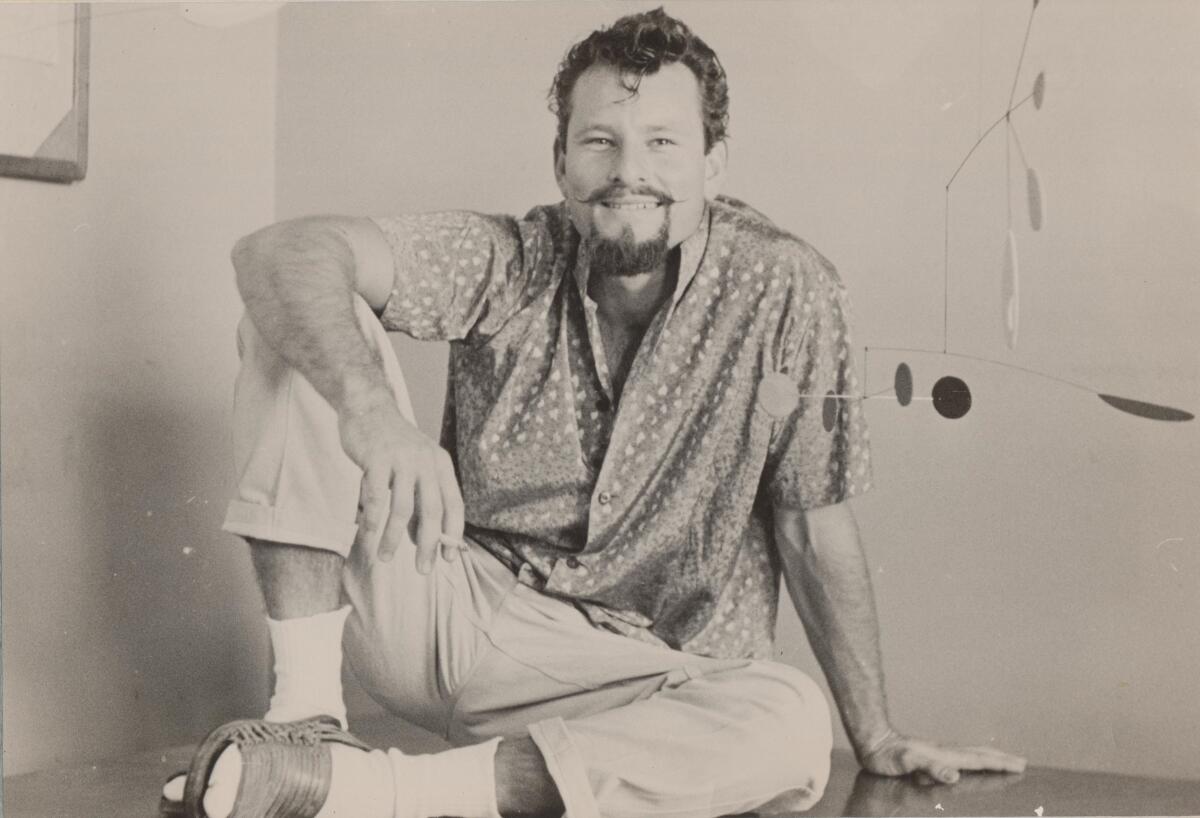
Rolly Crump in 1957, when the artist was working in animation at the Walt Disney Co.
(From Christopher Crump)
Like, there was no way he could paint like those other guys. But he found his voice, and these posters became more satirical. It’s kind of mock advertising but very tongue-in-cheek. I’ll be playing a soundtrack of a lot of the music Dad had in his collection at home. So it’s a 4½-hour compilation of Miles Davis, Nina Simone, Peter, Paul and Mary, Quincy Jones, Harry Belafonte, Wes Montgomery — all the stuff we listened to the house or I heard in his Porsche listening to the jazz station.
How do you connect what we’ll see in this show with his best-known Disney work on It’s a Small World or the Enchanted Tiki Room?
Because he was drawing every day, his line work, his composition, his technical chops as an artist got better. That led to how he was able to come up with stuff in the Tiki Room, the toys in Small World. He didn’t wake up and roll out of bed one morning and become really good. There was a gradual development of who he was. Then he got to a confidence level. He knew who he was and he was unapologetic about it.
“Crump’s The Lost Exhibition”
He started watching how Walt [Disney] behaved and he found his groove with Walt. He waited a few years before he really started becoming opinionated, and then once Walt started listening to him, it annoyed all the other Imagineers. They were all singing and dancing. “Whatever Walt wants.” Rolly wasn’t a dancer. How could this crazy beatnik character be Disney? It’s like musicians. It’s the chops. You mentioned the jazz thing — jazz is about improvisation. Jazz is about going with however the flow is going and following your crazy ideas. Walt believed in Dad’s crazy ideas.
And yet those crazy ideas helped define the tone of Disneyland. Modern theme parks are very much aligned with the look of film and television, yet there are multiple times, say, on It’s a Small World, where it’s very clear what Rolly’s influence was.
My wife didn’t know much about Disney. She rides It’s a Small World — and my dad had been doing birthday cards and Christmas cards — and she looked up at It’s a Small World and said, “Oh my God, it’s my father-in-law.” And that’s kind of my thought. This was all developed and worked out, and by the time the World’s Fair hit, and the ’60s hit, he had a good eight or nine years of messing around, and now he’s blossoming. Now he’s got a stage to work on.
So I’m talking about the ’50s and early ’60s before all that. What was it that happened to him that developed him and developed his confidence to be able to be that big-time guy?
It’d be like in music. He played a lot of little clubs before he hit the big stages. My vibe is to just kind of have people remember how artists become what they become.

Lifestyle
Doctors says ‘The Pitt’ reflects the gritty realities of medicine today
From left: Noah Wyle plays Dr. Michael “Robby” Robinavitch, the senior attending physician, and Fiona Dourif plays Dr. Cassie McKay, a third-year resident, in a fictional Pittsburgh emergency department in the HBO Max series The Pitt.
Warrick Page/HBO Max
hide caption
toggle caption
Warrick Page/HBO Max
The first five minutes of the new season of The Pitt instantly capture the state of medicine in the mid-2020s: a hectic emergency department waiting room; a sign warning that aggressive behavior will not be tolerated; a memorial plaque for victims of a mass shooting; and a patient with large Ziploc bags filled to the brink with various supplements and homeopathic remedies.
Scenes from the new installment feel almost too recognizable to many doctors.
The return of the critically acclaimed medical drama streaming on HBO Max offers viewers a surprisingly realistic view of how doctors practice medicine in an age of political division, institutional mistrust and the corporatization of health care.
Each season covers one day in the kinetic, understaffed emergency department of a fictional Pittsburgh hospital, with each episode spanning a single hour of a 15-hour shift. That means there’s no time for romantic plots or far-fetched storylines that typically dominate medical dramas.
Instead, the fast-paced show takes viewers into the real world of the ER, complete with a firehose of medical jargon and the day-to-day struggles of those on the frontlines of the American health care system. It’s a microcosm of medicine — and of a fragmented United States.

Many doctors and health professionals praised season one of the series, and ER docs even invited the show’s star Noah Wyle to their annual conference in September.
So what do doctors think of the new season? As a medical student myself, I appreciated the dig at the “July effect” — the long-held belief that the quality of care decreases in July when newbie doctors start residency — rebranded “first week in July syndrome” by one of the characters.
That insider wink sets the tone for a season that Dr. Alok Patel, a pediatrician at Stanford Medicine Children’s Health, says is on point. Patel, who co-hosts the show’s companion podcast, watched the first nine episodes of the new installment and spoke to NPR about his first impressions.
To me, as a medical student, the first few scenes of the new season are pretty striking, and they resemble what modern-day emergency medicine looks and sounds like. From your point of view, how accurate is it?
I’ll say off the bat, when it comes to capturing the full essence of practicing health care — the highs, the lows and the frustrations — The Pitt is by far the most medically accurate show that I think has ever been created. And I’m not the only one to share that opinion. I hear that a lot from my colleagues.
OK, but is every shift really that chaotic?
I mean, obviously, it’s television. And I know a lot of ER doctors who watch the show and are like, “Hey, it’s really good, but not every shift is that crazy.” I’m like, “Come on, relax. It’s TV. You’ve got to take a little bit of liberties.”
As in its last season, The Pitt sheds light on the real — sometimes boring — bureaucratic burdens doctors deal with that often get in the way of good medicine. How does that resonate with real doctors?
There are so many topics that affect patient care that are not glorified. And so The Pitt did this really artful job of inserting these topics with the right characters and the right relatable scenarios. I don’t want to give anything away, but there’s a pretty relatable issue in season two with medical bills.
Right. Insurance seems to take center stage at times this season — almost as a character itself — which seems apt for this moment when many Americans are facing a sharp rise in costs. But these mundane — yet heartbreaking — moments don’t usually make their way into medical dramas, right?
I guarantee when people see this, they’re going to nod their head because they know someone who has been affected by a huge hospital bill.
If you’re going to tell a story about an emergency department that is being led by these compassionate health care workers doing everything they can for patients, you’ve got to make sure you insert all of health care into it.
As the characters juggle multiple patients each hour, a familiar motif returns: medical providers grappling with some heavy burdens outside of work.
Yeah, the reality is that if you’re working a busy shift and you have things happening in your personal life, the line between personal life and professional life gets blurred and people have moments.
The Pitt highlights that and it shows that doctors are real people. Nurses are actual human beings. And sometimes things happen, and it spills out into the workplace. It’s time we take a step back and not only recognize it, but also appreciate what people are dealing with.
2025 was another tough year for doctors. Many had to continue to battle misinformation while simultaneously practicing medicine. How does medical misinformation fit into season two?
I wouldn’t say it’s just mistrust of medicine. I mean that theme definitely shows up in The Pitt, but people are also just confused. They don’t know where to get their information from. They don’t know who to trust. They don’t know what the right decision is.
There’s one specific scene in season two that, again, no spoilers here, but involves somebody getting their information from social media. And that again is a very real theme.
In recent years, physical and verbal abuse of healthcare workers has risen, fueling mental health struggles among providers. The Pitt was praised for diving into this reality. Does it return this season?
The new season of The Pitt still has some of that tension between patients and health care professionals — and sometimes it’s completely projected or misdirected. People are frustrated, they get pissed off when they can’t see a doctor in time and they may act out.
The characters who get physically attacked in The Pitt just brush it off. That whole concept of having to suppress this aggression and then the frustration that there’s not enough protection for health care workers, that’s a very real issue.
A new attending physician, Dr. Baran Al-Hashimi, joins the cast this season. Sepideh Moafi plays her, and she works closely with the veteran attending physician, Dr. Michael “Robby” Robinavitch, played by Noah Wyle. What are your — and Robby’s — first impressions of her?
Right off the bat in the first episode, people get to meet this brilliant firecracker. Dr. Al-Hashimi, versus Dr. Robby, almost represents two generations of attending physicians. They’re almost on two sides of this coin, and there’s a little bit of clashing.
Sepideh Moafi, fourth from left, as Dr. Baran Al-Hashimi, the new attending physician, huddles with her team around a patient in a fictional Pittsburgh teaching hospital in the HBO Max series The Pitt.
Warrick Page/HBO Max
hide caption
toggle caption
Warrick Page/HBO Max
Part of that clash is her clear-eyed take on artificial intelligence and its role in medicine. And she thinks AI can help doctors document what’s happening with patients — also called charting — right?
Yep, Dr. Al-Hashimi is an advocate for AI tools in the ER because, I swear to God, they make health care workers’ lives more efficient. They make things such as charting faster, which is a theme that shows up in season two.
But then Dr. Robby gives a very interesting rebuttal to the widespread use of AI. The worry is that if we put AI tools everywhere, then all of a sudden, the financial arm of health care would say, “Cool, now you can double how many patients you see. We will not give you any more resources, but with these AI tools, you can generate more money for the system.”
The new installment also continues to touch on the growing corporatization of medicine. In season one we saw how Dr. Robby and his staff were being pushed to see more patients.
Yes, it really helps the audience understand the kind of stressors that people are dealing with while they’re just trying to take care of patients.
In the first season, when Dr. Robby kind of had that back and forth with the hospital administrator, doctors were immediately won over because that is such a big point of frustration — such a massive barrier.
There are so many more themes explored this season. What else should viewers look forward to?
I’m really excited for viewers to dive into the character development. It’s so reflective of how it really goes in residency. So much happens between your first year and second year of residency — not only in terms of your medical skill, but also in terms of your development as a person.
I think what’s also really fascinating is that The Pitt has life lessons buried in every episode. Sometimes you catch it immediately, sometimes it’s at the end, sometimes you catch it when you watch it again.
But it represents so much of humanity because humanity doesn’t get put on hold when you get sick — you just go to the hospital with your full self. And so every episode — every patient scenario — there is a lesson to learn.
Michal Ruprecht is a Stanford Global Health Media Fellow and a fourth-year medical student.
Lifestyle
In Beauty, Private Equity Is Hot Again
Lifestyle
10 books we’re looking forward to in early 2026
Two fiction books about good friends coming from different circumstances. Two biographies of people whose influence on American culture is, arguably, still underrated. One Liza Minnelli memoir. These are just a handful of books coming out in the first few months of 2026 that we’ve got our eye on.
Fiction
Autobiography of Cotton, by Cristina Rivera Garza, Feb. 3
Garza, who won a Pulitzer in 2024 for memoir/autobiography, actually first published Autobiography of Cotton back in 2020, but it’s only now getting an English translation. The book blends fiction with the author’s own familial history to tell the story of cotton cultivation along the U.S.-Mexico border.
Crux, by Gabriel Tallent, Jan. 20
Tallent’s last novel, My Absolute Darling, was a harrowing coming of age story about a teenage girl surviving her abusive survivalist father. But it did find pockets of beauty in the outdoors. Tallent’s follow up looks to be similarly awestruck by nature. It’s about two young friends, separated by class and opportunity, but bound together by a love of rock climbing.
Half His Age, by Jennette McCurdy, Jan. 20
The former iCarly actress’ bracing and brutally honest memoir, I’m Glad My Mom Died, was a huge hit. It spent weeks on bestseller’s lists, and is being adapted into a series for Apple TV+. Now McCurdy’s set to come out with her fiction debut, about a teenage girl who falls for her high school creative writing teacher.
Kin, by Tayari Jones, Feb. 24
Similarly to Crux, Kin also follows two friends across the years as options and opportunities pull them apart. The friends at the center of this book are two women who grew up without moms. Jones’ last novel, 2018’s An American Marriage, was a huge hit with critics.
Seasons of Glass & Iron: Stories, by Amal El-Mohtar, March 24
El-Mohtar is an acclaimed science-fiction writer, and this book is a collection of previously published short stories and poetry. Many of the works here have been honored by the big science-fiction/fantasy awards, including the titular story, which is a feminist re-telling of two fairy tales.
Nonfiction
A Hymn to Life: Shame Has to Change Sides, by Gisèle Pelicot, Feb. 17
Pelicot’s story of rape and sexual assault – and her decision to wave anonymity in the trial – turned her into a galvanizing figure for women across the world. Her writing her own story of everything that happened is also a call to action for others to do the same.
Cosmic Music: The Life, Art, and Transcendence of Alice Coltrane, by Andy Beta, March 3
For decades, the life and work of Alice Coltrane has lived in the shadow of her husband, John Coltrane. This deeply researched biography hopes to properly contextualize her as one of the most visionary and influential musicians of her time.
Football, by Chuck Klosterman, Jan. 20
One of our great essaysists and (over?) thinkers turns his sights onto one of the last bits of monoculture we’ve got. But in one of the pieces in this collection, Klosterman wonders, how long until football is no longer the summation of American culture? But until that time comes, there’s plenty to dig into from gambling to debates over the true goat.
Kids, Wait Till You Hear This! by Liza Minnelli, with Michael Feinstein, March 20
Minnelli told People that previous attempts at telling her story “didn’t get it right,” so she’s doing it herself. This new memoir promises to get into her childhood, her marriages, and her struggles with substance abuse.
Tom Paine’s War: The Words that Rallied a Nation and the Founder of Our Time, by Jack Kelly, Jan. 6
If you haven’t heard, it’s a big birthday year for America. And it’s a birthday that might not have happened if not for the words of Thomas Paine. This new book from historian Jack Kelly makes the argument that Paine’s words are just as important and relevant to us today.
-
Detroit, MI5 days ago2 hospitalized after shooting on Lodge Freeway in Detroit
-
Technology3 days agoPower bank feature creep is out of control
-
Dallas, TX4 days agoDefensive coordinator candidates who could improve Cowboys’ brutal secondary in 2026
-
Health5 days agoViral New Year reset routine is helping people adopt healthier habits
-
Nebraska2 days agoOregon State LB transfer Dexter Foster commits to Nebraska
-
Iowa2 days agoPat McAfee praises Audi Crooks, plays hype song for Iowa State star
-
Nebraska3 days agoNebraska-based pizza chain Godfather’s Pizza is set to open a new location in Queen Creek
-
Entertainment2 days agoSpotify digs in on podcasts with new Hollywood studios