Washington, D.C
Thousands rally at Christian nationalist event in DC to ‘turn hearts back to God’


Tens of thousands of Christians poured onto the National Mall on Saturday to atone, pray and take a stand for America – which, in their vision, should be ruled by a Christian god.
Summoned to Washington DC by the multilevel marketing professional-turned-Christian “apostle” Jenny Donnelly and the anti-LGBTQ+ celebrity pastor Lou Engle, they streamed onto the lawn holding blue and pink banners emblazoned with the hashtag #DontMessWithOurKids – a nod to the myth that children are being indoctrinated into adopting gay and transgender identities.
It was no coincidence that the event was held on the Jewish holiday of Yom Kippur: evangelicals and charismatic Christians find spiritual meaning in Old Testament scripture, Jewish rituals and support for Israel – where they believe the end times prophecy will take place.
November’s presidential election hung heavy over the crowd, too. A promotional newsletter for the event called on “the Lord’s authority over the election process and our nation’s leadership”, and organizers handed out flyers promoting a pre-election prayer event hosted by the Donald Trump-aligned organization Turning Point USA Faith.
“I was here at January 6,” said Tami Barthen, an attendee who traveled from Pennsylvania to attend the rally, and who described her experience of Trump supporters carrying out a deadly attack on the US Capitol as profoundly spiritual. “It’s not Democrat versus Republican,” she said. “It’s good versus evil.”
It’s the first of a series of Christian nationalist gatherings in DC to rally believers to the Capitol ahead of the 2024 election.
Donnelly billed the event as a rallying call for mothers concerned about changing gender norms in the modern US and casting the gathering at the Capitol as an opportunity for women to stand their ground and play a pivotal role in changing the country’s cultural and political trajectory.
The rally is a collaboration organized by multiple far-right Christian leaders affiliated with the New Apostolic Reformation, a movement on the political far right that seeks to establish long-term Christian dominion over government and society as well as get Trump a second presidency in November.
Matthew Taylor, a senior scholar at the Institute for Islamic, Christian and Jewish Studies, said the effort was aimed at “creating a network – a mass of people – who see it as their spiritual mission to take over Washington DC”
Most prominent in the push to turn out women to the National Mall is Engle, a rightwing pastor and staunch opponent of LGBTQ+ rights and abortion, whose tutelage of anti-gay Ugandan pastors and coordination of mass prayer mobilizations has earned him international notoriety and celebrity.
The Southern Poverty Law Center, which characterizes Engle as an anti-LGBTQ+ extremist, notes that Engle has in the past compared the anti-LGBTQ+ push to the secessionist south during the American civil war, calling on opponents of gay rights to emulate the Confederate general Robert E Lee, who “was able to restrain Washington”.
Donnelly’s vision – of a crowd of moms descending on the Capitol in pink and blue – is her own. Engle, whose mass prayer rallies have drawn hundreds of thousands to DC in the past, offers a platform to turn people out.
“We are seeing a million women and their families coming together to see this great country turn their hearts back to God,” said Donnelly, on a 21 June podcast promoting the march. Donnelly, who lives in Portland, Oregon, with her family, described how during the Covid-19 lockdowns and Black Lives Matter protests – twin forces she says shut down her church – she was called by God to go deeper into the political realm.
“I said: ‘Lord, I’m just a mom of five, I have a great church – it’s not huge. I’ve done women’s retreats, I think I’ve been doing my part in the kingdom and I love Jesus so much, but I don’t even know where to begin, but would you put me in the fight?’” she said.
Donnelly has sought to pass along that message to other Christian women through an organization called Her Voice Movement Action, which organizes women into decentralized, independently-run “prayer hubs” – a source of spiritual community for women that also functions as a political mobilization tool.
“We’ve been praying for our nation for a couple years in small prayer hubs,” said Louette Madison, who traveled from Washington state to DC for the rally. Madison has teenagers in the public school system and described hoping for a day when prayer is embraced in schools, saying: “I think that the schools are kind of getting rid of the values, and also getting rid of the discipline, [and] when there’s no consequences, that can cause a lot more chaos in school.”
The decentralized organizing model carries echoes of Donnelly’s previous life: before reinventing herself as a leader in the New Apostolic Reformation, Donnelly earned millions through the multilevel marketing company AdvoCare, which collapsed after settling with the Federal Trade Commission for $150m in a lawsuit alleging the company was an illegal pyramid scheme.
From Peru to Portland
Years before Donnelly flew the #DontMessWithOurKids flag, a movement under the same name took hold in Peru, promoted by Christian Rosas, a conservative Christian political strategist and consultant in the mining industry. The evangelical “No te metas con mis hijos” – “don’t mess with my kids” – coalition, which opposed LGBTQ+ inclusion and abortion, earned followers in 2016 during a wave of conservative backlash against governmental efforts to introduce themes of gender equality and LGBTQ+ inclusion in the school system.
When the government issued lockdown orders to slow the spread of Covid-19, it issued travel restrictions by gender, allowing women and men to leave the house on different days of the week and affirming that trans people’s gender identities would be respected in enforcing the rule. Rosas took issue with the trans-inclusive policy, claiming that police officers were obligated to enforce the rule based on travelers’ identification cards, not their gender identities.
During the lockdown orders, the Peruvian investigative reporting outlet OjoPúblico reported on 18 incidents of humiliating and abusive arrests of trans women by the police.
What started as street protests has turned into an electoral strategy to elect ultra-conservative allies of the Christian right into office in Peru. These lawmakers have passed a slew of socially conservative laws, including one this year that classifies transgender identities as mental illnesses.
Donnelly has taken up the mantle of this movement among Christian moms in the US, drawing directly from Rosas’s vision in Peru and consulting him on strategy.
“We challenged the law, why? Because the law was unjust. We challenged the curriculum. Why? Because the curriculum was unjust,” said Rosas on a podcast interview with Donnelly on 6 November 2023. “TV, news [outlets], they mocked us every day, they mocked us, they ridiculed us, saying: ‘Look at them, they’re radical, religious, whatever,’ but they saw that we are not retreating.”
Don’t Mess With Our Kids and No te metas con mis hijos have both attempted to cast their organizations as grassroots mobilizations. In a 2017 interview with Vice News, a spokesperson for the group spoke on the condition of anonymity, claiming to speak for “the collective”.
Donnelly’s Her Voice Movement adopts a similar approach. In a recording of a Zoom call in August – which journalist Dominick Bonny obtained and shared with the Guardian – Her Voice Movement spokesperson Naomi Van Wyk said the group had teamed up with Moms for Liberty to launch a multi-state campaign called March for Kids, but cautioned members to keep the association private.
“The parent company is Moms for Liberty, but they don’t wanna be recognized. They really want this movement to be grassroots, and to make a public statement that there are hundreds and thousands of people across the country that are coming together under one umbrella,” said Van Wyk.
Elizabeth Salazar Vega, a reporter covering gender and politics in Peru, said she was not surprised that the push had taken hold in the US – or that it had found expression just weeks before a presidential election.
“This is the ideal scenario to bind these voices together, that could normally appear siloed in civil society,” Salazar Vega told the Guardian in Spanish. “I don’t think it would be impossible for this to escalate rapidly in the United States.”
Sean Feucht, a Christian nationalist pastor who has organized “Kingdom to the Capitol” protests in swing states, is planning a similar march in DC later this month.



Washington, D.C
DC will pay $50,000 to man detained while protesting guard patrol with ‘Star Wars’ song, record says

WASHINGTON (AP) — The District of Columbia has agreed to pay $50,000 to settle a lawsuit filed by a resident who accused police officers of illegally detaining him for following an Ohio National Guard patrol while playing Darth Vader’s theme song from “Star Wars” on his cellphone, according to a document released Monday.
The plaintiff, Sam O’Hara, sued the district, four Metropolitan Police Department officers and a guard member from Ohio over what he says was his act of protest against President Donald Trump’s federal law enforcement surge in Washington, D.C.
A court filing on Thursday disclosed the settlement but didn’t specify any monetary terms. The amount is included in a copy of the settlement agreement that D.C. Attorney General Brian L. Schwalb’s office provided to The Associated Press.
The $50,000 settlement includes attorney’s fees and costs. O’Hara is represented by the American Civil Liberties Union of the District of Columbia. In an email on Friday, an ACLU spokesperson referred to the settlement’s financial terms as “a significant amount” that O’Hara “is pleased with” but said they weren’t disclosing the dollar figure to protect his privacy.
O’Hara, an artist who works in the hospitality industry, agreed to drop his claims against the district and the MPD officers within three business days of receiving the settlement payment. The settlement isn’t an admission of wrongdoing by the district, the agreement says.
O’Hara’s settlement with the district doesn’t resolve his related claims against an Ohio National Guard member, Sgt. Devon Beck, who has asked a judge to dismiss O’Hara’s claims against him.
O’Hara sued the district in October, claiming police officers violated his First Amendment rights to free speech and his Fourth Amendment rights against unreasonable seizures and excessive force.
O’Hara played “The Imperial March” theme from “Star Wars” on his phone as he followed several National Guard troops down a public street on Sept. 11, 2025. One of the troops summoned police officers, who stopped O’Hara and kept him handcuffed for 15 to 20 minutes before releasing him without charges, according to the lawsuit.
Trump’s ongoing deployment of guard members in Washington began last August after the Republican president issued an executive order declaring a crime emergency in the nation’s capital. The surge inflamed tensions with residents of the heavily Democratic district. Hundreds of guard members remain deployed in the district nearly a year later, with no clear end in sight.

US President Donald Trump escalated his criticism of Democratic mayoral nominee Janeese Lewis George, describing her as a “communist” and warning that her policy agenda could negatively affect Washington, DC, ahead of the city’s November mayoral election. Trump made the remarks on his Truth Social platform, placing crime, immigration and policing at the center of his criticism.Trump attacks Democratic agenda
In his statement, Trump claimed George supports measures including reducing prison populations, expanding sanctuary city policies, opposing Immigration and Customs Enforcement (ICE), restoring cashless bail, cutting police funding and resisting anti-crime initiatives. He argued that such proposals would weaken public safety in the US capital and reverse recent improvements.
George becomes favorite after primary victory
Janeese Lewis George secured the Democratic nomination earlier this month after winning the party’s mayoral primary in Washington, DC. Given the city’s strong Democratic voting base, her victory has positioned her as the leading candidate to succeed outgoing Mayor Muriel Bowser in the November general election.
Trump vows to protect Washington
Trump insisted that his administration would not allow Washington, DC, to be “destroyed,” arguing that the city has become significantly safer through crime reduction efforts and urban renewal projects. He also announced that he intends to meet with George, while describing the US capital as “again a Safe and Prestigious Community.”
Repeating his criticism, Trump said: “Many people, including myself, have worked long and hard to get it there, and we will not let it be destroyed by a Communist adherent who has no intention to, MAKE WASHINGTON GREAT AGAIN!”
Berk Kutay Gokmen
28 June 2026•Update: 28 June 2026
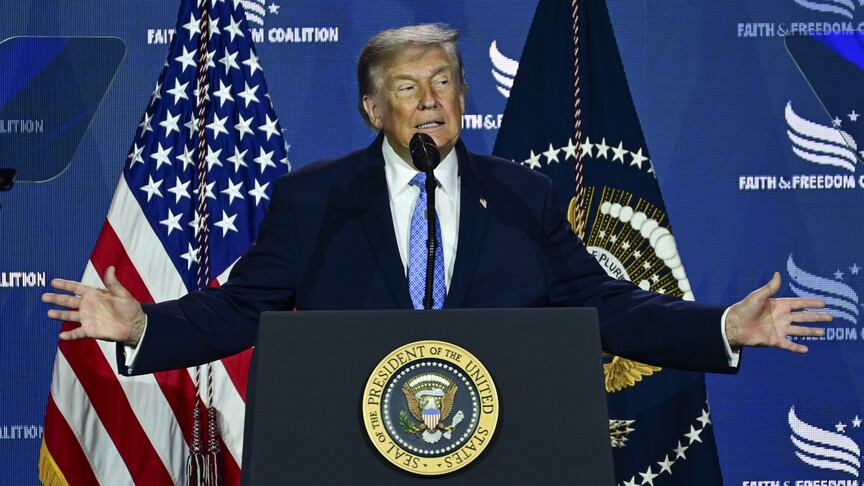
US President Donald Trump on Sunday criticized Democratic mayoral nominee Janeese Lewis George, calling her a “communist” and attacking her policy positions ahead of Washington, DC’s mayoral election.
“Janeese Lewis George, the Communist who is almost certainly going to be elected Mayor of Washington, D.C., has stated that she wants to empty the prisons, make D.C. a Sanctuary City, oppose ICE, welcome Criminal Illegal Aliens back into our beloved Capital, resist Anti-Crime Crackdowns, Defund the Police, continue and expand Cashless Bail, and so many other Capital destroying ‘things’,” Trump wrote on his Truth Social platform.
George won the Democratic primary for mayor of Washington, DC, earlier this month, securing her party’s nomination in the heavily Democratic city and becoming the likely successor to outgoing Mayor Muriel Bowser after the November general election.
Trump said he would not allow Washington, DC, to be “destroyed.”
“In the end, it will never work out, nor will I let it even have a chance because I have worked too hard to make Washington, D.C., the Envy of the World, with almost No Crime, and a Beautification process that has been second to none,” he said.
Trump also said he would “meet with Janeese Lewis George,” adding that Washington, DC, is “again a Safe and Prestigious Community.”
“Many people, including myself, have worked long and hard to get it there, and we will not let it be destroyed by a Communist adherent who has no intention to, MAKE WASHINGTON GREAT AGAIN!” he added.
-

 Milwaukee, WI8 minutes ago
Brewers, Salvation Army pack hundreds of lunches for Milwaukee children through Feed the Kids program
-

 Atlanta, GA11 minutes ago
New Venues in Atlanta for Summer 2026 Meetings and Events
-

 Minneapolis, MN16 minutes ago
Minneapolis City Council member Aisha Chughtai taking mental health leave for a month
-

 Indianapolis, IN23 minutes ago
State police arrest man in connection with two Monument Circle attacks
-

 Pittsburg, PA26 minutes ago
Tech community to Shapiro and Pennsylvania legislators: Wait on data center rules
-
Augusta, GA31 minutes ago
Louise Franklin Sheehan Obituary Jun 26, 2026 – Platt’s Funeral Home
-
Washington, D.C38 minutes ago
DC will pay $50,000 to man detained while protesting guard patrol with ‘Star Wars’ song, record says
-

 Cleveland, OH41 minutes ago
Cleveland Browns Legend Set for Induction into Greater Cleveland Sports Hall of Fame


