Dallas, TX
NBA Fans React To Klay Thompson’s Dallas Mavericks Debut Against Jazz


On Thursday evening, the Dallas Mavericks hosted the Utah Jazz in Texas for their second preseason game.
After missing Monday’s 121-116 victory over the Memphis Grizzlies, Klay Thompson made his debut for the Mavs against the Jazz.
Via Bleacher Report: “Klay sinks his first three in a Mavs uniform 🎯
Still doesn’t feel real 🤯”
Klay sinks his first three in a Mavs uniform 🎯
Still doesn’t feel real 🤯 pic.twitter.com/1zrn4kFVMm
— Bleacher Report (@BleacherReport) October 11, 2024
Many fans reacted to seeing Thompson play for the Mavs for the first time.
He had spent the first 13 years of his career playing for the Golden State Warriors.
@MavsMuse: “Klay Thompson in his preseason debut
10 PTS
3 AST
3/9 FG
3/5 3P
— Solid Dallas debut for Killa Klay 🙏”
Klay Thompson in his preseason debut
10 PTS — Solid Dallas debut for Killa Klay 🙏 pic.twitter.com/lYnCqgZQBI
— MavsMuse (@MavsMuse) October 11, 2024
3 AST
3/9 FG
3/5 3P
@lynziekate: “KLAY THOMPSON’S FIRST THREE AS A DALLAS MAVERICK RAHHHHHHH”
KLAY THOMPSON’S FIRST THREE AS A DALLAS MAVERICK RAHHHHHHH pic.twitter.com/Rj9A8TofND
— lynz (@lynziekate) October 11, 2024
@DL2GotNext: “His on ball defense is looking good so far”
His on ball defense is looking good so far
— DeniedByLively🐴💙(parody) (@DL2GotNext) October 11, 2024
@MarketMovers10: “This mavs team is going to be dangerous 🤯”
This mavs team is going to be dangerous
🤯— Yoda Trades (@MarketMovers10) October 11, 2024
@kyriecenterig: “Still can’t believe Kyrie & Klay Thompson are teammates 😭”
Still can’t believe Kyrie & Klay Thompson are teammates 😭pic.twitter.com/DIgVYdJEgJ
— Kyrie Center (@kyriecenterig) October 10, 2024
Legion Hoops: “Klay Thompson just went 0/3 in his first quarter with the Mavericks.
Oh boy.”
Klay Thompson just went 0/3 in his first quarter with the Mavericks.
Oh boy. pic.twitter.com/YL9LO23jQB
— Legion Hoops (@LegionHoops) October 11, 2024
Noah Weber of The Smoking Cuban: “Klay Thompson’s defense in the first quarter was impressive.
He spent time guarding Lauri Markkanen, Isaiah Collier, Jordan Clarkson, and Keyonte George and held his own in each matchup.
Moved his feet well in space and picked up multiple feet beyond the 3-point line at times.”
Klay Thompson’s defense in the first quarter was impressive.
He spent time guarding Lauri Markkanen, Isaiah Collier, Jordan Clarkson, and Keyonte George and held his own in each matchup.
Moved his feet well in space and picked up multiple feet beyond the 3-point line at times.
— Noah Weber (@noahweber00) October 11, 2024
Thompson finished last season with averages of 17.9 points, 3.3 rebounds and 2.3 assists per contest while shooting 43.2% from the field and 38.7% from the three-point range in 77 games.
The Mavs will play their first game of the regular season on October 24 when they host the San Antonio Spurs.


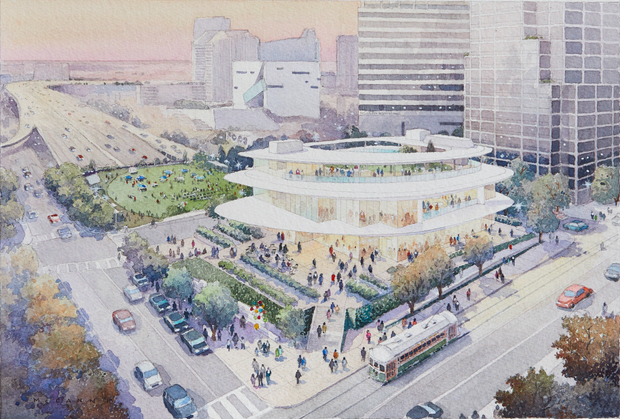
Klyde Warren Park, a top attraction in Dallas for more than a decade, is growing. Park and city leaders revealed details about the project on Monday morning, which will expand the park to 7.1 acres.
The park, which opened in 2012, connects Uptown Dallas with the Arts District over a recessed portion of Woodall Rodgers Freeway. The construction will span west to cover the remaining portion of the freeway, totaling 1.7 acres of new park space, according to the plans released Monday.
It will feature the Jacobs Lawn, a 37,000-square-foot green space that can be used for all types of community gatherings, performances and markets. In the winter, the lawn will feature an ice rink. Next to the lawn, the Overlook will give visitors a view of the highway traffic below them.
The expansion will also include a two-story pavilion with 24,000 square feet of climate-controlled event space, plus a rooftop terrace.
“This expansion isn’t simply about adding acreage. It’s an investment in Dallas, an investment in the community and an investment in future generations,” Klyde Warren Park chairman Jody Grant said in a statement.
“The expansion of this Park is exactly the kind of transformative investment we must continue to make throughout Dallas’s urban core. It will add new green space for residents to enjoy while driving continued economic growth, connecting our communities, and enhancing the quality of life that makes Dallas a destination for families, businesses, and visitors from around the world,” Dallas Mayor Eric Johnson said in a statement.
Construction firm Archer Western won a competitive bid to work on the project, the same firm that built the first phase of the park.
Construction will begin by the end of the year, and is expected to take two years to complete.

FRISCO, Texas — After 12 seasons in the NFL and the last eight with the Dallas Cowboys, defensive back CJ Goodwin has announced his retirement.
Goodwin, 36, has played in 108 games for the Cowboys since he joined the team in 2018. He was the second longest-tenured Cowboy on the roster behind only Dak Prescott, who preceded Goodwin by two seasons.
Since 2019, Goodwin has been one of Dallas’ key players on special teams, recording 69 tackles with the Cowboys [ninth in Cowboys history] and 87 in his NFL career. In 2021, Goodwin became the first player in franchise history to lead the team in special teams tackles for three consecutive seasons.
After going undrafted in 2014, Goodwin received a tryout with the Pittsburgh Steelers after Steelers Hall of Fame cornerback Mel Blount, whose son attended high school with Goodwin and who Goodwin had worked for as a farm hand, urged the team to give him an opportunity. Pittsburgh would sign him as an undrafted free agent afterwards.
Following time with the Steelers, Falcons, Cardinals, Giants, 49ers and Bengals, the Cowboys signed Goodwin off of Cincinnati’s practice squad in October of 2018.
In his eight seasons with Dallas, Goodwin notched 2,211 snaps on special teams. He worked primarily as a gunner on punt coverage and was one of Dallas’ most impactful defenders on kickoff coverage during his career with the team.
Goodwin was named one of the Cowboys’ six captains in 2025, and the second captain on special teams alongside Brandon Aubrey. He finished the year with 18 special teams tackles.
In 2026, the Cowboys will now have to look to fill Goodwin’s shoes on special teams. Some of their offseason signings, like safety P.J. Locke, have a strong history as defenders on special teams and could end up being crucial for special teams coordinator Nick Sorensen in his second season in Dallas.

-

 Fitness32 seconds ago
This unspectacular full-body exercise could be the secret to long-term fitness
-

 Movie Reviews13 minutes ago
‘The Invite’ Movie Review – Spotlight Report
-

 World27 minutes ago
Russia's ruling party runs Ukraine war veteran among lead candidates for September election
-
Politics36 minutes ago
Supreme Court Expands Presidential Powers to Fire Independent Regulators
-

 Culture1 hour ago
Test Your Knowledge of New York’s Algonquin Round Table
-
 Lifestyle1 hour ago
They were world-class tennis rivals. Now friends, they’ve teamed up against cancer
-

 Technology1 hour ago
T-Mobile is booting customers from its oldest plans
-

 World1 hour ago
Gunman kills 6 at youth welfare facility in suspected child custody dispute: reports

