Entertainment
Playwrights, back in the spotlight on Broadway, kick-start New York's fall theater season


Reports of the demise of the straight play on Broadway are greatly exaggerated, at least by the evidence of the fall theater season that has come front-loaded with high-profile drama.
Sam Mendes’ searing production of Jez Butterworth’s “The Hills of California” at the Broadhurst Theatre, hands down the best play I saw in a spree of late September playgoing, has become the essential ticket for discerning New York theatergoers this fall. Ayad Akhtar’s “McNeal,” starring Robert Downey Jr. in his Broadway debut at Lincoln Center Theater’s Vivian Beaumont, didn’t live up to expectations. But who could pass up the opportunity to hear from one of our sharpest playwrights on a subject that has already begun challenging our sense of reality, AI.
I was scheduled to see Jen Silverman’s “The Roommate,” starring that most enticing Broadway odd couple, Patti LuPone and Mia Farrow, but illness in the cast scuttled my plans. Still, I managed to pack in, on a four-day itinerary, David Henry Hwang’s “Yellow Face” (starring Daniel Dae Kim) at Roundabout Theatre Company’s Todd Haimes Theatre, Max Wolf Friedlich’s “Job” at the Hayes Theater, and in my one off-Broadway run, James Ijames’ “Good Bones” at the Public Theater. (I also caught the jaunty Broadway revival of “Once Upon a Mattress,” about which I’ll have more to say when the production, starring Sutton Foster, opens at the Ahmanson Theatre in December.)
Daniel Dae Kim in the play “Yellow Face.”
(Joan Marcus)
It was a pleasure to re-encounter “Yellow Face,” which had its world premiere at the Mark Taper Forum in 2007. Leigh Silverman, who directed that production, has returned to helm the play’s Broadway premiere, which runs through Nov. 24. This clever comedy, a self-referential work in which Hwang harks back to a theatrical controversy he found himself embroiled in after speaking out against the casting of Jonathan Pryce as a Eurasian character in the 1991 Broadway premiere of “Miss Saigon.” The uproar that followed was more than the Tony-winning playwright had bargained for. But he decided to tackle some of the questions about racial identity that emerged from the casting brouhaha in his play “Face Value,” a spectacular flop that closed in previews on Broadway in 1993.
In “Yellow Face,” Hwang reassembles these related events in a comedy that introduces a fictional device to what is otherwise a straightforward recounting. DHH, the playwright’s surrogate, is now played by Kim, a magnetic screen star (“Lost,” “Hawaii Five-0”) with Hollywood sex appeal to spare. Any male writer would be flattered to be played by Kim, but the casting is delectably ironic in a play that recalls a time when producers would throw up their hands when asked to find an Asian American leading man to anchor a film or Broadway show.
Silverman’s production, in other respects, doesn’t quite seem as comfortable blown up on a big Broadway stage. Some of the comic acting comes off as cartoonish, but the writing is so smart, fluid and free that it hardly matters. And the scenes between Kim’s DHH and Ryan Eggold’s Marcus, the purely invented figure in the play, revel in the hilarious hypocrisies that Hwang impishly sends up.
The conceit of the play is that DHH has accidentally cast a non-Asian performer as the lead in “Face Value,” and Marcus, grateful for this jump-start to his acting career, takes on a communal advocacy role that only makes the situation more farcically dangerous. DHH is afraid of losing face over his role in making Marcus an Asian American star. He came up with the bright idea of claiming that the actor was of Siberian Jewish heritage when learning the truth of his identity. As the accidental spokesperson for politically conscious casting, he’d rather not be hoisted on his own petard.
Hwang’s self-irony is part of the comic wonder of “Yellow Face.” But what is especially refreshing about the play is the way it approaches profoundly serious matters of identity politics with a light touch. Hwang is too agile a playwright to be doctrinaire. He recognizes what must be redressed, but he refuses to lose his sense of humor in the struggle or exempt himself from the human comedy that may be the only reliable equal opportunity employer.
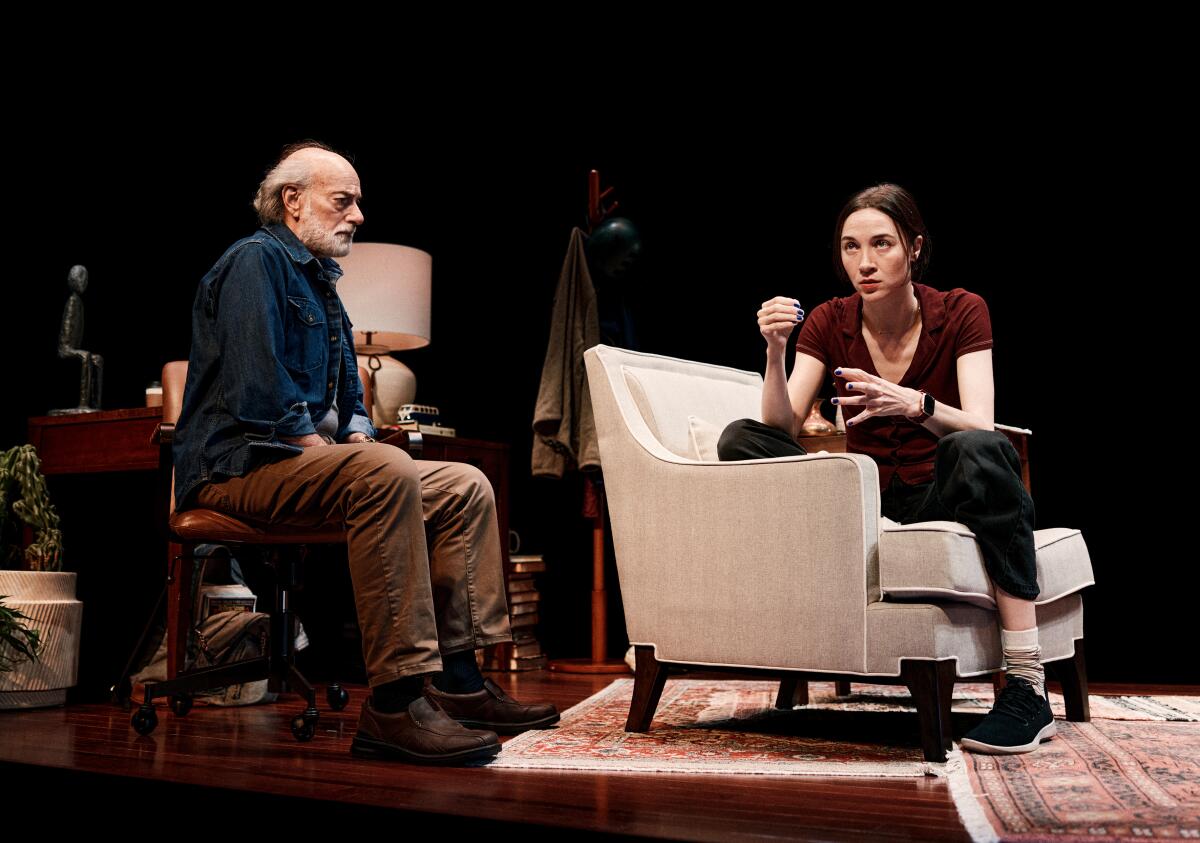
Peter Friedman and Sydney Lemmon in “Job” at Broadway’s Helen Hayes Theater.
(Emilio Madrid)
“Job,” which had a much talked-about run last fall off-Broadway at the Soho Playhouse, moved to Broadway’s Helen Hayes Theater this summer and might be the sleeper of the season. A two-character work, the play (which is scheduled to close on Oct. 27) stars veteran Peter Friedman and Broadway newcomer Sydney Lemmon, a Yale School of Drama graduate who happens to be the granddaughter of Jack Lemmon.
Why has Friedlich’s play become so popular with New York theatergoers? The situation of a young woman showing up at a psychotherapist’s office with a gun sets up a self-contained dramatic situation that audiences seem to relish. Lemmon plays Jane, a content moderator at a tech company, who had a breakdown at the office after being exposed to the most horrific videos and now needs a psychologist to sign off on her return to work. Friedman takes on the role of Loyd, a San Francisco shrink who, in a period of time shorter than two sessions, must somehow dissuade Jane from pulling the trigger.
The contrivances of the situation are inescapable, despite the scrupulous honesty of the performers in director Michael Herwitz’s charged production. (As the Berkeley-educated, aging hippie therapist, Friedman is especially good at dispensing professional empathy to save his own life). The play contains a twist that wild horses couldn’t drag out of me, but how convinced you’ll be depends on your willingness to succumb to a plot that has been carefully programmed to ratchet up the dramatic tension. I remained at a skeptical remove, but I appreciated the absorption of my fellow audience members, who were more than happy to suspend disbelief and hop on an 80-minute-dramatic thrill ride.
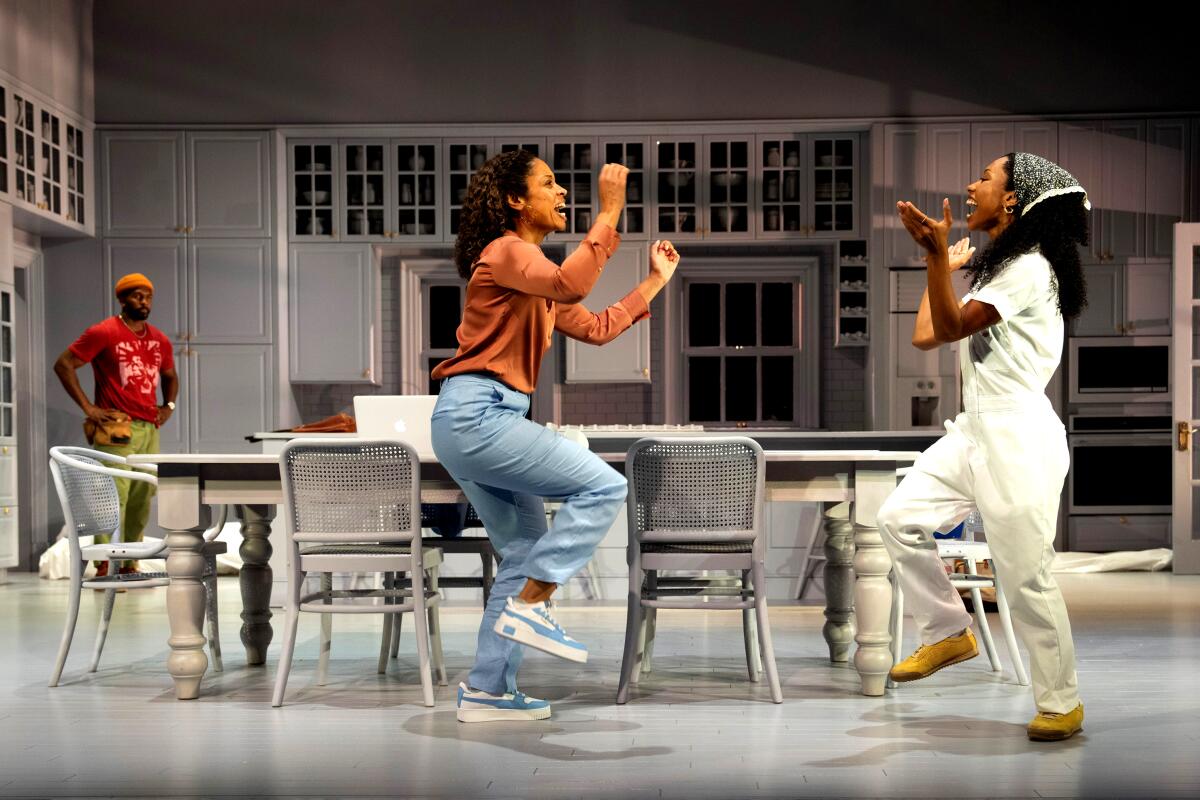
Khris Davis, from left, Susan Kelechi Watson, and Tea Guarino in the New York premiere of “Good Bones,” written by James Ijames and directed by Saheem Ali.
(Joan Marcus)
The final play on my itinerary was “Good Bones,” by Ijames, a playwright I’ve been eager to get to know better after “Fat Ham,” his brilliantly hilarious Pulitzer Prize-winning riff on “Hamlet.” “Kill Move Paradise,” an earlier Ijames play still running at the Odyssey Theatre, constructs an emergency racial justice ritual to confront the epidemic of fatal police shootings of unarmed Black people. “Good Bones,” a play about a married couple, Travis (Mamoudou Athie) and Aisha (Susan Kelechi Watson), who are renovating a townhouse in the city where Aisha grew up, is much more conventional in form.
Aisha, who grew up poor, has a love-hate relationship with her hometown. She works for a company that’s erecting a sports complex that is going to tear down the same projects that she used to call home. Her husband, a chef from a more affluent background, is opening an upscale soul food restaurant in the midtown area. The two embody the spirit of gentrification, but they have as many differences between them as they have with Earl (Khris Davis), a meticulous contractor who still lives in the projects that Aisha wants to dismantle.
Ijames sets up debate drama in which the characters bring their unique life histories to the conflict. Earl’s sister Carmen (Téa Guarino), a finance major at the University of Pennsylvania, introduces a different generational viewpoint when she joins her brother to finish the renovation job.
The production, directed by Ijames’ frequent collaborator Saheem Ali, unfolds in the spacious modern kitchen that Earl is painstakingly refurbishing to restore this historic townhouse to its former luster. The scenic design (Maruti Evans) and costumes (Oana Botez) maximize the production’s televisual appeal. Perhaps this is the reason that “Good Bones” sometimes comes off as a TV pilot. The play has urgent social concerns that are right at home at a theater like the Public, where it runs through Oct. 27, but pat resolutions and a little too much window-dressing prevent the conflicts from becoming uncomfortably real.
“Fat Ham,” “Kill Move Paradise” and “Good Bones” are written in such different styles they could be the works of three separate authors. Except that each play is urgently concerned with the lifeblood of community. For Ijames, that includes not only who is on stage but who is in the audience. Expanding the circle of theatergoers isn’t an afterthought but an imperative for a playwright who recognizes that drama, at its most flourishing, serves as a societal meeting point.
My New York theatergoing brought this dynamism home to me, confirming that a theory of physics holds true for drama. When spectators enter a fictional world, their very presence changes what they observe. Proof of this concept is everywhere in a busy New York fall season that is fostering deeper connections between playwrights and their attentive public.


Comedy is a matter of taste and preference — it’s a deeply personal thing. Which makes it hard for a critic to give a blanket assessment of a specific kind of comedy, especially if it didn’t work for them, but clearly worked for others (the laughter or lack thereof is the indication). “It’s not funny,” the critic says, “well I had fun,” someone else can reply, and then we’re at an impasse.
Which is the dilemma one finds oneself in with “Gail Daughtry and the Celebrity Sex Pass,” a very strange and shaggy Hollywood satire of sorts from David Wain and The State crew, still riding the goodwill of “Wet Hot American Summer” after all these years. If only this were as funny.
“Gail Daughtry” lives in the same world as that iconic summer camp spoof, as well as Wain’s 2014 rom-com parody, “They Came Together,” in that he’s playing with genre convention and expectation, taking well-known norms to the goofiest extremes. But those films hewed more closely to their respective genres, while “Gail Daughtry” is totally scattered, combining crime and spy movie tropes with a fish-out-of-water comedy and a Hollywood send-up. It has far too many ideas for its own good, and yet no ideas that are good enough to sustain this bizarre curio of a comedy.
What’s ironic is that one of the problems driving this wacky plot forward is the characters have to come up with a movie idea to pitch to star Jon Hamm (playing himself of course), leading them to do some pretty inane and shockingly violent things. It’s almost as if Wain and co-writer and co-star Ken Marino had no idea for a movie, then baked their search for an idea into their script, and then turned it into a madcap adventure about a woman on a quest to have sex with Jon Hamm. What an ouroboros!
OK, about the sex quest. Gail Daughtry (Zoey Deutch) is a chipper hairdresser from Kansas born without the part of the brain that recognizes sarcasm or irony. She’s a cheerful, Pollyanna-ish naïf whose literal-mindedness is almost as extreme as Amelia Bedelia. Her childhood sweetheart and fiancé Tom (Michael Cassidy) is the same. She tells him about the concept of the “celebrity sex pass” as a joke, and he promptly boinks Jennifer Aniston at local book reading.
(Nitpicky aside: why didn’t they use the common nomenclature “hall pass”? Is it copyrighted? “Celebrity sex pass” is clunky and sounds like an off-brand version of the well-known slang.)
That infidelity crisis is how Gail ends up in Los Angeles determined to bang Hamm, collecting a motley crew of similarly clueless helpers along the way. There’s her best friend Otto (Miles Guttierez-Riley), her salon bestie; Caleb (Ben Wang), an overly ambitious intern at Creative Artists Agency; Vince (Marino), a screenwriter turned paparazzo with a heart of gold; and John Slattery, as John Slattery, down on his luck. An accidental briefcase swap has a pair of thugs on their tail, in a forgettable and underdeveloped B-plot.
With a parade of celebrity cameos and collaborators in bit parts, “Gail Daughtry” at times feels like an excuse for Wain and co. to make something at home with all of their friends. Fair enough, it’s great to see all these people employed, but what about what we’re watching? Behold, the Los Angeles of the middle-aged working comedian: the CAA lobby, the Chateau Marmont, Griffith Park, etc. And the plot is as half-baked as the pitch they present to Hamm.
What’s actually interesting about this comedy is the distinct streak of despair and even resentment that reveals itself at the climax, a feeling of helplessness and uselessness. Everyone’s been striving to make it in this crazy town: the intern, the actor, the paparazzo. But not even Jon Hamm can help them get a movie made; even he feels inherently powerless. There’s an unexplored anxiety vibrating there that feels the most thematically fruitful, about what it means, some 25 years after bursting onto the scene with a generation-defining comedy, about maintaining the work, the drive, a sense of purpose, after years of strikes, and in the face of a constricting industry. Do they still have it? Is the dream still alive?
Maybe that’s why Wain and Marino need to invent a dreamer stand-in with Gail, a guileless eternal optimist who knows nothing of the craven Los Angeles and accepts everything at face value (though she is filled with a scary bit of rage too). She might behave like she has a head injury, but she’s going to achieve her goal, dammit. “Gail Daughtry and the Celebrity Sex Pass” might not be as funny as “Wet Hot American Summer” (for this critic), but reframed, it serves as a fascinating status update on life in La La Land for this troupe.
‘Gail Daughtry and the Celebrity Sex Pass’
2 stars (out of 4)
MPA rating: R (for sexual content, violence/bloody images and language)
Running time: 1:33
How to watch: In theaters July 10
Entertainment
Emily Ratajkowski’s viral essay on sex life as a single mom scores her a seven-figure book deal

Emily Ratajkowski’s viral essay detailing her sex life as a single mom just landed her a seven-figure book deal.
According to Page Six, the model’s essay in the Cut had publishers champing at the bit in a 12-way bidding war that culminated in the hefty pay day. Editor Helen Rouner at Penguin Press — who also edited Lauren Christensen’s memoir “Firstborn” and Michael W. Clune’s novel “Pan” — reportedly landed the deal.
Penguin Press did not immediately respond to The Times’ request for comment Friday.
Publishers Marketplace announced the forthcoming memoir, describing it as “an examination of modern female identity through the story of the author’s own efforts as a newly single mother in New York City to discover what really constitutes a good life for a woman.”
The essay, which dropped a month ago and quickly broke the internet, drops the veil on EmRata’s sexual adventures (or maybe misadventures) since she and her former husband, Sebastian Bear-McClard, split in 2022.
“It was a violent transition into a new reality of screaming baby on my aching tit and ring on my swollen finger,” Ratajkowski writes of new motherhood. “And then, in a time period that felt both instant and excruciatingly slow, my marriage collapsed. Six months after my son was born, my husband and I stopped having sex. Less than a year later, we separated.”
In the missive, the model interrogates her sexuality — is she a Madonna or a whore? — while untangling bigger questions around gender, power and self-actualization. If Carrie Bradshaw wrote about “Sex and the City,” then Ratajkowski is writing about sex, the city and single motherhood. And naturally, her fleeting paramours have vague monikers: “Vegan Graffiti Artist,” “Spanish Gen-Zer” and “Son of a Billionaire.”
“And then there was the Elder Millennial: obsessed with dental hygiene, psychedelics, and dirty talk,” she writes. “He had approached the subject coyly at first, like it was something he was kind of embarrassed about — the way a kid will test you to see if you’ll talk to them about their dorky obsession of the moment. Do you like Godzilla? What about Star Wars?”
Would-be sleuths with Ratajkowski’s essay and a gossip rag handy will have their work cut out for them.
This will be Ratajkowski’s second book. The first, “My Body,” dropped in 2021 and was a bestselling collection of essays exploring gender, power dynamics, sexuality and the commodification of female beauty in the modeling and entertainment industries.
Ratajkowski’s foray into the spotlight came more than a decade ago when Robin Thicke’s controversial “Blurred Lines” music video made the model an overnight star. She was cast in David Fincher’s adaptation of “Gone Girl,” which hit theaters the following year, and catapulted to top fashion runways — Marc Jacobs, Versace, Victoria’s Secret and Dolce & Gabbana, to name a few. She she’s been romantically linked to Harry Styles, Eric Andre, Shaboozey, Brad Pitt and Pete Davidson, among others.
In 2023, she moonlighted as the host of the “High Low With EmRata” podcast, where she interviewed sex workers, investigated ethical nonmonogamy and pondered the etymology of the word “toxic.” The same year, she told The Times that she was coming into herself post-divorce, “Being able to assert what I want — that feels like it just started: My life as a creator and not as a muse.”

Wainheads will be delighted to see his alums in cameos: Kerri Kenney-Silver, Michael Ian Black, Thomas Lennon, and supporting roles for Zickel and Truglio. A large portion of the cast are his homies. But with Deutch, Gutierrez-Riley, Wang, Slattery, Impacciatore, and yes, Hamm, it’s as if they’re being inducted into a new mad family. Wain and Marino are basically catching Pokémon and hoping they can hold onto the roster (by that logic, yes, Paul Rudd is a legendary Pokémon). The film is anchored by Zoey — everything everywhere all this summer with Voicemails From Isabelle to Minions & Monsters — Deutch in the Dorothy Gale role, exuding a high level of perkiness consistent with the character’s can-do, wide-eyed, midwestern charm and heart.
A major standout, Ben Wang finally gets to show off his comedic abilities, portraying a self-assured, quick-witted agent who makes me laugh every time he reveals his sheltered upbringing in snappy whines at every inconvenience. Sabrina Impacciatore, who has proven to be a comedic juggernaut in The Paper, is having so much fun hamming it up as the mob boss-esque wicked witch counterpart, torturing her henchmen and deliciously chewing up the scenery whenever onscreen. I don’t think they use her to the height of her comedic prowess, but she’s a delight nonetheless. John Slattery is the film’s comedic MVP. The way the writers use his over-the-top character for comedy is downright hilarious every time. They use him as either a punchline or a force of nature, and he’s great. This movie is like Mad Men propaganda, and by God, it works. As someone who’s never seen it, Gail allowed me a better appreciation for Slattery and Hamm.
Man, we don’t deserve Jon Hamm. This is the second time I’ve seen him play a silly, fictionalized version of himself this year (the other being the SXSW crowd-pleasing rom-com Wishful Thinking, which Gail distributor Sony Pictures Classics acquired), and he also voice-acted in his comedic Mayor Jerry role in Hoppers. Maybe working with Wain in 2007’s The Ten was the canon event, but I consider his weird little sex scene with Kristen Wiig in Bridesmaids his awakening. Since then, I’ve only seen him as unserious, and it’s delightful. Oz-like in appearance, he’s funny and befitting the film’s overall light, joyful nature.
LAST STATEMENT
Ultimately, Gail Daughtry and the Celebrity Sex Pass is a campy, delightful romp that succeeds as both a distinctive Hollywood‑centric riff and a Wizard of Oz reimagining, retaining a loving, twisted, demented charm. It’s a weird description, but it’s so high‑spirited and light‑hearted despite being strangely ultraviolent. It might as well be a live‑action episode of Smiling Friends (RIP), yet it’s everything the theatrical market needs today. Ten years ago, this would’ve been a studio production rather than an indie Sundance acquisition, but thank God it exists for the big screen. More absurdist Gail Daughtrys for cinemas (not streaming), please, because this is the most fun to be had in a theater all summer, if not the year thus far.
-

 New York45 minutes ago
How ‘The Wire’ Star Jamie Hector Spends a Hot Day in Brooklyn
-

 Los Angeles, Ca48 minutes ago
Burglars ransack Sherman Oaks condo building during fumigation
-

 Detroit, MI1 hour ago
Metro Detroit weather forecast, July 10, 2026 — 11 p.m. Update
-

 San Francisco, CA1 hour ago
Classical music series helps reconnect downtown San Francisco community
-

 Dallas, TX1 hour ago
Dallas police officers, paramedics recall saving woman stuck in a ravine for days;
-

 Boston, MA2 hours ago
Red Sox win 7th straight game just hours after landing in New York
-
 Denver, CO2 hours ago
One tree at a time: Denver nonprofit works to close shade gap as heat dome threatens neighborhoods
-

 Seattle, WA2 hours ago
VIDEO: West Seattle Summer Fest 2026 day 1, evening report

