Science
My town became environmentally conscious and so did I


Growing up, I realized that children are a product of their environment, so let me tell you a little bit about mine: I grew up in Secaucus, N.J., a town called “the Jewel of the Meadowlands.” My suburban hometown exists within a large ecosystem of wetlands, the Meadowlands, through which the Hackensack River flows. But with post-agricultural pig farm effluent and debris from New York’s train station decay being dumped into the area, the Meadowlands became a jewel in need of polishing.
Secaucus is working to recover the natural marshes by designating them as protected so fewer apartment complexes can be built and begin to sink a few years down the road, which has happened in the past. The town became environmentally conscious, and existing within that environment, I did the same.
In high school, I worked with the Secaucus Environmental Department for over three years as part of the Next Generation Community Leaders, or NGCL, program created by the Lindsey Meyer Teen Institute. Little did I know just how much this experience would influence my life. Throughout that time, I learned about climate change, the planet’s environmental challenges, and the actions we need to take to reduce our footprint. I helped implement a plastic bag and Styrofoam ban, designed a food waste composting system at my high school and local gardens and created eco-friendly living PSAs. I canvassed to promote eco-friendly living and educated residents on how to compost at home.
I also certified local businesses as “green,” depending on whether they followed practices set by the Sustainable Jersey network. These practices included recycling, reducing food waste, not using Styrofoam, etc. My contributions to the environmental department helped Secaucus to earn recognition from Sustainable Jersey as a Silver Certified Community.
That experience showed me how local actions can create change. By educating residents in Secaucus, we altered their behaviors, if even slightly, to be more environmentally conscious. Residents began to grow produce in the community gardens, compost at home and reduce their plastic bag usage. I witnessed how humans responsible for harming the planet have the potential to make changes to fix it and make it better for future generations. From that day forward, I carried that responsibility with me.
I will be honest: I don’t know the current status of those projects I worked on in Secaucus. I hope that residents are still composting at home and that those businesses continue their green practices.
I began my journey into learning about sustainability at USC with a major in industrial and systems engineering and a minor in law and public policy. Although these are not fields directly tied to the climate ecosphere, my advocacy in Secaucus made me realize that a systematic mindset and policy knowledge would be strong tools with which I can effect change within both the government and private sector in advocating for larger-scale sustainability solutions. With the opportunities provided by USC, I knew I could get involved in environmentalism and sustainability without having to be an environmental science major.
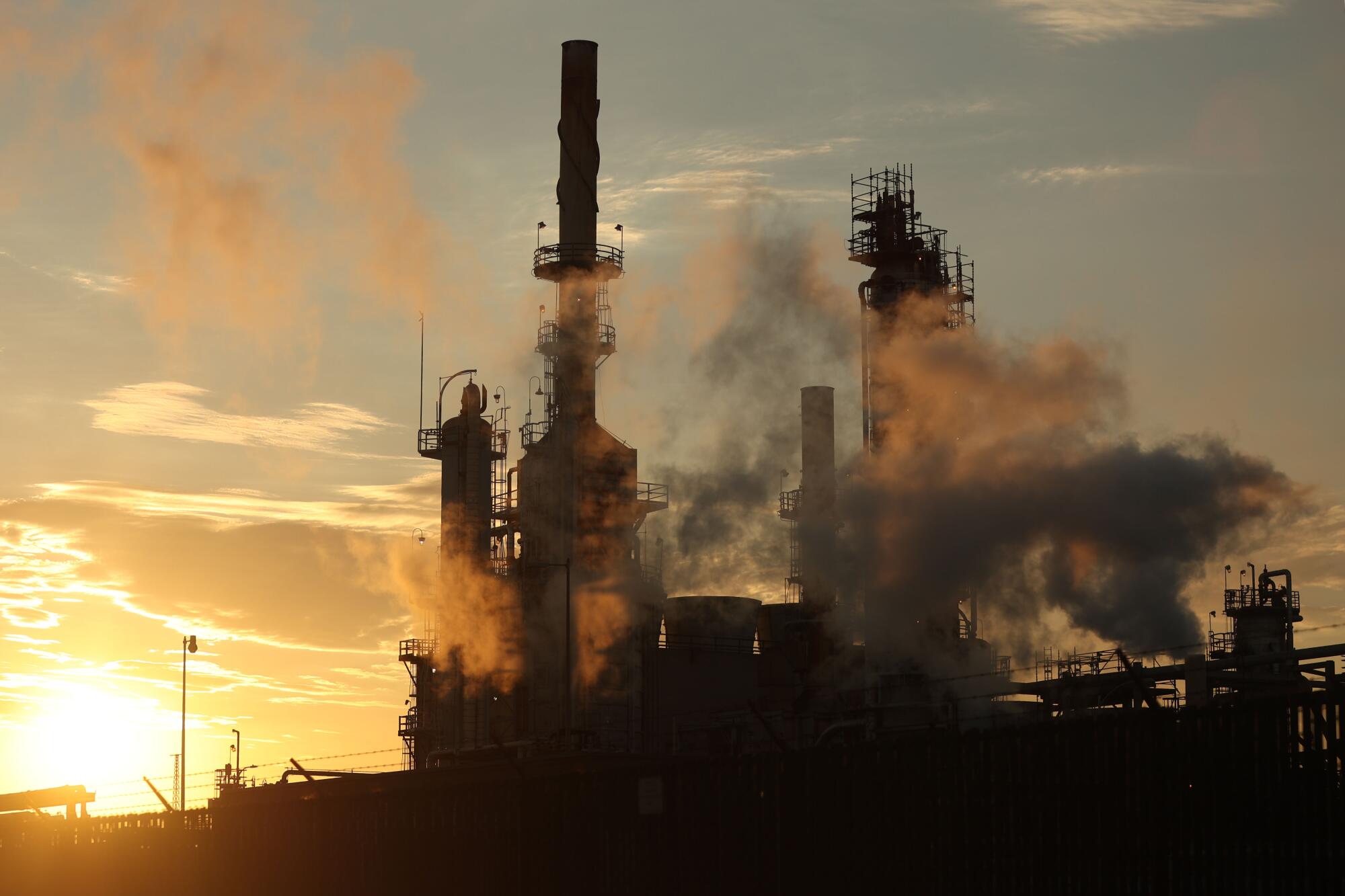
“We have canvassed [local] youth … and discovered that their top environmental priorities are cleaner air, green spaces and green buildings,” says Alyssa Jaipersaud, a member of the L.A. County Youth Climate Commission.
(Michael Blackshire / Los Angeles Times)
If you asked freshman Alyssa what her ultimate career goal was, she would have said, “Facilitate systemic change within the bureaucracy through ecological and climate-preservation policies to make society more sustainably conscious.” I wrote this on an index card and kept it in my backpack throughout college to constantly remind me of the goal because being an environmentalist can be discouraging, given the current climate.
Since then, I think I would have made freshman Alyssa proud. I was accepted into the USC Student Sustainability Committee and became a mentor to new members. The SSC acts as a representative for the student body within the Presidential Working Group for Sustainability. We work on projects such as getting reusable takeout containers in dining halls, ensuring ongoing campus construction is adhering to green practices, and creating a central physical space where sustainability-minded students can gather.
As a member of the SSC, I ensured that sustainability would become a standard educational practice at USC and change student behaviors toward respecting their environment. I continued my education at USC by pursuing a master’s in sustainable engineering, and I have earned the distinction of a National Academy of Engineering Grand Challenges Scholar by focusing on sustainability.
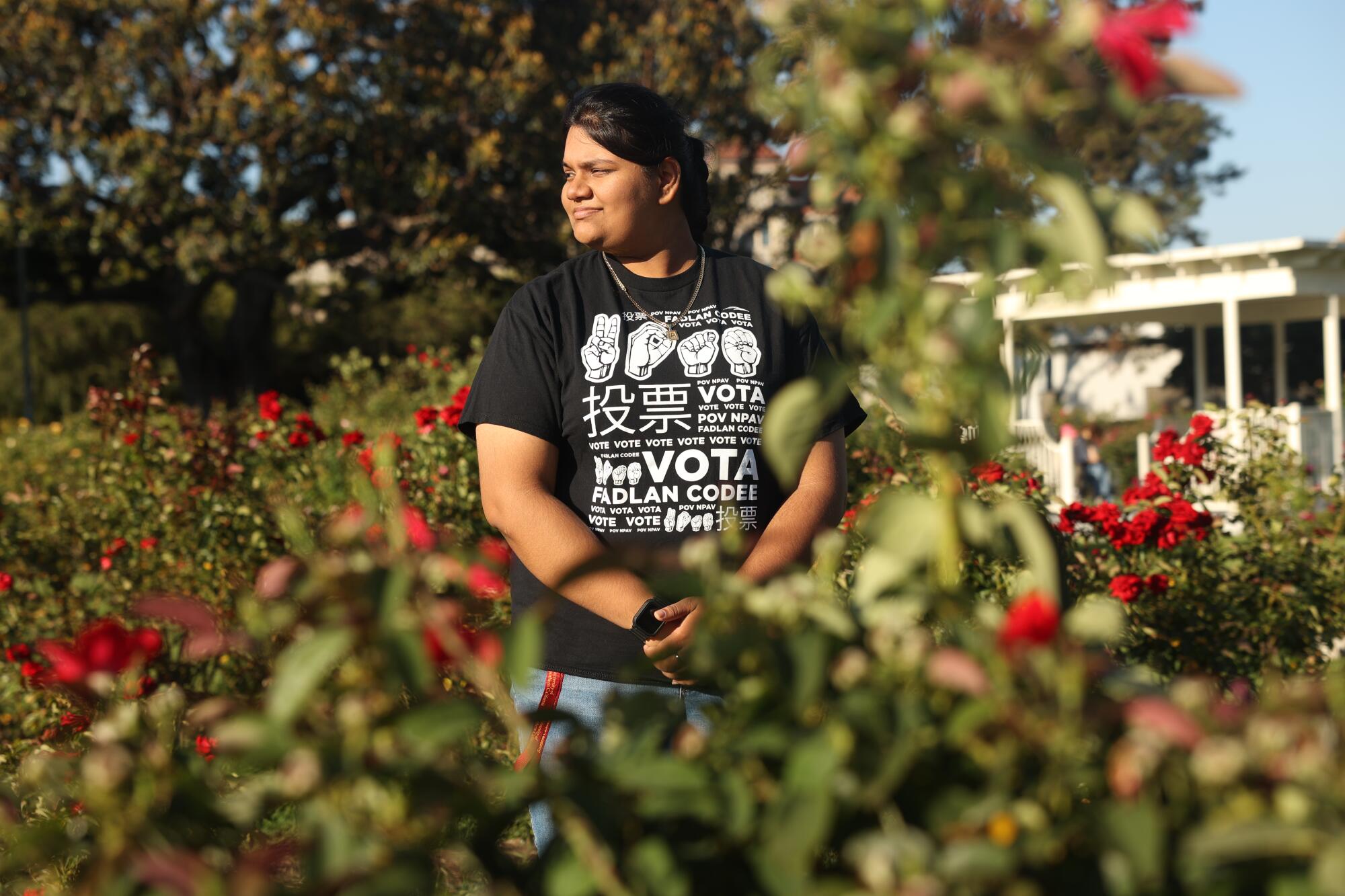
Alyssa Jaipersaud poses for a portrait at Exposition Park Rose Garden.
(Michael Blackshire / Los Angeles Times)
My environmental pursuits have culminated in my becoming a Los Angeles County Youth Climate commissioner in the world’s first such organization. We have canvassed the youth in L.A. County and discovered that their top environmental priorities are cleaner air, green spaces and green buildings.
Now, as a member of the legislative committee, I track all federal and state measures that relate to these priorities and bring them to the attention of the county Board of Supervisors so that they can weigh in on whether the legislation should be amended, supported or rejected. We are working actively to support legislation currently going through the U.S. Senate that would call for establishing opportunities for youths to be involved in policy development so they can ensure a healthy environment for their future and those to come.
Since children are a product of their environment, we should help future generations have a good environment to live in. With the environment constantly changing due to global warming, future generations will have a chance only if we work to make the world sustainable starting today. Instead of forcing future generations to learn how to survive to fix the environmental mistakes we are making today, they should have the opportunity to live without the repercussions of the past.
I witnessed the negative effects of a mistreated environment in my hometown, and I want to make sure future generations aren’t suffering from the consequences of what we are doing. With a sustainability mindset, local changes can influence the politicians and create the systemic change needed to get the biggest offenders under control. One of the significant steps is behavioral changes, which can begin locally and be brought by people not even studying in the environmental field, just like me.
Alyssa Jaipersaud earned a bachelor of science in industrial and systems engineering with a minor in law and public policy at USC and is also completing a master’s of science in sustainable engineering. She is setting her sights on a full-time role in the sustainability industry either as a consultant or practicing engineer.


new video loaded: NASA Announces Artemis III Crew
transcript
transcript
NASA Announces Artemis III Crew
NASA announced the crew of Artemis III mission, which will fly to low-Earth orbit to test rendezvous and docking maneuvers with one or two lunar landers.
-
“I am excited to welcome you as the next crew in the Artemis journey to successfully return to the moon — this time to stay.” “I’m honored by the role that I’ve been given. I’m also very humbled by the task in front of us. But first and foremost, I’m grateful.” “So with that, the Artemis II crew, comrade, hands you the baton. You got the controls.” “As you know, we had a significant anomaly at our Launch Complex 36A on May 28. We’ve redoubled our efforts and are moving forward.”
By Alisa Shodiyev Kaff
June 9, 2026
Science
Santa Monica Mountains’ last steelhead trout survived the Palisades fire — and even had babies

Scientists feared the Santa Monica Mountains’ last remaining steelhead trout were dead, smothered by debris flows unleashed by the Palisades fire.
But the endangered fish surprised them: A team of biologists recently spotted 30 of the rare trout — and 21 babies — in Topanga Creek.
“There was a lot of happy dancing in the creek,” said Rosi Dagit, principal conservation biologist for the Resource Conservation District of the Santa Monica Mountains, which works with public and private landowners to conserve natural resources.
That’s because the steelhead here are endangered, at both the state and federal levels. Once, they swam in most streams of the Santa Monicas, but their numbers plummeted amid overfishing and coastal development. Increasingly frequent wildfire has further stressed their habitat. Topanga Creek, a biodiversity hot spot, is home to their last known population in the mountains that stretch from the Hollywood Hills to Point Mugu in Ventura County.
The trout that were spotted, including this one, are part of a distinct Southern California population that’s listed as endangered at the state and federal levels.
(RCDSMM Stream Team)
The California Department of Fish and Wildlife spearheaded a complex mission to rescue trout threatened by the Palisades fire that sparked in January 2025.
Time was of the essence. The fire hadn’t yet been fully contained. But rain was on the way, which would sweep massive amounts of sediment from the denuded hillsides into the water. Fish are often killed this way.
Crews stunned the fish with electricity, scooped them up in buckets, trucked them to a hatchery and ultimately moved them to Arroyo Hondo Creek in Santa Barbara County.
Within days, Topanga Creek was choked with mud. Some assumed the fish left behind were goners.
But in March, the conservation district’s team found four. The following month, when water conditions were clearer, they saw more.
“These fish continue to amaze me,” said Kyle Evans, environmental program manager for the state Department of Fish and Wildlife, who had seen the damage to the creek. “I had seen populations get wiped out in similar situations. So when I heard, I was thrilled.”
Evans surmises the fish that survived were in an area of the creek where less charred material and sediment were swept in.
“These fish likely hunkered down, were hiding under some rocks or places to try to get away from the main concentration of flow,” he said. “And luckily they weren’t buried.”
The ones that were spotted were fairly small, around 6 to 14 inches. Rainbow trout and steelhead trout are the same species, but with different lifestyles. If the fish remain in freshwater, they’ll be considered rainbows. However, they can migrate to the ocean and become steelhead, where they typically grow larger before returning to their natal waters to spawn.
Topanga Creek hasn’t fully recovered from the damage it sustained, but scientists say it’s looking better. Surveys last year were “so depressing,” Dagit said, with very few animals, and stretches that were essentially transformed into flat roads from all the sediment buildup. Some of the riparian canopy burned right down to the creek.
Then came 32 inches of rain over the last nine months, scouring out and moving sediment, creating deeper pools. Dagit said they recently found newt egg masses for the first time in years, as well as a few adult newts and many frogs. Plants that provide cover are starting to recover.
She provided photos comparing certain pools last year and this year, some dramatically transformed. In September 2025, the Shrine Pool could have been an overgrown hiking trail. This April, it was filled with shallow water.

The Shrine Pool in September 2025, left, and the same location in April 2026, right, with RCDSMM’s Isaac Yelchin donning a wetsuit.
(RCDSMM Stream Team)
Topanga Creek is home to another endangered fish, the small but hardy northern tidewater goby, often described as cute. Not long before the trout operation, Dagit led a rescue of hundreds of these fish too. Many were repatriated to the lagoon at the mouth of the creek in a moving ceremony last June.
There’s still the matter of what to do with the trout that were moved to Santa Barbara County last year. Evans would like to bring them home to the Santa Monicas at some point, but isn’t sure if it will happen. On one hand, they could bolster the small, genetically isolated surviving population. On the other, they might inadvertently bring in a disease or bacteria. There is some time to decide. Evans estimates the creek still needs to recover for two to three more years.
For now, the fish are functioning fine in their adopted creek. Experts worried the trauma wrought by the move would disrupt their spawning process, but they had babies that spring. This year, they spawned again.

The Pacifica Municipal Pier was shut down and taped off Thursday after city workers noticed cracks running through the landmark structure and concrete chunks falling into the ocean.
It’s just one of many coastal California structures that have recently crumbled under pressure from a rising and relentless ocean.
Officials from the small, beach city south of San Francisco said the pier was closed due to “cracking, separation, and displacement of the concrete walkway and structural elements.”
It will stay closed while structural engineers asses its safety.
Photos taken by city employees show a wide crack that runs from top to bottom and across the structure as well. Other photos show a large horizontal crack under the foundation of a small restaurant on the pier, the Chit Chat Cafe.
The cafe was also shut down.
This is not the first time the 53-year-old pier has shown signs of stress. In 2021, part of it was shut down after handrails along the edge collapsed. And in 2023, after a series of storms pummeled the Central California coast, damaging parts of the pier, the structure was partially closed for more than year.
Those same storms caused extensive damage in Aptos and Capitola, 70 miles south, where piers and waterfront infrastructure were swept away or damaged.
In 2024, a 150- to 180- foot section of the Santa Cruz wharf was ripped off by powerful waves.
At least 10 of the state’s dozens of coastal public piers were closed for part or all of 2024 due to structural damage sustained in winter storms since 2022. At least five others have longer-term upgrades planned to address structural issues.
“These things are costly to maintain,” said Zach Plopper, senior environmental director at Surfrider. “They are a part of our California coastal culture in many ways, but we’re going to need to reckon with, one, the state that they’re in, and two, the continuous and worsening threats they’re going to experience,”
He said most of the piers were constructed in the early 1900s, and they weren’t built to withstand decades of rough seas, storms and rising sea level.
“With this incoming El Niño, which is forecasted to be significant, and this marine heat wave we’re in the midst of, we’re kind of in uncharted waters as far as what this winter could bring in terms of storms and swells to the California coast, and we’re likely going to see a lot more damage,” he said. “Not just piers, but roads and other coastal infrastructure up and down the state.”
There was no storm in Pacifica earlier this week, so no single event could be blamed for the destruction.
However, a 2025 report from an outside engineering firm, GHD, found that several sections of the pier were in “poor” or “serious” condition, and they recommended closure before anticipated storms or events that could “subject the piles to high winds, swells and large waves.”
The firm found several areas of the pier where concrete was missing and rebar was exposed and corroding.
“The pier has continued to experience high winds and large waves in a harsh marine environment,” the engineers wrote in the report, noting that continuous exposure to seawater or marine spray was “detrimental” to the structure.
A 2023 city report estimated it would cost $19 million to repair.
That same year, a state law was enacted to require local governments along the California coast to plan for sea level rise in the coming decades.
Sea level has risen some 8 inches, on average, along the coast in the past 150 years, Plopper said, and researchers anticipate another foot in the next 25 years.
“We’re going to see profound shifts on our coastline, none that we have ever experienced before, and building static structures on the coast just doesn’t work all that well,” he said. “We’re going to have to make some really hard decisions.”
-

 Maryland2 minutes ago
Alert Days Wednesday through Friday for severe weather risk, intense heat in Maryland
-

 Michigan9 minutes ago
Trieu: For Michigan State targets, visits, in-state decisions loom
-

 Massachusetts12 minutes ago
Make Father’s Day memorable with these 10 activities in Massachusetts
-

 Minnesota17 minutes ago
Strong winds, downed trees hit Twin Cities, cutting power to 50,000 in Minnesota
-

 Missouri22 minutes ago
New West Boulevard Elementary School principal announced
-

 Mississippi24 minutes ago
How Britain Became as Poor as Mississippi
-

 Montana32 minutes ago
DEQ to host Big Hole River water quality open house in Divide
-

 Nebraska39 minutes ago
Nebraska pitcher enters transfer portal

