Entertainment
Review: A nightmarishly good character actor obscures everything else about 'The Front Room'

“Are you f— kidding me?” a character whispers to herself, disbelievingly, in “The Front Room” (she’s played by singer-actor Brandy Norwood, returning to horror movies 26 years after “I Still Know What You Did Last Summer”). Her puzzled reaction sums up the experience of watching the outrageous parade of bodily excretion and malevolent smirks that make up the directorial debut of Max and Sam Eggers, working from a short story by English author Susan Hill. The twin filmmakers are half-siblings to Robert Eggers, a more notable name in genre cinema, responsible for “The Witch” and “The Lighthouse.” Yet there are hidden pleasures in this over-the-top, tonally bizarre endeavor by the lesser-known Eggers brothers.
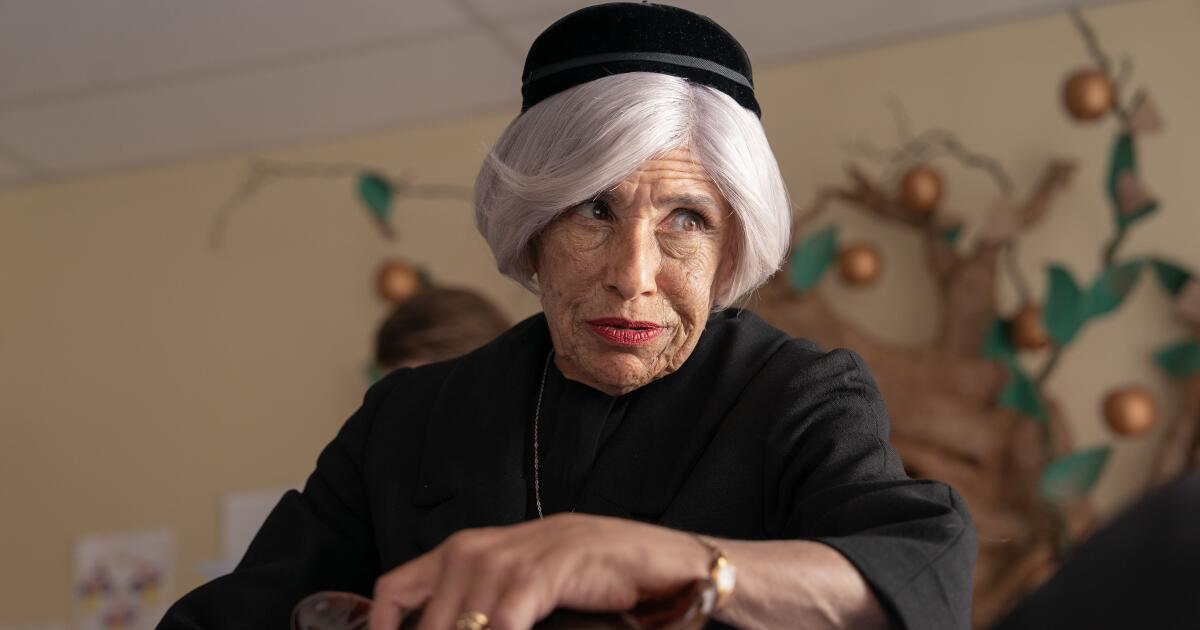
Struggling for money after she leaves her professorship over discrimination, Belinda (Norwood) and her husband Norman (Andrew Burnap), a public defender, are in a bind, one that appears to have a quick fix: After Norman’s father dies, his widow, the über-religious and conniving Solange (Kathryn Hunter), offers to give everything her husband left behind to the couple. The caveat? They must take her in to live with them until her final day.
As someone raised in Solange’s strictly Christian and unapologetically racist household, Norman warns Belinda that his stepmother wouldn’t approve of their interracial marriage. But with a baby on the way, a single income and a house in need of repairs, they accept Solange, a guest who, in time, will insidiously take over their space, thoughts and even the decisions they make as partners.
Andrew Burnap and Brandy Norwood in the movie “The Front Room.”
(A24)
Hunter’s character is introduced at the funeral covered in a black veil and holding onto two sturdy canes. The sound of those walking sticks against the house’s wooden floors become an unnerving motif. She moves with difficulty, as if awaking from a long slumber. But it’s her high-pitched voice and Southern drawl that complete the façade of harmless and sweet benevolence that initially fools Belinda into trusting her intentions. To make matters worse, Solange believes she holds a special connection to the Holy Spirit that manifests by speaking in tongues.
The frightful premise of “The Front Room” doesn’t nearly prepare you what it delivers: laugh-out-loud punchlines, explosive flatulence and moments of such darkly humorous absurdity that would have a more natural home in a raunchy juvenile comedy. Solange’s disgusting behavior as she torments her housemates is what the Eggers seem to be getting at. She seems to demand as much attention as a newborn infant by weaponizing her exaggerated infirmity.
The perverse playfulness with which Hunter handles even the most grotesque scatological scenes fuels a disturbing yet stellar performance, one that’s far more memorable than the movie as a whole. A revered actor with a long career in the theater and seen in recent films such as “Poor Things” and Joel Coen’s “The Tragedy of Macbeth,” Hunter is a disruptive force. Meanwhile, Norwood’s wide-eyed reactions to the jaw-dropping boldness of Solange’s antics serve as a potent grounding agent, leaving her in a wholly justified state of perpetual shock . If “The Front Room” packs any surprises, they certainly come in how far Solange is willing to take her foul attacks.
The Eggers ultimately weaken their concentrated dose of WTF midnight-movie fun by attempting to smuggle in a deeper commentary on race and the overbearing presence of the Judeo-Christian worldview over American society. The dreamlike mishmash of religious iconography and in-your-face motherhood imagery that Belinda witnesses in ghostly visions reads as derivative and unoriginal. (Try instead the 2022 Mexican standout “Huesera: The Bone Woman,” a supernatural thriller also about the perils of first-time parenting, in which the metaphors are better embedded into the story’s fabric.)
A familiar resolution deflates the status the movie had earned up until that point as a wildly unpredictable work of trashy cleverness. The contrived third act notwithstanding, expect audiences in movie theaters to engage with “The Front Room” in audible gasps, one nauseating stunt at a time.
‘The Front Room’
Rating: R, for language, some violent/disturbing content, brief sexuality and nudity
Running time: 1 hour, 34 minutes
Playing: In wide release Friday, Sept. 6

Movie Reviews
1986 Movie Reviews – About Last Night, Big Trouble in Little China, The Great Mouse Detective, Howling II, Psycho III, Under the Cherry Moon | The Nerdy

Welcome to an exciting year-long project here at The Nerdy. 1986 was an exciting year for films giving us a lot of films that would go on to be beloved favorites and cult classics. It was also the start to a major shift in cultural and societal norms, and some of those still reverberate to this day.
We’re going to pick and choose which movies we hit, but right now the list stands at nearly four dozen.
Yes, we’re insane, but 1986 was that great of a year for film.
The articles will come out – in most cases – on the same day the films hit theaters in 1986 so that it is their true 40th anniversary. All films are also watched again for the purposes of these reviews and are not being done from memory. In some cases, it truly will be the first time we’ve seen them.
This time around, it’s July 4, 1986, and we’re off to seeAbout Last Night, Big Trouble in Little China, The Great Mouse Detective, Howling II, Psycho III, and Under the Cherry Moon.
About Last Night
St. Elmo’s Fire was awful. This feels like a make-good for two of the actors.
Danny Martin (Rob Lowe) meets Debbie Sullivan (Demi Moore) and their chemistry is electric and immediate. They waste no time becoming serious, and moving in together, despite neither of them having ever had a serious relationship. They quickly discover it’s not quite as easy as just sharing an apartment like you do with a roommate.
I didn’t love the movie (mainly due to Jim Belushi’s Bernie character), but I did enjoy it far more than I anticipated.Moore and Lowe’s on-screen chemistry really clicked far more than most on-screen couples.
It’s a good character study, and keeps you engaged. Is it essential viewing? That’s up to you.
Where to watch: Available to stream.
Big Trouble in Little China
If there was ever a poster child for a movie that found a second life in rentals and on cable, this is it.
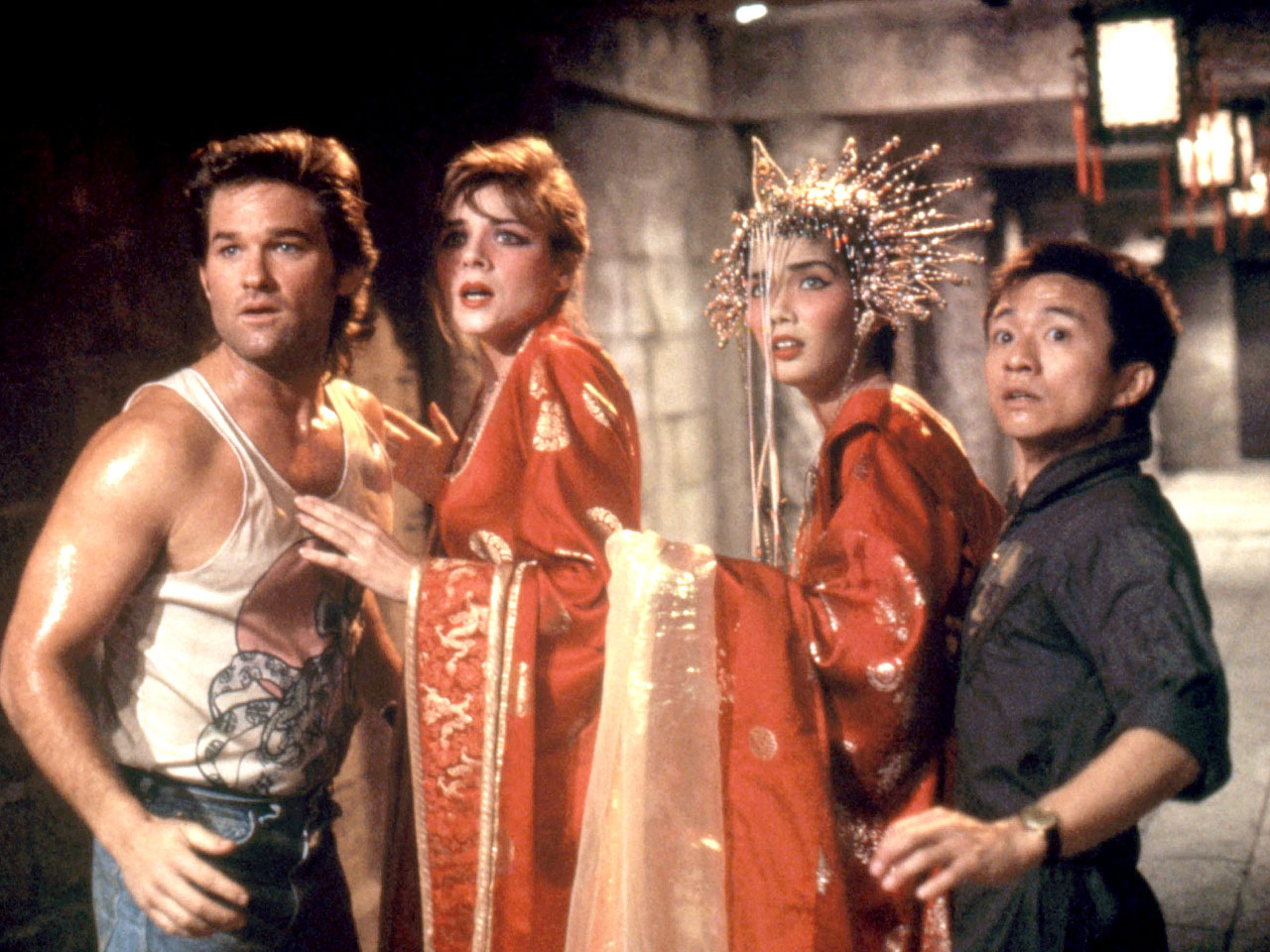
Jack Burton (Kurt Russell) is a over-the-road trucker with a lot of thoughts on life and how important reflexes are. While making a delivery in Chinatown, he gets sucked into a situation with an ancient Chinese evil trying to regain its humanity, and all Jack really wants is to get his truck back.
John Carpenter wasn’t quite a household name, but with films such as Halloween, The Thing and Escape From New York to his name, people were taking notice. Teaming with Russell for another outing seemed like it would be another win, but this one proved just a little too odd for mainstream audiences. Once it got into our homes, however, everyone fell in love with it.
As Jack Burton always says, it’s a must-see for any 80s journey.
Where to watch: Available to stream.

The Great Mouse Detective
I had never seen it, and as Disney films go, I would have been fine keeping it that way.
Set in Longon in 1897, a young mouse named Olivia Flaversham witnesses her toymaker father get kidnapped. She seeks out Basil of Baket Street, also known as the Great Mouse Detective. Along with David Q. Dawson, recently returned from serving in the military in Afghanistan, the three of them try to stop Professor Ratigan from replacing the Queen.
It’s just a Sherlock Holmes story, but with mice. I didn’t find anything that compelling about it. It was pretty enough to look at, but the story just left me fairly empty.
Where to watch: Available to stream.

Howling II
I… have a lot of thoughts.
Following up on the end of the The Howling, Ben White (Reb Brown) buries his sister Karen White, and quickly learns she was a werewolf. He teams up with werewolf hunter Stedan Crosscoe (Christopher Lee) to take down Stirba (Sybil Danning), the queen of the werewolves who is about to celebrate her 1,000th birthday, and stop the spread of the werewolf curse.
On paper it sounds fine, in execution it is just… horrible. Poorly lit, horrible acting, low-grade effects, and costuming that leaves you more confused than anything else.
Avoid at all costs.
Where to watch: Available to stream.

Psycho III
I have to admit, so far these sequels haven’t been horrible.
Following up shortly after the vents of Psycho II, Norman (Anthony Perkins) is still hiding the body of Emma Spool, and having issues again with seeing “Mother.” He hires drifter Duane Duke (Jeff Fahey) to run the motel. He also meets Maureen (Diana Scarwid), a nun on the run after she accidentally kills one of her sisters. With a new woman in his life, Mother has some thoughts on what Norman should be doing.
In general I actually enjoyed this new outing in the franchise, although it feels it missed some opportunities at the end of the story of Norman and Maureen working together. What if Maureen had actually been the one manipulating Norman this time? There was another movie lurking in the background that sadly never gets broached.
What we did end up with, however, was entertaining.
Where to watch: Available to stream.

Under the Cherry Moon
This film was unfairly maligned.
Christopher Tracy (Prince) and Tricky (Jerome Benton) as wooing women in France in hopes of getting enough money to head back to Miami one day. When Christopher hears about Mary Sharon (Kristin Scott Thomas) inherting a trust fund of $50 million for her 21st birthday, she becomes his next mark, but little does he know how it will end for him.
Following Purple Rain, Prince could do no wrong in Hollywood and was given a blank check for his next film. Audiences and critics did not warm to this film as it wasn’t Purple Rain 2 and it lived with a bad reputation for years.
I hadn’t seen it in 35 years or more when I watched it for this report, and… I really enjoyed it. It’s over-the-top, but in the right way. Prince was clearly paying homage to the silent movie romance films, and it works for what it is. Is he a great actor? No. Does it work for this film? Yes.
Honestly, this may be one of the most enjoyable films I’ve had in this project in several weeks. It’s worth a reassessment.
Where to watch: Available to stream.
1986 Movie Reviews will continue on July 11, 2026, with Club Paradise.
Entertainment
Taylor Swift and Travis Kelce: Revisit the roots of their love story ahead of MSG wedding bash

Taylor Swift and Travis Kelce’s love story will reach new heights this week with a totally low-key two-day wedding bash at New York’s Madison Square Garden.
The billionaire pop titan and the NFL star, both 36, kicked off their wedding festivities Thursday afternoon with a rehearsal dinner at the famed sports arena. They have all but confirmed that they will then exchange their vows Friday in a grand MSG celebration with around 1,000 guests (including Swift’s celebrity friends and Kelce’s fellow sports stars) in attendance, at least according to numerous reports. The celebrity wedding will also reportedly feature heightened security around Madison Square Garden, performances by Stevie Nicks and Tim McGraw, and a red carpet outside the arena.
Representatives for Madison Square Garden, Swift and Kelce have not responded to The Times’ requests for comment.
Swift and Kelce’s relationship began nearly three years ago during the singer’s blockbuster Eras tour with a simple request and a friendship bracelet. Read on to revisit the roots of Swift and Kelce’s whirlwind romance turned generational love story, from the Kelce brothers’ “New Heights” podcast to a romantic garden engagement.
July 2023: Travis Kelce shoots his shot
Swift and Kelce’s romance can be traced back to summer 2023, when the Kansas City Chiefs tight end attended an Eras tour concert at Arrowhead Stadium, the Chiefs’ house. Kelce — a self-proclaimed Swiftie — told brother Jason Kelce in an episode of their “New Heights” podcast that he had a friendship bracelet with his phone number on it but didn’t get it to the singer. “I was a little … hurt I didn’t get to hand her one of the bracelets I made for her,” he said at the time. Eventually, the two got in touch.
September 2023: Taylor Swift shows up for her guy
Taylor Swift watches the Chiefs take on the Chicago Bears at Arrowhead Stadium in Kansas City, Mo., on Sept. 24, 2023.
(David Eulitt / Getty Images)
The then-rumored romance quickly became commentary fodder for NFL broadcasts (sometimes to sports fans’ chagrin) but took a turn when Swift seemingly accepted Kelce’s personal invitation to a home game. She was seen cheering for him in a private box alongside his mother, Donna Kelce. Soon enough, Swift became a staple in the Chiefs audience. In the following months, Swift and Kelce further solidified their relationship, making it paparazzi-official during an after-party for “Saturday Night Live” and on her Eras tour in November when the singer changed her “Karma” lyrics to reference her budding romance.
February 2024: Super Bowl LVIII (Taylor’s Version)

Chiefs tight end Travis Kelce and Taylor Swift smooch after Kansas City Chiefs defeated the San Francisco 49ers at the Super Bowl in Las Vegas in February 2024.
(John Locher / Associated Press)
Swift and Kelce’s love notably played out at Super Bowl LVIII, where the Chiefs faced the San Francisco 49ers. When the Chiefs won, the Grammy winner joined Kelce on the field, kissing and hugging him. A week before the big game, Swift announced her album, “Tortured Poets Department,” at the Grammy Awards. The album seemingly refers to Kelce in songs “The Alchemy” and “So High School.”
The pair continued going strong throughout 2024. As Swift‘s tour continued, Kelce joined his superstar girlfriend on stage in London. She also returned regularly to Arrowhead Stadium for Chiefs home games during the 2024-25 NFL season. Swift ended her Eras tour in December 2024 and hosted a private wrap party to celebrate her musical marathon. Of course, beau Kelce was in attendance.
August 2025: Baby, just say ‘yes!’
The following year was a relatively quieter one for the couple. Kelce and his Chiefs failed to beat the Philadelphia Eagles at Super Bowl LIX and Swift was in the midst of recovering from her tour and preparing for her newest album. But just when there seemed to be a lull in all things Taylor-Travis, the couple hit some major milestones.
First, Swift finally appeared on the Kelce brothers’ “New Heights” podcast. Remember, that’s where all of this started. The couple, of course, spoke about their whirlwind romance, but the main headline was that Swift would release her album “The Life of a Showgirl” later that fall. With songs “Redwood” and “Wish List,” it was pretty clear Kelce inspired Swift during the songwriting process.
Second, and more importantly, “Love Story” singer Swift announced on Instagram that she and Kelce were engaged. She shared photos from their dreamy garden proposal with the caption: “Your English teacher and your gym teacher are getting married.” Kelce popped the question with an elongated old mine cut cushion set within an engraved gold band. Speculation on the details of their nuptials, including date and location, were almost immediately underway.
Since their engagement, Kelce and Swift have appeared together at a handful of high-profile events including the iHeartRadio Music Awards in March, courtside at Rocket Arena in Cleveland during the 2026 NBA playoffs and the Songwriters Hall of Fame induction ceremony in June, which honored Swift.
For now, welcome to New York, soon-to-be Mr. and Mrs.
Movie Reviews
Movie Review: ‘Minions & Monsters’ is a very yellow mash note to Hollywood – Sentinel Colorado

-

This image released by Universal Pictures shows a scene from Illumination’s “Minions & Monsters.” (Universal Pictures via AP) -

This image released by Universal Pictures shows minions with the alien character Goomi, voiced by Trey Parker, right, in a scene from Illumination’s “Minions & Monsters.” (Universal Pictures via AP) -

This image released by Universal Pictures shows minion Henry, voiced by Pierre Coffin, left, and Goomi, voiced by Trey Parker, in a scene from Illumination’s “Minions & Monsters.” (Universal Pictures via AP) -

This image released by Universal Pictures shows a scene from Illumination’s “Minions & Monsters.” (Universal Pictures via AP)
Every once in a while, Hollywood gets high on its own supply and makes a love letter to moviemaking. It happened recently with Steven Spielberg’s “The Fabelmans” and George Clooney’s “Jay Kelly.” Now it’s time for the unlikeliest of love-letter writers: canary-yellow, gibberish-speaking, overall-wearing mini-monsters.
“Minions & Monsters” — the third chapter in the ongoing standalone adventures of the “Despicable Me” pint-sized enablers — is about the sheer greatness of moviemaking, and it’s a navel-gazing misfire. Few industries — maybe journalism, sure — is as enamored at making its profession seem heroic.
The Minions this time find themselves at the dawn of both the movie business in Hollywood and the last push by suffragists to get the vote. It’s a weird confluence that writers Brian Lynch and Pierre Coffin fumble.
The movie has playful references to old screen gods — Harold Lloyd dangling from the hands of a clock and Charlie Chaplin swallowed by the gears of a mechanical system — along Hollywood nods to “Casablanca” and the punny title “The Good, the Bad and the Stupid” — but the kids in the audience won’t get them and their parents are just too tired. Harold Lloyd jokes don’t hit as hard in 2026.
Two of the legion of faceless Minions step forward this time — best friends James and Henry, creative misfits amid a smear of yellow drones — to unite and make a movie. (Who knew there was a Minion counterculture?)
Things go very well at first — turns out adding a Minion or two to a cowboy or a heist movie makes them instant kings of the box office — and they soon move into a Beverly Hills mansion and become insufferable. James dreams of winning an Oscar, which in this case is a statuette of a gold banana, a Minion obsession.
But they hit a wall when silent movies turn to talkies. And since they spout nothing but nonsense — “Fantastico” “miso soup” and “vamos” — can’t make the transition. They’re dumped out of the studio system.
That’s when James and Henry finally get the plot going: Make their own killer monster movie by conjuring up real monsters. The first one they try turns out a little weird: The gigantic, fearsome octopus-dragon they request turns out to be a cute green Funko Pop-like critter called Goomi, voiced by Trey Parker. Goomi promises to find them some real monsters. But should we trust him?
Coffin, making his first solo directing effort after co-helming all three “Despicable Me” films and the first “Minions,” voices all the Minions — he must be fun to have at parties — and is an assured hand. The violence levels are a little high for PG, including a beheading and various impalings, plus the usual senseless mayhem.
The screenwriters have included a romantic subplot involving a suffragette voiced by Zoey Deutch who falls for a robot-alien (standout work by Jesse Eisenberg) in a storyline that makes less and less sense. And the framing device — a museum tour guide explaining how Minions shaped Hollywood — sags awkwardly.
Adults can keep awake looking for the Easter eggs Coffin has left for serious cinephiles: “20,000 Leagues Under the Sea,” “Steamboat Bill, Jr.,” “A Trip to the Moon,” “Metropolis,” “Citizen Kane” and “The Blob.” Maybe the best moment in the movie is almost a throwaway: Director George Lucas, appearing as himself.
“Hooray for Hollywood” is on the soundtrack and that might have been the subtitle for the movie itself. There are some people whose eyes get moist thinking about picking up a film camera and following their muse, having their work play in a dark theater to cheers. And then there are others who just want to get on with it already. “Vamos!”
“Minions & Monsters,” a Universal Pictures release that opens in theaters July 1, is rated PG by the Motion Picture Association for “violence/action, language, and rude/macabre humor.” Running time: 90 minutes. One and a half stars out of four.
Related
-

 Los Angeles, Ca1 hour ago
Motorcyclist struck, killed by driver making U-turn in L.A. neighborhood
-

 Detroit, MI2 hours ago
GameThread: Detroit Tigers vs. Texas Rangers, 4:05 p.m.
-

 San Francisco, CA2 hours ago
Why Vogue World Should Definitely Head to San Francisco Next
-

 Dallas, TX2 hours ago
Mistake avoided? Cowboys FA signing could’ve been drafted… but fate
-

 Miami, FL2 hours ago
No Room For LB Ronnie Harrison In Miami?
-

 Boston, MA2 hours ago
Celtics’ Jaylen Brown trade leaves Boston fans, community feeling bankrupt: ‘A huge void’
-

 Denver, CO2 hours ago
Kalshi Promo Code DENVER: Claim $10 Bonus for July 4th World Cup, MLB Trades – Denver Stiffs
-

 Seattle, WA2 hours ago
Experts release new WNBA predictions for Portland Fire vs. Seattle Storm tonight

