West
Colorado police hope missing puppies hold key to dog breeder’s suspicious death: ‘This is such a rare case’

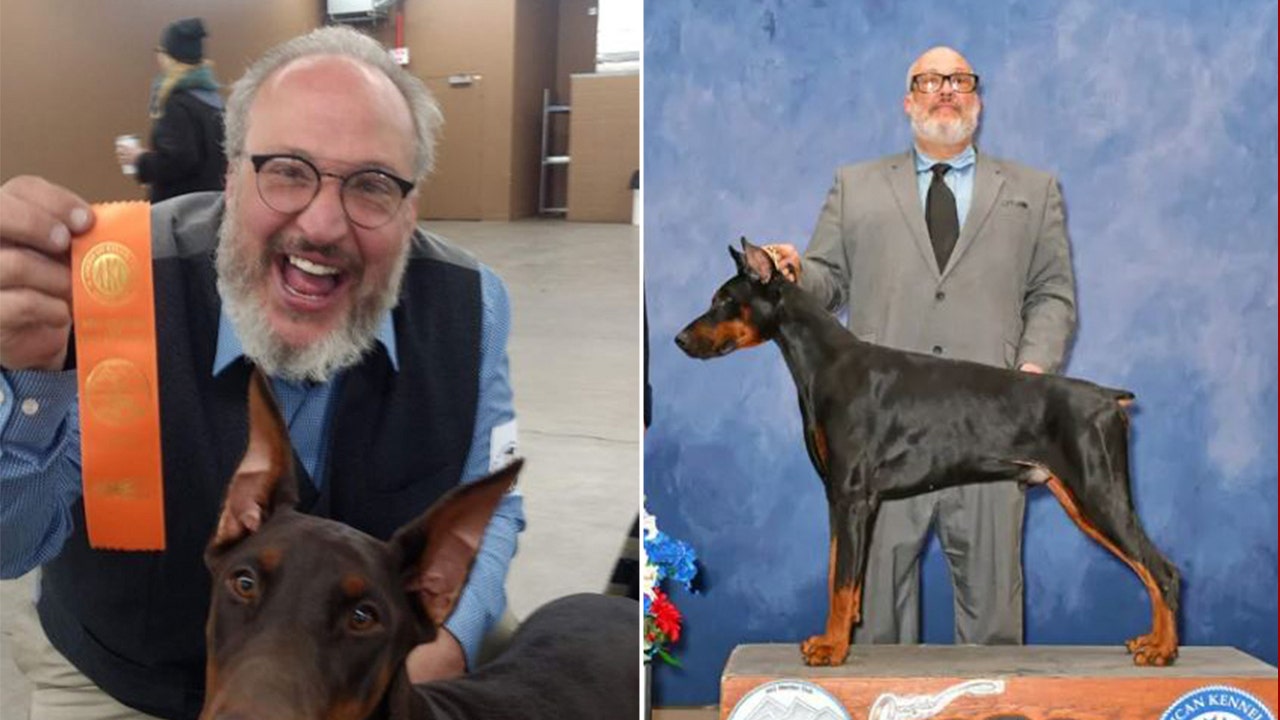
Colorado police hope a missing litter of purebred Doberman puppies could be the key to solving the suspicious death of a decorated dog breeder, “a rare case” that left the dog community with jaws on the ground, one expert said.
Paul Peavey, 57, was found dead on his 110-acre Idaho Springs property by a search party of concerned family members on Saturday.
Although his three adult dogs were unharmed and brought to an area animal shelter, sheriff’s office communication manager Jenny Fulton said on Wednesday that his latest litter of as many as 10 puppies was nowhere to be found.
Police believe the animals, each of which was microchipped, were sold on social media. Anyone who has purchased a Doberman puppy in the Colorado area since Peavey was last seen alive on Aug. 19 is asked to contact the department or bring the animal to a shelter or veterinary office where it can be scanned.
“This is such a rare case that our jaws were on the ground,” American Kennel Club spokesperson Brandi Hunter Munden told Fox News Digital. “We don’t see this – this is not what the sport is made of. It’s tragic to see that this man lost his life, especially because he dedicated his life to dogs. This is not typical behavior among dog breeders. This is definitely different.”
SANCTUARY CITY’S POLICIES PUSH VIOLENT MIGRANT GANG INTO SUBURBS: ‘IT’S A NATIONWIDE PROBLEM’
Paul Peavey, 57, was last heard from on the evening of Aug. 19 and was found dead on his Idaho Springs property on Aug. 24. (Facebook/Elite European Dobermans)
Fulton said Peavey delivered two litters this summer, and anyone who purchased an animal directly from Peavey’s Elite European Dobermans business since June is also asked to contact Clear Creek County detectives. The department wrote in its social media post that “this will help [them] determine how many puppies are unaccounted for.”
“We’ve gotten over 40 tips related to this investigation; probably 25 of those are related to puppies,” Fulton said. “Of those, there are probably half a dozen who have purchased a puppy from Paul.”
The department has not disclosed the condition that Peavey was found in, only saying that they suspect foul play was involved in his death. Fulton said further information will be released after his autopsy.
CO-WORKERS LEAVE COLORADO MAN BEHIND ON MOUNTAIN SUMMIT DURING OFFICE RETREAT
As many as 10 Doberman puppies were missing from Peavey’s property when he was found dead. They were all microchipped, and detectives hope they will be found and provide a lead in the unsolved case. (Facebook/Elite European Dobermans)
“We haven’t quite come to a determination on motive yet,” Fulton said.
Police do not believe that there is a danger to the public, the department wrote in its press release.
“Dog flipping” – the practice of stealing high-value dogs and selling them on Craigslist for a profit – is on the rise in many parts of the United States, according to the FACE Foundation (Foundation for Animal Care and Education).
Although it’s rare, breeders have fallen victim to mass thefts of their purebred dogs. In 2022, for example, a Long Island, New York, dog breeder’s home was broken into by thieves, according to ABC 7, and five French bulldog puppies and two adult dogs were stolen.
“Normally, a dog theft is something quick; they snatch the dog away because it’s outside, from its human. But you generally don’t hear about breeders being targeted in this way,” Munden said.
Paul Peavey is pictured at a Colorado Kennel Club show in February 2024 with his prized stud, Jax Von Maximus. (Facebook/Elite European Dobermans)
Victims of dog flipping are generally targeted in advance, Munden said.
“Someone is aware that they have a litter or an expensive dog breed. It’s someone who had to pay attention,” she said.
Dog trainer Tom Davis told Fox News Digital that purebred Dobermans sell for between $1,000 and $5,000.
Although Peavey did not disclose pricing for his dogs on his website, he priced stud services from his prized male, Jax Maximus Von Zipper, at $7,500.
Read the full article from Here


The San Francisco Giants selected Rutgers outfielder Peyton Bonds in the third round (90th overall) of the MLB draft on Saturday.
You might note the name Bonds and the Giants and wonder. You’re mostly right.
Bonds is the son of Bobby Bonds Jr. (11-year minor league veteran, spending four seasons in the Giants’ system), the grandson of Bobby Bonds (14-year big league veteran who played seven years for the Giants and amassed 57.2 career WAR) and the nephew of Barry Bonds (seven-time MVP, all-time home run king, 22-year veteran, with 15 of those campaigns playing for the Giants).
This wasn’t a nepotism or a feel-good pick: Peyton Bonds is a real talent. He ranked 115th in ESPN’s final draft rankings, which included a number of high school players ahead of him who will be going to college instead of turning pro. Based on his talent, selecting Bonds in the third round was appropriate.
The 6-foot-5, 230-pound outfielder played for Campbell in 2024 then at Rutgers in 2025 and 2026, hitting .305 with 16 home runs over three college seasons. He hit .352 with six home runs and 13 stolen bases this past season.
Bonds has plus raw power like many of his family members. He hit a ball 111.2 mph off a wood bat in batting practice at the MLB draft combine and with a maximum exit velocity of 120.7 mph with aluminum in a game this spring.
Bonds also has above-average bat-to-ball ability (.352 batting average this past season), but a poor chase rate (39%, well worse than average). He is a solid average runner, with enough speed to steal a few bases and possibly stick in center field long term.

DENVER (KDVR) — More sunny and hot conditions are in Denver’s weather forecast for the rest of the weekend and into next week.
Denver weather tonight: Mainly clear
Saturday night will stay mainly clear and warm. Low temperatures will fall to the mid 60s, which is about 5 degrees warmer than normal for this time of year.
Denver weather tomorrow: Sunny, hot
Sunday will be sunny, breezy and hot with wind gusts out of the south southwest picking up to 20-30 mph. High temperatures will climb to the mid 90s, which is more than 5 degrees warmer than normal for this time of year, but well below the daily record of 102 set in 2024.

Looking ahead: Hot week ahead
Sunshine and a warming trend continues on Monday. High temperatures will reach just below the daily record of 100 degrees set in 2003.

More sunny and dry conditions are on the way through the workweek. Every day will start with a low in the 60s, then plenty of sunshine helping to boost high temperatures to the mid to upper 90s.

There is a slight chance for showers, mostly in the High Country, that return by the end of the week and the start of the weekend.

Tech billionaire Vinod Khosla and his family have reached an agreement to buy the Seattle Seahawks for $9.6 billion, according to people familiar with the details, as reported by Variety‘s sibling sports news outlet Sportico.
The deal marks one of the largest valuations ever for a sports team in a control transaction, nearing the $10 billion price tag in Mark Walter’s purchase of the NBA’s Los Angeles Lakers. The India-born Khosla, who is a prominent VC, is worth about $13.7 billion, according to Forbes. He is buying the defending Super Bowl champions from the estate of late owner Paul Allen.
Khosla’s group beat out a handful of other bidders, including a group led by billionaire Aditya Mittal, a member of one of India’s richest families, said the people, who were granted anonymity because the details are private. Sportico was first to report on Khosla’s interest back in May.
Khosla’s wife Neeru Khosla will serve as the team’s control owner, according to a memo that the NFL sent Saturday to its clubs. Neeru Khosla is the co-founder and chair of the CK12 Foundation, an education non-profit. Their son Neal Khosla, the CEO of Curai, will also have a leadership role in the team, according to the memo, a copy of which was viewed by Sportico.
It’s not immediately clear how the deal is being financed. Khosla didn’t immediately respond to an email seeking comment. The Allen estate said Saturday in a statement that the team had been sold to the Khosla family and included a quotation from Khosla himself. The statement did not provide any details about the deal structure or financing, but said the Khoslas would be the team’s new control owner.
The Seahawks are worth $6.59 billion, according to last year’s Sportico numbers, but the team was always expected to sell for quite a bit more than that. It’s relatively rare for NFL teams to sell—this is just the third to formally hit the market in the past decade—and the league’s structure virtually guarantees that each team turns a nine-figure profit annually.
The co-founder of Sun Microsystems, Khosla was one of a handful of local investors that bought into the San Francisco 49ers last year at a valuation higher than $8.5 billion. Sportico reported at the time that Khosla bought the biggest stake, though the specifics were not available.
It’s become common for new NFL owners to be existing LPs in other franchises, a process that gives them familiarity with the league—and vice versa. Billionaire David Tepper, who bought the Carolina Panthers in 2018, was a minority owner in the Pittsburgh Steelers. So was Josh Harris, who bought the Washington Commanders in 2023. Harris’ Commanders group included longtime business partner David Blitzer, who was also a Steelers LP. Khosla will need to sell his 49ers equity if the Seahawks deal closes.
Khosla came to the U.S. in his early 20s. He earned an MBA from Stanford, and co-founded Sun Microsystems in 1982, serving as the tech company’s first CEO. His VC career started at Kleiner Perkins, and he launched Khosla Ventures in 2004. His firm’s notable exits include Affirm, Opendoor and DoorDash, which all went public.
New NFL owners are heavily restricted in how their financing can come together. There is a $1.5 billion debt limit, and the control owner must hold a minimum of 30% of the equity. Institutional funds can own 10%, and the total group cannot exceed 24 minority owners.
The Seahawks are being sold by Allen’s estate, which assumed ownership after his 2018 death. Allen’s will called for his sports assets, which included the Seahawks and the NBA‘s Portland Trail Blazers, to be sold to benefit charitable causes. His sister Jody Allen, the executor of his will and trust, has run the teams in his absence. The Trail Blazers were recently sold for $4.1 billion to a group led by Tom Dundon.
To date, the most expensive NFL team ever purchased in a control sale is the Commanders ($6.05 billion), while the Los Angeles Lakers are the most expensive sports team acquired in a control sale ($10 billion). A minority stake in the parent company of the Miami Dolphins recently sold to a Chinese billionaire at a $12.5 billion valuation.
Mittal previously contributed about $1 billion to the 2025 takeover of the Boston Celtics, his first major move into U.S. sports. His Seahawks bid group included former Celtics control owner Wyc Grousbeck, Sportico previously reported.
Latham & Watkins was legal advisor to the Allen estate in the transaction.
(Pictured: Seattle Seahawks wide receiver Cooper Kupp on Feb. 8 at the 2026 Super Bowl held at Levi’s Stadium in Santa Clara, Calif.)
-

 Los Angeles, Ca43 minutes ago
19-year-old arrested, accused of distributing marijuana to minors across Riverside County
-

 Detroit, MI1 hour ago
Phillies end the Tigers’ winning streak at 6 with a 4-2 victory
-

 San Francisco, CA1 hour ago
Giants select Barry Bonds’ nephew Peyton in third round
-

 Dallas, TX1 hour ago
Mark Cuban takes legal action against the Dallas Mavericks ownership over proposed arena deal
-

 Miami, FL1 hour ago
South Florida businesses report economic boom, as FIFA officials estimate a billion dollar economic impact
-

 Boston, MA1 hour ago
Forecast: Looking ahead to toasty temps next week
-

 Denver, CO2 hours ago
Denver weather: Warming trend continues this weekend and into next week
-

 Seattle, WA2 hours ago
Tech Investor Vinod Khosla to Acquire the NFL’s Seattle Seahawks for $9.6 Billion

