Austin, TX
Student sues UT Austin after arrest during pro-Palestinian protest

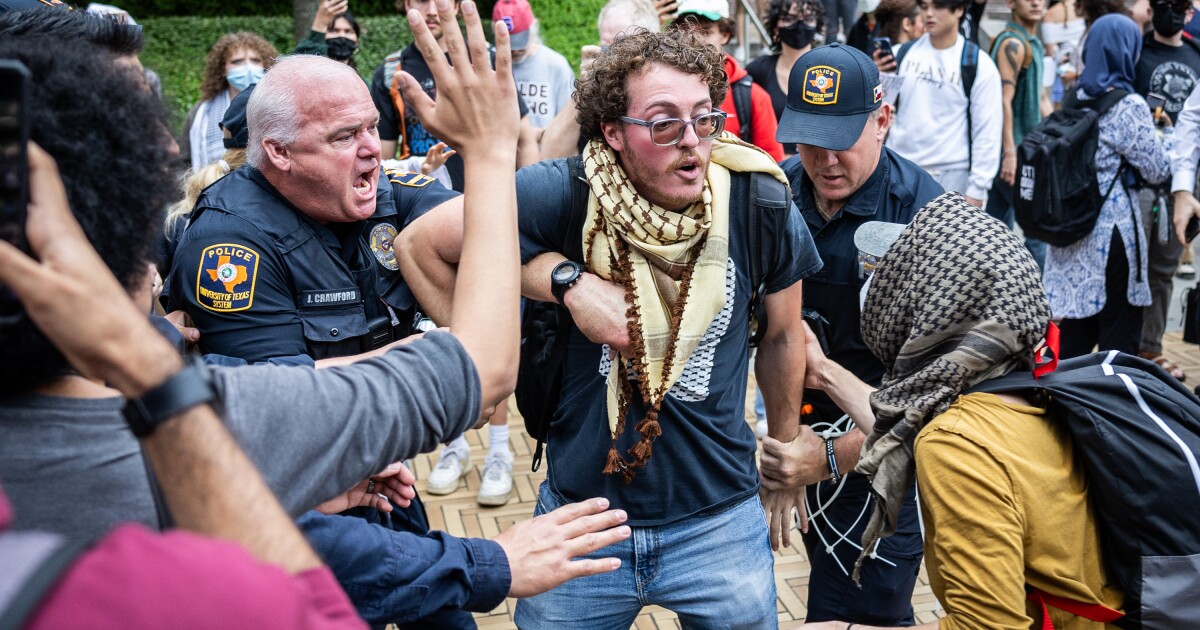
A UT Austin student is suing the university and two of its leaders, claiming they violated his First Amendment rights when he was arrested while protesting Israel’s war in Gaza.
Ammer Qaddumi, now a senior at UT, also claims that the university, President Jay Hartzell and Provost Sharon Wood wrongfully retaliated against him by threatening him with suspension. An attorney filed the lawsuit in federal court on Tuesday, which was first reported by KXAN.
“These were kids who were walking down the sidewalk chanting, ‘Hey, hey, ho, ho, the occupation’s got to go,” Brian McGiverin, Qaddumi’s lawyer, said. “There’s nothing dangerous or scary or frankly remarkable about it as far as First Amendment activity goes.” McGiverin says he believes this is the first lawsuit filed by a student over the university’s response to the protests.
Qaddumi is asking for the university to pay for damages and to stop any further disciplinary action against him.
KUT reached out to a UT Austin spokesperson for comment. “[T]he University’s response to the lawsuit and claims will be set out in our court filings,” university spokesperson Mike Rosen wrote in an email. “Until then, no further comment.”
The lawsuit is the latest in the fallout from two pro-Palestinian protests held on UT Austin’s campus in April. University officials called on state law enforcement to intervene and police arrested more than 130 participants — many of them for criminal trespass. County officials later dropped most of these charges.
Michael Minasi
/
KUT News
Since then, students arrested at the protests have faced discipline, including probation and suspension. Faculty have criticized the university’s response to the protests, including in a recent report where a university committee alleged administrators, not protesters, violated institutional rules.
Qaddumi and his lawyer say the university first violated his rights when they told organizers they could not hold the planned demonstration. His lawsuit alleges the university stifled students’ speech before they had a chance to express themselves.
Despite the university’s directive, dozens of protesters gathered the next day on the South Mall. As police arrived and began to encircle the group, they asked for a mediator and Qaddumi volunteered, according to the lawsuit.
Both the university and Qaddumi’s lawyer say the student told demonstrators to follow the order to disperse. University officials say he then rejoined protesters. Police arrested him just before 1 p.m. His lawyer says by restraining Qaddumi, the university and its officials violated his right to free speech.
Several months after the protests, UT sent notice to Qaddumi and other students that they faced discipline for allegedly violating university rules.
According to documents filed as evidence in his lawsuit, the university has threatened to suspend Qaddumi for three semesters, during which he would not be able to enroll in classes or enter campus without written approval.
He is protesting this decision and has a hearing Friday, according to his lawyer.
The university has defended its response to the April protests by citing several rules officials say protesters broke, including failing to disperse when told by police and administrators to do so. The university has also said protesters brought a variety of weapons to campus, but county prosecutors refuted that claim. In May, one man from San Marcos was charged with illegally carrying a gun during the protests.


AUSTIN (KXAN) — The Fourth of July is just around the corner, and with it being America’s 250th birthday this year, celebrations will be big. But before you stop at your local fireworks stand, you should be familiar with the laws surrounding fireworks.
In Austin, fireworks are illegal to possess or use within city limits, unless a permit has been issued for a professional display, according to the city. Requests for aerial fireworks must be submitted at least 30 days ahead of the event.
Most major cities in Texas have similar fireworks bans in city limits, too.
At the state level, Texas only allows the sale and use of consumer fireworks under specific conditions. The Texas Occupations Code § 2154 outlines the laws surrounding who can sell fireworks, when sales are permitted, and what types of fireworks are allowed.
According to the Texas Association of Counties, the state allows the sale of fireworks during nine periods annually.
Those times are Fourth of July, December holidays (Christmas through New Year’s), Lunar New Year, Texas Independence Day, San Jacinto Day, Cinco de Mayo (only counties not more than 150 miles from Texas-Mexico border), Memorial Day, Juneteenth and Diwali.
Commissioners’ courts typically have to approve the regulation of fireworks within a certain timeframe ahead of each holiday.
The 2026 fireworks calendar can be found here.
According to Daly & Black P.C. Trial Lawyers, violations of fireworks laws can result in fines of up to $2,000 per incident and, in certain cases, criminal charges.
When Texas does allow the sale of fireworks, it only includes “consumer fireworks,” which are things like:
- Roman candles
- Sparklers
- Ground spinners
- Aerial shells (under specific size limits)
However, Texas law outright prohibits certain fireworks, which are considered too dangerous for consumer use. Those typically include:
- Sky rockets and bottle rockets
- Missiles with fins or rudders for aerodynamic flight
- Explosive fireworks exceeding 200 grams of pyrotechnic composition
Always check local burn bans and fireworks restrictions before popping fireworks.

A long holiday weekend and America’s 250th birthday are giving Central Texans even more reasons to celebrate this Fourth of July. From fireworks over Lady Bird Lake and Willie Nelson’s annual picnic to hometown parades and rooftop parties, there are plenty of ways to spend the day around the Austin area.
Here’s a look at some of the biggest events, from Austin’s signature Star-Spangled Fest to neighborhood traditions and Hill Country celebrations. Unless otherwise noted, all events take place Saturday, July 4.
The main events
Star-Spangled Fest
Auditorium Shores & Long Center, 900 W. Riverside Dr.
Austin’s signature Fourth of July celebration stretches from morning to night as the city marks America’s 250th anniversary. The day begins with The Morning Spin from 10 am to 1 pm, featuring house music, craft coffee, cocktails, local vendors, and food trucks. The evening festival returns at 4:30 pm with kids’ activities, food trucks, and performances by Austin soul-funk favorites Tomar & the FCs, country singer Shelby Stone, a Veteran Recognition Celebration, and the Austin Symphony Orchestra’s annual patriotic concert before fireworks over Lady Bird Lake at 9:45 pm. The concert and fireworks will also be simulcast on KMFA 89.5. A number of parking garages are open around the park. General admission is free. VIP Lawn Access starts at $45, while reserved tables and private cabana experiences range up to $2,500. Tickets and VIP packages are available through the Star-Spangled Fest website.
Several downtown hotels and rooftops are offering elevated alternatives to the crowds below along Auditorium Shores.
- P6 at The Line Austin is hosting its “Creole Surf Riot” celebration with live music by Louisiana Surf Department, Creole-inspired food stations, and two complimentary drinks. Early bird tickets start at $75, with general admission at $90.
- The Loren at Lady Bird Lake is celebrating with a waterfront barbecue, curated beverages, and live music by Working Title. Reservations are available from 6-10 pm, with the band performing from 6-11 pm. Admission is $98 per person, plus a 17 percent gratuity. The hotel recommends making reservations in advance, as last year’s Fourth of July celebration sold out.
- Otopia Rooftop at The Otis Hotel in West Campus is hosting a Fourth of July party from 7 -11 pm, featuring specialty cocktails with Still Austin Whiskey Co., a complimentary welcome cocktail, light bites for purchase, and giveaways. Tickets start at $23.18. The rooftop offers skyline views, though organizers note the downtown fireworks display is not visible from the venue.
Willie Nelson’s Fourth of July Picnic
Germania Insurance Amphitheater, 9201 Circuit of the Americas Blvd., Del Valle
Fresh off his 93rd birthday, Willie Nelson returns to Circuit of The Americas for the latest edition of his annual Fourth of July Picnic, a Texas tradition spanning more than five decades. This year’s lineup features Willie Nelson & Family, bluegrass phenom Billy Strings, alternative rock legends Wilco, Rock & Roll Hall of Famer Sheryl Crow, Lukas Nelson, Stephen Wilson Jr., Rodney Crowell, Margo Price, and Lily Meola. The evening concludes with fireworks. Gates open at 2:30 pm and music begins at 3:30 pm. Most tickets are priced around $100, with options ranging from reserved seating to pit tickets and VIP packages. Tickets, VIP packages, and the full event lineup are available on Willie Nelson’s official website.
Hill Country Galleria Independence Day Festival
12700 Hill Country Blvd., Ste. T-100, Bee Cave
Families looking to avoid the downtown crowds can head west for one of the area’s biggest free celebrations honoring America’s 250th birthday. More than 40 artisan vendors, carnival rides, water games, and complimentary face painting fill the afternoon before an evening of live music. School of Rock opens the entertainment at 4 pm, followed by CAZAYOUX, Jeska Forsyth, Jo James, and Austin Latin rock veterans Vallejo. Then fireworks complete the event. Attendees are invited to bring a lawn chair or blanket. The festival runs from 4-10 pm, with fireworks scheduled for about 9:40 pm. Admission and parking are free.
Red, White & Buda
Buda Amphitheater & City Park, 204 San Antonio St., Buda
Buda turns Independence Day into an all-day celebration, beginning with the community’s annual Bike Parade at 9 am. Festivities resume at 4 pm with a DJ, bounce houses, a splash pad, food vendors, a vendor market, cornhole, sand volleyball, and rock climbing. Live music begins with Elle Townley at 6:30 pm, followed by Shinyribs, the Gulf Coast soul and swamp-funk band led by former Gourds frontman Kevin Russell, at 7:40 pm. The evening concludes with fireworks at about 9:15 pm. Admission is free.
Free neighborhood parades and hometown traditions
Northwest Austin Civic Association
Austin’s largest neighborhood Independence Day parade happens in the North Austin Civic Association, at the 53rd annual Fourth of July Parade and Freedom Fest. The festivities begin with a community breakfast at 7:30 am, followed by the parade at 9 am. Austin Mayor Kirk Watson will serve as grand marshal as decorated bicycles, antique cars, marching bands, community groups, and the popular Ladies Lawn Chair Brigade wind through Northwest Hills before the Freedom Fest continues with family activities.
Members of the Northwest Austin Civic Association’s Arm Chair Brigade gather with parade grand marshal Council Member Alison Alter before the neighborhood’s annual Fourth of July parade in Northwest Austin.Alison Alter/Facebook
Cedar Park
Cedar Park’s Sparktacular returns to Milburn Park with live music, carnival rides, inflatables, food trucks, and fireworks at 9:30 pm.
Georgetown
Georgetown’s celebrations last all day with amusement rides and games, a kiddie parade, arts and crafts booths, food vendors, live music, and a fireworks show to round it all out.
Lakeway
Lakeway’s Fourth of July Celebration begins with its annual parade at 8:30 am, followed by family activities before the city’s evening fireworks display.
Leander
Leander is getting things started early with Liberty Fest on July 3. There will be live music and food, plus activities for kids and fireworks to end the day.
Pflugerville
Pflugerville’s Pfireworks lights up Typhoon Texas with live music, food vendors, family activities, and one of the area’s largest fireworks displays.
Round Rock
Just north of Austin, Round Rock’s Frontier Days begins with the annual Sertoma Independence Day Parade at 8:30 am along Mays Street. Giant helium balloons, festive floats, marching bands, and community groups kick off a full day of carnival rides, pig races, live music, and festival food before the evening’s fireworks show.
America250
Want to keep celebrating America’s 250th birthday? The Fourth of July is only the beginning of the nation’s yearlong semiquincentennial celebration.
Texas America250 exhibit
Lorenzo de Zavala State Archives and Library Building, 1201 Brazos St.
This exhibit next to the Texas Capitol spotlights the Lone Star State’s outsized role in American history through historic photographs, maps, artifacts, sheet music, state records, and other treasures from the State Archives. From cowboys to astronauts, and from Beaumont to Big Bend, the exhibit explores how Texas helped shape the nation. The exhibit is on view throughout 2026.
Other things to see at the archives include:
For even more, the Texas America250 events calendar lists celebrations taking place across the state throughout the year.

“We’re thrilled to expand our relationship with the team at NRP and our focus on the Affordable Housing market in
The transaction represents Safehold’s second transaction with NRP in
Safehold established a dedicated Affordable Housing team in 2025 and has continued to expand its investment into the sector. Additional information is available at www.safeholdaffordablehousing.com.
About Safehold:
Safehold Inc. (NYSE: SAFE) is revolutionizing real estate ownership by providing a new and better way for owners to unlock the value of the land beneath their buildings. Having created the modern ground lease industry in 2017, Safehold continues to help owners of high quality multifamily, affordable housing, office, industrial, hospitality, student housing, life science and mixed-use properties generate higher returns with less risk. The Company, which is taxed as a real estate investment trust (REIT), seeks to deliver safe, growing income and long-term capital appreciation to its shareholders. Additional information on Safehold is available on its website at www.safeholdinc.com.
About The NRP Group:
The NRP Group is a vertically integrated developer, owner, builder, and manager of best-in-class multifamily housing with a mission to create exceptional rental housing communities for individuals and families, regardless of income. Since its founding in 1994, NRP has developed more than 62,000 apartment homes and currently manages over 30,000 residential units. Through its disciplined approach to vetting opportunities, NRP has established a track record of delivering impressive returns for investors. The company’s formidable size and depth of talent provide the experience and infrastructure necessary to execute developments of varying degrees of complexity and scope in both urban-infill and suburban locations, including market-rate, affordable, mixed-income, and senior housing. The NRP Group has been consistently named a largest developer and builder in the U.S. on the NMHC “Top 50” lists, the Top 5 on the Multi-Housing News’ “Top Multifamily Developers” list, named a Top Affordable Housing Developer by Affordable Housing Finance, and has won three NAHB Pillar awards since 2020 for Development, Construction and Ones to Watch. The NRP Group has become the top multifamily developer in the U.S. that creates both affordable and market-rate housing at a national scale. Based on over 30 years of experience and expertise, NRP provides construction and property management services to outside owners and developers. For additional information, visit www.nrpgroup.com.

View original content to download multimedia:https://www.prnewswire.com/news-releases/safehold-closes-second-affordable-housing-ground-lease-in-texas-302809796.html
SOURCE Safehold
-

 Utah4 minutes ago
Utah weather conditions trigger historic red flag warning as wildfires rage in state
-

 Vermont11 minutes ago
Arlington Common, Albert Construction recognized by Preservation Trust of Vermont
-

 Virginia13 minutes ago
Virginia Cannabis: Will Retail Finally Start In 2027?
-

 Washington18 minutes ago
Touring Trump’s Washington: How the president is putting his imprint on the nation’s capital
-

 Wisconsin26 minutes ago
Northwest Wisconsin Highway Construction Update – Jun. 26, 2026
-

 West Virginia28 minutes ago
West Virginia AD: McAfee’s Value to School ‘Maybe Eight Figures’
-
 Wyoming34 minutes ago
Politicians mull action as details of alleged abuse, falsified records at Wyoming Boys’ School become public
-

 Crypto41 minutes ago
CLARITY Act Needs 60 Votes and 7 Democrats as GOP Races the August Recess Clock

