Sports
Why USMNT coaching target Mauricio Pochettino could turn to lemons in quest for World Cup glory


If and when Mauricio Pochettino moves to the United States and becomes U.S. men’s national team head coach, he’ll be in for an adjustment.
Atlanta, Georgia — the future site of U.S. Soccer’s headquarters and training center — is a far cry from Barcelona, Paris or London. Atlanta is, by most accounts, cosmopolitan, but it’s likely missing a bit of the Old World charm possessed by some of Pochettino’s previous stations in life.
Maybe he’ll work to decorate his office to give it a touch of those places. A photo of his former roommate and teammate at Newell’s Old Boys, Diego Maradona, might get thrown up on one wall. Maybe a jersey from his time at Paris Saint-Germain, or La Liga side Espanyol, the club that formed him more than any other.
And, of course, there will be lemons.
You see, in at least one sense, Pochettino is already uniquely equipped for life in America.
The 52-year-old Argentine has a bit of an obsession with the types of motivational techniques and borderline supernatural beliefs that many Americans are obsessed with.
GO DEEPER
Is becoming USMNT head coach the right move for Mauricio Pochettino?
If you’re an insomniac, you’ve probably seen the late-night infomercials. Pochettino will speak of auras, of self-determination, of bravery. He’ll walk you over hot coals, or walk you into a wall with an arrow pressed to your throat. Spend enough time around the guy and you might end up in a trust fall.
And then there are the lemons. Walk into Pochettino’s office in Atlanta once he gets settled and you’ll surely see the lemons.
“An Argentinian friend told me that lemons absorb negative energy and cleanse the air,” Pochettino writes in Brave New World, a book which documents his five years as head coach of London-based Premier League club Tottenham Hotspur. “Which is why I have a tray of them in my office.
“We all have the potential to see the energy that surrounds objects and people, although not everyone has honed that sense. For whatever reason, I’ve been able to develop an ability which allows me to see others’ auras.”
Indeed, Brave New World, a breezy, 267-page read produced alongside Spanish author and journalist Guillem Balague, is full of motivational buzzwords. Search for the word “brave” and you’ll find some version of that word used on 18 different occasions. “Energy” is in there 40 times, “aura” a half-dozen. Lemons, well… they get just the one mention.

(Julian Finney/Getty Images)
Pochettino is famously thorough in how he prepares his teams for play, both from a tactical standpoint and from a fitness perspective. Equally as important, though, are his motivational beliefs and the faith he puts in his players. Those beliefs underpin everything Pochettino does as a manager. And in a way, many of those beliefs were formed with the help of Xesco Espar.
Espar first met Pochettino while the Argentine was finishing his playing career at Espanyol in the mid-2000s. A few years later, when Pochettino became that Barcelona club’s head coach during a fierce La Liga relegation battle, the two reconnected. Pochettino had read Espar’s book Jugar con el Corazon (Play from your Heart) — and felt it closely mirrored his own philosophies. Espar, a former handball player and coach who led FC Barcelona’s handball team to a European championship, was happy to help.

GO DEEPER
Who is Pochettino? Is this a coup for the USMNT? Will it help them at World Cup?
Years later, when Pochettino took over a promising Southampton side midway through the 2012-13 Premier League season, Espar remembers his friend feeling frustrated.
“The first time we talked (after he arrived) he said, ‘These players are much better than they think’,’” says Espar. “‘We have to do something to make them realize this’.”
Espar and Pochettino pulled their solution right out of an American corporate retreat.
In the following preseason, the squad went to Espar’s home base in Spain for a few days of seminars and motivational talks. And then they all filed outside, where they saw a bed of hot coals laid out in front of them. Pochettino went first, calmly and cooly traversing the briquettes without a hint of hesitation. Newcomer and current CF Montreal midfielder Victor Wanyama had a tougher time, as did 31-year-old striker Rickie Lambert, who approached with clear hesitation. In the end, they all passed over the coals, egged on by their teammates and by Pochettino himself.
“It was just a metaphor for breaking your own beliefs about yourself and what you can do,” says Espar. “And they had an amazing season. They were safe (from relegation) very quickly (and finished eighth in the 20-club English top flight, Southampton’s highest final placing for 11 years). He trusts the players. This is one of his main characteristics.”

Pochettino used motivational techniques on his Southampton players (AMA/Corbis via Getty Images)
Espar picked up the hot-coals trick from Tony Robbins, who is maybe the poster child of self-help and motivational techniques in the United States. Pochettino also had his players do something a little bit more terrifying — place the shaft of an arrow on the soft tissue around their throat and lean against a board until it snapped.
His motivational beliefs, though, extend well beyond the Robbins-inspired team-building exercises. There’s his belief in the power of a handshake — at Spurs, Pochettino required players to shake his hand every morning as they entered the team cafeteria, and do the same with each other as well.
“When you touch some people, you feel the energy,” Pochettino once said in a podcast appearance. “You feel if it’s good, if they need love, if they’re upset, if they sleep well. You can have a lot of information that is so important afterwards to manage — you are not managing a robot, you are managing a person that you’re going to ask for the best form. You are going to try to get the best to try to achieve all that you want.”
Instituting mandatory handshakes was likely just a bonding exercise at Spurs, but to Pochettino, he may have been after something more. While the Argentine relies on sports scientists and analysts for performance data, he relies on personal contact with players to gauge another metric: their aura.
GO DEEPER
Pochettino’s tactics: How he can energise the USMNT ahead of the 2026 World Cup
“I believe nothing happens by chance,” Pochettino writes in Brave New World. “There is a reason for everything.
“Since those early days, I’ve had the ability to notice something powerful that you can’t see, but that does exist. A vital force, an energy field that makes the world go round, an aura that accompanies people, which gives lots of information about them. It’s in my skin, I feel it. (Wife) Karina and I call it ‘universal energy’. My wife helped me get to grips with it and gain a more in-depth understanding. Others helped me explore those feelings further. It isn’t superstition or black magic. I believe there is science behind it.”
American soccer fans are not unfamiliar with team-building or motivational quackery.
Previous USMNT boss Jurgen Klinsmann is German but was as close to a native Californian as he could be by the time he took the head coaching job in 2011, having lived there for the preceding 13 years, and it often felt like a lot of his remarks about players and his coaching philosophy felt steeped in West Coast self-help jargon.
If Pochettino’s trip over the hot coals feels like a scene out of The Office, Klinsmann took things a step further by having his players watch a 55-year-old dude in a tracksuit tear up a few phonebooks and bend a frying pan in half.
USMNT legend Tim Howard spoke about Klinsmann’s approach recently. He did not hold back.
“I don’t remember a time when there was a bigger disconnect between the players and the manager than under Jurgen,” former goalkeeper Howard wrote in the UK’s Daily Mail newspaper. “He organized a lot of team excursions. He specialized in fluff and philosophical rhetoric. But there was zero soccer.”
Such is not the case with Pochettino, of course, who would bring an extensive coaching resume with him and a reputation not only for man-managing but also managing the game itself. “He uses very advanced analytical techniques as well,” adds Espar. “He is not just a ‘motivational guru’ or something like that. He has a strong playbook, a strong model and methodology of the game and training and physical conditioning. It’s not just motivational stuff.”
The Argentine is explicit with players about positioning, almost micromanaging that aspect of the game, and about building play from the back. He also puts an extreme emphasis on trust and relationship building. Pochettino, famously, does not fine players for minor infractions and he never enters the changing room at the training facility. In many ways, he delegates much of the responsibility for leadership to the players themselves.
“He balances leadership and management,” says Espar. “Management is talking to the player’s head, leadership is talking to the player’s heart. He is very good at balancing those things. He has a strong structure in training, with practices, assistants, all of that work. And then he also trusts the players more than most other coaches. He gives the power to the players. He gives recognition to players, but he also gives accountability to them.
“For both of us, the difference between a championship team and a team that wins multiple championships is who holds the accountability. In a championship team, the coach holds the accountability. But in a multi-championship team, it is the players who hold each other accountable. That is one of the main philosophies for Pochettino. He sees the players better than what they already are.”
But let’s not forget about the lemons.
Because after all of this work, after forming a deep well of knowledge and crafting his own unique vision for his team, Pochettino still relies on a citrus fruit — at least a little bit — to turn the ship around.
The USMNT is in a bit of a low moment right now after having crashed out of this summer’s Copa America on home soil and is seeking a turnaround ahead of the 2026 World Cup, which they’ll co-host with Canada and Mexico. If Pochettino has anything to say about it, the lemons will probably play a part in that.
“They started to work after two years at Tottenham,” he said during his tenure at Spurs’ London rivals Chelsea last season. “Give time to the lemons. It is a thing that we all believe… They need a long time, they are not magic, but more than ever, I still believe in them.”
(Top photo: Sebastian Frej/MB Media/Getty; additional photo credit to iStock; Design: Dan Goldfarb)



NEWYou can now listen to Fox News articles!
The World Cup group stage can get complicated quickly.
With 48 teams participating for the first time ever, FIFA instituted new tiebreaker rules to determine the top two in each group along with the eight highest third-place finishers.
Below, FOX Sports Research has broken down what each team needs to advance, what results would send them through, and which scenarios could leave their fate hanging in the balance.
Here’s where every group stands heading into the next round of matches, and the simple scenarios for them to advance.
Note: Below scenarios are through all games played on June 25. Additionally, three points is now the minimum required for teams to advance as one of the eight third-place teams.
GROUP A SCENARIOS
- Mexico won the group and will face a third-place team from either Group C or E in the Round of 32 in Mexico City on June 30.
- South Africa finished as runner-up in the group, and will play Canada on June 28 in Los Angeles.
- South Korea finished third, and currently ranks eighth among the third-place teams.
- Czechia cannot advance to the knockout stage.
Mexico celebrates after securing the top spot in Group in the win vs. South Korea.
This page may contain affiliate links to legal sports betting partners. If you sign up or place a wager, FOX Sports may be compensated. Read more about Sports Betting on FOX Sports.
GROUP B SCENARIOS
- Switzerland won the group and will play a third-place team from either Group G or J in the Round of 32 in Vancouver on July 2.
- Canada finished as runner-up in the group and will play South Africa on June 28 in Los Angeles.
- Bosnia and Herzegovina finished third, and will play USA in the Round of 32 on July 1 in Santa Clara.
- Qatar cannot advance to the knockout stage.
GROUP C SCENARIOS
- Brazil won the group and will play Japan on June 29 in Houston.
- Morocco finished as runner-up of the group and will play the Netherlands on June 29 in Monterrey.
- Scotland finished in third, and currently ranks tenth among third-place teams.
- Haiti cannot advance to the knockout stage.
GROUP D SCENARIOS
- USA won the group, and will play Bosnia and Herzegovina in the Round of 32 on July 1 in Santa Clara.
- Australia finished as runner-up of the group and will play Egypt on July 3 in Arlington.
- Paraguay finished in third, and will play Germany on June 29 in Foxborough.
- Türkiye cannot advance to the knockout stage.
Folarin Balogoun of the U.S.
GROUP E SCENARIOS
- Germany won the group and will play Paraguay on June 29 in Foxborough.
- Ivory Coast finished as runner-up of the group and will play Norway on June 30 in Arlington.
- Ecuador finished in third, and clinched a spot as a third-place team.
- Curaçao cannot advance to the knockout stage.
GROUP F SCENARIOS
- Netherlands won the group and will play Morocco on June 29 in Monterrey.
- Japan finished as runner-up of the group and will play Brazil on June 29 in Houson.
- Sweden finished third, and will play France on June 30 in East Rutherford.
- Tunisia cannot advance to the knockout stage.
GROUP G SCENARIOS
- Belgium won the group and will play a third-place team from Group A, I, or J on July 1 in Seattle.
- Egypt finished as runner-up of the group and will play Australia on July 3 in Arlington.
- Iran finished in third and currently ranks sixth among the third-place teams.
- New Zealand cannot advance to the knockout stage.
GROUP H SCENARIOS
- Spain won the group and will play the runner-up of Group J on July 2 in Los Angeles.
- Cape Verde finished as runner-up of the group and will play Argentina on July 3 in Miami.
- Uruguay cannot advance to the knockout stage.
- Saudi Arabia cannot advance to the knockout stage.
GROUP I SCENARIOS
- France won the group and will play Sweden on June 30 in East Rutherford.
- Norway finished as runner-up of the group and will play Ivory Coast on June 30 in Arlington.
- Senegal finished in third, and clinched a spot as a third-place team.
- Iraq cannot advance to the knockout stage.
GROUP J SCENARIOS
- Argentina won the group and will face Cape Verde on July 3 in Miami.
- Austria will advance with a win or draw; in a draw, the runner-up will be decided by tiebreakers.
- Algeria will advance with a win or draw; in a draw, the runner-up will be decided by tiebreakers.
- Jordan cannot advance to the knockout stage.
Lionel Messi of Argentina.
GROUP K SCENARIOS
- Colombia has advanced.
- Colombia will win the group with a win or draw.
- Portugal will advance with a win or draw, and will win the group with a win.
- Uzbekistan can advance with a win, but it is not guaranteed.
GROUP L SCENARIOS
- England will advance with a win/draw.
- England will win the group with a win AND a Ghana draw/loss.
- Ghana will advance with a win/draw.
- Ghana will win the group with a win AND an England draw/loss.
- Panama cannot advance to the knockout stage.
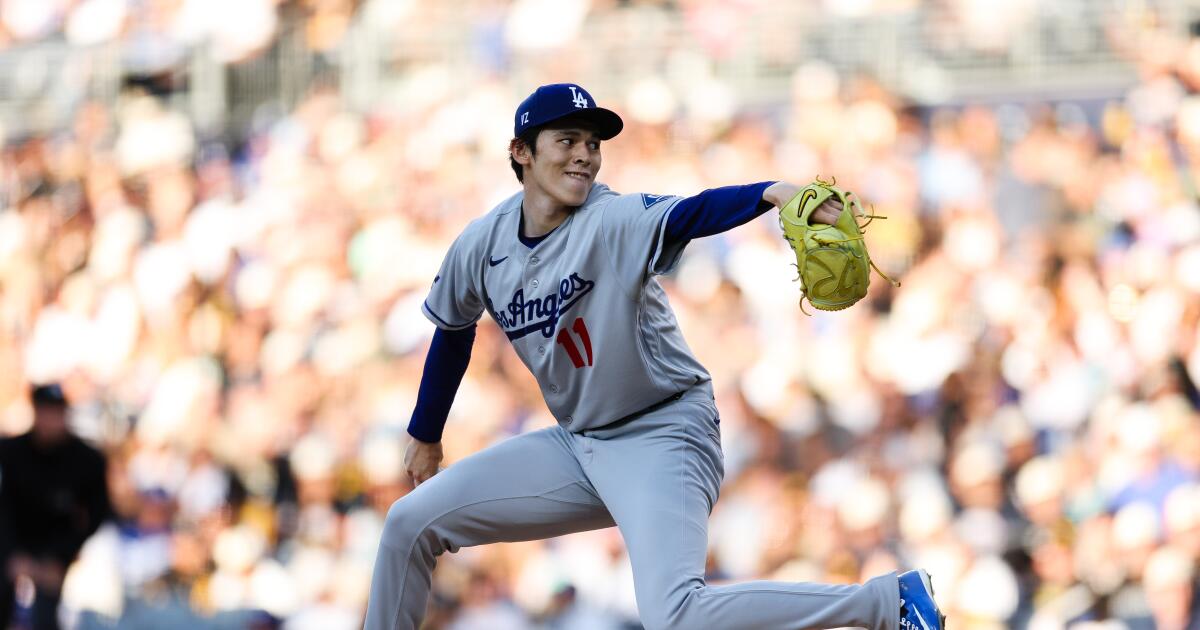
SAN DIEGO — The home run that Roki Sasaki gave up to San Diego’s Ty France was more dramatic than the two walks he issued to open the inning. But it was the free passes that really hurt him.
In the Dodgers’ 7-1 loss to the Padres on Friday, Sasaki was out of the game before he could record an out in the fifth inning. He gave up only three hits but issued five walks, tying his season high, and hit a batter.
“I actually felt different than I ever felt before, mechanically,” Sasaki said through interpreter Kensuke Okubo, noting that his lower body felt a little off. “So I need to go over it and see what was really happening.”
Sasaki successfully pitched around traffic for much of his outing, other than the three-run homer to France in the second inning. But the inefficiency sent his pitch count past 80 before he exited with runners on first and second in the fifth.
“I’m not going to have it every time out, so that’s something I have to improve,” Sasaki said. “And also the game plan. I was able to execute some of the pitches, but some of the pitches I couldn’t, so that’s something I have to go through before next start.”
Earlier this month, when Sasaki held the Angels scoreless through seven two-hit innings, it seemed as if he’d had a breakthrough. But in three starts since, including a seven-run dud against the Chicago White Sox two weeks ago, he has yet to pitch through the sixth inning.
“I am a little surprised, because there was such good momentum going on,” manager Dave Roberts said. “Hopefully we can get him back to throwing the way he did in May.”
The Padres’ Walker Buehler walks off after holding his old team to one run for 5-1/3 innings Friday at Petco Park.
(Derrick Tuskan / Ap Photo/derrick Tuskan)
Sasaki’s command issues Friday showed up almost immediately. After striking out Padres leadoff hitter Fernando Tatis Jr., Sasaki walked Samad Taylor on 10 pitches. But Sasaki bounced back by inducing a double play.
The next inning, there would be no such escape. Sasaki walked both Manny Machado, whom he also battled for 10 pitches, and Gavin Sheets to open the frame. Then Xander Bogaerts’ sharp line drive to center field found leather.
France’s long fly ball to left field, however, found the seats.
Sasaki’s only clean inning, the third, was made possible by catcher Dalton Rushing’s successful challenge of a called ball four against Tatís, flipping a walk into a strikeout.
“I know that there’s confidence in there,” Roberts said. “But when you feel good and you don’t feel good mechanically and can’t execute pitches, then the results are walks, and 1-2 [count] homers, and things like that. But I do think that we can kind of tackle the mechanical things that he’s probably looking for right now.”
The Padres piled on in the eighth inning against reliever Jonathan Hernandez, as the sold-out crowd chanted “Beat L.A.!”
Mookie Betts hit a home run off former teammate Walker Buehler for his second homer in as many games. Betts seems to have come out of his offensive funk, entering Friday with a 1.061 on-base-plus-slugging percentage over the previous 11 games.
Buehler earned the win, delivering five strikeouts in 5⅓ innings.
“[Buehler] is reinventing himself,” Roberts said. “He’s throwing the kitchen sink at you. Cutter, slider, changeup, two-seamers. He doesn’t just try to bully you, and he’s finding ways to just get guys out. So yeah, he’s gonna still go up there and compete.”
The Dodgers went 0 for 4 with runners in scoring position and squandered a bases-loaded opportunity with one out in the sixth inning after chasing Buehler. Max Muncy popped out and Kyle Tucker, back in the lineup after exiting Monday’s game because of back spasms, flied out.
The Dodgers have built such a big lead in the division that the loss barely made a dent. The Padres, in second place, trail by eight games.

Caitlin Clark hit in throat during WNBA loose-ball scramble, sparking backlash and game suspension
WNBA superstar Caitlin Clark was hit in the throat during a loose-ball scramble, sparking outrage and a one-game suspension for Alyssa Thomas. Fox News’ Garrett Tenney reports on the ‘absolutely unacceptable’ incident and the coach’s reaction. Political analyst Gianno Caldwell discusses Clark’s immense impact on WNBA viewership, including a $2.2 billion deal, and the role of gender and race in the controversy.
NEWYou can now listen to Fox News articles!
Phoenix Mercury All-Star Alyssa Thomas is the latest villain to Caitlin Clark fans after punching Clark in the throat during a game on Wednesday night.
The referees missed the punch in real time, but fans and the league office did not.
A viral clip of the punch in slow motion spread across social media, pouring gasoline on the ongoing culture war surrounding Clark’s physical treatment by opposing players, which has been a controversial issue dating back to Clark’s rookie season in 2024.
And Less than 24 hours after the incident, the WNBA slapped Thomas with a one-game suspension for what was deemed a “reckless” and “non-basketball act.”
Who is the woman behind the punch?
If Thomas wasn’t in the WNBA, she says she would go pro in combat sports
In a 2019 interview with Nike PLAYlist, Thomas answered what sport she would have gone pro in if she didn’t go pro in basketball.
“Either boxing or MMA,” Thomas said.
If Thomas never went pro in any sport, she said she would have gotten into dentistry.
“Since I was a kid, I loved going to the dentist. I just was fascinated with teeth and still am. I’m passionate about that whole process of cleaning,” according to a profile on WNBA.com.
The first time Thomas stepped on a basketball court, she threw a ‘hissy fit’
Thomas was signed up to try basketball for the first time at the age of five by her mother, Tina, per the WNBA.
Thomas said she “Threw myself all down the stairs, down the hallway,” while her mom said “She just threw an absolute hissy fit.”
WNBA SUSPENDS ALYSSA THOMAS FOR ‘RECKLESSLY’ HITTING CAITLIN CLARK IN THROAT DURING SCRAMBLE
Her parents didn’t let her win a popular board game
Thomas’ parents never took it easy on her when they played “Candyland” as she was growing up.
“We weren’t the parents that were just going to let you win,” Tina said, per the WNBA.
“In life, you have to fight, and how are you going to fight if you don’t teach your kids to fight? So if she fell over, ‘get up, you’re alright,’ and if she didn’t get up, you knew something was wrong.”
It was a parenting tactic also used by the father of New York Yankees legend Derek Jeter, who famously never let Jeter win in board games or card games when he was growing up, to instill harsh competitiveness at an early age.
Thomas added that her mom was especially hard on her and helped develop her toughness.
“By no means was it easy, and it’s still not easy,” Thomas said.
Thomas plays more physically because shoulder issues hinder her shooting ability
Phoenix Mercury forward Alyssa Thomas scrambles to get up over Indiana Fever guard Caitlin Clark during a game at Gainbridge Fieldhouse in Indianapolis on June 24, 2026. The Phoenix Mercury defeated the Indiana Fever 111-109. (USA TODAY Network via Reuters Connect)
Thomas currently plays basketball with torn labrums in both of her shoulders.
The injuries are so severe that she completely lacks the structural integrity to lift her arms and shoot a traditional, fluid jump shot. Instead, she is forced to use a rigid, one-handed pushing motion from her chest just to get the ball to the rim.
Because she cannot rely on outside shooting, Thomas adapted by leaning entirely into her physical frame. She drives directly into the teeth of opposing defenses, absorbing heavy contact in the paint to score closer to the basket.
Indiana Fever guard Caitlin Clark shown after falling in the lane while Phoenix Mercury forward Alyssa Thomas watches the ball at Gainbridge Fieldhouse Indianapolis, Indiana on June 24, 2026. (Grace Smith/IndyStar / USA TODAY NETWORK via Imagn Images)
That brutal, driving style requires her to initiate intense physical collisions on nearly every single possession.
Despite the mechanical limitations and constant pain, the tactical shift worked. She transformed herself into a six-time All-Star, three-time First-Team All-WNBA, an Olympic gold medalist and the undisputed triple-double queen of the WNBA.
Thomas has been the center of immense criticism this week
The throat punch on Clark ignited a fierce wave of backlash.
Indiana Fever Head Coach Stephanie White led the charge, completely unloading on Thomas and the league’s officials during her postgame press conference.
“We have a generational talent and a WNBA superstar who had two cheap shots right there that weren’t called,” White said, pointing directly at Thomas’s actions. “Absolutely unacceptable.”
White argued that Thomas regularly crosses the line from playing physical defense into inflicting dangerous, non-basketball contact.
“It’s absolutely egregious and utterly disrespectful,” White continued to fume to reporters. “The fist in the throat is crazy. It’s crazy. It’s dangerous.”
On Thursday, Fever President Kelly Krauskopf released a statement praising the decision to suspend Thomas.
“Player safety should be paramount in our league. We appreciate the WNBA’s review of last night’s incident and the action taken. Right now our focus is on Caitlin and our entire team as we prepare for Saturday,” Krauskopf wrote.
Former Minnesota Vikings captain and prominent conservative activist Jack Brewer said the punch would be considered a “hate crime” if the roles were reversed.
CLICK HERE TO DOWNLOAD THE FOX NEWS APP
“This would be considered a hate crime if it were the other way around,” Brewer told Fox News Digital.
Other critics have expressed their own outrage on social media.
-

 Delaware4 minutes ago
Delaware ranks among top ice cream-loving states, study finds
-

 Florida11 minutes ago
Missing Florida diver found after multi-agency search
-

 Georgia14 minutes ago
Heat wave expected to bring potential dangerous conditions to South Georgia
-

 Hawaii19 minutes ago
University of Hawaii study finds San Andreas Fault stress at 1,000-year high | Honolulu Star-Advertiser
-

 Idaho26 minutes ago
Idahoans left to deal with rat problem in the Treasure Valley for another year
-
 Illinois29 minutes ago
Illinois in the trenches again to protect fair housing
-

 Indiana34 minutes ago
How to watch Indiana Fever vs Los Angeles Sparks: Time, channel
-

 Iowa41 minutes ago
After two decades, Iowa Events Center could get a new operator

