Northeast
Trump assassination attempt: Newly uncovered footage shows figure on roof seconds before gunfire

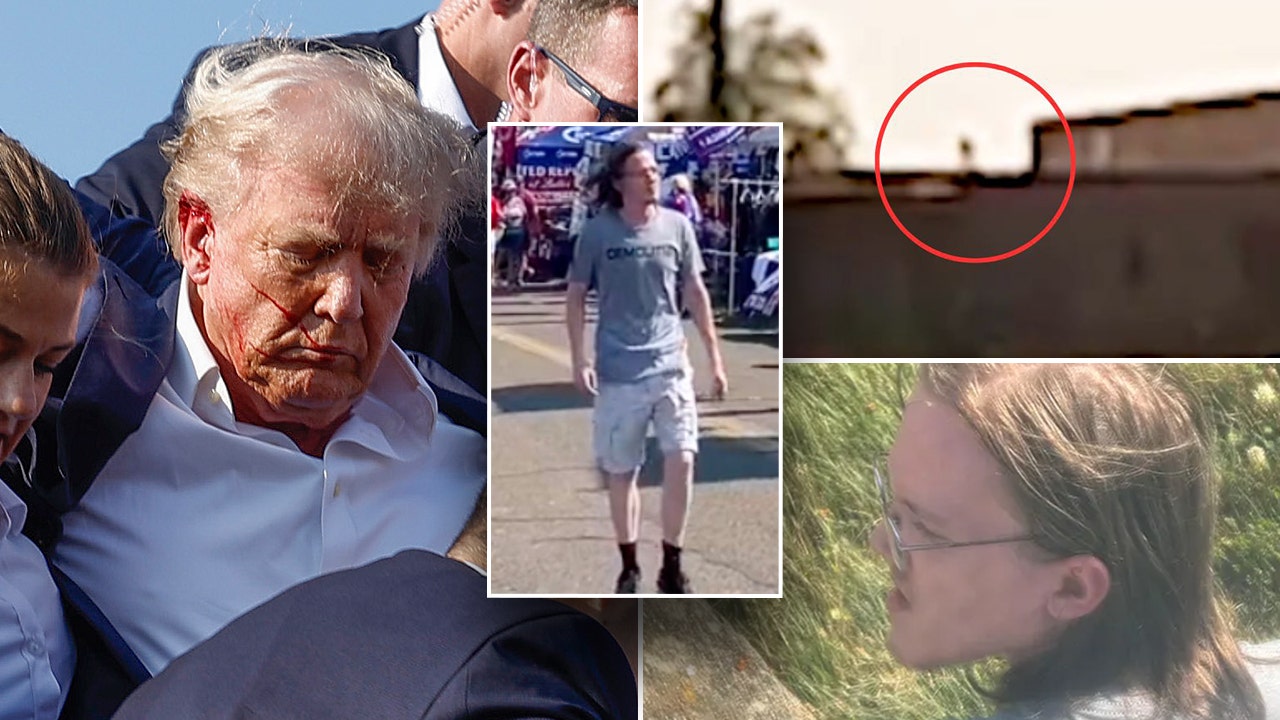
A deep dive into the recently released bodycam footage of the attempted assassination of former President Trump appears to show the shooting suspect walking on top of a roof just minutes before he managed to fire off his deadly rounds at the campaign rally in Butler, Pennsylvania, last month.
The newly unearthed footage sheds further light on the assassination attempt and the seconds leading up to the July 13 shooting.
When stabilized and zoomed in, one of the bodycam clips released by Butler Township Police Department shows a shadowy figure emerging on top of the American Glass Research (AGR) complex building at 6:08 p.m.
ATTEMPTED TRUMP ASSASSIN SEEN WALKING AROUND PENNSYLVANIA RALLY HOURS BEFORE OPENING FIRE
New video appears to show Thomas Matthew Crooks, top right, on a roof before his attempted assassination attempt on former President Donald Trump, left. (Anna Moneymaker/Getty Images, left, Iron Clad USA, middle, Butler Township Police Department, to right, Fox News, bottom right. )
The police officer whose bodycam captures the figure is walking in a green area on the east side of the AGR complex, near the water tower, when his body camera captures who is believed to be Thomas Matthew Crooks, 20, roof-hopping and making his way to the southernmost structure of the complex.
Another figure, likely a police officer, can be seen walking on the ground in the opposite direction of Crooks and appears unaware that the shooter is on the roof, the footage shows.
In the intervening minutes, the police officer can be seen communicating with other officers and then patrolling the adjoining car park. His bodycam does not have sound.
As the figure on the roof disappears again, the officer’s bodycam footage strikes 6:09 p.m., meaning Crooks took about two and a half minutes to set himself up and shoot at Trump and the other attendees, based on timestamps from other police bodycam footage.
The AGR Building where Thomas Matthew Crooks fired his shots. (AP Photo/Gene J. Puskar)
The FBI has previously stated that Crooks accessed the roof of a building by climbing up HVAC equipment and piping. Crooks then traversed multiple rooftops before he found his shooting position on top of a building about 150 yards from where the former president spoke at his rally.
Investigators have determined that Crooks purchased a ladder hours prior to the assassination attempt, but he left it at his residence in Bethel Park and did not use the ladder at the rally. No ladder was found at the scene.
The newly uncovered video corroborates Crooks’ timeline in a video by James Copenhaver, one of the victims shot. That video also shows a figure maneuvering on the rooftop.
Crooks got off eight shots while trying to take out Trump, according to a preliminary report released by Rep. Clay Higgins, R-La., last week.
TRUMP SHOOTING: TIMELINE OF ASSASSINATION ATTEMPT RAISES QUESTIONS ABOUT HOW GUNMAN EVADED SECURITY
A new video from James Copenhaver, one of the victims critically wounded in a July 13 assassination attempt against former President Trump, shows a figure moving across a rooftop just minutes before gunfire rang out at Trump’s rally in Butler, Pennsylvania. (James Copenhaver)
One bullet grazed Trump’s right ear, while firefighter Corey Comperatore was fatally struck. Rally-goers James Copenhaver and David Dutch were also shot and injured.
Another shot was fired by a Butler SWAT operator from the ground, about 100 yards away from the AGR building. The shot hit Crooks’ rifle stock and fragged his face and shoulder area due to the stock breaking up, Higgins said.
Another shot was fired by the southern Secret Service counter-sniper team, which entered Crooks’ left mouth area and exited the right ear area.
Chilling new video has also just been released showing Crooks casually walking through a crowd in Butler, Pennsylvania, nearly two hours before the shooting.
Chilling new video has been released showing Thomas Matthew Crooks casually walking through a crowd in Butler, Pennsylvania, nearly two hours before he opened fire on former President Trump and attendees at a campaign rally. (Anna Moneymaker/Getty Images, main, and Iron Clad USA, inset.)
The short clip, released by the clothing company Iron Clad USA, shows Crooks at 4:26 p.m. dressed in shorts and a “Demolitia” T-shirt walking past a line of vendors selling Trump merchandise ahead of the July 13 rally, not carrying anything. He was wearing the same T-shirt when he opened fire on Trump.
CLICK TO GET THE FOX NEWS APP
Text messages sent by local law enforcement responsible for monitoring former President Trump’s Pennsylvania flagged Crooks to colleagues as suspicious at least 90 minutes before he opened fire.
The messages, obtained by Fox News Digital via Sen. Chuck Grassley, R-Iowa, who obtained them from the Beaver County Emergency Services Unit, showed that officers flagged Crooks after he was spotted using a range finder – but did not approach him.
Fox News’ Bonny Chu and Audrey Conklin contributed to this report.
Read the full article from Here

Boston, MA
‘Enough is enough’: Weekend violence in Boston sparks calls for change, from more police to community investment – The Boston Globe

“We are all saying today, enough is enough,” City Councilor Brian Worrell said Monday at a news conference in Roxbury. “We are calling for everyone to put down the guns, stop the community violence.”
He joined City Councilor Miniard Culpepper and others in calling for more resources to support grassroots organizations that work to reduce violence across Boston’s most historically underserved neighborhoods.
Culpepper said police are part of the solution, but real change comes from within impacted communities, and it doesn’t happen overnight.
Instead of taking a reactive approach, “we have to be consistent out there in the streets, promoting a culture of peace among our young people,” said Randy Muhammad, founder of 10,000 Fearless Peacemakers, a Dorchester-based group. “We need to be proactively in the community, building those relationships.”
Meanwhile, leadership of Boston’s largest police union decried a staffing crisis that has left the department lacking the manpower to properly respond to calls, especially on a busy weekend like July 4.
“Until we take back our streets, enforce the law, and have enough officers to do so, we’re just gambling that somebody won’t lose their life or get hurt,” said Larry Calderone, president of the Boston Police Patrolmen’s Association. “That should be an embarrassment to the city of Boston elected officials and the leadership of this department.”
Calderone described an incident early Sunday in Dorchester when disorderly revelers threw fireworks at the police. A crowd of several hundred people was effectively blocking traffic at the intersection of Franklin Hill Avenue and Shandon Road.
“While officers were attempting to gain control of the crowd and restore order, numerous individuals threw beverages, miscellaneous objects, and ignited fireworks in the direction of responding officers,” according to a police report provided by the department.
Calderone said three injured officers were sent to the hospital for treatment.
He argued that reductions in overtime spending have exacerbated the problem.
The department’s massive overtime budget, long a point of contention among police reform advocates, regularly places officers among the city’s highest-paid employees. Department officials said during a City Council hearing in May that they were working to minimize overtime shifts without letting staffing drop below necessary levels.
A Roxbury resident told the Globe on Sunday that she had called the police multiple times about noise complaints as a raucous block party continued into the early morning hours, but a dispatcher responded that officers were busy. Gunshots broke out around 3:15 a.m. in the area, killing one person and injuring several others, according to police.
“We’re woefully understaffed. We’re outnumbered on the street,” Calderone said in an interview Monday.
However, Police Commissioner Michael Cox refuted the union’s complaints. He said there were many factors that contributed to the recent violence.
“The lawless behavior of this weekend is a combination of large crowds, alcohol, illegal fireworks and firearms, and we will hold those responsible accountable,” he said in a statement Monday evening. “There is no correlation between overtime and crime.”
Cox said his department remains focused on strengthening relationships with the community, ongoing efforts that help prevent crime. He also said they’re continually adding new officers to the force and rising to the challenge amid a slew of major events this summer, including World Cup games, the country’s 250th anniversary and an upcoming Tall Ships festival.
“Thanks to the work of our officers and partnership with the public, crime is heading in the right direction,” he said. “As we work through the duration of an incredibly busy summer, public safety and officer wellness are our priorities.”
Overall, gun violence in Boston is rare and homicides are down compared to this time last year. But the numbers lose meaning when residents feel unsafe, said Steve Wilson of the Ella J. Baker House Violence Reduction Taskforce.
“Right now, to people that look like me, it doesn’t feel like the safest city in America,” he said. “So the work’s being done, and we’re going to continue the work.”
City officials often tout a holistic approach to crime-fighting, which means addressing the root causes of violence and investing in impacted neighborhoods. Mayor Michelle Wu recently announced her latest summer safety plan, offering paid summer jobs to Boston Public Schools students.
In a statement Monday, City Councilor Erin Murphy said she’s requesting a hearing on the safety plan. She also joined Councilor Ed Flynn in calling for a public safety summit.
Officials have not yet identified either of the weekend homicide victims. No arrests have been announced in the shootings.
“This weekend’s violence is a heartbreaking reminder that every life lost leaves behind families and communities who are forever changed,” said Clementina Chery, president and CEO of the Louis D. Brown Peace Institute. “Every homicide creates a ripple that extends far beyond the crime scene, and adds another family to a club that no one wants to join.”
Lea Skene can be reached at lea.skene@globe.com. Follow her on X @lea_skene.


HADDAM, Conn. — Thousands of Connecticut residents remained without power Monday, nearly 48 hours after a storm struck the state on Independence Day, as Eversource crews worked through rain to restore electricity across the region.
Dan Stevens, a chief lineman with Eversource with nearly 25 years of experience, said his team was on standby before the storm hit July 4, anticipating a significant weather event. Stevens and his crew were working in rural Haddam on Monday, restoring power to thousands of customers.
Crews ask for patience
Stevens said the work is demanding under normal conditions and becomes more difficult in the rain. Some crew members have been working 16-hour shifts. Downed trees and power lines across the state have created a continuous workload — with new jobs opening as others are completed.
“Have some patience,” Stevens said. “If you see somebody, good chance they’re not from this area so just have some patience. We know the first couple days everyone plays nice, and then as it progresses, 4-5 days into it people get impatient. But just hang in there and have a little patience, we all want the same thing here.”
Out-of-state help arrives
Eversource has brought in crews from Massachusetts, New Hampshire, Vermont and Canada to assist with restoration efforts in Connecticut.
As of Monday, 98 percent of Eversource customers had power restored. The company said it hopes to have power back for nearly all remaining customers by Tuesday night.
Copyright 2026 WFSB. All rights reserved.
-
 Lifestyle26 minutes ago
What a divorce coach wishes couples knew before ending a marriage
-

 Technology34 minutes ago
Hoto’s PixelDrive screwdriver is down to $60, matching its best price
-

 World41 minutes ago
Cuba plunges into third major blackout this year as power crisis worsens
-

 Politics44 minutes ago
Top Platner ally turns on him after bombshell rape allegation rocks campaign: ‘Red line’
-

 Health49 minutes ago
Experimental vaccine shows promise against dangerous intestinal illness
-

 Sports56 minutes ago
England’s Jordan Henderson officially ruled out after freak fall causes fracture, opts for surgery
-

 Technology59 minutes ago
Starship delivery robots leave campuses for cities
-
 Business1 hour ago
Orange County real estate investor pleads not guilty in $100 million bank fraud case

