Business
Fed leader, concerned about jobs downturn, tees up interest rate cuts

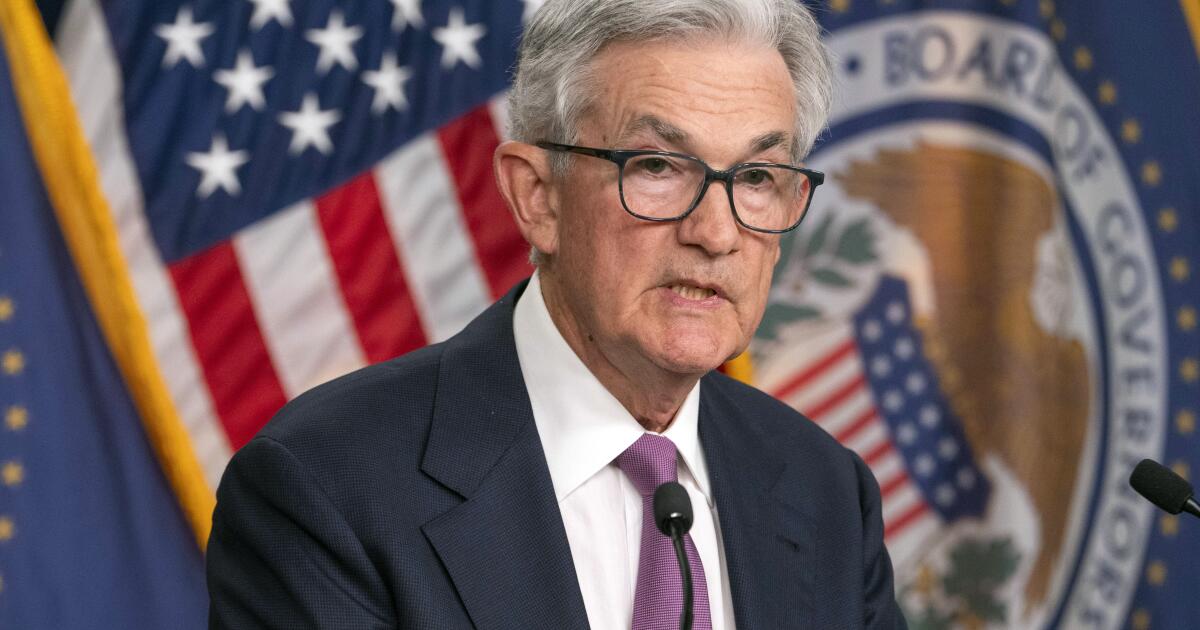
After a near-textbook campaign to rein in inflation by raising interest rates, the head of the Federal Reserve, Jerome H. Powell, all but promised Friday to start lowering rates next month — with fingers crossed that it’s not too late to avoid a recession.
From the beginning of the inflationary surge triggered more than three years ago by the economic disruptions of the pandemic, it was clear that raising interest rates could tame price hikes. It was also clear that, if rates stayed too high too long, they could choke the economy into recession.
And few states are showing stronger signs of a possible downturn than California, which has felt the impact of high interest rates more severely than others. Not only has its unemployment rate been among the highest in the land while its job creation rate lagged, but pillar industries such as entertainment and tech have also gone through major disruption and many residents and businesses have left the state.
“Overall, the economy continues to grow at a solid pace,” Powell said in a widely anticipated speech at the annual summer symposium of central bankers in Jackson Hole, Wyo. “But the inflation and labor market data show an evolving situation. The upside risks to inflation have diminished. And the downside risks to employment have increased.
“The time has come for policy to adjust,” he said, giving the strongest signal yet of an imminent rate cut.
Investors cheered the news. Major stock indexes rose almost immediately after he began speaking.
Powell did not tip his hand on the size of the coming rate cut, but most analysts widely expect a small quarter-point move next month and a succession of similar reductions over the next year.
But Powell’s emphasis on doing “everything we can to support a strong labor market” gave some economists reason to think that the Fed could make a half-point move next month. Powell said that the pace of policy actions would “depend on incoming data, the evolving outlook, and the balance of risks.”
Whatever the initial size may be, it should fairly quickly nudge down interest rates on credit cards, auto loans and other consumer financing, but the broader economic effects of Fed policy are likely to take hold only gradually.
And with the political climate at a boil and the U.S. unemployment rising significantly since the start of the year, the Fed may find itself behind the curve in reversing course after what has been, up to now, a successful run of lowering inflation while preventing the economy from falling into a recession — the so-called soft landing.
“They’ve got to get going,” said Mark Zandi, chief economist at Moody’s Analytics, who for months has been calling on the Fed to start lowering rates.
Barring major economic changes or extreme volatility in markets, most economists see two to three quarter-point cuts this year and several more over the course of 2025, eventually bringing the Fed’s benchmark rate from the current two-decade high of 5.3% down to around 3%.
Financial markets have already priced in a September quarter-point cut, with stocks having mostly recovered from a big jolt a couple of weeks ago when investors feared the economy was turning down quickly and that it was already too late for the Fed.
Interest rates for a conventional 30-year mortgage were down to a hair below 6.5% this week, from more than 7% as recently as May. Lower rates should also help with auto purchases. Zandi said car sales have slowed as consumers have been waiting for better rates. The average interest rate on a five-year new auto loan was 8.2% in the second quarter, the highest since the Fed’s record keeping began in 2006.
The overriding question with the economy is jobs, both for workers and for political leaders facing a national election in November. And jobs are one of the two basic elements of the Fed’s responsibility. The other is price stability.
Powell acknowledged on Friday that the Fed initially misjudged the inflation spike in spring 2021, thinking that the pandemic-related surge in prices would be “transitory” and one that the Fed could look past.
Most analysts criticized Fed officials for waiting too long to raise rates, but Powell noted that they were hardly alone. “The good ship Transitory was a crowded one,” he said, adding in impromptu remarks, “I think I see some former shipmates out there today,” prompting a moment of laughter from the audience during his 15-minute speech.
It wasn’t until March 2022 when the Fed began raising rates. And, until recently, Powell and his colleagues focused squarely on consumer price inflation, which peaked in June 2022 at 9.1% and has since dropped to just under 3%. With inflation now trending toward the Fed’s 2% target, the central bank’s attention has turned to employment, which has become more worrisome in recent weeks.
First-time unemployment claims have moved up while the number of job openings has shrunk. The nation’s unemployment rate, 4.3% in July, is up from 3.7% in January, and new reports this week indicate that job growth from March 2023 to March 2024 was considerably smaller than previously estimated, though still healthy.
“The cooling in labor market conditions is unmistakable,” Powell said, adding, “We do not seek or welcome further cooling in labor market conditions.”
California’s unemployment rate has held steady in the last three months at 5.2%, but that’s still the second-highest in the country after Nevada. (California earlier in the year had the highest jobless figure.) More recently the pace of job growth in California has picked up, but the July report from the state’s Employment Development Department shows workers in California on average are putting in fewer hours of work.
That may not be a bad thing if more workers are opting for a better work-life balance, something that has become more important since the pandemic, said Erica Groshen, an economist and former commissioner of the U.S. Bureau of Labor Statistics. And, longer term, it could mean companies are more productive if they’re producing as much or more with less labor input.
But the decline in work hours, she said, could signal weakening demand and pending layoffs if business conditions persist or worsen.
The latest data from the state EDD show average weekly hours of work for all private-sector employees was down to 33.4 hours in July, from 34.5 a year ago. That may not seem like much, but it means a significant corresponding drop in average weekly earnings, which turned negative in July compared with a year earlier. Workers in information, education and health services, professional and business services, and the leisure sector, posted fewer hours of work.
“The softening job market tends to go with reduced hours,” said Sung Won Sohn, professor of economics and finance at Loyola Marymount University. “Typically, firms start cutting back hours before shedding jobs.”
That is likely even more true now because over the past several years many employers have had trouble finding new workers when they needed them.
Tom Trujillo, president of a family-owned business that operates eight Wienerschnitzel restaurants in the Southland, has held on to his staff of about 140. But like many other fast-food franchisees, Trujillo said he has cut back on overtime and some part-time employees’ hours as a result of the $20 minimum wage that took effect in April for his industry.
In response , he said he’s raised prices and that some of his stores are opening a little later and some dining rooms closing an hour or two earlier.
“I have a reserve credit line, with a zero balance,” Trujillo said. “The lower interest rates would be nice if I have to draw on that.”
But what he said he needs most today are more customers and for them to come more often.
Whether lower interest rates could help drive greater sales at Trujillo’s and other businesses remains to be seen.


Rocket Lab took a big step Monday to better compete with rivals SpaceX and Amazon, announcing an $8-billion acquisition of satellite communications company Iridium.
The Long Beach rocket-and-satellite maker is buying a company that provides critical communications services to pilots, mariners and others, while giving Rocket Lab a foothold in the emerging satellite-based mobile phone market.
“We are going to absorb it, optimize it and scale it into something that is really truly fantastic,” said Rocket Lab Chief Executive Peter Beck in a YouTube presentation of the deal.
Rocket Lab is paying $54 a share for McLean, Va.-based Iridium — $27 in cash and the rest in shares. Deutsche Bank and Wells Fargo are providing $3.6 billion in financing in the deal, which is expected to close next year.
Iridium’s 66 low-Earth-orbit satellites provide voice, data, navigation and other services to remote regions and across the globe to 2.55 million government, defense, aviation, maritime and commercial subscribers.
Iridium reported net income of $114 million in 2025, up 2% from the previous year. Revenue climbed 5% to $872 million.
The market for mobile cellular and other satellite-based communications is growing rapidly.
Elon Musk’s SpaceX spent $17 billion last year to acquire spectrum from EchoStar and then followed it up with a $2.6-billion purchase. The spectrum will allow its Starlink broadband satellite network to provide mobile phone service worldwide.
In April, Amazon agreed to acquire satellite operator Globalstar in a roughly $11.6-billion deal that would expand the services of its satellite system and the so-called direct-to-device smartphone market.
The competition has raised concerns about Iridium’s ability to compete.
SpaceX went public this month in the largest initial public offering ever, raising $86 billion, with the company now valued at more than $2 trillion.
In February, Iridium Chief Executive Matthew Desch said the company has shown it’s not “in decline,” dismissing concerns that it couldn’t compete with Starlink, according to Morningstar.
Founded in 2006 in New Zealand, Rocket Lab moved to the U.S. a decade ago and opened its Long Beach headquarters in 2020. It has manufacturing and mission operations in Virginia, New Mexico, Colorado, Maryland, Toronto and New Zealand.
The company manufactures a small rocket called Electron that has launched 262 satellites into space, making it the second-busiest U.S. launch provider behind SpaceX. Rocket Lab is developing a larger rocket called Neutron, and it also makes satellites, subsystems and space components.
Beck said the acquisition of Iridium will propel Rocket Lab into the satellite communications business. That would otherwise be a slow process, requiring the acquisition of spectrum, satellite development and establishment of a customer base.
“We think we’ve found a little bit of a shortcut here,” Beck said, noting the combined company will be vertically integrated, able to design, build, launch and operate its own satellites.
The deal is “very strategic” for Rocket Lab, William Blair analyst Louie DiPalma said in a note to clients, according to Morningstar.
Rocket Lab has announced multiple contracts this year.
Last week, the company said it would launch Electron rockets for three NASA missions from its New Zealand site.
In May, Rocket Lab announced a $30-million contract with Costa Mesa defense contractor Anduril for multiple hypersonic test flights in Virginia using Rocket Lab’s HASTE launch vehicle.
The company is among scores of businesses that have revitalized Southern California’s aerospace and defense industries since SpaceX was founded in 2002. SpaceX, now headquartered in Texas maintains operations in Hawthorne.
Secretary of Defense Pete Hegseth visited Rocket Lab’s headquarters in January during a stop on his tour of defense contractors in Southern California and across the country.
“This company, you right here, are front and center, as part of ensuring that we build an arsenal of freedom that America needs,” Hegseth told several hundred cheering workers. “The future of the battlefield starts right here with dominance of space.”
Iridium investors cheered the news. Its shares gained 25% to close Monday at $54.59. Rocket Lab shares jumped 16% to close at $97.95.

With SpaceX’s historic initial public offering minting a small army of new millionaires overnight, the Southern California housing market is bracing for a big wave of buyers looking to upgrade their digs or perhaps snag a second home, potentially driving up prices in some in-demand neighborhoods.
Shares of SpaceX started trading June 12 and ended the day having raised $75 billion and making founder Elon Musk the world’s first trillionaire. It was by far the largest IPO on record, more than double the 2019 offering by Saudi Arabia’s state-owned oil giant Saudi Aramco.
At least 4,000 current and former SpaceX employees are expected to become millionaires, with about 400 of them earning $100 million or more, said Andrew Benson, chief executive of Hill.com, an investment platform for trading stock in pre-IPO tech companies.
SpaceX’s compensation philosophy historically favored equity over cash salaries, so this windfall extends well beyond executives and engineers to include nontechnical staff, entry-level workers and even cafeteria employees.
Because SpaceX has its highest concentration of employees in humble Hawthorne south of the 105 Freeway, the homebuying spree is expected to be most pronounced in the sandy South Bay and the “Silicon Beach” tech corridor that includes Venice and Santa Monica, but it may also appear in other upmarket Los Angeles-area neighborhoods or even farther away in the form of second homes.
One SpaceX buyer has been eyeing a $32-million pocket listing of his in tony Brentwood for months while waiting for the IPO, according to real estate broker Cory Weiss of Douglas Elliman.
“People are starting to look,” he said, and most will spend $5 million or more.
Melissa Pilon, a real estate agent in the South Bay with Compass, heard from one SpaceX buyer the day the company went public on a property in north Redondo Beach, and expects to hear from more would-be homeowners.
“I’m not sure how this will play out, but I think real estate agents are feeling optimistic,” Pilon said. “I think there will definitely be an uptick, but I don’t know if it will be a sustainable thing. There might be some superficially inflated prices.”
The SpaceX IPO and planned initial public offerings of OpenAI and Anthropic could generate millions in capital gains tax revenue for the state over years as shareholders cash out.
Even without inclusion of those IPOs, state finance officials this year upped their forecast of capital gains income Californians would earn due to the huge run-up in the stock market driven by AI companies. On average, gains are taxed at 10%.
While SpaceX shares have fallen recently, current and former employees who were granted shares or options still would come away winners given the stock remains above the $135 IPO price. Shares closed Friday at $153.23, up 0.15%.
It could take several months for the housing market to feel the full effect of SpaceX millions, said Paul Habibi, a UCLA lecturer and real estate expert witness at Grayslake Advisors.
The most significant buying boom is likely to take place early next year, he predicted, after the standard lockup on stock sales is fully ended in December. Batches of limited stock sales will be allowed in the coming months, however, and some real estate agents and bankers are putting together workarounds to help expectant millionaires leverage their future gains to secure loans.
Habibi expects the largest concentration of purchases to be focused in the South Bay, primarily Manhattan Beach and Redondo Beach, with some spillover into Culver City and possibly north Orange County.
The gush of new money stands to drive up the cost of homes in neighborhoods already in hot demand, echoing a pattern that has occurred in the San Francisco Bay Area.
“A place like Manhattan Beach has roughly 11,000 housing units, so there could be a pretty significant impact if a lot of those folks decide that they want to go buy houses in those neighborhoods that have such a supply constraint,” Habibi said. “Those markets are already among the priciest in Southern California and I can only imagine that will continue with this new wealth creation.”
Hermosa Beach real estate agent Ed Kaminsky agrees interest will center in the South Bay, including Palos Verdes, and he has already heard from prospective SpaceX buyers. Their dream houses have ocean views, swimming pools and four or more bedrooms, which may be hard to find.
“There are a lot of buyers that were in rentals from the Palisades fire looking to buy now and combined with all of the IPOs this summer, I think inventory in South Bay could be tight,” Kaminsky said, “The question is whether we have the kinds of properties on the market that they’re looking for.”
The concentration of buyers looking to purchase property in the South Bay could temporary inflate prices in the area, similar to when Snap Inc., social media platform Snapchat’s parent company, went public in 2017 valued at $24 billion, Habibi said. SpaceX by comparison was valued at $1.77 trillion.
“What’s interesting about Snap is that the workforce was largely clustered on the Westside, and you could see almost immediate effects in Venice and Santa Monica within months of the IPO,” Habibi said. “That was a pretty notable and significant effect on that local housing market” that temporarily inflated prices in an already hot market.
“The amount of wealth and how it comes into L.A. is always very different and vacillates,” Weiss said. “I’m not saying this is groundbreaking and nothing like L.A.’s ever seen before, but I do know that there are people who have been waiting for this to happen.”
Among them are potential buyers who have toured condominiums in Century City, where some of the region’s most luxurious condo towers stand, he said.
Certain buyers may want to buy a condo in a fancy full-service building in L.A. to use as a pied-à-terre, Weiss said, while moving their families to a distant city or state where they could commute by plane on weekends.
San Diego County should see an influx of new buyers with SpaceX dollars, said Del Mar real estate agent Kristina Quesada, co-owner of the Yost Quesada Team at Douglas Elliman. They’ll join a recent wave of house hunters from the Bay Area flush with new tech fortunes and an appetite for second homes or vacation properties near the ocean.
Buyers want to “obtain that coastal lifestyle” for less money than it would cost in other California waterfronts, she said. Popular San Diego County locations run west of Interstate 5 from Carlsbad south through such seaside communities as Encinitas, Del Mar, La Jolla and Coronado Island. Prices start around $2 million.
San Francisco real estate agent Butch Haze of Compass has seen tech booms followed by ravenous bursts of homebuying since the first internet gold rush of the late 1990s.
“Show me a great job market and I’ll show you a really strong real estate market,” he said.
San Francisco’s surging tech industry, which is getting a burst of new business around artificial intelligence, may even have a knock-on effect on Los Angeles-area real estate, Haze said.
After making a fortune through an IPO or acquisition of their companies, “the single tech guys love to move down to L.A. to be closer to the beautiful people,” Haze said. “And they get their beachfront property.”

Tech stocks took another big hit Tuesday as investors sold off shares of companies that have powered the artificial intelligence boom.
Technology companies have been spending billions of dollars investing in data centers and infrastructure needed to support the race to advance AI. But sky-high valuations and geopolitical tensions have some investors questioning whether massive AI spending will pay off, analysts said.
Reflecting the unease, the tech-heavy Nasdaq composite dropped roughly 2%. The Standard & Poor’s 500, a stock market index that tracks the performance of the largest U.S. publicly traded companies, fell by more than 1%.
Share prices for major California tech companies including Nvidia, Qualcomm, Intel and Marvell Technology all dropped. Meta Platforms, Apple, and Google’s parent company, Alphabet, also saw their stock prices slide, though the decline wasn’t as large as the drop in chip stocks.
Shares of Micron Technology, a U.S. memory chip manufacturer, plunged by more than 13% a day before the company was scheduled to report its third-quarter financial results. Anxiety in the U.S. spilled over from Asia, where South Korean tech companies SK Hynix and Samsung Electronics, both major computer memory chip manufacturers, saw their stocks plunge Tuesday by more than 12%.
“Investors are just a bit skittish after very strong moves in tech stocks where any hint of caution causes some investors to hit the sell button,” said Dan Ives, an analyst who heads technology research at Wedbush Securities, adding that it’s a “gut-check moment.”
On Monday, SpaceX saw its shares plunge 16% after a record-breaking initial public offering this month. Its share price then rebounded Tuesday, closing up less than 1% to roughly $156.
Tech companies have been making big bets on the role AI will play in people’s work and personal lives. They’ve been improving chatbots that can generate code, words, photos and videos. The companies also are betting that “AI agents” will be able to proactively tackle more in the future, automating repetitive tasks in customer service, online shopping and other industries. They’re releasing more AI-powered hardware such as smartglasses.
Major tech companies are going head-to-head in the race to dominate AI, competing to sway talent and consumers into using their products. Alphabet saw its stock slip after two of the company’s prominent AI researchers left for rival companies OpenAI and Anthropic.
Despite profitability questions, AI use has been growing. Roughly half of U.S. adults use an AI chatbot, according to a Pew Research Center report released this month. They’re using these tools for search, work tasks, entertainment and even companionship. More U.S. adults reported using OpenAI’s ChatGPT, followed by Google’s Gemini, Microsoft Copilot and Meta AI.
Amid all the hype and spending, there also have been growing fears about whether AI will take over people’s jobs and whether the boom will lead to a bubble that will eventually burst. California AI startups OpenAI, valued at $852 billion, and Anthropic, valued at nearly $1 trillion, are preparing to potentially become publicly traded companies.
“I don’t view this as a bubble,” Ives said. “I view it as we’re going to go through these white-knuckle moments as tech stocks continue to move higher, but the bears will continue to yell fire in a crowded theater when we have these pullbacks.”
Economic factors also could affect how much people are willing to invest in tech company stocks. There’s anxiety over whether the new Federal Reserve Chair Kevin Warsh will raise interest rates, making it more expensive to borrow money. That could cut into a company’s profit margin or decrease consumer spending. United States’ war with Iran is driving up gas prices while the U.S. inflation rate rose to 4.2% in May.
The AI boom is fueling the demand for memory and storage chips, but prices for them are on the rise, prompting some companies such as Apple to look at raising prices for consumer electronics.
Globally, AI spending is projected to increase to $2.59 trillion in 2026, up 47% year over year, according to a forecast by research firm Gartner.
Driven by AI demand, memory and storage vendors have significantly outperformed the S&P 500 and the SOX index, a global semiconductor and microchip index, since the start of 2025, according to a note to clients from BNP Paribas.
Still, investors are on edge ahead of Idaho-based Micron Technology’s earnings report Wednesday, said Gil Luria, head of technology research at financial services company D.A. Davidson. Since January, Micron Technology’s stock has climbed more than 233% to more than $1,000 per share.
“Any indication of a slowdown in demand for AI is seen as a potential turn in the cycle,” Luria said. “While the overwhelming sense is that demand is still far exceeding supply, investors are waiting for Micron to indicate that is still the case.”
Times staff writer Nilesh Christopher contributed to this report.
-

 Detroit, MI20 minutes ago
18 New Kid-Friendly Places That Opened in Metro Detroit in 2026 (So Far!)
-

 San Francisco, CA35 minutes ago
Anza expedition celebrates 250th anniversary in San Francisco
-

 Dallas, TX38 minutes ago
Preston Hollow residents oppose proposed $800 million mixed-use development in Dallas, survey reveals
-

 Miami, FL43 minutes ago
Bradley Beal to Miami Heat rumors draw skepticism
-

 Boston, MA50 minutes ago
Boston Pops surprise travelers at Logan Airport with July 4th preview performance
-

 Denver, CO51 minutes ago
Denver Broncos Crack Top 10 in NFL Uniform Rankings
-

 Seattle, WA58 minutes ago
PHOTOS: Visiting all 12 stops during this year’s West Seattle Garden Tour
-

 Milwaukee, WI1 hour ago
Milwaukee Barbecue: A Legacy of Smoke

