Midwest
Archaeologists unearth 13,000-year-old mastodon skull in Iowa

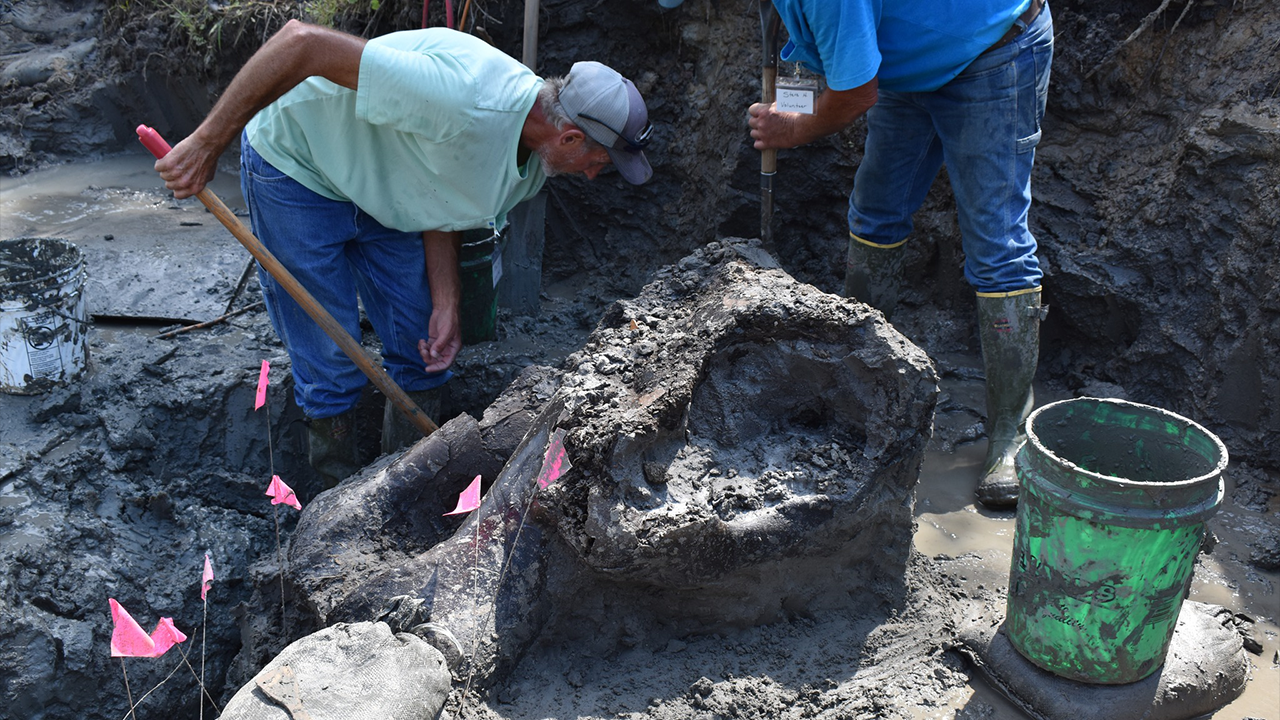
Archaeologists in Iowa have unearthed an ancient mastodon skull in pristine condition, which they hope will provide clues about human interaction with the ancient animal.
The bones were excavated earlier this month from a creek bank in Wayne, taking nearly two weeks to complete. The eroding site was first brought to the attention of Office of the State Archaeologist, Iowa (OSA) in 2022.
The excavation took nearly two weeks to complete. (Office of the State Archaeologist, Iowa)
EXCAVATIONS IN EGYPT UNEARTH TROVE OF ANCIENT ARTIFACTS FROM ITS FINAL DYNASTIES
Radiocarbon dating showed that the mastodon is around 13,600 years old, which corresponds to when humans occupied the area.
OSA will closely examine the bones to determine if there is any evidence of human activity, like cut marks.
The eroding creek was first brought to archaeologists’ attention in 2022. (Office of the State Archaeologist, Iowa)
“We’re really hoping to find evidence of human interaction with this creature – perhaps the projectile points and knives that were used to kill the animal and do initial butchering,” said John Doershuk, director and state archaeologist at OSA. “There’s also potential evidence on the bones themselves – there could be identifiable cut marks.”
Radiocarbon dating showed the remains to be around 13,600 years old. (Office of the State Archaeologist, Iowa)
Mastodons were large mammals similar to elephants that roamed North America from around 3.5 million years ago to around 10,500 years ago.
Iowa Archeology said the mastodon skull was the “first-ever well-preserved mastodon (primarily the skull) that has been excavated in Iowa.”
Archaeologists said the bones were in excellent condition. (Office of the State Archaeologist, Iowa)
The mastodon bones will become part of a new exhibit at the Prairie Trails Museum once conservation and analysis is complete at the University of Iowa.
Read the full article from Here


SPRINGFIELD, Mass. (WGGB/WSHM) – Before 9 a.m. on Saturday, July 4th, firefighters at the Springfield Fire Department responded to a call for a fire at a multi-family home at 479 Central Street in Springfield.
When crews arrived, they had noticed flames shooting from the windows of the home. When crews began their attack of the fire, they had also spotted a teenager and an infant trapped inside the home, both of them were rescued safely.
The fire was quickly put out and without any injuries. 8 people were displaced as a result of the fire and are currently being assisted by the Springfield American Red Cross.
The cause of the fire remains under investigation by the Springfield Arson and Bomb Squad.
Copyright 2026 Western Mass News (WGGB/WSHM). All rights reserved.

As many are celebrating America’s 250th birthday, a threat of severe weather looms, as watches and warnings have been issued for most Illinois and northwest Indiana counties for Saturday.
A Severe Thunderstorm Warning is in effect for Kane and Kendall counties in Illinois until 3:45 p.m.
A Severe Thunderstorm Watch has been issued for DuPage, Kane, Kankakee, Grundy, Kendall, and Will counties in Illinois and for Porter, Newton, Jasper, and Lake counties in Indiana until 7 p.m.
A Flash Flood Watch is in effect for Central Cook, De Kalb, DuPage, Eastern Will, Grundy, Kane, Kendall, La Salle, Northern Cook, Northern Will, Southern Cook, and Southern Will in Illinois and Lake in Indiana until 10 p.m.
A Flash Flood Warning is in effect for De Kalb, La Salle, and Lee counties in Illinois until 5 p.m.
Storm Prediction Center has areas along and south of I-80 at a Level 1 (out of 5) for severe chances. Strong-to-severe storms are expected around 2 p.m. and sunset. Frequent lightning, damaging winds and torrential downpours may accompany the strongest storms.
Be sure to stick with CBS News Chicago and the First Alert Weather team for the latest.

The national anniversary is an opportune time to explore what a commitment to history, particularly local history, does and doesn’t look like.

The history of Iowa: From Native Lands to statehood
What we know as Iowa was once home to several Native American tribes. Here’s how the state got its name and when it joined the union.
As the United States reaches 250 years, many Iowans’ thoughts on the next four months, when, for the first time, in two decades, they’ll elect a governor who hasn’t already been governor.
The gubernatorial campaign’s contours are taking shape in television ads, on social media and in meetings around the state. In those forums, some narratives about Republican Zach Lahn and Democrat Rob Sand are emerging — and are easily rebutted.
One idea worth a closer look, though, comes from one of Lahn’s consistent refrains: that Iowans are not properly sharing our state’s story or its history with each other and with our children. The national anniversary is an opportune time to explore what a commitment to history, particularly local history, does and doesn’t look like.
“I believe we are losing our culture as Iowans,” Lahn said at the Republican State Convention June 13. “I believe the history and the heritage of our people truly matter. I believe the stories of our history matter.”
While the editorial board believes our history matters, what he appears to define as our culture and our heritage also matters. And it also matters how we, as a state and nation, preserve the teaching of our history.
We can talk about history outside of the culture-war context
Lahn ties this plank to accusations, essentially, that Democrats want to suppress broader American history because they want children to hate their country. After the soaring quote about what matters, Lahn went on to say that “the left” knows that “the shortest way to destroy a culture is to destroy their stories ― make sure that they are ashamed of where they came from.”
That isn’t close to this editorial board’s view. Lahn is misrepresenting the majority of left-of-center Americans. Understanding this state and this country’s history, both the glorious and shameful parts, are key to telling our stories.
But let’s try our best to set aside this culture-war land mine for today and instead zero in on how we can best conserve the tapestry of Iowa’s past.
This December will mark 180 years since Iowa’s statehood ― more than two-thirds of the United States’ existence. The state’s government should reinvigorate its commitment to conveying and preserving Iowa history. That includes how and when history is taught in public schools, as well as the work of the State Historical Society and related units, which depend on state support.
That’s easy enough to say. But both pieces involve some zero-sum games.
Make some room for Iowa history in high school curriculum
Teachers are in front of students for only so many hours in a year, and state lawmakers and other regulators are constantly stuffing more curriculum requirements into that time. Just this year Gov. Kim Reynolds signed into law new minimum requirements for time spent in physical activity. That was one of the better parts of the mixed-bag “Iowa MAHA” bill, but Iowa can’t stuff 1,500 hours of worthy coursework into the 1,080 hours of each school year.
Also this year, the state Board of Education approved new social studies standards for use in kindergarten through 12th grade. The 219-page document is filled with Iowa connections to social sciences, national politics and world history to enrich lessons in those subjects. But specific focus on Iowa’s past is limited mostly to first and second grades. That’s too little.
Nothing in the standards’ high school curriculum screams that it’s dispensable, to be fair. But U.S. history classes could make some room to expose high school minds for a few weeks to Iowa’s story, from before European exploration to territory days and early statehood and the constant transformation since.
Restore funding for Annals of Iowa and other history initiatives
Meanwhile, relentless belt-tightening has threatened the work of historians to investigate and answer questions about Iowa’s past. The State Historical Society and other agencies were once combined in the state Department of Cultural Affairs; the 2023 state government reorganization closed that department and shunted pieces of the history apparatus to the Department of Administrative Services and the Economic Development Authority.
More concretely, much consternation greeted the 2025 announcement that the Iowa City branch of the Historical Society would be closed, leaving the only physical facilities in Des Moines. Experts said it would stunt research work in eastern Iowa and could lead to the permanent loss of some documents and artifacts, to say nothing of cutting off the possibility of locals deciding to try more casual research.
The state also announced plans last year to step back from editing the history journal Annals of Iowa, a change attributed to “increasingly lean staff.” Historians have called it a singular outlet for scholarship on Iowa topics. Subscribers covered most of the printing cost. No new publisher has been announced.
If history is as important as Lahn says, the next governor and Legislature should resist the temptation to see it as an easy place to save a few bucks compared with, say, taking state troopers off the roads or compromising public health services. The state budget will speak more loudly than rhetoric. And if it truly comes down to history vs. state troopers, Iowa might need to figure out ways to increase government revenue.
History should elicit wonder, regret and pride
A few of Iowa’s stories are widely known, especially to longtime residents. The Iowa Supreme Court’s first ruling, in 1839, In Re Ralph, declaring a Missouri man was free and not bound to his former slave owner in Missouri. The seed genetic innovations that Henry Wallace used to transform the agriculture profession. The Day the Music Died. The despair of the 1980s farm crisis.
But few Iowans could say very much about the periods before statehood and before European exploration. And even the above 19th-century-and-beyond bullet points barely scratch the surface of the wonder, regret and pride to be found in our collective pasts between the Missouri and Mississippi.
When Lahn visited the Register editorial board before the Republican primary election, he gave the right answer to a question about his divisive framing about teaching history. “People that have challenged me on this, they go back to talking about the horrid past of America, the harms that we’ve done to other groups and things like that. And I don’t want to ignore those things,” he said. “I think there’s truth behind things that that we have done wrong as a country. But I think what defines America is how we’ve tried to set the path right. And I just want to make sure that that’s the story we’re telling our young kids is that, yes, we’ve had these pieces in our history that were really tough, that were bad, but look at what we did to make things better, not just for us, but for the entire world.”
The campaign for governor will be better off if Lahn and other candidates stick to that more holistic and more unifying message. All Iowans running for office ought to be able to agree on that philosophy ― and then work to back it up with resources. That would give students and adults a better chance to understand, and continue to discover more about, where we’ve come from.
Lucas Grundmeier, on behalf of the Register’s editorial board
This editorial is the opinion of the Des Moines Register’s editorial board: Rachel Stassen-Berger, executive editor; Lucas Grundmeier, opinion editor; and Richard Doak and Rox Laird, editorial board members.
-

 Colorado10 minutes ago
Most Expensive Colorado Buffaloes Road Tickets This Fall
-

 Connecticut15 minutes ago
Bushnell Carousel offers free rides as Hartford celebrates America’s 250th
-

 Delaware22 minutes ago
Heavy rain, lightning may dampen July 4th fireworks shows in Delaware
-

 Florida24 minutes ago
Motorcyclist killed in crash in Fort Lauderdale
-

 Georgia30 minutes ago
Georgia football predicted to be dethroned in SEC championship
-

 Idaho35 minutes ago
Fireworks blamed for 2 Ammon brush fires that threatened homes – East Idaho News
-

 Hawaii37 minutes ago
La Hoihoi Ea highlights Native Hawaiian perspective amid 4th of July celebrations
-

 Illinois45 minutes ago
8 people displaced, children rescued after fire in Springfield’s Six Corners

