Politics
Column: Biden shows what it means to make America great — and why Democrats are glad to bid him farewell

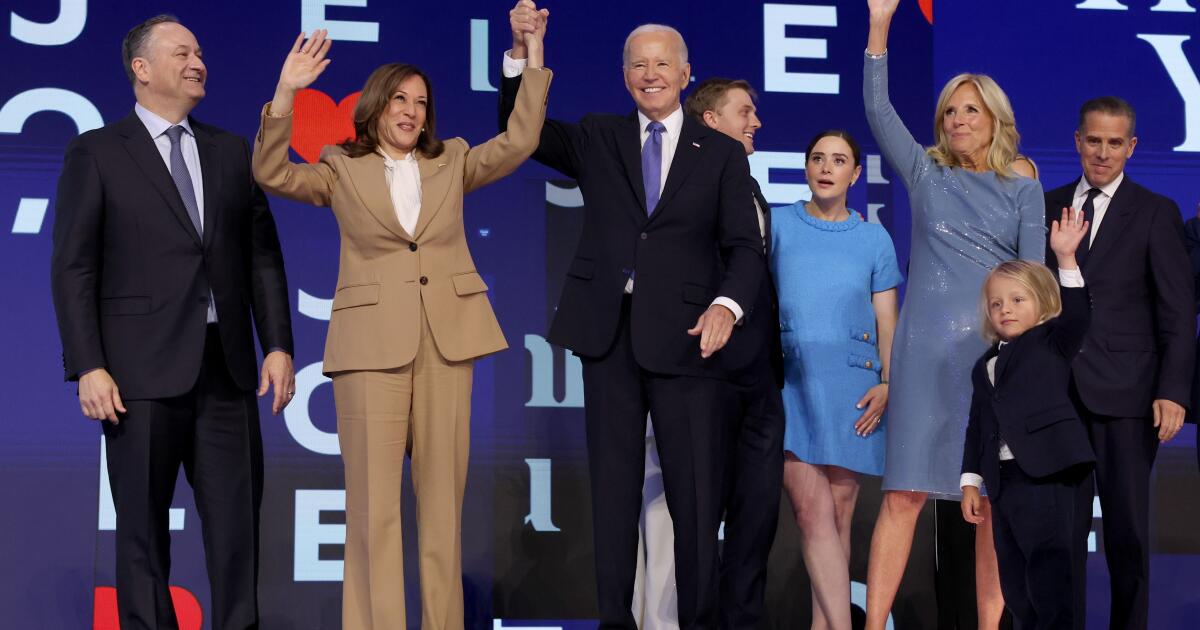
The Democratic National Convention started off with hope, hype and smaller protests than some feared — and a surprise appearance from Kamala Harris, looking very demure, very mindful.
(That’s a TikTok thing, if you don’t know.)
The snark level, meantime, was sky-high as cheeky partisans projected onto Trump Tower — which loomed over downtown like a middle finger extended at Democrats — a set of taunting slogans along the lines of: “Trump-Vance ‘Weird As Hell.’ ”
That’s trolling on a 92-story scale.
There were a great many speeches and a great number of entertainers, representing Democratic constituencies from Hollywood to Nashville. (Yes, there are still some Southern Democrats.)
But, of course, Monday night belonged to Joe Biden, the president who reluctantly walked away from his reelection campaign and showed up just long enough to endorse Harris before making his poignant exit — long after much of the country had gone to bed.
Columnists Mark Z. Barabak and Anita Chabria laid off the deep-dish pizza so they could devote all their energies to the convention and came away with these thoughts:
Barabak: He came, he spoke and he showed why Democrats were glad to bid their party leader a heartfelt — but nevertheless relieved — farewell.
Biden has never been a great orator. His strength was knowing how to work the levers in Washington, and for just about 45 minutes Monday night the president outlined all he’d managed to accomplish in his lone term.
Simply stated, he said: “We’re building a better America.”
Biden, too, was mindful, making a point of wrapping Harris in the mantle of his successes. (And the last 3½ years have been filled with nothing but an unbroken series of triumphs, to hear the president tell it, but, hey, it’s a convention speech.)
After he cited legislation bringing down the costs of some prescription drugs, the crowd chanted, “Thank you, Joe!”
“Thank you, Kamala, too!” he interjected.
The emotions were genuine.
Biden was greeted with a lusty ovation lasting more than 4½ minutes, by far the longest of the night. He pulled a white hanky from his breast pocket and dabbed away a tear after a prolonged embrace from his daughter, Ashley, who delivered a loving introduction.
It was moving to hear Biden discuss the long arc of his career — from too young to serve in the Senate (he was 29 when first elected and turned the required age of 30 shortly before being sworn in) to being too old to serve another term as president, as he finally acknowledged.
It was also a reminder of why Democrats collectively looked to November’s election with heart-in-their-throats anxiety — and that was even before Biden’s crashingly awful debate performance.
On Monday night he appeared every bit his 81 years. He was stiff, occasionally stumbling over his words. His waxen face was frozen in a perpetual scowl. He shouted out his words, not at all the joyful warrior of Harris-Walz fashion, but more like a cranky old man shooing kids off his lawn.
The contrast with Harris, who bounded onstage afterward to embrace Biden and join him in the traditional arms-raised tableau, couldn’t have been more stark.
There was speculation that convention programmers purposely pushed the president’s appearance out of television’s prime time on the East Coast and, by the time he finished, in the Central time zone. Of course, they denied it; the program ran long because speakers were just so darned popular, people wouldn’t stop cheering and clapping, party officials said.
What did you think about Biden’s speech?
Chabria: The emotions were genuine, as you say, but I think they were also complex.
Nancy Pelosi had tears in her eyes, though many claim she was a key architect of Biden’s exit. When Harris went onstage she told Biden — not for the cameras — that she loved him.
Ashley Biden brought up the spirit of her departed brother, Beau, and at the end, Biden walked offstage with a young grandson, named in that son’s honor.
When the crowd chanted “Thank you, Joe,” Biden seemed resigned, but also a bit defiant with the long list of accomplishments he touted — reminding us how much he’s done that seems forgotten in the scrum of the election.
Until a few weeks ago, this was a proud and stubborn man who believed not only that he was the best person for the presidency, but believed we thought so, too. So Monday night — as much as it was billed as a gratitude-driven sendoff — was also a forced retirement for a guy who does know more about government and governance than half of Congress combined.
My takeaway is that for all his flaws, and we all have them, this is a man of duty and honor.
Biden quoted a line from the song “American Anthem” to sum up why he made the choice to step away from power: “What shall our legacy be, what will our children say? Let me know in my heart when my days are through, America, America, I gave my best to you,” he said.
And there’s no doubt he gave his best, for decades.
But, as Hillary Clinton said in an earlier speech, change is afoot. And that change doesn’t include Biden.
Barabak: It was a forward-looking Clinton appearance, yes. But the might-have-been vibe was strong when the former first lady and secretary of State took the stage.
The ovation lasted nearly a minute and a half, as Clinton repeatedly started and stopped over the prolonged clapping and cheers.
She acknowledged the outgoing incumbent — “first, let’s salute President Biden” — then dwelled at length on the history-making nature of Harris’ candidacy.
“Something is happening in America,” said Clinton, who was the first woman to win a major party’s presidential nomination. “Something we’ve waited for and dreamed of for a long time.”
More than 66 million Americans voted for her in 2016, Clinton noted, poking more than 66 million small holes in the glass ceiling that’s kept a woman from the Oval Office.
She then tore with relish into the man who beat her — not in the popular vote but narrowly in the electoral college.
“Kamala Harris” — a former district attorney and California’s attorney general— “prosecuted murderers and drug traffickers. Donald Trump fell asleep at his own trial,” Clinton gibed. “And when he woke up, he made his own kind of history” as the first ex-president convicted of a felony.
“Lock him up!” the crowd chanted, and Clinton smiled.
Anita, you were taken with one of the non-celebrity speakers, weren’t you?
Chabria: I really felt what April Varrett said, and what she represented.
Varrett, the first Black woman to lead the Service Employees International Union, came out of California as the former head of SEIU Local 2015, the state’s largest local union representing long-term care workers.
Its rank-and-file consists of many Black and brown women, a number of whom are immigrants struggling with poverty in an industry as necessary as it is underfunded. Varrett promised to create a labor movement that is “younger, darker, hipper, fresher, sneaker-wearing.”
That is a powerful vision that is already happening in both labor and politics. I think in a little-noticed way, this convention is all about immigration and communities of color — the immigrants who fuel our economy, fight for their communities and now are claiming political power in a way that terrifies conservatives to the point they demonize them.
Comparing the crowd at the Republican National Convention to the one in Chicago is startling. It really feels like two different Americas, and a crossroads election where we decide which one we believe in.
I was also struck by the everyday Americans who spoke about abortion access. Hadley Duvall, a Kentuckian who was raped and impregnated by her stepfather when she was 12, floored the room with a single question.
Trump calls abortion bans a “beautiful thing,” she said. “What is so beautiful about a child having to carry her parent’s child?”
What else stood out to you?
Barabak: How several of the night’s speakers, in addition to Clinton, leaned into the historic nature of Harris’ nomination as the first Black woman and first Asian American to lead a major party presidential ticket.
That was a major theme in 2020, when Harris first ran for president, and it seemed at times that campaign was more about her hopes of making history than what voters had on their minds.
But there’s no denying the precedent-shattering nature of Harris’ nomination, and it was celebrated with the right amount of balance and perspective.
The vice president was placed in a long line of pioneering women who helped tear down race and gender barriers, among them Diane Nash, Rosa Parks, Fannie Lou Hamer, Coretta Scott King and Shirley Chisholm.
“We must all understand that Black history is American history,” said Derrick Johnson, president of the NAACP. “And in this historic moment, we will write the next chapter together.”
That remains to be seen, depending on what happens in November. But there is no doubt the moment inscribed in Chicago stands apart from all that have preceded.

Politics
Jacob Frey praises Somali community as Minnesota faces renewed scrutiny over fraud investigations

NEWYou can now listen to Fox News articles!
Minneapolis Mayor Jacob Frey told members of the city’s Somali community over the weekend that they are “our family,” pledging solidarity and praising their contributions to the city during remarks celebrating Somali Independence Day.
Frey’s remarks came as Minnesota continues to face scrutiny over several high-profile fraud investigations and weeks after a Republican-led House Oversight Committee report alleged the Minnesota Governor Tim Walz’s administration failed to act on repeated warnings about widespread fraud in the state’s social services programs.
“Through the most difficult of times and through Operation Metro surge, we all saw that they tried to come for some of us,” Frey told members of the Somali community on Saturday. “And when that happens, we say that you’re coming for all of us.”
BLUE STATE’S ANTI-ICE PLEDGE COLLAPSES AS GOP WARNS OF NEW SANCTUARY ‘CONFEDERACY’
Minneapolis Mayor Jacob Frey speaks during a Somali Independence Day celebration in Minneapolis as attendees stand on stage holding Somali flags. (Credit: Mayor Jacob Frey X Post)
“In Minneapolis, we loved our neighbors. In Minneapolis, we do not see you as immigrants. We see you as our family,” he added. “You are our brothers. You’re our sisters. You have done so much for this incredible city, and for that, we stand with you.”
Frey appeared to reference Operation Metro Surge, the Trump administration’s immigration and public safety initiative in Minnesota.
The operation concluded in February after border czar Tom Homan announced it had resulted in the arrest of more than 4,000 people in the Minneapolis-St. Paul area and had reduced what he described as public safety threats.
BLUE STATE’S ANTI-ICE PLEDGE COLLAPSES AS GOP WARNS OF NEW SANCTUARY ‘CONFEDERACY’
Minneapolis Mayor Jacob Frey speaks to the media at City Hall on Jan. 9. (Aaron Lavinsky/The Minnesota Star Tribune via Getty Images)
Frey shared the video on X, writing, “Happy Somali Independence Day.”
“Here in Minnesota, home to one of the largest Somali communities in the United States, we celebrate the resilience, culture, and leadership that continue to enrich our city and community,” he said.
Earlier this month, a Republican-led House Oversight Committee report alleged Walz’s administration repeatedly failed to act on warnings about fraud involving state social services programs, including the Feeding Our Future scandal.
WALZ ADMINISTRATION IGNORED FRAUD WARNINGS AS BILLIONS VANISHED, HOUSE OVERSIGHT REPORT ALLEGES
Democratic Gov. Tim Walz speaks during a news conference on Tuesday, Jan. 6, 2026, in Minneapolis, Minnesota. (Alex Kormann/Star Tribune via AP)
The committee said more than 110 people have been charged in connection with various fraud schemes in Minnesota, including many defendants identified as members of Minnesota’s Somali immigrant community.
The report also alleged concerns about potential racial discrimination claims contributed to delays in addressing suspected fraud and estimated Minnesota lost roughly $300 million in stolen federal child nutrition funds during the COVID-19 pandemic.
CLICK HERE TO DOWNLOAD THE FOX NEWS APP
Walz administration officials have disputed the committee’s findings.
Fox News Digital’s Adam Pack contributed to this report.

For as long as I’ve been a journalist, which is a really long time, public entities have hated public records requests, even while claiming they don’t.
Ask your typical elected or hired official, from the governor to the animal control folks, and they’ll tell you transparency is vital and sunshine in government a key value.
Then turn in the most benign of public records requests — access to a calendar, for example — and prepare for weeks of delays and excuses. Want emails or financial records or, heaven forbid, anything from the police? Months or even years may pass before a single page is delivered, no joke.
That’s why I am deeply concerned about a bill winding its way through the California Legislature that would definitely slow down public records requests and likely make them more difficult and expensive. At its worst, it could push people into costly court battles just for having the audacity to ask for information.
The legislation, Assembly Bill 1821, is authored by Democratic Assemblymember Blanca Pacheco, whose district includes Norwalk, Downey and Bell, where legendary scandals are Example 1 of why public records matter.
Pacheco’s office told me Wednesday that the troubles with the bill are far from what Pacheco set out to do.
“It was never the author’s intention to take away people’s rights to a [Public Records Act] request,” said her chief of staff, Nikki Johnson.
Johnson said the bill was meant to curtail malicious records requests, which do happen, where a citizen goes after copious amounts of records just to be a jerk and cost the government time and money.
It was also meant to address the growing problem of artificial intelligence and other for-profit businesses requesting thousands of records with the intent of using the information to create money-making products — think of sites that already sell publicly available personal information as “background checks.”
I believe Johnson on the good intentions of the bill in addressing those real if nebulous difficulties, but you know what they say about the best-laid plans.
The bill passed through the Assembly recently with ease, largely because most of its problematic portions (I’ll get to those in a minute) were removed — though not all. Even in a watered-down form, which basically gave government more time to answer requests, I found myself in the unlikely position of agreeing with conservative Republican Assemblymember and Trump supporter Carl DeMaio of San Diego, who offered some of the only opposition from elected leaders during the Assembly vote.
“We cannot police the public’s right to know, and we want to err on the side of transparency in how government agencies operate,” DeMaio said.
Amen, brother.
But the Democratic-controlled Assembly erred on the side of secrecy and slowdown instead, and the measure sailed to the Senate, where seemingly out of the blue, a bunch of new provisions were added that fill it with loopholes, vague language and tons of room for abuse.
David Snyder, executive director of the First Amendment Coalition, said the bill as written now was “comprehensively bad for transparency and therefore for government accountability.”
Sean McMorris, transparency, ethics and accountability program manager for the advocacy organization California Common Cause, put it even more forcefully. He pointed out that “public records are the public’s records.”
“They’re not owned by the government,” he said. But this bill would shift that paradigm and make the public “prove why you need them.”
“It’s going to chill people who want to make requests, and it’s going to complicate the process, and it’s just wrong,” McMorris said.
In its new form, the bill basically allows government entities to decide if they feel a public records request is malicious or for commercial gain. If they do, they can petition a court to intervene — potentially sparking both legal costs and new fees associated with fulfilling the request.
It would also, Snyder said, force a requester to explain why they wanted the records — something California law has repeatedly avoided because it gives power to government to treat those it perceives as enemies differently.
In this age of fairness and reason, it’s hard to imagine a government official misusing power to keep secrets, but I’m told it happens. That makes it all the more crucial that people not be forced to explain why they want information, or if they will use it to, say, expose corruption — be it wrongdoing by a single individual or the entire system.
Faced with unintended consequences, Assemblymember Blanca Pacheco (D-Downey), shown in 2023, will seek to scale back the bill to its original form, according to her chief of staff.
(Rich Polk / Getty Images for Equality California)
“I have little doubt that some agencies will use that provision to overburden requesters that they view as political opponents, requesters that they view as just a hassle, requesters that ask for things the government doesn’t want to disclose,” Snyder said. “They can bring the requester into court, and at a minimum, slow down the process, and probably more likely get the requester to simply withdraw.”
As written, the bill also gives a shoddy carve-out meant to protect journalists, but which in reality could be used to curtail requests from freelancers, student journalists and more.
McMorris said access to public records is a “moral issue,” and fixing any problems with the current law requires “a scalpel, not a meat ax.”
This bill, he warned, is a meat ax.
“I don’t discount that there are abusive requests, and that there are requests that really are a burden on government agencies, but the law right now has ways for government agencies to address that,” he pointed out. “Once these laws go into place, they’re going to be hard to roll back.”
It could “fundamentally change” our access to public records, he said.
Johnson, Pacheco’s chief of staff, told me that faced with all these unintended consequences, the Assembly member is going to ask for the amendments to be removed, and for the bill to progress as it was written when it passed the Assembly. That could happen as early as next week, when the bill with the new provisions is scheduled to come up again in a Senate committee for debate.
Reverting to the bill the Assembly voted on would be better, but slowing down public records is in government’s best interests, not the people’s. The bill does nothing to address the problems it seeks to fix, but stretches out the time officials have to simply tell a requester if any records do exist — never mind delivering them.
So even back to its watered-down form, the bill remains a meat ax for a scalpel problem, chopping up transparency with good intentions.

NEWYou can now listen to Fox News articles!
Former President Joe Biden appeared to briefly seek directions before exiting the stage after delivering remarks at a Democratic gala Saturday night, capping his speech with an awkward onstage moment.
After delivering a roughly 10-minute keynote speech at the Maryland Democratic Party’s “Fight Back & Win Gala” near Baltimore, the 83-year-old paused onstage and looked toward the wings before pointing in two different directions, seemingly trying to determine where to exit. After receiving guidance, Biden turned and walked off the stage with his back to the audience.
Unlike several other speakers at the gala, who exited on the opposite side of the stage after their remarks, Biden left in a different direction.
EX-DEM INSIDER REVEALS SHE WILL EXPOSE DEMOCRATS WHO COVERED UP BIDEN’S COGNITIVE DECLINE IN NEW BOOK
Former President Joe Biden exits the stage after delivering remarks at the Maryland Democratic Party’s Fight Back and Win Gala near Baltimore on Saturday. (CSPAN)
The moment came after Biden delivered one of his sharpest public critiques of President Donald Trump since leaving office. During his remarks, Biden defended his own administration’s record while accusing the Trump administration of corruption. He also took aim at what he described as Trump’s “vanity projects,” including renovations to the White House, changes at the Kennedy Center and the ongoing saga with the reflecting pool on the National Mall.
“Whoa, what a loser,” Biden said.
After pausing several times to cough throughout his remarks, Biden concluded with a call for Democrats to “fight back,” saying the country could overcome its challenges by acting together.
“Folks, I guarantee we can do this. And we will. We just remember who in the hell we are. We’re the United States of America,” Biden said. “There’s nothing, nothing beyond our capacity if we act together. So let’s get up and fight back, God darn it.”
The latest onstage moment comes just days after another widely shared incident at the opening of the Obama Presidential Center in Chicago.
WATCH: BIDEN LEFT SEARCHING FOR FAMILY AFTER OBAMA PRESIDENTIAL CENTER CEREMONY
The star-studded ceremony brought together former Presidents Barack Obama, Bill Clinton and George W. Bush, along with former Secretary of State Hillary Clinton, former Vice President Kamala Harris and other political leaders and entertainers. At the conclusion of the event, Biden remained onstage after others had exited before calling out, “Where’s my granddaughter?”
Former First Lady Jill Biden then returned to the stage, took his hand and guided him off.
SIGN UP TO GET THE POLITICS NEWSLETTER
Former U.S. President Joe Biden and Former first lady Jill Biden appear on stage during the dedication ceremony for the opening of the Barack Obama Presidential Center in John Lewis Plaza on June 18, 2026 in Chicago, Illinois. (Scott Olson / Getty Images)
Biden has largely stayed out of the public eye since withdrawing from the 2024 presidential race after facing intense pressure from fellow Democrats to end his reelection bid.
CLICK HERE TO DOWNLOAD THE FOX NEWS APP
The former president has since made only occasional public appearances and recently disclosed that he is undergoing treatment for Stage 4 prostate cancer.
-

 Pennsylvania3 minutes ago
MSU basketball extends offer to Pennsylvania 4-star center prospect
-
Rhode Island10 minutes ago
RI Lottery Numbers Midday, Numbers Evening winning numbers for June 28, 2026
-

 South-Carolina12 minutes ago
South Carolina Lottery Pick 3, Pick 4 results for June 28, 2026
-
South Dakota18 minutes ago
SD Lottery Millionaire for Life winning numbers for June 28, 2026
-
Tennessee25 minutes ago
TN Lottery Cash 3 Evening, Cash 4 Evening winning numbers for June 28, 2026
-

 Texas27 minutes ago
After historic floods, Texas Hill Country Little League is back
-

 Utah33 minutes ago
Sculptor to build $55 million monument depicting American history in Utah
-
Vermont40 minutes ago
VT Lottery Pick 3, Pick 3 Evening results for June 28, 2026

