South Dakota
How South Dakota, Michigan took different paths to 'election integrity'


DETROIT, Mich. – Justin Roebuck can recall the exact moment that distrust of 2020 presidential election results impacted his status in the Republican Party.
The top election official of Ottawa County in western Michigan was speaking to a GOP women’s group when he was asked who won the race between Republican Donald Trump and Democrat Joe Biden in the Midwest battleground state.
“When I told them that Biden won Michigan by about 154,000 votes, the gasp was audible in the room,” said Roebuck, adding that he was castigated by other party members for legitimizing the results. “I think it hit home for me at that point.”
Roebuck was among a group of election officials who spoke to journalists as part of the National Press Foundation 2024 Elections Fellowship in late July, assessing the state of American voting systems ahead of November.
They illustrated how unfounded claims of voter fraud, exacerbated by public frustration over social restrictions during the COVID-19 pandemic, emboldened electoral activists seeking to overturn results and erode trust in the democratic process.
These reverberations were felt in South Dakota, where grassroots efforts from organizations such as South Dakota Canvassing Group put pressure on state legislators to address election security through post-election audits and the banning of unmonitored drop boxes.
But the heightened scrutiny of casting and counting votes was hardly unique to the Republican-run Mount Rushmore State.
Michigan, a Democratic-controlled swing state that voted for Trump in 2016 and Biden four years later, was at the center of civil unrest before, during and after the tumultuous 2020 presidential race.
The way the two states handled the fallout – with Michigan expanding voting opportunities through ballot measures and South Dakota restricting access with legislative action – reveals disparate strategies to defend the sanctity of the vote.
South Dakota House Majority Leader Will Mortenson told News Watch that, in the case of restricting drop boxes, there were questions about the “susceptibility of abuse” and whether that justified changing the law. “Or do we have to wait until there’s actual abuse that we see before we address the susceptibility?” he asked.
Stu Whitney / South Dakota News Watch
Ballot measure expands voter access
In June 2021, after months of investigation, a Republican-controlled Senate Oversight Committee in Michigan issued a report that found “no evidence of widespread or systematic fraud” related to the 2020 presidential election in Michigan.
But GOP lawmakers still pointed to vulnerabilities in the system and moved to pass nearly 40 bills aimed at restricting voter registration, absentee ballots, voter ID and drop boxes. Whitmer vetoed the bills and overcame a narrow Republican legislative majority, which has since shifted to a slim Democratic advantage.
In 2022, Michigan voters adopted Proposal 2, a constitutional amendment that established at least nine days of early voting, provided voters with a right to request an absentee ballot, and enshrined voter ID rules that Republicans had sought to restrict.
The measure also mandated at least one state-funded drop box for each municipality, with additional boxes for every 15,000 voters, building on absentee voting reforms passed in a similar Promote the Vote amendment in 2018.
Proposal 2, lauded by supporters as Promote the Vote II, passed with 60% of the vote, a notable mandate at a time of election-related angst in the state.
Message matches the moment
South Dakota’s own introspection on election access was accelerated by groups such as South Dakota Canvassing, whose founders were inspired by My Pillow founder and conspiracy theorist Mike Lindell’s 2021 Cyber Symposium in Sioux Falls.
Lindell, who campaigned for Trump alongside South Dakota Gov. Kristi Noem, claimed to have incriminating 2020 election data showing that China hacked into U.S. voting systems to help elect Biden. He offered $5 million to anyone who could prove him wrong, which did indeed happen, forcing him into a court battle as he tried to avoid honoring the bet.
“Fair elections equal a representative republic, but stolen elections equal slavery,” Canvassing Group co-founder Jessica Pollema told followers, who put county auditors and commissioners on the defensive by echoing accusations from conservative media and demanding proof of secure systems, even in a state that Trump won by 26 points in 2020.
For some Republicans, the message matched the moment. In a May 2024 poll co-sponsored by News Watch, more than 6 in 10 South Dakotans said they were dissatisfied with how democracy is working in the United States, including 32% who said they were “very dissatisfied.”
The same poll found that 58% of Republican respondents said they accepted the outcome of the 2020 presidential election.
‘Make sure that it’s done right’
That was the political climate in which South Dakota’s Republican leadership, in consultation with county auditors, explored the issue of election security during the 2023 state legislative session in Pierre.
Those seeking major overhauls included Rick Weible, a computer analyst and Canvassing Group adviser who supports the hand counting of ballots and criticizes South Dakota’s 46-day early voting period, tied for longest in the nation.
Opportunity Solutions Project, a conservative nonprofit that advocates restrictions to absentee voting, also worked with legislators and county auditors to make it “easier to vote but harder to cheat,” a mantra newly adopted by election reformists.
Some of the testimony included allegations of people dumping unauthorized ballots into drop boxes in other states, without providing proof that it happened or how it was connected to South Dakota.
An Associated Press survey of election officials in each state revealed no cases of fraud, vandalism or theft involving drop boxes that could have affected the results of the 2020 election.
That didn’t mean it couldn’t impact South Dakota in future elections, said Mortenson, who along with Senate Majority Leader Casey Crabtree helped pass a package of 10 election reform bills in 2023.
“Some of the news we heard inspired legislators to kick the tires and figure out if some of the allegations seen in other states would show a vulnerability in our system,” said Mortenson.
“What we found is that we started out with a very secure, trustworthy system. The steps we took were to shore up security and acknowledge that if we’re going to have this really long early voting window, we’ve got to make sure that it’s done right.”
EDITOR’S NOTE: This story was produced by South Dakota News Watch, an independent, nonprofit news organization. Read more in-depth stories at sdnewswatch.org and sign up for an email every few days to get stories as soon as they’re published. Contact Stu Whitney at stu.whitney@sdnewswatch.org



South Dakota is getting another chief elections officer.
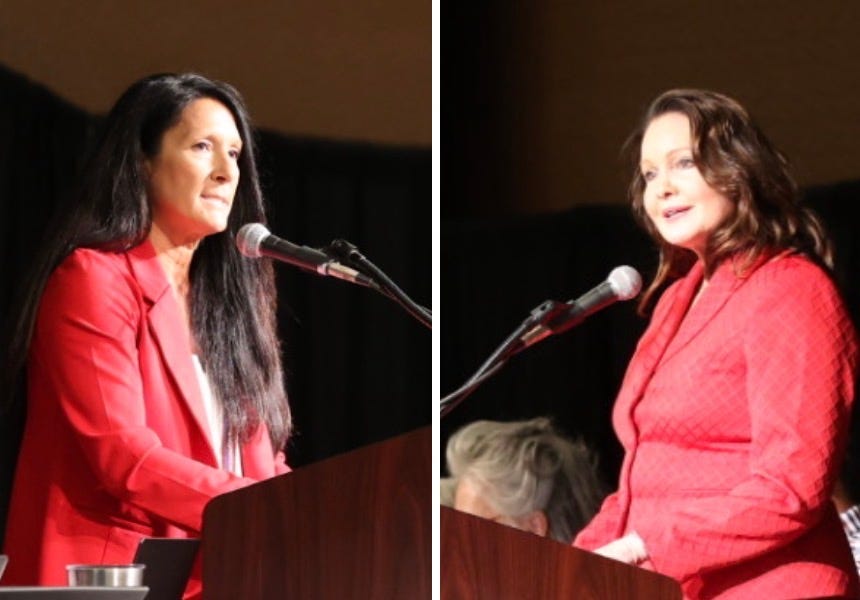
Secretary of State Monae Johnson failed to win the Republican nomination for a second term during the South Dakota Republican Party Convention Saturday in Rapid City, where GOP delegates instead favored another Pierre outsider to oversee the state’s elections for the next four years.
“When this office runs well, you don’t notice it. When it doesn’t, you feel it everywhere,” Rep. Heather Baxter told a capacity crowd of delegates and attendees at The Monument events center, where she received nearly 60 percent of votes cast by more than 700 party delegates.

Populist push falls short in South Dakota GOP contest for Public Utilities nod



South Dakota
Work, housing and staffing: How South Dakota’s corrections chief aims to keep inmates from returning

SIOUX FALLS – South Dakota’s repeat offense rate for people who leave prison can return to the low point it saw a a dozen years ago, the state’s corrections secretary said Tuesday.
Nick Lamb, now six months into his role atop the Department of Corrections, laid out the agency’s plan Tuesday at the Correctional Rehabilitation Task Force at its meeting in Sioux Falls. The plan includes work release programs, residential housing for inmates and a top-to-bottom restructuring of how the department operates.
Recidivism measures how many inmates return to prison within three years of their release. The figure for South Dakota stood at
50%
in the most recent data, which was based on the performance of inmates released in 2021.
South Dakota’s lowest recidivism rate in the last two decades was 39% in 2014.
“We’ll get back there,” Lamb said Tuesday.
Lamb told reporters after the meeting he wants “to start getting in the business of closing prisons” during his tenure.
“Our population is too high for our state,” Lamb said. “We need to get our population down, but we’ve got to give the offenders the tools they need that they haven’t always had.”
Several recommendations presented on Tuesday, by Lamb and other criminal justice experts, will require more staff and funding.
State Rep. John Hughes, R-Sioux Falls, worries that the Legislature’s budget-setting committee will balk at new spending.
“My concern is that we put all these elaborate proposals together, then when we get to appropriations we’re going to hit the wall,” Hughes said.
Inmates return to work release
Under Lamb’s predecessor, Kellie Wasko, pay for inmate work performed outside the prison walls
was increased to minimum wage
. After that policy change, fewer communities and organizations contracted inmate workers for community service jobs.
Rep. Tim Reisch, R-Howard, said most of the roughly 250 minimum-security prisoners he oversaw during his tenure as corrections secretary participated in work release.
“They got up and they all had jobs. They were used to getting out of bed, going to work, getting in a habit of that,” Reisch said.
When he toured the prison last year, fewer than 20 were working, he said.
Lamb has cut inmate wages below minimum wage since he started.
“We reached out to a lot of these communities, basically asking if they need help,” Lamb said. “We lowered the wage, which upset some people, but we need them out working.”
This summer, inmates will work at Sioux Falls parks and at its regional landfill, and they’ll prepare the fairgrounds in Huron for the State Fairgrounds in August. They’ll also help out during Riverboat Days in Yankton, and pitch in on tournament preparation for the National Field Archery Association.
Statewide residential facilities planned
Lamb also wants to establish a residential corrections program. He shared a presentation showing how such a program
operated in Iowa
, where he served as deputy director of institutional operations for the Iowa Department of Corrections before his move to South Dakota.
In Iowa, most residential facilities were filled with people on probation, parole or work release. He envisions a similar program in South Dakota, with housing outside of traditional prison settings designed to help transition back into the community, but he hasn’t finalized details or a timeline.
“We’re going to try it,” Lamb said. “I’ll be honest, I haven’t talked to the lieutenant governor or anybody else about it, but we need to try it. It works.”
The program has been in Iowa for decades. Iowa’s three-year recidivism rate peaked at 38.9% in 2019 and has since fallen to 32.8%, based on the
latest data available
.
“I’m not trying to throw you a sales pitch,” Lamb said, but residential programming is “a good idea.”
Lamb said he doesn’t want to replace programs like the one run by the Sioux Falls-based nonprofit St. Francis House, but to add to it.
St. Francis House doesn’t cap how long residents can stay and limits rent to $250 a month. Lamb said a state-run program would include a time limit and higher rent.
A lack of “felon-friendly housing” is a major driver of recidivism, said Sioux Falls Mayor Paul TenHaken, who’s leaving his position soon after two terms in office. The problem won’t improve without government involvement, he added.
“If the state ever chooses to invest in St. Francis House programming, it’s money well spent,” TenHaken said.
Justice Center recommendations
The percentage of inmates who got rehabilitative programming increased from 27%to 44% between 2023 and 2025, according to a report presented Tuesday by the Council for State Governments Justice Center.
The national nonprofit was contracted to analyze the state’s prison system and help guide the task force’s work.
Despite the gains in programming, the group reported, 46% of inmates released in 2025 received none. Access was also limited by where inmates were held, due to space and staffing restrictions.
The justice center recommended several changes, including:
- Creating a rehabilitation and reentry division and hiring several new positions.
- Creating a centralized waitlist for programs.
- Streamlining the program catalog to reduce overlap and fill gaps.
- Sequencing programming to cover an inmate’s entire stay, rather than stacking programs in the last few months of their sentence.
- Creating a dedicated parole violation program track.
Many of those recommendations hinge on hiring and retaining adequate staff — one of the department’s most significant challenges, according to the group.
Sara Friedman, program director with the Justice Center, said her team consistently heard in interviews that the department tends to shift employees around when attempting new initiatives, rather than hiring. That creates gaps for inmates seeking programming.
Sometimes, for example, shifting staffing patterns will leave facilities without enough security staff to transport inmates to classrooms.
“Technically, you’re fully staffed, but you’re fully staffed so thinly that the moment one thing goes wrong, the waterfall effect is people are not getting their rehabilitative services,” Friedman said.
Lamb told South Dakota Searchlight after the presentation that he wasn’t surprised by the staffing recommendations. The department lacks adequate staff to backfill for sick or vacationing employees, he said, though he didn’t say how many more employees would need to be hired to address the issue.
The department is already working to create the new rehabilitation and reentry division and centralize its scheduling.
The task force plans to meet two more times before it’ll finalize its recommendations for the Legislature ahead of the next session, which starts in January.
— This story was originally published on southdakotasearchlight.com.

South Dakota Republican delegates rejected a push to censure Senate Majority Leader John Thune (R-S.D.) over the stalled SAVE America Act, exposing a fight within the GOP over how far the party should go to force through sweeping new voting restrictions.
South Dakota Republicans voted down a proposed censure of Thune at the state party convention Friday after a resolution accused him of blocking President Donald Trump’s election agenda.
The measure had advanced out of the party’s Resolutions Committee, but failed before the full convention.
The resolution targeted Thune for what it called “his failure in regards to the SAVE America Act,” a Republican-backed bill that would impose strict proof-of-citizenship and photo ID requirements to vote.
Voting rights advocates have warned the bill could block millions of eligible Americans from registering, especially people who do not have easy access to passports, birth certificates or documents matching their current names.
Trump has sharply escalated pressure on Republicans to pass the bill. This week, he abruptly canceled a planned signing ceremony for a bipartisan housing affordability bill, tying the unrelated legislation to his demand that Congress first pass the SAVE America Act.
“Today’s Housing News Conference and Signing is hereby cancelled until such time as we pass the desperately needed SAVE AMERICA ACT, which I consider to be a National Emergency,” Trump wrote.
The censure push reflects growing anger among Trump allies who want Senate Republicans to change or bypass filibuster rules to pass the bill. A filibuster is a Senate procedure that usually requires 60 votes to move most legislation forward. Republicans do not have those votes.
“We don’t have the votes, either to proceed to a talking filibuster nor to sustain one if we got one,” Thune said last week. “That’s just a function of math. There isn’t anything I can do about that.”
For pro-democracy advocates, the fight is not simply about Thune. It is about a broader Republican effort to turn Trump’s election denialism into federal policy. Noncitizen voting is already illegal and exceedingly rare.
But the SAVE America Act would use that false crisis to create new barriers for eligible voters.
The South Dakota vote shows the limits of MAGA pressure even in a deep-red state. Delegates were willing to debate punishing their own Senate majority leader, but ultimately rejected escalating the internal fight.
Still, the episode underscores how central voting restrictions have become to the Republican agenda ahead of the midterms.
-

 New York48 minutes ago
Metropolitan Diary Challenge Day 1: What Is Your N.Y. Story?
-

 Los Angeles, Ca55 minutes ago
LASD releases video of man shot by deputy after allegedly charging them with knife
-

 Detroit, MI1 hour ago
Rick Mahorn returns to coaching Detroit basketball with BIG3 Amps
-

 San Francisco, CA1 hour ago
Suspect arrested after shooting near San Francisco Pride events, police say
-

 Dallas, TX1 hour ago
Dallas shooting injures 2 as police search for suspect
-

 Miami, FL2 hours ago
Colombia wins Group K after 0-0 draw with Portugal in Miami Stadium; both teams advance to World Cup knockouts
-

 Boston, MA2 hours ago
Beyond the frame: ‘Where’s Boston?’ revisited through new oral histories – Boston News, Weather, Sports | WHDH 7News
-

 Denver, CO2 hours ago
Arizona Cardinals will face Denver Broncos QB Bo Nix for 1st time

