Politics
In Tim Walz's rural hometown, his Democratic politics are an awkward fit


Mayor Kyle Arganbright steered his dusty diesel truck through this ranching town, past the rodeo grounds and livestock auction, and pointed out the football field of the Valentine High School Badgers, whose roster once included a teenage Tim Walz. Next up: the quiet, tree-lined street where the Walz family once lived.
After Walz, the Minnesota governor, was named Vice President Kamala Harris’ running mate, reporters descended on his hometown of Valentine, population 2,600.
“Now I’m the local Tim Walz tour guide. Write that on the list of things I never thought I’d do,” Arganbright said with a laugh as a fishing rod, stretching from the back seat, rattled on his dashboard.
Harris and Walz come from vastly different worlds.
Harris is the biracial daughter of immigrants whose career was forged by the rough-and-tumble Democratic politics of the Bay Area — a place nationally synonymous with West Coast liberalism.
Walz is a white guy who spent formative years in Valentine, the remote seat of Cherry County, the nation’s top producer of beef cows.
Walz leans heavily on his upbringing, and during a campaign stop in Los Angeles this week, he even walked onstage to the John Mellencamp song “Small Town.”
But here in Cherry County — where former President Trump won 87% of the vote in 2020 — the presence of a hometown boy on the Democratic ticket is, well, a little awkward.
Asked if Walz might flip many votes, Arganbright chuckled.
“Um, no,” he said.
Vice President Kamala Harris’ running mate, Tim Walz, grew up in Valentine, population 2,600.
(Hailey Branson-Potts / Los Angeles Times)
Arganbright, a fifth-generation Valentinian, said most voters here are Republicans with a leave-me-alone libertarian bent.
“If Tim Walz came back, I bet someone would buy him a beer if they saw him and say, ‘Hey, welcome home, man,’” he said. “People are very accommodating. But they’re not going to give up on their principles to impress somebody.”
Arganbright would not say whom he will be voting for — but said it might be a hint of his party preference that he once interned for Nebraska-born former Vice President Dick Cheney and that one of his young nephews had a show steer named Donald.
With Harris tapping Walz and Trump picking as his running mate Ohio Sen. JD Vance — whose bestselling “Hillbilly Elegy” chronicled his impoverished upbringing in the Rust Belt and Appalachia — the race has become, in part, a contest of rural bona fides.
Though the Trump campaign branded Walz “a West Coast wannabe,” Democrats are betting Walz will help them broaden their appeal in overwhelmingly white swaths of rural America, where the party has been trying to claw back voters after two decades of steep losses.
The country’s urban-rural political divide — evident even in California, where conservative northern counties have long talked of seceding to form their own State of Jefferson— has only grown wider since Trump was elected in 2016.

The Niobrara River bridge on the Cowboy Trail, a hiking and biking path along a former railroad track in Valentine.
(Hailey Branson-Potts / Los Angeles Times)
For urban Democrats, “it’s as if rural America has become a throwaway, and that lack of interest morphed into enormous resentment after Trump was elected,” said Lisa Pruitt, a professor at the UC Davis School of Law and president-elect of the Rural Sociological Society.
During the 2022 midterm elections, 69% of rural voters cast ballots for Republicans, compared with 29% supporting Democrats, according to the Pew Research Center. Among urban voters, 68% supported Democrats and 30% backed Republicans.
Randy Adkins, a political scientist at the University of Nebraska Omaha, said he does not see places like Nebraska suddenly going blue.
“What we’re seeing in the polls right now is there’s a little bit of movement toward Harris, but people made hard decisions and they made them a long time ago,” he said.

A building under construction along the newly refurbished Main Street in Valentine.
(Hailey Branson-Potts / Los Angeles Times)
Still, there is palpable excitement among rural Democratic organizers, who say they have long been overlooked by their national party.
Jane Kleeb, chair of the Nebraska Democratic Party, said in an email that Harris “has absolutely expanded the map beyond swing states with Tim Walz” and that “we do not have to hand him a briefing book on rural issues, because he has lived our experiences.”
Among Democrats’ many identity-based Zoom fundraising calls that have raised millions — including “White Dudes for Harris” — was an event last week called “Rural Folks for Harris.” It drew about 6,000 listeners across 48 states and raised $22,000.
In Valentine, there were no visible yard signs for Harris or Trump this week. At the Cherry County Rodeo, people donned cowboy hats, not MAGA caps.
The rodeo clown wondered aloud if one cowboy in a green shirt had actually “gone green” and had an electric pickup truck in the parking lot. It was a wink-wink joke in this far-flung town with no electric vehicle chargers, where such vehicles are seen not only as impractical — it is 130 miles to the nearest Walmart — but as a whiff of liberalism.
Arganbright — whose 7-year-old daughter rode a sheep bareback for just over two seconds in the rodeo’s mutton-bustin’ contest — is amused by the sudden, if fleeting, national interest that Walz’s selection has brought to Valentine. He hopes to use the spotlight to highlight positive things, like the just-finished, multimillion-dollar overhaul of Main Street.
But, he said, there are pressing issues here in vast Cherry County, where the population has dropped nearly 11% since 2000, to roughly 5,500 residents. Residents have struggled with high inflation, job losses as agricultural work becomes more mechanized, and a lack of child care and affordable housing.
As for people’s views of the federal government? One of the best examples, he said, of how “federal policies aren’t taken great locally” is the federally established time zone line, which, until the late 1960s, ran along Main Street, splitting Valentine between Mountain and Central time.
He said it took the government too long to fix it — although some bars are said to have benefited by opening on the west side of town, where they could stay open an hour later.
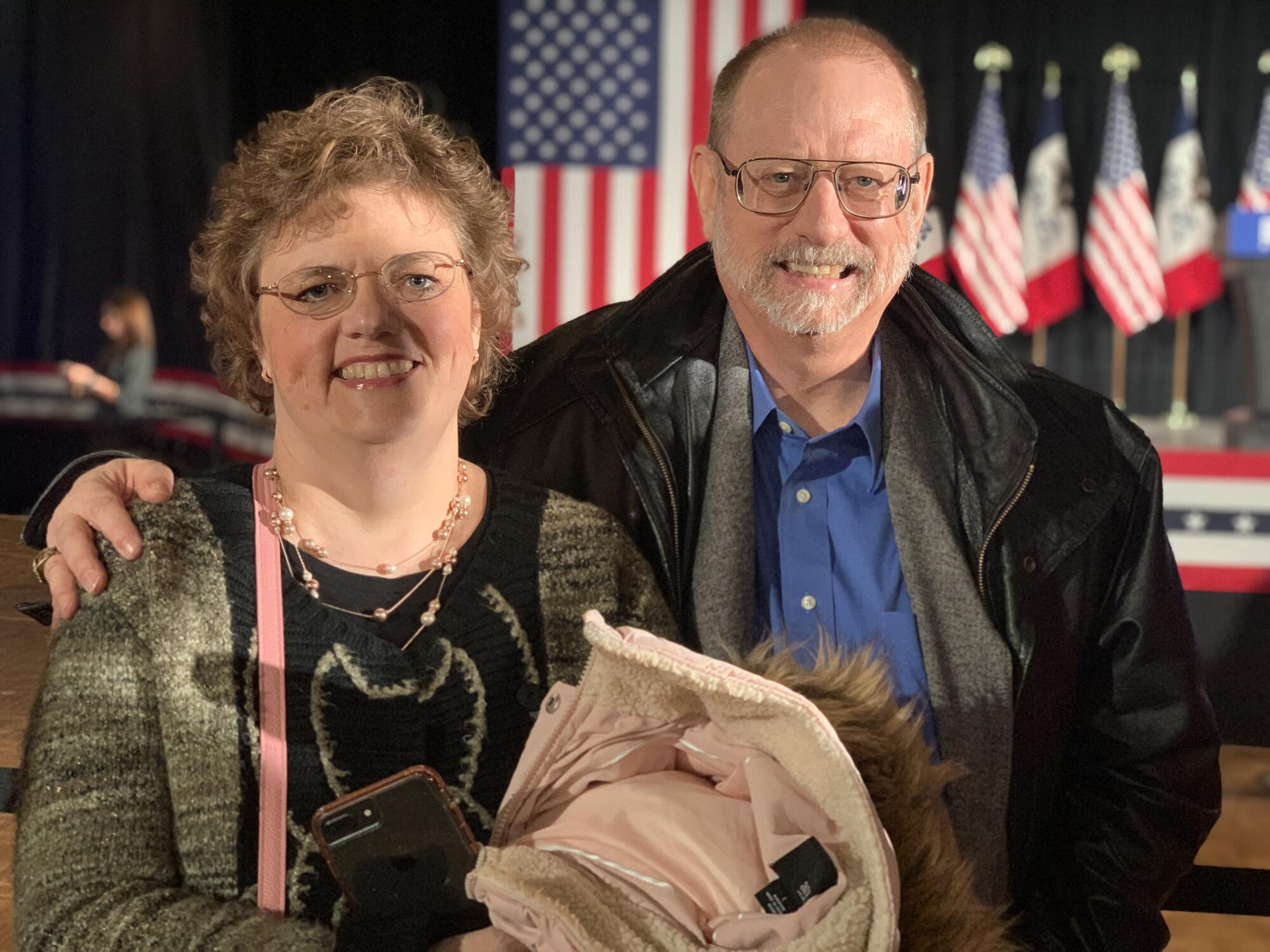
Bud Pettigrew, with wife Angie at the 2020 Democratic Iowa caucuses, attended Valentine High School with Tim Walz and is a former Nebraska Democratic Party official.
(Melanie Mason / Los Angeles Times)
Bud Pettigrew, who attended Valentine High School with Walz and is a former Nebraska Democratic Party official, said he’s heard mixed reactions in the Cornhusker State to the vice presidential nod.
“The people who are Democrats or open-minded independents are all thrilled about Tim,” said Pettigrew, former Marine and high school teacher. “The MAGA-type Republicans, they don’t care. He’s just another liberal. Once you move away, you don’t count anymore. You hear this a lot from rural people.”
Pettigrew, 63, was a senior when Walz was a freshman quarterback on the junior varsity team. Pettigrew saw in Walz “a pretty tough kid who had some ability.”
Walz’s father was the school superintendent, and Pettigrew remembers him fighting for a school bond — not an easy feat in a fiscally conservative town — to replace the 1897 schoolhouse said to be haunted by the ghost of a student who died after someone poisoned her clarinet reed.
Pettigrew is planning to vote for Harris and Walz.
Darlene Meyer, who owns the Plains Trading Company bookstore on Main Street, said she “was frightened” when she learned Harris was running — not because she dislikes her, but because she figured too many conservatives would refuse to vote for her because she’s a woman, because she’s Black and Asian American, and because she’s from California.
“How many strikes can you have against you?” she said. Walz, she added, was a smart choice.
Meyer is a registered Republican but not a party-line voter. She does not like Trump and said it was frustrating that he politicized masks during the COVID-19 pandemic lockdown.
Meyer, a septuagenarian and longtime nurse, still requires masks in the bookstore, a 1914 building with poor ventilation. A few people have spit on the floor in protest. Others boycotted.
Still, Meyer tries to avoid discussing politics.
“There’s plenty else to talk about. The weather. Grasshoppers.”

The quiet main drag in Butte, Neb., where Walz moved with his family when he was a teenager.
(Hailey Branson-Potts / Los Angeles Times)
When he was a sophomore, Walz moved with his family 100 miles east to the farm town of Butte to be near relatives after his father was diagnosed with lung cancer. His dad died when he was 19.
Butte, which had a population of around 500 back then, has shrunk to about half that size. Butte High School — from which Walz graduated in 1982 among a class of 25 students — closed years ago. A fading mural downtown reads: “Save the Rural Schools.”
A Trump 2024 flag flies alongside the American flag next to the Butte Community Center.
Walz’s mother, Darlene, still lives in town, and some residents said that while they don’t agree with her son’s politics, they try not to talk about it because they don’t want to hurt her feelings.
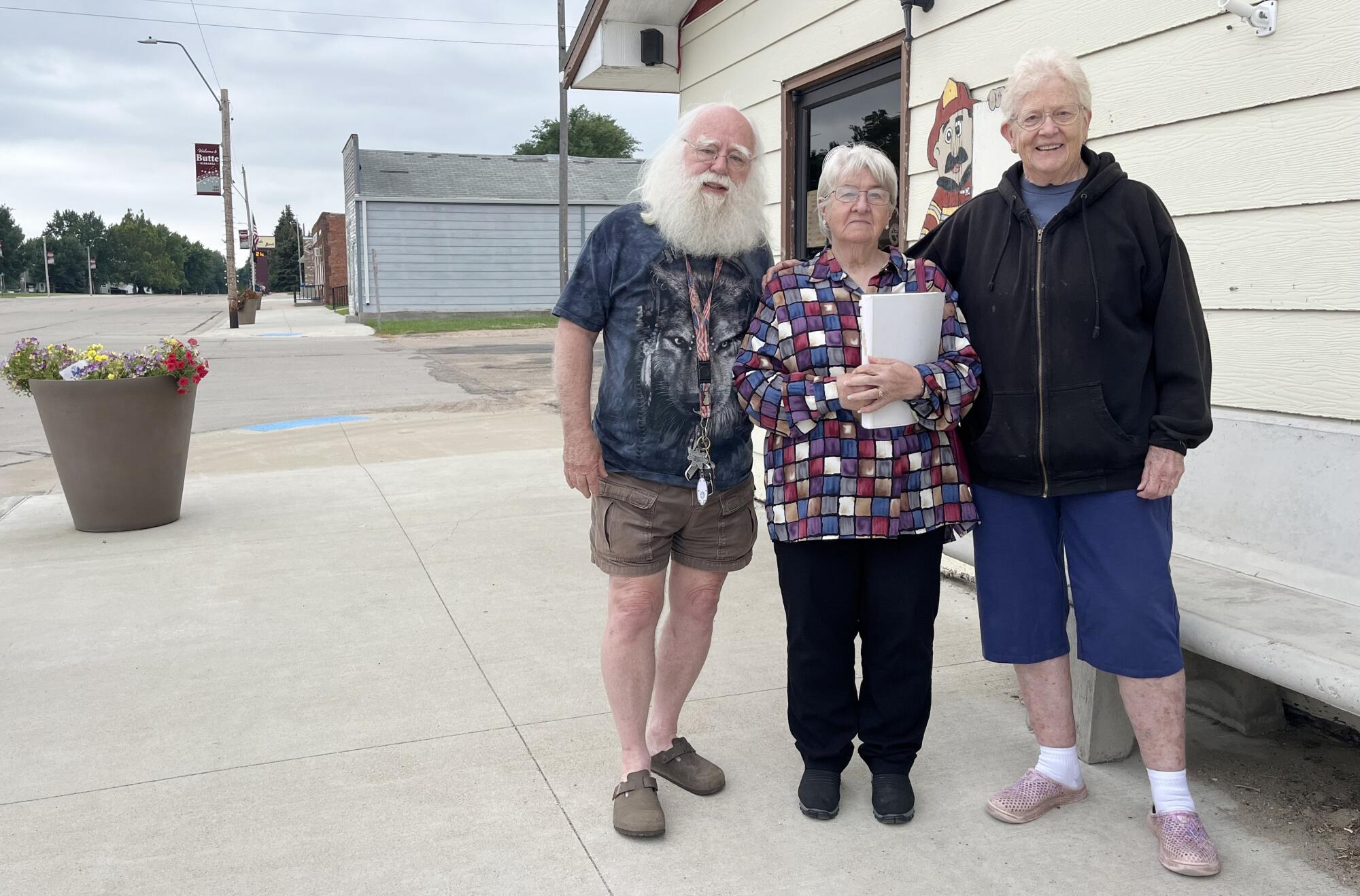
Richard Meadows, from left, Dorothy Boes and Francine Meadows are friends of Tim Walz’s mom, Darlene, in Butte, Neb.
(Hailey Branson-Potts / Los Angeles Times)
Dorothy Boes, a retired special education teacher who lives just over the South Dakota line, goes to church in Butte and is in a women’s coffee group with Darlene Walz.
Boes does not like the way Trump “talks about and bad-mouths women” and was outraged by the Jan. 6, 2021, insurrection. She worries about more potential violence.
“I just feel like he’s not going to go quietly into the night if he doesn’t win,” she said.
Boes, 77, does not know much about Walz’s political record. But she knows that he comes back to Butte often to take care of his mom and that he frequently brings her to Minnesota.
“Those are good, positive things, and, in my heart, I feel that he deserves a chance. And so does she,” Boes said of Walz and Harris. Boes is a longtime Republican who voted twice for Trump — but is undecided this year.
Richard Meadows, an 81-year-old “die-hard Democrat” who mows Darlene’s lawn, said he and his wife “coexist” peacefully with their Republican neighbors in Butte.
But Meadows — who has a chest-length white beard and worked for years as a professional St. Nick — knows who’s getting his vote.
“Santa Claus is gonna vote for Tim and Kamala.”
As for Valentine? Its post office gets inundated with packages every February by romantics who want a holiday-themed postmark. But the town is not named for St. Valentine.
It is named for Edward K. Valentine, a Union soldier during the Civil War and a congressman.
He was a Republican.


NEWYou can now listen to Fox News articles!
The attorney who helped persuade the Supreme Court to strike down Hawaii’s private-property concealed-carry restriction on Thursday criticized the state’s reliance on a Reconstruction-era Black Code to defend the law.
In a 6-3 decision in Wolford v. Lopez, the Court held that Hawaii cannot require licensed gun owners to obtain express permission before carrying firearms onto private property open to the public. Gun-rights challengers dubbed the policy the “vampire rule” because lawful gun owners had to be “invited in” before entering businesses while armed.
“It is disgraceful that any state would rely on a law specifically aimed at taking away the Second Amendment rights or any constitutional right of Black Americans as it was at that time,” attorney Kevin O’Grady, who represented the plaintiffs, told Fox News Digital.
“And it’s not surprising, however, that Hawaii would rely on it as they are diametrically opposed to the Second Amendment. We fully expected that the Supreme Court would identify that as the kind of law that one absolutely should not look to determine whether or not something is constitutional because this is the perfect example of something which is not constitutional.”
SUPREME COURT HANDS SECOND AMENDMENT WIN TO CONCEALED CARRY HOLDERS IN BLUE STATE GUN CONTROL CASE
Justice Ketanji Brown Jackson speaks on stage during the “Ketanji Brown Jackson on Lovely One: A Memoir” panel at The Atlantic Festival in Washington, D.C., on Sept. 20, 2024. (Tasos Katopodis/Getty Images for The Atlantic)
A major flashpoint was Hawaii’s effort to justify the law under the Supreme Court’s 2022 decision in New York State Rifle & Pistol Association v. Bruen. Since Bruen, courts evaluating firearm regulations have generally asked whether modern gun restrictions are consistent with the nation’s historical tradition of firearm regulation.
Hawaii cited several historical laws, including an 1865 Louisiana statute enacted as part of the post-Civil War Black Codes. The law made it unlawful to carry firearms onto another person’s property without the owner’s consent.
Justice Samuel Alito, writing for the majority, rejected that argument outright, calling the Louisiana statute a “tainted artifact” that was enacted to disarm newly freed Black Americans and leave them defenseless after the Civil War. He concluded the law “cannot be taken seriously” as evidence of the Second Amendment’s original public meaning.
Justice Ketanji Brown Jackson, however, argued in her dissent the Court skipped an important constitutional question.
Jackson did not defend the Black Codes, which she acknowledged were racist and used to oppress newly freed Black Americans. But she argued the Court should have first decided whether the Louisiana law itself violated the Second Amendment, or whether the real constitutional problem was that it was enforced in a racially discriminatory way.
SUPREME COURT TAKES SECOND AMENDMENT CASE CHALLENGING HAWAII GUN LAW
Todd Settergren handles pistols inside his display case at Setterarms gun shop in Walnut Creek, Calif., on Jan. 13, 2017. (Michael Macor/The San Francisco Chronicle via Getty Images)
“It might well be that the Black Codes are invalid inputs for Bruen’s test,” Jackson wrote, “but only if they violated the Second Amendment — which may or may not be the case.”
Instead, she argued that under the Supreme Court’s Bruen framework, the Court could not simply dismiss those laws without first explaining why they should not count as historical evidence.
She outlined two possibilities: either the firearm restrictions in the Black Codes were constitutional but enforced in a racially discriminatory manner — making the constitutional defect an equal-protection problem — or the restrictions independently violated the Second Amendment. The Court, she argued, never resolved that question before excluding the Louisiana law from consideration.
US APPEALS COURT STRIKES DOWN CALIFORNIA’S OPEN-CARRY BAN IN MAJOR SECOND AMENDMENT RULING
“Either history does matter, and if so, all potentially relevant historical experiences must be thoroughly examined,” she wrote. “Or, it does not, and the Court should just admit that the test it has created is boundless.”
Her reasoning immediately drew pushback from critics, who argued the Fourteenth Amendment was passed in response to laws like the Black Codes that denied newly freed Black Americans their constitutional rights, like the right to bear arms.
Rain clouds roll over the United States Supreme Court building in Washington, D.C., on June 18, 2026. (Chip Somodevilla/Getty Images)
“I would simply point her to what Justice Alito pointed out in the majority ruling — it was in response to these types of laws that the Fourteenth Amendment was enacted in the first place,” Hannah Hill, vice president of the National Association of Gun Rights, told Fox News Digital.
US JUDGE TOSSES ILLINOIS’ BAN ON SEMIAUTOMATIC WEAPONS, GOVERNOR PLEDGES SWIFT APPEAL
“That right there is your answer,” Hill continued. “Yes, there was a historical tradition — they enacted a constitutional amendment to fix that deprivation of rights, and that is also in the Constitution now, so I think she should probably go back to law school.”
Tyler Yzaguirre, president of Second Amendment Institute, echoed O’Grady and Hill’s criticism.
“Those laws were not legitimate expressions of our Nation’s constitutional tradition; they were examples of government using its power to deprive Americans of a fundamental right,” Yzaguirre told Fox News Digital. “The Court was right to reject the notion that such laws could define the historical limits of the Second Amendment.”
CLICK HERE TO DOWNLOAD THE FOX NEWS APP
Businesses may still ban guns by posting or enforcing a “no firearms” policy. But what Hawaii can’t do, the Court said, is treat every business as off-limits to licensed gun owners unless the owner specifically says guns are allowed.

SACRAMENTO — Gov. Gavin Newsom reached an agreement Friday with legislative leaders on a $351.7-billion state budget in his final year as governor, a spending plan that uses a tax windfall to avoid major cuts and lessen California’s chronic deficit in the years ahead.
The deal provides nearly $2 billion in state revenue next year through tax hikes on corporations, new levies on software sales and a revamped tax on managed healthcare organizations. Lawmakers and the governor continue major investments in public schools, healthcare and agreed to increase spending on subsidized childcare and affordable housing.
“We want to leave the next governor not only a balanced budget, but a budget that is substantially structurally sound, and we’re going to accomplish that,” Newsom said in an interview Friday. “We were very cautious in terms of new spending,”
The agreement ends weeks of lobbying by outside interests and negotiations among lawmakers and the governor at the state Capitol about how to handle a surge of income tax collected on stock market gains related to artificial intelligence.
Early forecasts last June projected a $12.6-billion deficit in 2026-27, according to the California Department of Finance. Updated predictions now suggest the state will end the year with a surplus of $4.5 billion.
Democrats, following Newsom’s lead, are tucking away $6.4 billion for future years, which allows the governor to knock down a deficit previously projected through 2027-28 and assuage criticism about his spending habits.
But economists say the fix and revenue increase are likely only temporary.
Spending in California has generally exceeded revenue growth during Newsom’s tenure in the governor’s office, creating a chronic shortfall. Despite the extra funding, the budget continues a trend of relying on reserves, shifting funds, borrowing and suspending debt payments to balance state spending.
The Legislative Analyst’s Office, the nonpartisan fiscal advisor for lawmakers, has warned of a roughly $10-billion annual gap between the amount of money the state brings in and spends, which could grow dramatically worse if the stock market turns downward. The LAO has said the existence of any operating deficit during a revenue boom is a red flag and that the state is “ill-prepared” for even a modest decline.
Christopher Thornberg, an economist and founder of the consulting firm Beacon Economics, said it’s business as usual in Sacramento.
“They love increasing spending. But it seems politically impossible to go the other way,” Thornberg said. “We’ve seen this play out over and over again.”
Lawmakers and the governor offered a different take and asserted that their decision to put the $6.4 billion into a short-term reserve, called the Projected Surplus Temporary Holding Account, and ask voters to allow them to store more money in the rainy day fund are examples of prudent budgeting.
“You see us save more and you see us try to address the immediate needs of our community, but also the structural budget that potentially awaits us,” said Senate President Pro Tem Monique Limón (D-Goleta) in an interview. “We are forecasting a moment where we will need to address these issues and we want to start now to think about the future as well.”
Under a progressive tax structure, the state budget is dependent on income taxes paid by the ultra-rich on earnings largely from capital gains. The set up leaves California vulnerable to the unpredictable nature of the stock market, dramatic swings in revenue and, in recent years, reliant on poor projections.
Negotiations at the state Capitol included an agreement on a constitutional amendment that seeks to offset the revenue highs and lows.
If approved by voters on the statewide ballot in November, the amendment would raise a cap on mandatory deposits into the rainy day fund from 10% to 20% of general fund revenue. The measure would also allow lawmakers to exempt money they put into the rainy day fund and the temporary holding account from state spending limits.
Under an existing state appropriations restraint, also known as the Gann Limit, lawmakers cannot spend more than an amount determined by a formula that takes annual tax proceeds, changes to the population and cost of living into consideration. Tax revenue above the limit must be divided between schools and refunds to taxpayers.
With few exceptions, the limit applies to most appropriations of tax revenue, including when lawmakers put money away in the rainy day fund and other reserves.
Newsom said the change will leave the state in a much better position to weather the volatility. Though calls for tax reform remain in California, the governor said being able to place more money into the reserves could ultimately solve the state’s budget challenges.
“The one thing missing is the one thing that I think we finally landed, which is the change in the reserves,” Newsom said. “It changes the political dynamic, where now you’re not exchanging general fund priorities.”
Republicans criticized the proposed constitutional amendment, which passed in a budget trailer bill this week, for failing to require that excess revenue pays down the state’s $22 billion in unemployment insurance debt.
State Sen. Tony Strickland (R-Huntington Beach) called it a missed opportunity.
“It does not require debt payment to go to the UI debt,” Strickland said. “It facilitates more spending, exempting reserve deposits from the state spending limit.”
The proposed change to the state Constitution also jabs the president and asks voters to approve a 100% tax on payments any California taxpayers receive from the “Anti-Weaponization Fund” Trump established for allies who claim they were unjustly targeted by the federal government.
As part of the overall budget negotiations, lawmakers agreed to delay some healthcare cuts that would have required monthly premiums for immigrants and eliminated dental care. The deal adopts a Medi-Cal asset test of $21,000 on July 1, 2027, instead of $2,000.
The budget agreement includes a provision requiring California’s next governor to develop options to reduce taxpayer subsidies for corporations whose employees receive state-sponsored healthcare through Medi-Cal instead of the company’s health plan. The plan is aimed at raising revenue to offset federal cuts that are expected to leave millions of Californians without access to healthcare.
To generate $11.25 billion for affordable housing, Democrats approved a bond for the November ballot that would include down payment and mortgage assistance to veterans and low-income families. Democrats also approved $900 million in Homeless Housing, Assistance, and Prevention grants, marking a $400-million increase from Newsom’s budget proposal in May.
The California Department of Finance said state reserves are expected to total $28.8 billion under the 2026-27 budget.
Politics
Warren tells Trump to ‘sign the damn bill’ as bipartisan housing package remains stalled in Washington

NEWYou can now listen to Fox News articles!
Sen. Elizabeth Warren, D-Mass., lashed out at President Donald Trump during a recent local television interview, labeling him a “man-child” throwing a “tantrum” over his refusal to sign a sweeping bipartisan housing package.
Appearing on WCVB’s “On the Record,” the left-wing senator did not hold back her frustration over the stalled legislation, delivering a blunt message to the president: “Sign the damn bill.”
“If he cared about the American people, he’d have already signed the damn thing,” Warren said during the interview, arguing that Trump “does not care about the economic survival of America’s working families.”
FILE – The Senate previously advanced the massive housing package geared toward lowering the costs of homes and supercharging the housing supply. Sen. Elizabeth Warren, D-Mass., pitched it as legislation to prevent America from becoming a “nation of renters.” (Jemal Countess/Getty Images for Protect Borrowers ; Anna Moneymaker/Getty Images)
TRUMP-BACKED HOUSING BILL CLEARS HOUSE AFTER GOP DEFIES SENATE PRESSURE CAMPAIGN
The 21st Century ROAD to Housing Act is an expansive bipartisan package that she said contains nearly 50 provisions designed to address the nationwide housing emergency.
Warren noted that decades of under-building have driven prices up, leaving the U.S. in need of millions of new units.
The primary focus of the bill is to lower the costs of construction and make it easier to build new homes.
FILE – President Donald Trump previously said lawmakers must first approve the SAVE America Act before he moves forward with the housing package. (Yuri Gripas/Abaca/Bloomberg)
BIPARTISAN HOUSING PUSH ADVANCES, BUT TRUMP-BACKED INVESTOR BAN FACES RESISTANCE
The bill, which was co-sponsored by Sen. Tim Scott, R-S.C., also includes a secondary focus aimed at blocking corporate consolidation of the housing market.
Warren explained that the legislation is designed to keep private equity firms from buying up local neighborhoods and turning America “into a nation of renters.”
According to Warren, the legislation had widespread support from both sides of the aisle before it was stalled.
TRUMP VOWS BLOCK ON SIGNING NEW LAWS UNTIL SAVE AMERICA ACT PASSES SENATE
She claimed the bill was “handed to the president on a silver platter” and that lawmakers from both parties were eagerly taking credit for the legislation.
“Republicans were all going online, saying, ‘well, I helped write that bill. This bill is terrific,’” Warren said. “So everybody’s out there saying, ‘my bill, I helped make this happen,’ right up until the man-child has a tantrum and announces he will not be signing it.”
FILE – Sen. Elizabeth Warren called President Donald Trump a “man-child” during the interview, describing his refusal to sign the bill as a “tantrum.” (Chip Somodevilla/Getty Images)
CLICK HERE TO DOWNLOAD THE FOX NEWS APP
Critics of the legislation claim it does not allocate fresh federal funding, directly address rising costs of homeownership, or go far enough to address permitting issues.
The president previously canceled a scheduled signing event, insisting lawmakers must first approve the unrelated SAVE America Act, a voting-focused measure, before he moves forward.
The White House did not immediately respond to Fox News Digital’s request for comment.
Fox News Digital’s Alex Miller contributed to this report.
-
 News8 minutes ago
As Supreme Court expands Trump’s immigration power, experts warn of steeper U.S. population decline
-

 Los Angeles, Ca2 hours ago
About 20 detained after armed suspect call sparks LAPD response in Koreatown
-

 Detroit, MI2 hours ago
With Jack Flaherty returning, AJ Hinch ponders Tigers’ starting rotation
-
 San Francisco, CA2 hours ago
Serving up a slice of Palestine at Old Jerusalem in the Mission District
-

 Dallas, TX2 hours ago
All-day restaurant and patio coming to Dallas’ Knox and more top stories
-

 Miami, FL2 hours ago
Bugtopia takes center stage at Zoo Miami
-

 Boston, MA2 hours ago
What JJ Peterka Will Add to the Bruins’ Roster, ‘He’s Got an Elite Shot’ | Boston Bruins
-

 Denver, CO2 hours ago
This Boulder farm dinner serves up midsummer Slavic vibes with James Beard-worthy fare

