
Connect with us

Entertainment

‘Cuckoo’ director Tilman Singer breaks down Hunter Schafer's onscreen song performance

Published

on

‘Cuckoo’ director Tilman Singer breaks down Hunter Schafer's onscreen song performance

Many of the needle drops littered throughout Tilman Singer’s horror flick “Cuckoo,” released in theaters Friday, were written into the script’s first draft in 2019.

But the film’s musical touchstone, a soft rock number that “Euphoria” breakout star Hunter Schafer sings onscreen, didn’t come together until years later.

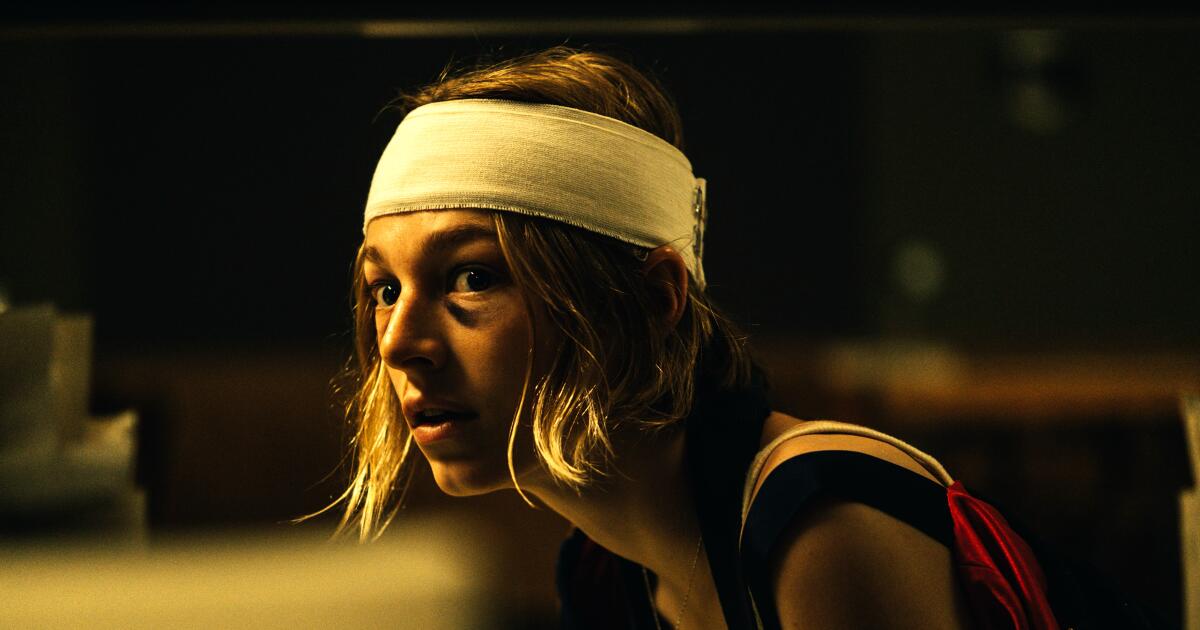
Schafer leads Singer’s sophomore feature film as Gretchen, an angsty teen who, after her mother’s death, leaves the U.S. to live with her father Luis (Marton Csokas), stepmother Beth (Jessica Henwick), and 8-year-old half-sister Alma (Mila Lieu) in a resort in the German Alps. After taking a receptionist job at a nearby lodge, Gretchen has increasingly bizarre encounters with the resort’s guests and offbeat owner Herr König (Dan Stevens) that suggest her picturesque new home is not the paradise it purports to be.

In the psychedelic horror trip that is “Cuckoo,” music serves as an emotional and narrative guide, telling “a different story” than the surface-level plot, Singer said.

Fittingly, the film’s first true horror moment unfolds as Gretchen is playing bass in her room. Sporting noise-canceling headphones, she sings and strums along to a grunge track as Alma watches from outside her periphery.

Advertisement

The long scene alternates sonic points of view, building tension, until Gretchen finally notices her young sister as she endures the first of her several seizures — which we later learn are reactions to the malign siren song of the cuckoo people, or what Singer calls “homo cuculidae,” residing in Resort Alpschatten.

Singer’s script was precise with this scene, which evokes the sisters’ estrangement and forges their central conflict. But not all went as planned.

Originally, Singer envisioned Gretchen playing a song by alternative rock band the Jesus and Mary Chain. The band’s style suited her perfectly: “They’re very noisy, but have this, like, shoegazey, blasé demeanor.” But when Neon deemed the licensing fee too steep, he went back to the drawing board.

“I look[ed] back at my list, and on my list was like, Suicide, or the Velvet Underground. I was like, ‘OK, I’m not gonna get any of these,’” Singer said. That’s when he called Simon Waskow.

Singer’s high school friend and longtime creative partner, Waskow had previously scored the director’s debut feature film “Luz” (2018) as well as a handful of short films they collaborated on in the early to mid-2010s. He wrote “Gretchen’s Song” in a single afternoon.

Advertisement

“It just kind of worked very quickly,” the Cologne-based composer said. “Of all the music I did for the film, that song was the easiest part.”

At Singer’s offhand suggestion, Waskow adapted a “spaghetti western melody” from their old short film “Dear Mr. Vandekurt” — and a beat from the Jesus and Mary Chain — into the bass-heavy track.

Schafer was so attuned to the song, Waskow said, that after she recorded her vocals, he re-recorded his own to match hers.

“Hunter’s performance, really sweet and charming, and super unforced, basically just kind of clicked in,” he said. Schafer learned bass for the film, but in the scene, she looks like she’s been playing for years.

“That’s the talent that I love so much about her — how she can do something very delicate, emotional, [and] really profoundly emotional in a sort of relaxed, but not casual, style,” Singer said.

Advertisement

A fragment of “Gretchen’s Song” also became the teenage protagonist’s theme, which recurs throughout “Cuckoo” — most notably when Gretchen and Alma reconcile at the film’s conclusion.

“It’s sort of this melancholic melody that then turns into something hopeful,” Singer said, characterizing Gretchen and “mirroring the entire intent of the movie.”

Other songs on the “Cuckoo” soundtrack similarly reflect their corresponding scenes. Gerhard Trede’s jazz-blues embody the old-timey atmosphere of the resort lobby, and Martin Dupont’s French New Wave expresses the romantic tension between Gretchen and a charming resort guest.

Just like costuming or set design, music is a world-building tactic in “Cuckoo,” Singer said.

More than that, though, he continued, music is Gretchen’s “philosophy” as she grieves her mother and her most reliable “weapon” against the cuckoo people, whose shrill call notably juxtaposes Gretchen’s low-toned theme.

Advertisement

“This is the super-classical hero journey,” Waskow said: “Gretchen facing danger and then becoming, like, a musician.”

“She was always supposed to defend herself with music,” Singer said.

Movie Reviews

‘Nightborn’ Review: Parenting Is a Nightmare in This Darkly Funny and Unabashedly Gory Horror Flick From Finland

Published

on

‘Nightborn’ Review: Parenting Is a Nightmare in This Darkly Funny and Unabashedly Gory Horror Flick From Finland

A bad case of the baby blues turns into a gory fight for survival in Nightborn (Yön Lapsi), Finnish writer-director Hanna Bergholm’s worthy follow-up to her well-received 2022 debut, Hatching.

Like that movie, which combined horror and fantasy tropes with f***ed-up family dynamics, the director’s second feature focuses on a couple in the aftermath of their child’s birth — an already anxiety-ridden event that’s compounded many times over by the fact that their baby boy is some kind of bloodsucking abomination of nature.

Nightborn

The Bottom Line

Do not check the children.

Advertisement

Venue: Berlin Film Festival (Competition)
Cast: Seida Haarla, Rupert Grint, Pamela Tola, Pirkko Saisio, Rebecca Lacey, John Thomson
Director: Hanna Bergholm
Screenwriters: Ilja Rautsi, Hanna Bergholm

1 hour 32 minutes

Or is he? Part of what makes Nightborn both stomach-churning and thought-provoking is how all the crazy stuff happening is just a slightly — okay, substantially — exaggerated version of the reality so many first-time parents face. The movie’s many metaphors are certainly on the nose, which can feel a bit redundant once we get the gist of it. But Bergholm has a deft, darkly comic touch that turns classic child-rearing moments (breastfeeding, a baby’s first steps, a dinner session in a highchair) into gross-out sequences that make you want to laugh and cringe at the same time.

There’s plenty of sordid irony from the get-go as we watch expecting couple Saga (Seida Haarla) and Jon (Rupert Grint) drive down a twisting forest road toward their isolated country home, which is run-down, abandoned and ripe for plenty of horror hijinks. Saga is Finnish and Jon is British, which means they mostly communicate in English (a convenient trick to lend the film international appeal). It also means that Jon feels a bit out of place in a strange land where even stranger things start happening once they settle in.

Advertisement

Bergholm, who co-wrote the script with Ilja Rautsi, establishes a tone that’s both unsettling and outrageous, especially when she match-cuts from an orgasm scene to a birth scene, the baby popping out in a nasty close-up that leaves Jon drenched in blood. Things get much freakier when Saga learns that her little tot is covered in body hair, then tries to breastfeed “it” — she refuses to call it “him” — and nearly loses a nipple.

The couple has clearly created a monster. And yet, part of what makes Nightborn so fun and compelling is that they might just be overreacting to the insanity a baby brings into the life of any new parent, especially when it refuses to sleep and cries all day long. “Your boy is perfectly healthy,” a pediatrician tells them, offering scant comfort when their child, who Saga has christened with the weird mystical name of Kuura, starts precociously sitting up and eventually walking, while also developing a taste for blood.

“It just takes and takes and takes,” Saga shouts during one of her many overtired freak-outs, speaking a truth that lots of debuting mothers have to reckon with. And yet, she can’t help developing a growing attachment to Kuura, especially when it comes to their mutual attraction to the spooky forest surrounding their abode. It turns out Saga has much more in common with her monster baby then she thinks. Meanwhile, Jon finds himself in the same position as so many dads who, at some point, realize they’re a bit of a third wheel beside the inseparable duo of mother and child.

The director cleverly dishes out these double meanings from start to finish, fusing the parental experience with tons of gore, hysteria, visual gags and occasional jump scares.  A particular standout is a “here comes the airplane” feeding scene that completely flies off the rails, revealing to what extent the happy household has been turned upside-down.

There are a few other freakish laugh-out-loud moments, although there are also times when the metaphor Bergholm keeps hammering into our skulls becomes repetitive. Her sense of humor is what often saves the day, with stars Haarla (Compartment No. 6) and Grint (who played Ron Weasley in the Harry Potter films) truly unafraid to do some batshit crazy things on screen, including fighting at one point over their baby’s blood snack.

Advertisement

The craft level of Nightborn is also a plus, whether it’s the fairytale-like lensing of Pietari Peltola, the creepy living spaces of Kari Kankaanpää’s sets, or the combination of puppets and CGI that turn Kuura into a wicked little cutie whom we hardly ever see in the daylight.

In fact, it’s never fully clear what kind of creature the baby even is: a vampire? A troll? A killer garden gnome? But that also seems to be the point. Kuura is every new parent’s fear wrapped into one tiny package — wailing day and night, refusing to eat or sleep, making you want to rethink your family planning and reach for that box of contraceptives.

Continue Reading

Entertainment

Criticism by Winter Olympic athletes of Trump policies mirror reaction to iconic 1968 protest

Published

on

Criticism by Winter Olympic athletes of Trump policies mirror reaction to iconic 1968 protest

History is once again unfolding at the Milan-Cortina Winter Games as Team USA members break records and score dominant triumphs.

But as the Games move into their second week, a different and more provocative history is starting to repeat itself, casting a politically charged shadow over the event.

Champion skier Mikaela Shiffrin, snowboarder Chloe Kim, and freestyle skiers Hunter Hess and Chris Lillas are among the top athletes who have been vocal about their uneasiness in representing their home country during a period of deep political crisis revolving several volatile issues, including the violent federal crackdown in Minnesota by Immigration and Customs Enforcement agents and the Trump administration’s attacks nationwide on immigrants and the LGBTQ+ community.

“It brings up mixed emotions to represent the U.S. right now,” Hess said at a press conference last week. “Just because I’m wearing the flag doesn’t mean I represent everything that’s going on in the U.S.”

Trump blasted Hess’ comments in a Truth Social post, calling him “a real Loser,” adding, “He says he doesn’t represent his Country … If that’s the case, he shouldn’t have tried out for the Team, and it’s too bad he’s on it. Very hard to root for someone like this.”

Advertisement

Commenting on the athletes in an interview with CNN, Vice President JD Vance, who was attending the Games, said the athletes who are critical should expect “some pushback.”

Vance, who was booed when he was shown on a large screen during the opening ceremonies, added, “You’re there to play a sport, you’re there to represent the country and hopefully win a medal. Most Olympic athletes, whatever their politics, are doing a great job, certainly enjoy the support of the entire country, and I think recognize that the way to bring the country together is not to show up in a foreign country and attack the president of the United States, but it’s to play your sport and to represent the country well.”

Vice President JD Vance and his wife Usha at the Winter Olympics opening ceremony in Milan on Feb. 6. Vance said athletes should expect pushback if they criticize the country.

(Natacha Pisarenko/AP)

Advertisement

The outspokenness of the Winter Olympic athletes echoes a dramatic protest by Olympians Tommie Smith and John Carlos which electrified the 1968 Summer Games in Mexico City. The sprinters, who placed first and third respectively in the 200 meter race, spoke not with words but with black-gloved raised fists on the victory stand, producing one of the most iconic images in Olympic history.

As the national anthem played following their victories, Smith and Carlos expressed their anger about racial injustice in America by bowing their heads and raising their fists. The gesture provoked a seismic reaction internationally while infuriating Olympic officials who claimed Smith and Carlos used the world stage to humiliate their home country.

Smith and Carlos’ salute to Black Power is explored in HBO Max’s documentary “Fists of Freedom: The Story of the ’68 Summer Games.” The 1999 Peabody Award-winning film chronicles the fiery moment and its aftermath for Smith and Carlos, who earned both heroic praise and pointed condemnation.

George Roy, who produced and directed “Fists of Freedom,” said “there are similarities between what happened in 1968 and what’s going on now. The similarities are it’s the Olympics and the United States, and in both cases there are athletes saying they wish they could be a little prouder given the current state of things.”

Three men standing on a podium, with two holding up their fists in the air.

U.S. athletes Tommie Smith, center, and John Carlos, right, hold their fists up in protest after winning medals at the 1968 Summer Olympic games.

(AP)

Advertisement

However, Roy, who has won multiple Emmys and is the founder of Jersey Line Films, added that there are marked differences.

“What Smith and Carlos did was so consequential because it affected them directly,” he said. “They were protesting along with millions in their community. Their point was that they were good enough to represent their country. But when they got back to the real world, they would have trouble getting into restaurants or finding an apartment.”

He added, “It was just more personal than what is happening now.”

In an interview included in the documentary, Smith said the gesture by him and Carlos was often misinterpreted.

Advertisement

“As soon as the national anthem was playing, my glove is going toward God,” said Smith. “The Black fist in the air was only in recognition of those who had gone. It was a prayer of solidarity. It was a cry for help by my fellow brothers and sisters in the country who had been shot, who had been bitten by dogs … It was a cry for freedom.”

He added, “I don’t like the idea of people looking at it as negative. It was nothing but a raised fist in the air and a bowed head to the American flag. Not symbolizing a hatred for it.”

Though he heard cheers, he also heard boos and jeers.

“Fists of Freedom” contains several interviews from sports and media figures who were present or covered the proceedings and had strong opinions about the gesture.

Bob Paul, who was the press secretary for the United States Olympic Committee in 1968, said, “[Smith and Carlos] were wrong. You are supposed to observe due order and decorum to the nth degree at every victory ceremony.”

Advertisement

Veteran TV sportscaster Brent Musburger, who at the time was a columnist with the Chicago American newspaper, wrote: “Airing one’s dirty laundry before the entire world during a fun and games tournament was no more than a juvenile gesture. Smith and Carlos looked like a couple of Black-skinned storm troopers.”

Incensed, Olympic committee head Avery Brundage ordered the sprinters to be expelled from the Games.

Despite the uproar, experts said the salute by Smith and Carlos was a defining moment for Black people, galvanizing the Civil Rights Movement. However, the two men encountered personal and professional difficulties when they returned home.

Both Smith and Carlos have participated in speaking engagements in recent years. They could not be reached for comment.

“We’re not Antichrists,” said Smith in “Fists of Freedom.” “We’re just human beings who saw a need to be recognized.”

Advertisement
Continue Reading

Movie Reviews

Assi Movie Review: Hard-hitting, horrifying, and heartfelt, this courtroom drama is impossible to ignore

Published

on

Assi Movie Review: Hard-hitting, horrifying, and heartfelt, this courtroom drama is impossible to ignore

Story: The courtroom drama follows a teacher, Parima (Kani Kusruti), who is brutally gang raped while returning home, and her lawyer Raavi’s (Taapsee Pannu) fight for justice. Beyond the horrific crime, it explores themes such as vigilantism, patriarchy, systemic corruption, and societal apathy that normalises sexual assault and crimes against women.Review: Director Anubhav Sinha’s title denotes the approximate number of rapes that take place each day in India — around 80. The film does not allow the viewer to sit comfortably with this statistic. Every 20 minutes, a reminder flashes on screen that another assault has occurred somewhere in the country during the film’s runtime. Alongside the alarming figure, the legal drama unsettles with its unflinching portrayal of how cruel society can be toward survivors.After Parima is violated, her male students joke about it in WhatsApp groups, while her husband Vinay (Zeeshan Ayyub) is pressured by his family to drop the case to “save honour.” Police corruption sabotages the investigation, victim-blaming becomes routine, and the accused display chilling apathy. They turn the crime into a game, with the loser buying beer; two of the four swap scarves in court to match their outfits, and one heads to a disco to party. Each culprit has a sister, girlfriend, or daughter — an irony the narrative quietly underscores.Parallelly, the story examines vigilantism through the rise of a ‘Chhatri Man,’ who begins targeting these rapists when the system fails. The film logically dissects the dangers of trial by media and mob justice. One of its most powerful moments sees Raavi’s face smeared with black ink by an irate supporter after she publicly speaks against vigilante justice. The success of any courtroom drama rests on the strength of its arguments and verbal sparring, and writer Gaurav Solanki delivers some of the sharpest exchanges through Raavi. Among the most heartrending sequences are her impassioned references to real cases, from infants assaulted to minors abusing an 80-year-old woman.Though hard-hitting, the narrative resists melodrama, making it more thought-provoking than sensational. It adopts a forward-looking stance through the children who appear during the proceedings, suggesting the need to sensitise the next generation. This is portrayed through the moving relationship between Vinay and his son, Dhruv. When Dhruv visits Parima in the hospital, Vinay quietly admits that the aftermath will follow them home anyway; there is no shielding a child from such a reality. Besides the legal battle, the narrative also has plot twists that will shake you to the core.Taapsee Pannu leads from the front here, embodying frustration, empathy, and even dry humour with finesse. Kani Kusruti is outstanding as a survivor attempting to rebuild her life. Revathy brings gravitas as the presiding judge, while Kumud Mishra leaves a mark with his layered performance. Zeeshan Ayyub’s restraint is moving.For its poignant storytelling, hard-hitting narrative, and fine performances, and to fully absorb the message it delivers, Assi deserves to be experienced in a theatre.

Continue Reading

Trending
