Entertainment
How the 2028 Olympics should showcase L.A.: 9 wild ideas from our wish list

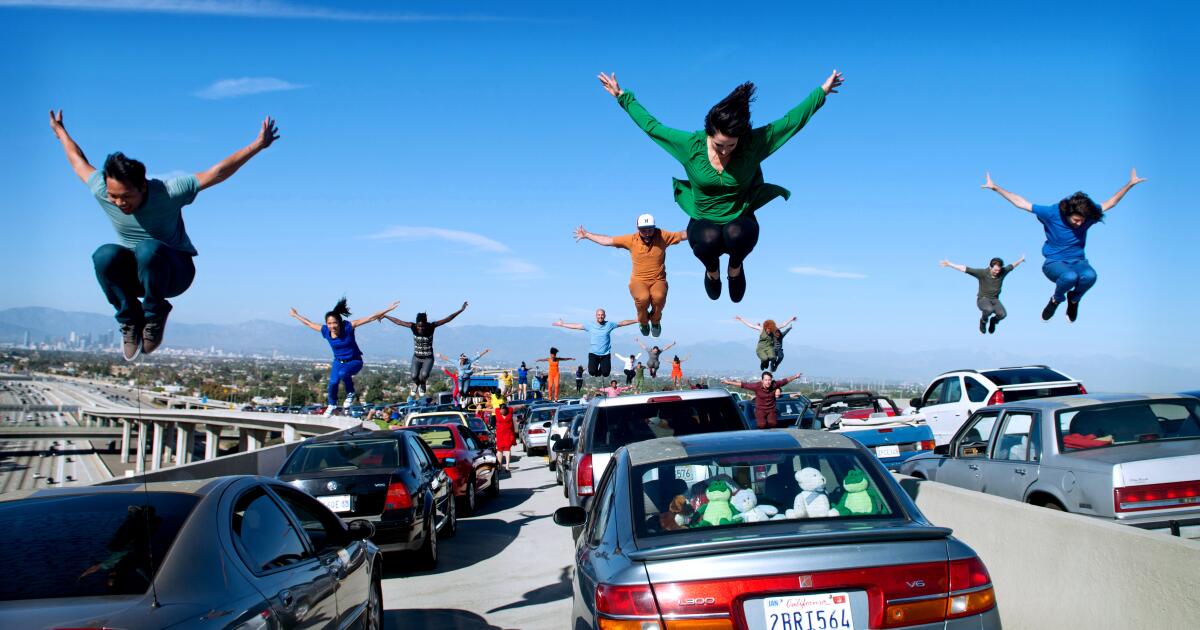
Inspired by the profound (and often profoundly silly) Frenchness of the Paris Games, we — like much of the internet — have been thinking about how to showcase L.A. when the Olympics come to town in 2028. While the next edition of the Summer Games has come in for criticism and complaints, it’s also likely to match or exceed events like the Super Bowl and the Oscars in terms of turning the world’s attention to the city. In the spirit of the loud, chaotic, inimitable City of Angels, here are nine wild ideas for making L.A. itself the star in four years’ time.
Erect the Olympic cauldron at Griffith Park…
In the land of sunshine and palm trees, one landmark that (literally) stands out above the rest, situated on the side of a mountain range overlooking the greater L.A. area, is the Griffith Observatory. That it can be seen from nearly every neighborhood and surrounding cities makes it a perfect location to build the cauldron. Imagine taking an evening stroll around the Silver Lake Reservoir and seeing the flame across the surface of the water? Or walking out of a bar in Koreatown and staring north up Normandie at the cauldron? Or staying in Mid-City and seeing the light of the burning fire from miles away? Imagine the photos taken on a clear night from all over Southern California. If the cauldron were built at the Griffith Observatory, it would also take advantage of being next to one of our most famous landmarks honoring our greatest cultural export: the Hollywood sign. —David Viramontes
… and make sure the torch relay visits California’s most iconic peaks
The Griffith Observatory at dusk.
(Luis Sinco / Los Angeles Times)
Celebrate California’s 14ers and the highest mountain in the contiguous U.S. by having a hiker or ultra-trail-marathoner take the flame up Mt. Whitney. Or the flame could be taken by a climber (Alex Honnold, maybe roped this time?) up Yosemite’s El Capitan. —Rebecca Bryant
Perform a “La La Land”-inspired dance on the 105 and 110 interchange
Paris has the glimmering Seine, we have . . . majestic freeways. It seems only appropriate that Olympic festivities involve commuters (or actors pretending to be commuters) in bumper-to-bumper traffic. An opening ceremony that acknowledges L.A.’s infamous traffic woes, rather than pretending they don’t exist, would be a sly way to nod at the inevitable slow roadways that the 2028 games will bring. And hey, I bet Ryan Gosling would be game to participate. — Alyssa Bereznak
Plant out L.A.’s ugliness
LAX, for example, is bleak. Aside from the difficulties of getting in and out of the airport, it’s such an ugly introduction to L.A. Back during World War II, The Times encouraged residents to plant victory gardens and even led by example; this time, residents, business owners and municipalities should plant trees and install planter boxes outside their homes and businesses and LAX should use them to soften passenger arrival and departure lanes. Why not counter the starkness of the cityscape with color and fragrance unique to our region? The catch: L.A. needs to start planting now, with trees, shrubs, etc. that take about three years to get established. Already, there are community groups trying to organize this, but their voices are small. Let this be their megaphone: If everyone pitches in, we can make our city more beautiful before the world comes calling. —Jeanette Marantos
Create a mechanical surfing ride for spectators
There could be several with different degrees of difficulty, so beginners can simply try to stand up on the board, while semi-pros ride waves closer to those faced in competition. It’s safer than the open water, and of course comes with lots of possibilities for commemorative photos. They do water rides at theme parks, where people get drenched. Why not the Olympics? —Jeanette Marantos
Mount a Randy’s Donut’s / rhythmic gymnastics crossover
Picture it: A giant Randy’s Donut, modeled on the famed Inglewood shop, rolls right into the stadium during the opening ceremony, helped along by a CGI rhythmic gymnast. Then a troupe of actual rhythmic gymnasts rolling rings that look like the doughnuts spread across the field. I’m kidding. But only sort of. —Rebecca Bryant

P-22 was the beloved mascot of Griffith Park.
(National Park Service)
Make a mountain lion the LA28 mascot
Recently, I’ve taken a deep dive into Olympic mascots after being wholly enamored by France’s Phryge — a red hat with expressive eyes that has taken a tumble, jet-skied and become a celebrity in Paris.
In 1984, Sam the Olympic Eagle strutted down in a stars-and-stripes top hat and bowtie at the L.A. Memorial Coliseum. And in 2028, it should be a mountain lion — donning sparkly eyeglasses or streetwear or whatever else is adorable — that welcomes athletes to Los Angeles.
It makes sense, and, no, it’s not too niche. L.A. is the only place on this side of the Earth that has big cats living within city limits, according to the National Park Service. Not only will this pay homage to the mountain lion king of Griffith Park — P-22 — but it’s also a chance to highlight a species that has long captured the zeitgeist of L.A. —Angie Orellana Hernandez
Turn the Hollywood pitch meeting into an Olympic short film
In this vision, an Olympic torchbearer makes their way into a studio building — could be a lot, could be CAA or somewhere corporate. It’s all filmed with GoPro. They get a fist bump from the valet. Run through the mailroom. Ride up in an elevator (Sly Stallone cameo). Race down a hallway. Finally, they sit in a private conference room or office. We cut to the runner and it’s Timothée Chalamet or someone of similar star quality. They make a beautiful pitch about the “spirit of the Games, the essential humanity of the moment. It’s bigger than Hollywood — bigger than all of us.” Cut to the studio executive and it’s Albert Brooks: “That was more than 25 words.” —Joshua Rothkopf
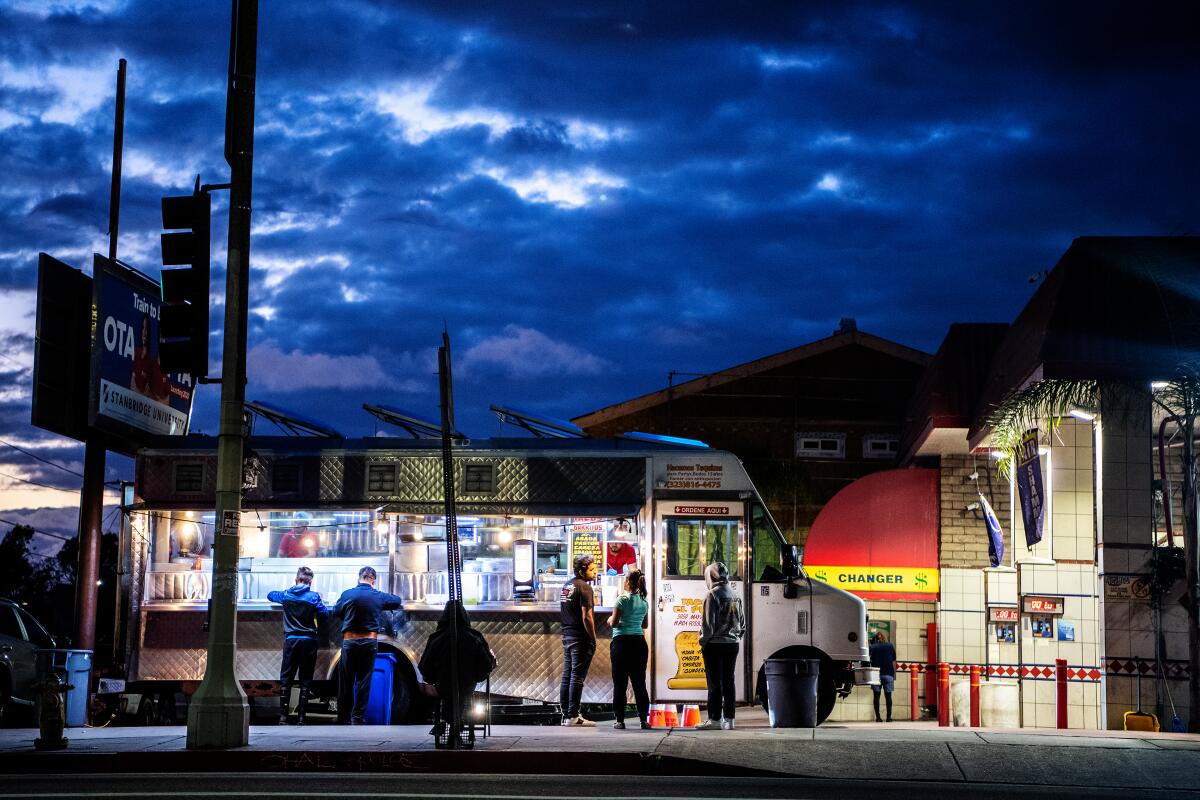
The nightly crowds have thinned at Tacos El Pecas on Monday, March 23, 2020. Taco trucks are just one of the many facets in the service industry being hit hard economically as COVID-19, aka Coronavirus, continues to spreads throughout the country and the world.
(Mariah Tauger / Los Angeles Times)
Launch a parade of taco trucks (and other homages to L.A. culture)
This one’s a no-brainer. Match them with lowriders cruising, maybe with Snoop Dogg leading the cruise. Aztec dancers and some ballet folklorico at Placita Olvera. How about a sea of performers dressed up as the al pastor vertical spit? Dancing trompos! I’d like to see two murals that are critical to L.A. art history and which were originally censored to be celebrated grandly: “America Tropical” by Siquieros and Barbara Carrasco’s “L.A. History: A Mexican Perspective” at Union Station. Reopen the murals in time for 2028! Plus, let’s see evocations of the tagged up walls of the L.A. River, Five Points in East L.A., the Compton civic center, a soccer game at MacArthur Park, the Korean Friendship Bell, a bonfire at Dockweiler, and cameos by Tommy the Clown, Angelyne if she’s available, and please, please, Harry Perry, the roller skating guitarist from the Venice Beach walk. —Daniel Hernandez



Lots of disturbing movies take place at summer camps. “Friday the 13th,” “Sleepaway Camp,” “Care Bears Movie II: A New Generation,” the list goes on, and it just keeps going because shoving dozens of kids into an emotional pressure cooker at the edge of civilization with minimal supervision and no escape is usually a bad idea. And that’s before you give them all bows and arrows.
Avalon Fast’s sophomore feature isn’t a typical summer camp horror movie. It’s a trippy, melancholic tragedy about healing psychic wounds, and finding out they’re already infected. Try to imagine an angsty, indie teen drama that’s parasitically burrowing its way into a Florence + The Machine music video. Now imagine it’s in theaters now and it’s called “Camp.”
“Truth or Dare” is a crappy game, even on “Love Island,” but it’s even crappier at the start of “Camp.” The halfhearted young friends of Emily (Zola Grimmer) can barely muster enough gusto to come up with a dare, and when they give up, their fallback “truth” is just asking her for her biggest regret. It may have been a haircut. It may have been the time she ran over a four-year-old with her car. Either way it’s a lousy icebreaker.
As if her night couldn’t get any worse, Emily’s best friend overdoses in her car, sending her spiraling into grief and misery. Months go by and her father arranges to get her a camp counseling gig, looking after other troubled youths at a place called only “Camp.” (I’d say the least plausible part of Fast’s film is that the domain name “camp.net” wasn’t already taken, but shut my mouth, because it really isn’t.)
The kids are non-entities, a vague distraction from her worries, but her fellow counselors are badasses. They smoke. They drink. They say things like, “I feel like doing drugs” and look, you gotta give ‘em credit, when they say they’re going to do something they do it. I can’t even take the recycling downstairs most of the time and here these girls are, saying they feel like doing drugs and then doing the damn drugs, making me feel like a lazy jerk.
There’s just one problem. Or maybe there isn’t. Emily’s new cohort, led by the alluring and oddly motherly Clara (Alice Wordsworth), begins each summer with a ritual to make their wishes come true. Nev (Lea Rose Sebastianis) wishes to have sex with their boss, Dan (Austyn Van De Camp), “really, really hard” and wouldn’t you know it, her wish was essentially a command.
Avalon Fast knows that’s wrong, but she knows her characters don’t care very much. Dan starts trudging across the camp grounds, confused and disturbed. He was saving himself for marriage, the poor guy, and looks like he’s on the verge of something terrible. But sacrificing Dan’s virginity gave Emily and her friends a taste of power, and it manifests in sparkly animated hand flourishes, which do nothing, it seems, except look cool. But it’s their power and they’re taking it, and they’ll take a lot more.
The problem with describing the plot of Fast’s “Camp” is that it places way, way too much emphasis on the plot. This movie doesn’t run from scene to scene, it gradually sinks into emotional rot. Emily thinks she’s getting better, finding friends and — in her own way — finding her spirituality. It’s just a selfish, detached spirituality and sees no value in anyone else’s feelings. Or anything else about them. What looks like a film about finding your way back from the darkness is, instead, a labyrinth that Emily probably can’t solve. She may not even want to.

“Camp” is a dreary, disturbing day dream of a movie, the kind you have when you’re all in your feels and close to getting heatstroke. It’s not about getting better, it’s about getting worse, and how that sometimes feels like getting better. You may not have worked through your baggage, you may not have processed your trauma, but at least everything looks simple. You can just while away your days with excess, abandoning all empathy, even for yourself.
It’s a sad film, “Camp,” and it’s a little tricky. Fast is working with familiar horror movie clichés, and falling into the old routine where witchcraft is initially empowering, then horrifying, and that probably doesn’t do real-life witches many favors. Then again, neither do a lot of the classic witch films — especially “The Craft,” the goth 1990s elephant in the room — and most of them aren’t as emotionally salient as Fast’s interpretation, although they’re typically more “fun.”
“Camp” isn’t a fun movie. That’s not a criticism, it’s just the way it is. Avalon Fast’s gloomy, lo-fi aesthetic occasionally segues into ornate, gorgeous imagery, proving the filmmaker — and cinematographer Eily Sprungman — are in total creative control. Fast wants us to feel Emily’s despair and the futile moral ambiguity of her distractions. It’s a cautionary tale, perhaps, about not hanging out with the wrong crowd, or taking solace in mind-altering experiences, but more than anything it’s a sympathetic mirror, and it’s pointed at anyone who ever got lost.


As La Cruz continues to break down barriers for the LGBTQ+ community in reggaeton, the rising Venezuelan star enjoys living out his gay fantasies in his music videos. Take the sultry video for his 2023 breakthrough single, “Quítate La Ropa,” which sees shirtless men perreando (twerking) before him in a locker room.
But at the same time, La Cruz has come to understand that his platform as a gay reggaeton artist coincides with a time when conservatism is sweeping the globe — and queer rights are receding.
“It fills me with happiness to represent a community that has been denigrated, treated badly and pushed into a corner for many years,” a bedheaded La Cruz says over Zoom from his New York City hotel room. (He had just performed at a Pride event the night before.)
“It’s a fact that [LGBTQ] rights are becoming progressive, but they’re rolled back even faster than they advance,” he adds. “This is very painful and concerning. This is happening in every country in different ways. During these difficult times, I’m going to keep putting my heart into my music more than ever.”
La Cruz is the stage name of Alfonso La Cruz. The native of La Guaira, a coastal city in Venezuela, pursued a music career after relocating to Spain in 2015. Following a brief stint on the singing competition “Operación Triunfo” three years later, La Cruz was closeted and found his momentum stifled. In 2022, he took the brave step of singing about his affection and lust for other men in his debut album, “Hawaira.”
Venezuelan reggaeton singer La Cruz released his new EP, “El Nene, Vol. 2,” on June 11.
(Maria Camila Pinzon)
Backed by the beats of reggaeton, a genre that had historically excluded the LGBTQ+ community, La Cruz found both his groove and his tribe with hits like “Te Conocí Bailando” and “Quítate La Ropa.” Early supporters included Colombian superstar Karol G, as well as Mexican American R&B singer Omar Apollo.
Alongside Puerto Rican provocateurs like Young Miko and Villano Antillano, La Cruz has continued to queer the heteronormative urbano space. He has also pushed his sound to broader horizons in his new EP, “El Nene, Vol. 2,” which includes “Sírveme,” a Brazilian funk banger with drag pop star Gloria Groove — and “Te Perdí,” a touching tribute to the victims and survivors of the 2016 Pulse nightclub shooting in Orlando, Fla.
La Cruz’s EP dropped on June 11, the day before the 10th anniversary of that tragedy, which largely impacted the queer Latino community. In an interview with The Times, he opened up about being a gay reggaetonero and “Te Perdi,” his tribute to the 49 people lost at Pulse.

It’s been three years since you first went viral with “Quítate La Ropa.” What have you learned about yourself during that time?
There are songs that have brought me a lot of love and I’m thankful to my fans that consider that song to be a classic. It’s brought me a lot of blessings. At this moment, I feel like I have the best opportunities in my life. However, I feel like the industry is a bit uncomfortable with an artist that’s openly gay and wants to be a part of this. That hasn’t stopped me at all. It’s the gasoline in my motor. It’s what pushes me to keep working hard. My fans are what’s building my career and I won’t let them down. I’m sticking with this until the end.
You connected with Karol G early in your career. Did she give you any advice when you met her?
I want to say publicly that I would love to open for her concerts on her Viajando Por El Mundo Tropitour. I’m very close to her. I love her so much. She has always treated me with so much love. I hope that something between me and her can happen sometime. I know everything happens in due time. I told her that I love the way she is and how she connects with her fans. When I see her singing and performing, I feel like she’s a sister to me. A big piece of advice that she gave me and that I’ll always carry with me is to never lose the humility and closeness that I have with my fans. The key to success is humility. I never want to be out of reach. I want people to see me and say, “I want to achieve my dreams like he has.”
How did your collaboration “Sírveme” with Gloria Groove come together?
I love her so much! I’ve always been a big fan of hers. I’ve gotten close to a lot of artists in Brazil and Gloria has been one of them. We didn’t think twice about making this song. Gloria was coincidentally traveling to the amusement parks in Orlando. I told her: “Baby, let’s go! I’m ready for you in Miami.” She told me: “Baby, I’m going to Miami!” We met one afternoon to create this song. She paused her vacation to go to the studio with me. It was very beautiful. I love my Brazilian fans.
With “El Nene, Vol. 2,” why was it important for you to also shed a light on the 10th anniversary of the Pulse nightclub shooting?
In 2016, when I recently arrived in Spain and my brother recently arrived in the U.S., we had a call with our family. My brother said, “There was a shooting close to where I live and it was in a gay club.” My family has supported me since I first told them about my sexuality. I thought that that could’ve happened to me.
I’m following up on this tragedy because it shaped my life. As the years go on, information about this attack has faded away. Each day people are talking less about it. It’s a tragedy that’s super important to remember, like 9/11 and the [2017] Las Vegas shooting, because it’s one of the worst attacks in U.S. history. Why are we not talking about it anymore? We have to keep talking about things so that they don’t happen again.
What inspiration did you pull from the Pulse tragedy for your song “Te Perdí”?
On this path, I’ve gotten to know the stories of people that survived that shooting. For example, there was a boy with his mother that lost her life and he survived. There’s a lot of stories of love from that club that have [since] come out. When I went to the studio, I was inspired by loss, or a love that’s gone away, with respect and love for the community that supports me. It is my gift, to be a voice for this situation that should never be repeated. There are people that don’t know about this tragedy and I want to let the world know that this happened. I hope that the victims’ families and the people that survived are living lives of peace and calm.

RICHMOND, Va. (WRIC) — In this episode of 8News Reel Talk, Julia Broberg sits down with Hekla Petursson and Catori Ryan to talk about “Toy Story 5.”
The hosts gave their reviews and provided the following star ratings:
Catori: ★★★★
Hekla: ★★★★★
Julia: ★★★★.2
To watch more livestreams and digital video content, head to the WRIC+ Originals page. You can also watch full on-demand videos on your smart TV using the WRIC+ app.
-

 World3 minutes ago
Copernicus lead warns extreme heat measures needed or deaths to ensue
-

 News28 minutes ago
“It’s blood money”: Family of exonerated man in Texas yogurt shop murders speaks out after settlement
-

 Los Angeles, Ca2 hours ago
Woman ambushed, violently attacked by robber in downtown Long Beach
-

 Detroit, MI2 hours ago
Where to watch Houston Astros vs Detroit Tigers: TV channel, start time, streaming for June 26
-
San Francisco, CA2 hours ago
I own a Turkish Restaurant in San Francisco. Turkey’s World Cup match here has changed my business.
-

 Dallas, TX2 hours ago
Australia advances at World Cup, how to buy Australia soccer tickets
-

 Miami, FL3 hours ago
2 detained after police pursuit ends with bailout, neighborhood search in NW Miami-Dade – WSVN 7News | Miami News, Weather, Sports | Fort Lauderdale
-

 Boston, MA3 hours ago
Delta flight returns to Logan after smoke scare in cockpit – Boston News, Weather, Sports | WHDH 7News

