Politics
Pro-Palestinian activists prepare to rally at Democratic convention in Chicago

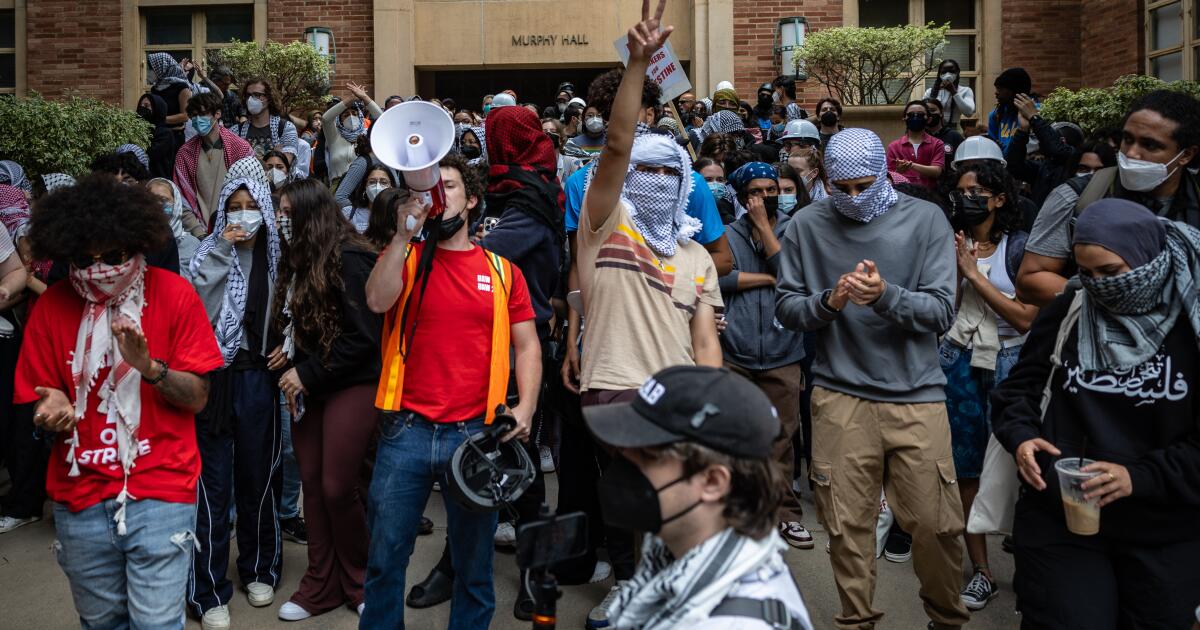
He walked down a side street, eyes darting here and there, wondering how it would unfold.
“What kind of fences will the police have? Will they bring dogs?” Hatem Abudayyeh asked. He stopped in the shadow of the United Center, home of the NBA’s Bulls and the NHL’s Blackhawks and a draw for tens of thousands of pro-Palestinian demonstrators who are expected to protest against U.S. support for Israel at the Democratic National Convention this month. “I hope they don’t militarize it,” he said. “The first statement the police made was about mass arrests. They’ve backed off a little. But they’re trying to intimidate us.”
The son of Palestinian immigrants, Abudayyeh is one of the march’s organizers and has long been at the center of civil rights protests. He was investigated by the FBI more than a decade ago — no charges were brought — and in 2017 he helped block traffic at Chicago O’Hare International Airport over then-President Trump’s Muslim travel ban. The demonstration he is preparing comes as this onetime city of stockyards and slaughterhouses hopes it can avoid the chaos and police brutality that marked the antiwar protests that engulfed the Democrats’ convention here in 1968.
Hatem Abudayyeh, a longtime Palestinian activist and organizer, is preparing for a march on the Democratic National Convention at Chicago’s United Center this month.
(Alex Garcia / For The Times)
“Palestine is this generation’s Vietnam War,” Abudayyeh said, noting that more than 39,000 Palestinians, according to Gaza health authorities, have been killed by Israeli forces since Hamas attacked Israel in October. “We’re unabashed about the Palestinian right to self-defense to end Israeli genocide. We have momentum. I don’t think we’ll lose any steam with [President] Biden out of the race. Kamala Harris and other Democrats are still backing Israel.”
Abudayyeh’s parents emigrated from the Israeli-occupied West Bank village of Al Jib and settled on Chicago’s North Side in the 1960s. Both were activists and community leaders, who on Sundays drove their son to Arab neighborhoods on the South Side so he would know his lineage and learn that social change comes from sacrifice and solidarity. That lesson has kept him on the front lines of hundreds of demonstrations. But few as consequential as the national stage he and his compatriots from more than 150 organizations will find themselves on when an energized Democratic Party arrives here with the expectation of nominating Harris for president.
“I don’t feel there’s anything to lose,” said Abudayyeh, 53, a large man with glimmers of gray in his beard who calls himself an “anti-imperialist” and sounds at times like a provocateur from a long-ago newsreel. “We’ve already dealt with political repression. We know the feds are here and will be crawling up and down Chicagoland.”
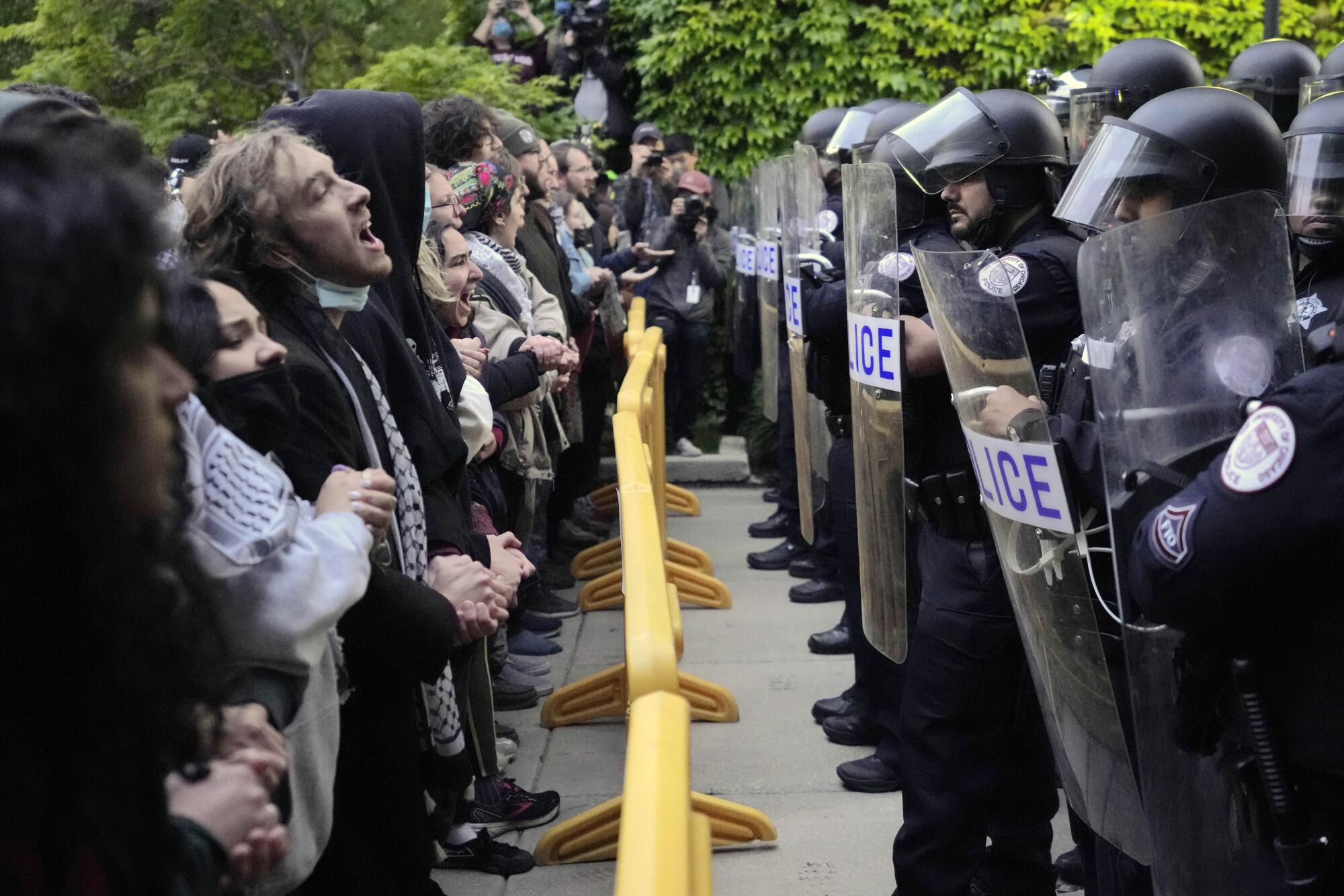
Pro-Palestinian protesters chant at University of Chicago police officers as a student encampment is dismantled in May.
(Charles Rex Arbogast / Associated Press)
The Chicago Police Department has been training to de-escalate threats of unrest at the convention and is calling in hundreds of law enforcement officers from across the state for backup. The department — just weeks after a Fourth of July weekend that saw more than 100 shootings citywide — is under intensifying pressure over security after the assassination attempt on Trump at a Pennsylvania rally last month. This comes after a 2021 report by the city’s Office of Inspector General found the department was marred by confusion and intelligence failures during violence related to the George Floyd protests a year earlier.
The police will “not only allow everyone who comes here to express their 1st Amendment rights, but we will protect their rights while doing it,” department Supt. Larry Snelling told reporters recently. “What we will not tolerate is vandalism to our city. What we will not tolerate is violence.”
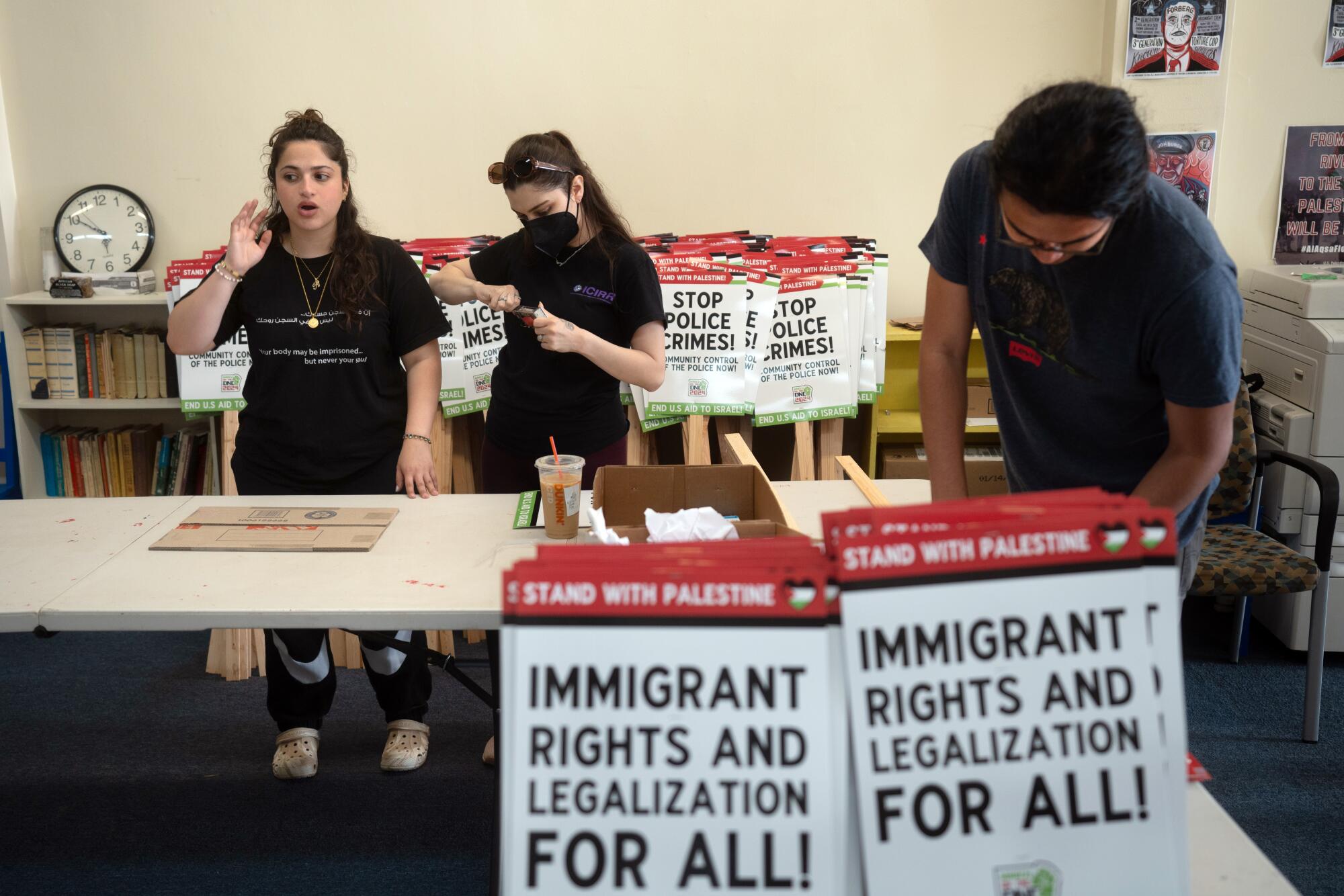
Activists at the Chicago Alliance Against Racist and Political Repression prepare protest signs for demonstrations at the Democratic National Convention.
(Alex Garcia / For The Times)
The overall goal of the protest — organizers have condemned the Democratic Party as being “a tool of billionaires and corporations” — is ending U.S. military aid to Israel and the creation of an independent Palestinian state. That same demand ignited demonstrations that shook college campuses in the spring. But the protesters in the March on the DNC 2024 come from many causes, including immigrant, reproductive and LGBTQ+ rights, anti-racist networks and those seeking to stop police repression in minority communities.
“We are in unconditional solidarity with the Palestine liberation movement,” said Frank Chapman, a mentor to Abudayyeh and field organizer and education director of the Chicago Alliance Against Racist and Political Repression. “Our political destinies are entwined. All those billions of dollars going to Israel could be used to build up America and reverse the injustices against Black Americans. You can’t have a war on poverty and at the same time perpetuate genocide overseas.”
Activists stapled together protest signs on a recent evening at the alliance’s South Side headquarters, where a picture of Malcolm X hung on the wall, and outside, not far from the L train, a man carried an open bottle in a crumpled bag and wandered beneath a sign for Living Hope Church and a lawyer’s billboard that read, “Call Top Dog.” The activists ranged in age from students to a gray-haired man; they moved swiftly and quietly stacking signs near the windows like a small army waiting to advance.
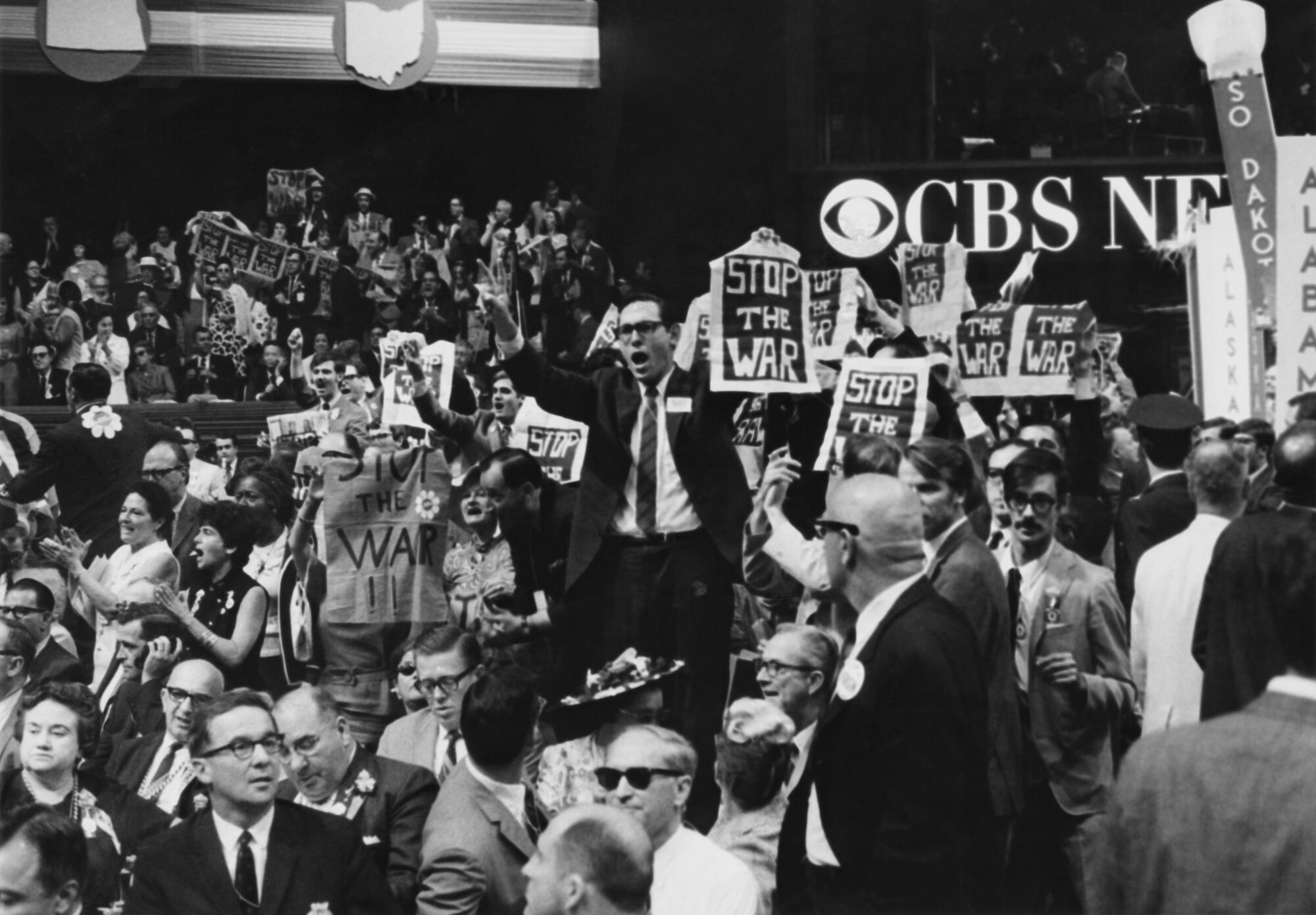
New York delegates protest U.S. involvement in the Vietnam War on the floor of the 1968 Democratic National Convention in Chicago.
(Getty Images)
“It feels like we’re building something,” Adrian Gallegos, a computer science major at the University of Illinois Chicago, said next to rows of “Stop Police Crimes” signs. The air was sharp with the spirit of rebellion, as if one were listening to Jimi Hendrix while eavesdropping on the 1960s anti-establishment musings of Black Panther deputy chairman Fred Hampton or Yippie activist Abbie Hoffman.
“The system has been exploiting and oppressing people for 400 years,” said Kobi Guillory, co-chair of the Chicago alliance. “It’s inevitable it will crumble under the weight of its own contradictions.”
The 1968 peace movement “was a mostly white-led movement. This is not,” said Chapman, a revered figure in the city’s civil rights scene for half a century. “The struggle for peace today is more multi-ethnic and multi-international. It is broader and deeper than the antiwar movement around Vietnam. This will lead to a political realignment for people of color and working-class white people who want change.”
Abudayyeh sees similarities to and contrasts with 56 years ago. The 1968 convention followed Democrat incumbent Lyndon B. Johnson’s decision not to seek another term; this year Biden dropped out of the race. Then and now, the Democrats were divided over unpopular wars. But the Israel-Hamas war is different from the Vietnam War, which consumed the American imagination for years, killing more than 58,000 U.S. service members and an estimated 2 million to 3 million Vietnamese. Israel’s bombardment of the Gaza Strip is supported by U.S. military aid, but Washington has not declared war, and no American soldiers are dying.
What’s more, the politics of Chicago and the country are not the same as in 1968, when the nightly news echoed with reports of rioting and the assassinations of Robert F. Kennedy and the Rev. Martin Luther King Jr. Back then, Chicago Mayor Richard J. Daley, who was known as “the Boss,” ordered a clampdown on dissent, and police attacked protesters with billy clubs and tear gas, leaving hundreds arrested or injured. Current Mayor Brandon Johnson is a progressive and onetime union organizer who has supported activists and in June ordered a task force to study making reparations to Black residents.
The protests at this year’s convention will confront a troubled and distracted land. The assassination attempt against Trump, Biden’s departure, the rise of Harris and battles over abortion, inflation, book banning, housing prices and other issues have left many Americans inward-looking and dispirited about the future. But Abudayyeh said the injustices against Palestinians are visceral enough to force Democrats, including Harris, who has been more forceful than Biden in criticizing Israel for creating a “humanitarian catastrophe” in the Gaza Strip, to take notice of the marchers’ demands at the convention.
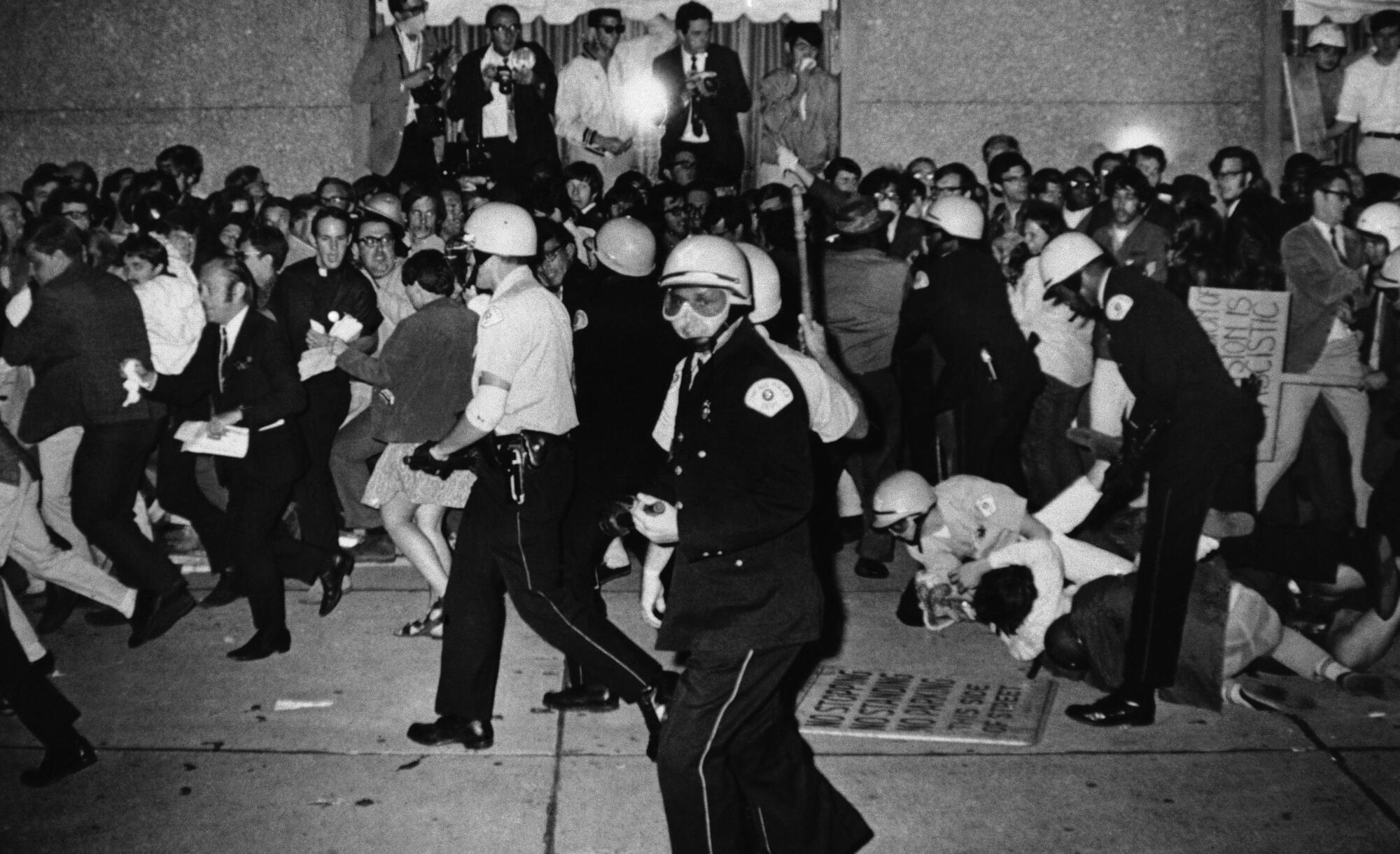
Chicago police officers forcefully disperse demonstrators outside the Democratic National Convention on Aug. 29, 1968.
(Michael Boyer / Associated Press)
“Yes,” he said, “the timing is right.”
The other day, Abudayyeh, wearing a face mask after a bout with COVID-19, drove beyond his office at the Arab American Action Network, where he is executive director, to an Arab neighborhood of sweet shops, jewelry stores and beauty academies. The streets and swirling dialects connected him to Palestinians, like his deceased parents, who emigrated here after Middle East wars and Israel’s occupation of the West Bank.
“They always wanted to return home, but [Palestinians are] now an established presence in Chicago,” said Abudayyeh, who has a daughter, and is also national chair for the U.S. Palestinian Community Network. “It took my parents 25 years to buy a house and give up on the dream of going back.”
The conversation, as often with Abudayyeh, who seems to be in many places at once, turned in a new direction. Protest organizers, he said, have been in a months-long struggle with the city on a route that would allow demonstrators to march close to the United Center.
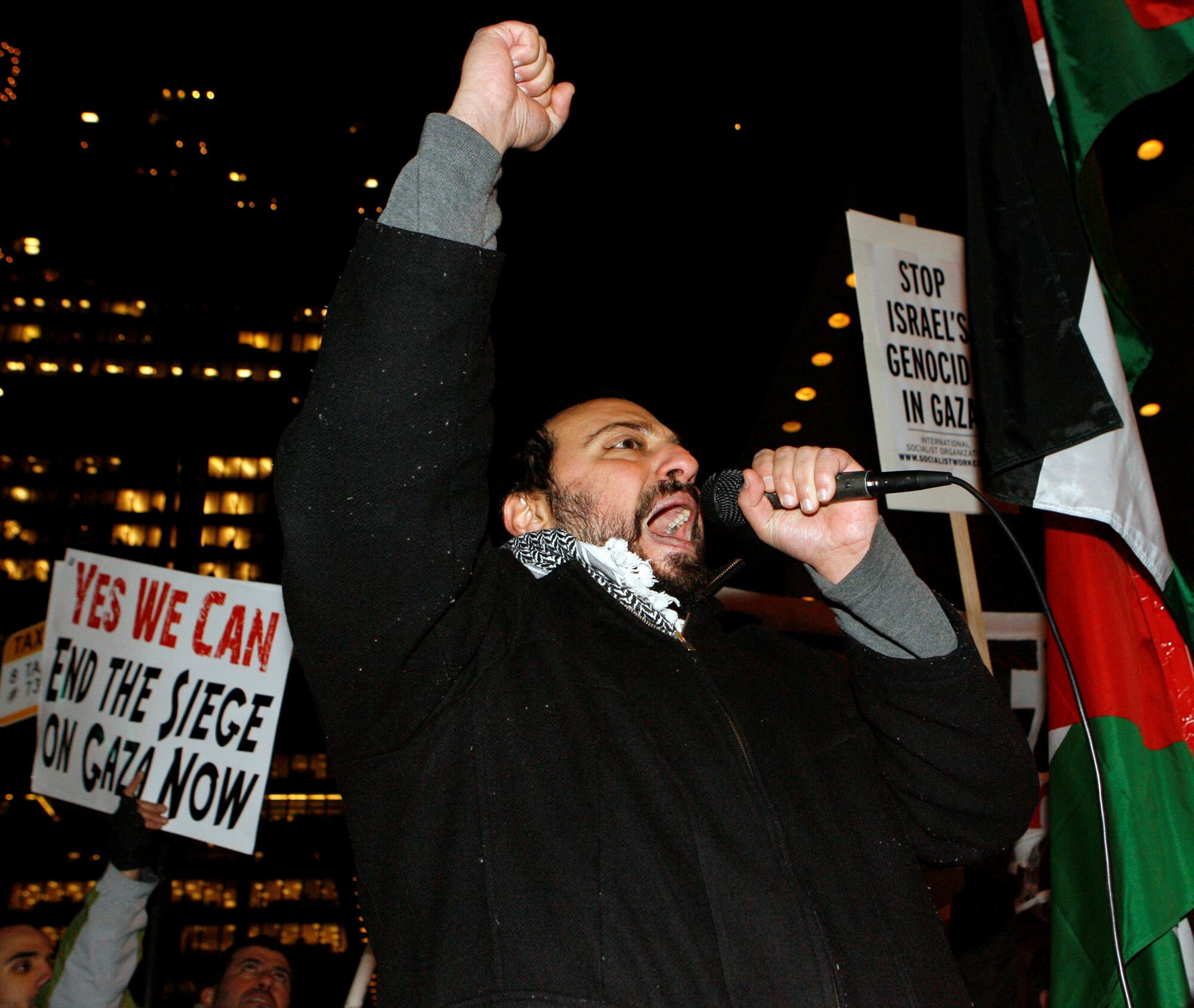
Hatem Abudayyeh speaks in downtown Chicago in January 2009, protesting against Israeli military actions in the Gaza Strip.
(Nam Y. Huh / Associated Press)
“We’re making progress,” he said. “When we first filed for a permit, the city wanted to keep us four miles away from the center.” The new plan allows protesters to gather at and march from Union Park, several blocks from the site. “We’re within sight and sound,” he said, “but they’re not giving us a long enough route to accommodate tens of thousands of people.”
Abudayyeh is accustomed to the reach of the state. Two years after working with antiwar activists at the 2008 Republican National Convention in St. Paul, Minn., the FBI raided his home, seizing computers, files, books and documents. His bank accounts were frozen. The sweep was part of an investigation into about two dozen activists in the Midwest suspected of supporting international terrorist organizations. Abudayyeh was targeted over helping arrange delegations to Gaza and the West Bank of activists opposed to Israeli occupation.
He said he had no connection to militant groups. Months earlier, he had been invited to the Eisenhower Executive Office Building, next to the West Wing of the White House, for an outreach meeting for Arab Americans. Activists and community leaders came to his defense. He refused to answer a grand jury subpoena, and more than two years later his confiscated materials were returned and no charges were filed.
“This is a massive escalation of the attacks on people that do Palestine support work in this country and antiwar work,” he said at the time. “We’re not going to stop speaking out against U.S. support of Israel’s violations of the Palestinian people.”
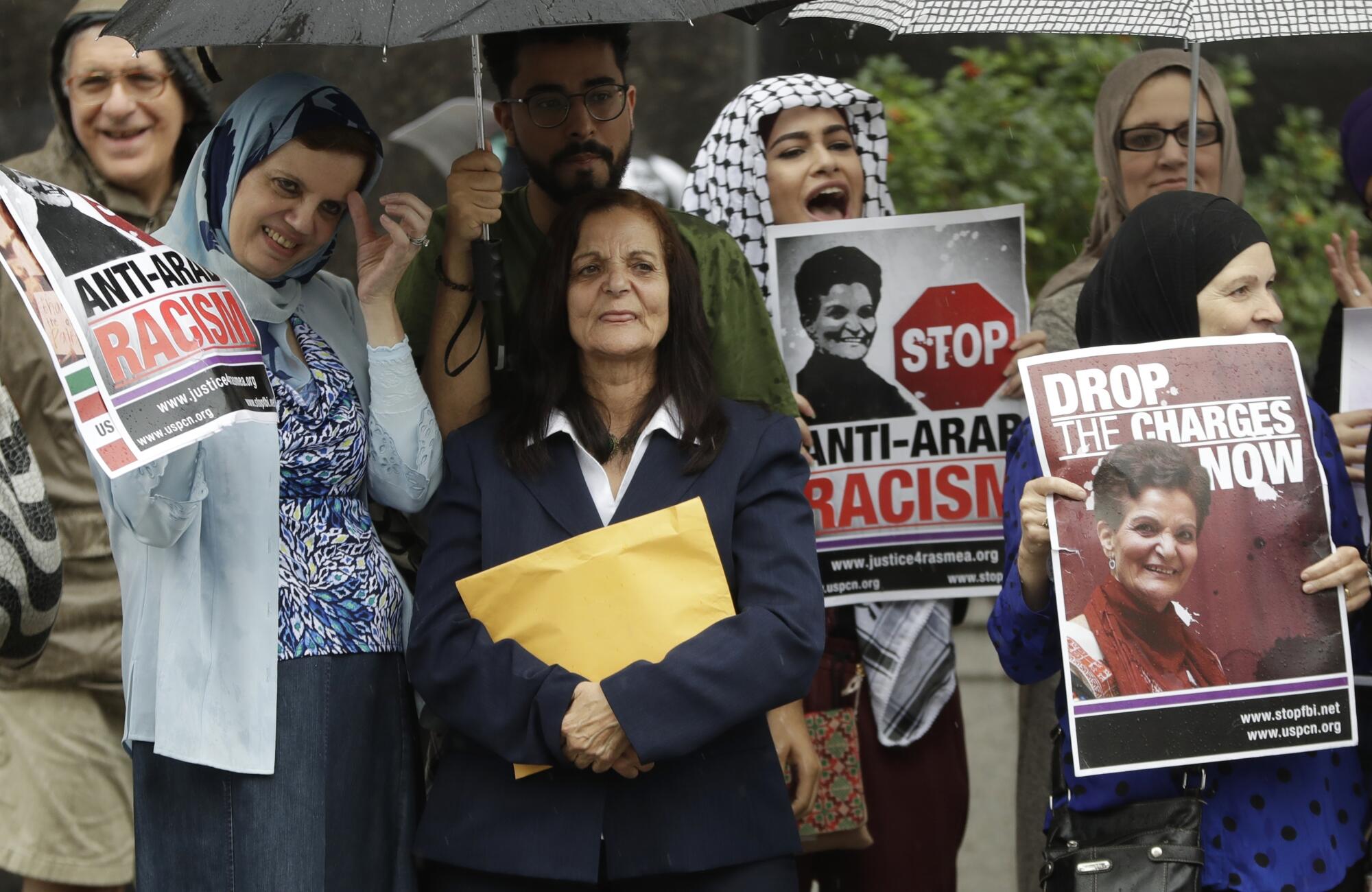
Abudayyeh coordinated the defense committee in 2017 for Rasmea Odeh, a Palestinian activist imprisoned in Israel for her involvement in two bombings in Jerusalem in 1969. Above, Odeh is joined by supporters outside a federal courthouse in Detroit in 2017.
(Carlos Osorio / Associated Press)
Abudayyeh’s statements and sentiments are often provocative in an age when some protesters against the Gaza war have been assailed as antisemitic or for espousing terrorism for their support of Hamas. He has called Hamas “a legitimate resistance force” and has said “the real terrorists are the governments and military forces of the U.S. and Israel.” When Iran retaliated against Israel with missiles and drones in April, Abudayyeh broke the news during an activist meeting, where a few in the crowd cheered.
In 2017, Abudayyeh coordinated the defense committee for Rasmea Odeh, a Palestinian activist imprisoned in Israel for her involvement in two bombings in Jerusalem in 1969. Odeh said she confessed after being tortured by the Israeli military. She was released in a prisoner swap a decade later and eventually moved to Chicago, where she was associate director of the Arab American Action Network. She became an American citizen but was deported after pleading guilty to not disclosing her criminal history to immigration officials.
Abudayyeh’s activism has been ingrained since childhood. His father, who worked for an insurance company, was a co-founder of the Arab Community Center, and his mother was Chicago chapter president for the Union of Palestinian Women’s Assns. He attended UCLA in the early 1990s, studying biology and English and hoping to join a progressive campus culture. Instead, he said, he found a mostly white and well-to-do population that was uninterested in activism, except for Latino students who taught him about the Chicano movement.
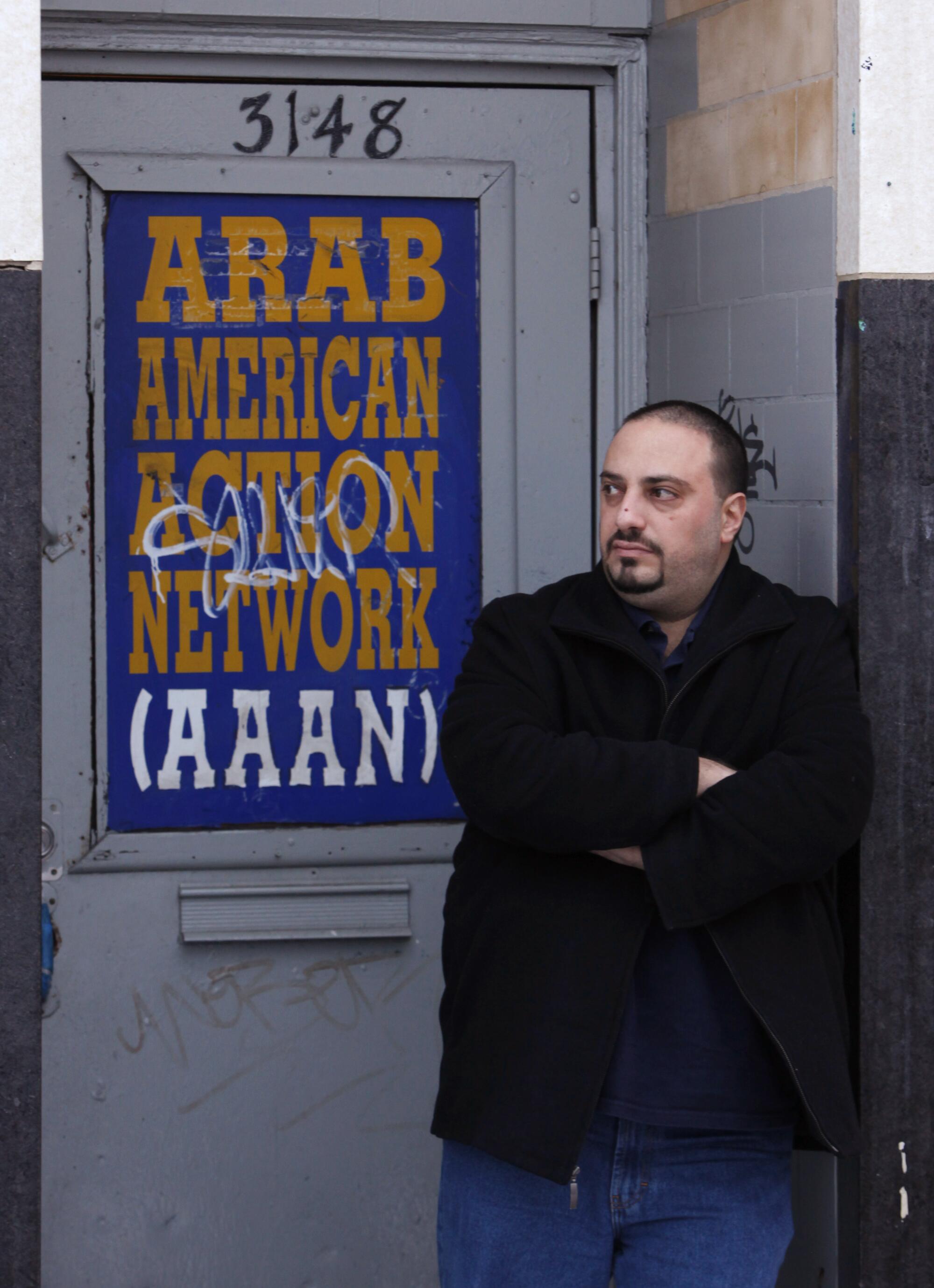
Abudayyeh stands outside the office of the Arab American Action Network in Chicago in 2011.
(Charles Rex Arbogast / Associated Press)
“I saw that social change wasn’t going to happen at UCLA,” he said, noting that that was no longer the case, given the university’s pro-Palestinian protests in recent months. He left campus and returned to Chicago, where he coached high school basketball and was increasingly drawn to civil rights issues and working with the Palestinian community. In 2002, he traveled to Jerusalem, Gaza and the West Bank as part of a program to teach young Arab and Palestinian Americans and others about the Israeli occupation so they could return to the U.S. to help organize for Palestinian independence.
“I came back from that trip transformed,” he said. “I think for a while I had felt diaspora guilt. I realized I had to commit more of my life to ending the occupation. I owed it to my parents and my grandparents and cousins of mine who did not have the opportunity I had to grow up in safety and security. They faced bullets and repression.”
The morning after his drive to the Arab neighborhood, Abudayyeh parked near Union Park and walked toward the United Center in west Chicago. He approached from a side street, wondering how close he could get during the convention. He talked logistics and spoke of the St. Paul Principles for protest — put together by activists at the 2008 Republican convention — that call for solidarity and opposing “any state repression of dissent including surveillance, infiltration, disruption and violence.”
The parking lots were empty. A local film crew was shooting video. “I know the camera guys,” he said. “The reporters don’t always come to our protests. But the photo guys do. They know me.” He turned and walked back toward Union Park. He mentioned that his father never finished college; he had children and relatives back in Al Jib to support. It was that way for many, he said, turning past First Baptist Church, his jeans frayed and cuffed, his T-shirt blowing in a hot breeze.
Marchers, he said, would be arriving from across the country in buses, trains and caravans. He predicted they would fill the park and swell into the streets. There were only weeks left to prepare. The sun was high and he was sweating. He pulled down his COVID mask and took a breath, disappearing into the shadows at the edge of the park and driving home for a few hours’ rest.
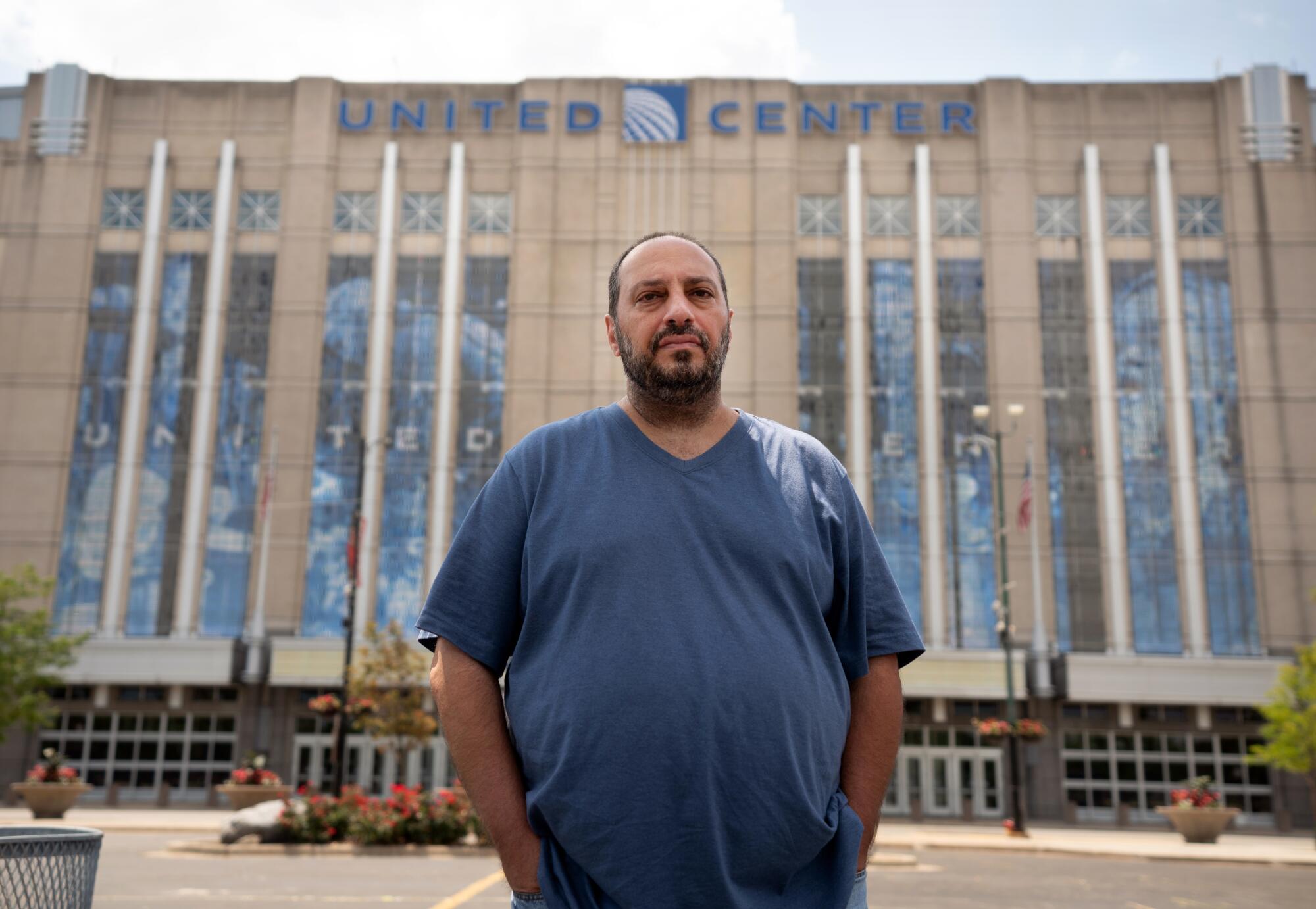
“I don’t feel there’s anything to lose,” Abudayyeh said about the upcoming protest in Chicago. “We’ve already dealt with political repression. We know the feds are here and will be crawling up and down Chicagoland.”
(Alex Garcia / For The Times)


NEWYou can now listen to Fox News articles!
The House has officially shipped a colossal bipartisan housing package to President Donald Trump, and lawmakers are hoping that, at the very least, he doesn’t veto it.
Trump was supposed to sign the 21st Century ROAD to Housing Act last week, but his last-minute decision to ghost the signing ceremony with House Speaker Mike Johnson, R-La., and Senate Majority Leader John Thune, R-S.D., put into question whether the bill was dead.
His refusal to sign the bill, which passed with overwhelmingly bipartisan support in both chambers, was to leverage the Safeguarding American Voter Eligibility (SAVE) America Act, which doesn’t currently have the votes to succeed in the Senate.
WARREN TELLS TRUMP TO ‘SIGN THE DAMN BILL’ AS BIPARTISAN HOUSING PACKAGE REMAINS STALLED IN WASHINGTON
Trump has refused to sign the 21st Century ROAD to Housing Act. (Shawn Thew/EPA/Bloomberg via Getty Images)
Trump appears to be in no hurry to sign the bill, despite Republicans who are hungry for a win in the affordability fight ahead of the midterm elections.
“It’s so unimportant … compared to the SAVE America Act,” Trump told reporters in the Oval Office on Monday. “I think the SAVE America Act is exactly what it says. It’s saving America from crooked elections.”
“Here’s what I would like to sign, much more than a bill that — big deal, it’s a yawn,” he continued. “Some people say it’s wonderful. To me, compared to the SAVE America Act, just about everything is a big yawn.”
GOP INFIGHTING OVER TRUMP’S VOTER ID BILL ERUPTS AS TOP SENATOR CALLS STRATEGY ‘FANTASY’
It’s legislation that is loaded with nearly 60 provisions from both sides of the aisle in both chambers that’s designed to make it easier for homes to be built and for younger Americans to buy their first home. It also includes a ban on hedge funds buying up housing stock that Trump pushed Congress to include during the State of the Union earlier this year.
Sen. Elizabeth Warren, D-Mass., one of the architects behind the bill in the upper chamber alongside Sen. Tim Scott, R-S.C., charged that Congress handed the bill to Trump “on a silver platter.”
“When you ask me what happens next, if he cared about the American people, he’d have already signed the damned thing, and we’d be underway,” Warren said on WCVB’s “On the Record” on Sunday.
But Trump doesn’t have to put his signature on the bill for it to become law.
IRATE REPUBLICANS ACCUSE TRUMP OF HANDING DEMOCRATS A WIN AFTER BLOWING UP HOUSING PACKAGE
The Senate advanced a massive, Trump-backed housing package geared toward lowering the costs of homes and supercharging the housing supply. Sen. Elizabeth Warren, D-Mass., pitched it as legislation to prevent America from becoming a “nation of renters.” (Jemal Countess/Getty Images for Protect Borrowers; Anna Moneymaker/Getty Images)
The Constitution grants presidents the ability to veto a bill within 10 days of it being transferred over to the White House. In that scenario, Congress could override a veto of the housing package.
It’s happened before under the Trump administration. In early 2021, Congress overrode Trump’s veto of the annual National Defense Authorization Act — a massive Pentagon funding authorization package that some House Republicans are trying to use as a vehicle to pass the SAVE America Act.
But during that 10-day period, if Trump doesn’t sign the bill, it would automatically become law. That’s unless Congress completely adjourns, in which case a “pocket veto” could happen. The Senate is currently in recess and the House is scheduled to leave town by week’s end, but neither count as a full adjournment.
CLICK HERE TO DOWNLOAD THE FOX NEWS APP
Johnson, who spent the last few days meeting with Trump at the White House about the housing bill and the SAVE America Act, said: “I hope he does sign it.”
“If he doesn’t, it’s still law,” Johnson said. “We’ll still celebrate it, but he’s trying to make a point, and I think he’s making it very effectively. And the fact that you all ask me every three steps down the hallway illustrates that he has achieved the desired objective, and that is to make SAVE America the number one thing, because if we don’t get that right, everybody’s concerned about what happens next.”
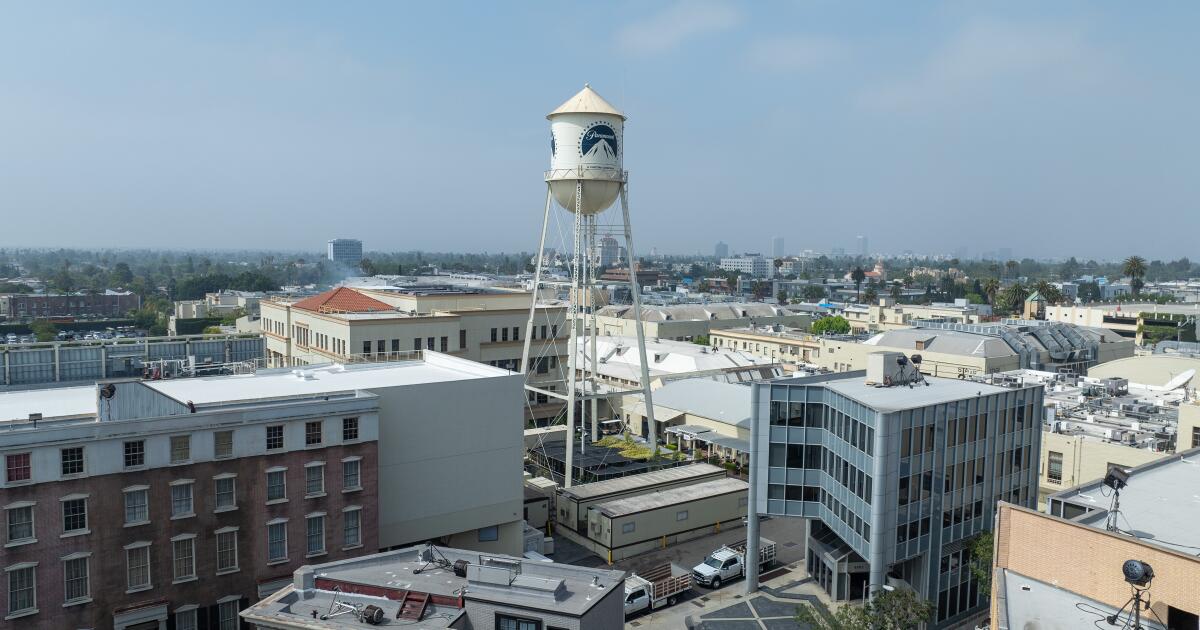
Britain’s culture minister may challenge Paramount Skydance’s takeover of Warner Bros. Discovery — presenting a potential speed-bump to David Ellison’s plan to wrap up his $111-billion deal by September.
Earlier this month, Paramount secured the U.S. Justice Department’s blessing to buy the Warner assets, which include CNN, HBO, Cartoon Network, Animal Planet and the Warner Bros. film and TV studios in Burbank.
Paramount also must win the approval of British and European regulators, who are known for drilling deeply into media matters because of their influence on society.
Britain’s Competition and Markets Authority took a preliminary step this month by opening an investigation into Ellison’s proposed merger.
On Tuesday, Lisa Nandy, Britain’s Secretary of State for Culture, Media and Sport, notified Parliament that she was inclined to intervene in the blockbuster deal.
In a written statement, Nandy cited her ability to weigh in on “public interest grounds,” due to concerns about maintaining a competitive media market in Britain.
“The UK’s move to intervene in the Paramount–WBD deal confirms what we’ve been saying for months. The real regulatory risk was never in the US — it’s in Europe,” Forrester VP Research Director Mike Proulx said Tuesday in a statement.
While Nandy cautioned she has not made “a final decision on intervention at this stage,” she has invited Paramount and Warner Bros. to respond to her concerns by July 6.
June 2026 photo of Culture, Media and Sport Secretary Lisa Nandy arriving at Downing Street for the weekly Government cabinet meeting in London.
(Alishia Abodunde/Getty Images)
Paramount did not offer immediate comment.
The company owns CBS News, children’s channel Nickelodeon and Channel 5, one of the largest over-the-air television broadcasters in the United Kingdom.
Warner Bros. Discovery owns CNN, Cartoon Network and TNT Sports, which broadcasts the Olympics, Champions League and Premier League soccer matches.
“I am conscious that the proposed acquisition is global in nature,” Nandy wrote in her statement. “In reaching this decision, my focus has been, and will remain, on the UK public interest and the range of services available to UK audiences, including Channel 5, TNT Sports, Cartoon Network, Nickelodeon, and CNN International, as well as Paramount+ and HBO Max.”
If Nandy decides to intervene, the Office of Communications, known as Ofcom, would launch an assessment of the deal. Britain’s Competition and Markets Authority also would determine how the merger might reshape the competitive landscape.
Teams from the two companies have been huddling for months to plan for the melding of the two operations as soon as Paramount receives all of its regulatory approvals.
Australia, New Zealand, China, Saudi Arabia, Ukraine, Serbia, France and Italy have already given their approvals to the deal.
Saudi Arabia’s Public Investment Fund is planning to contribute $10 billion to help the billionaire Ellison family pull off the merger, which would make the Saudi royal family a significant, although passive, equity owner. In addition, the royal families of Qatar and Abu Dhabi have agreed to each contribute $7 billion in equity financing.
The Federal Communications Commission must evaluate the foreign ownership stakes due to Paramount’s holding of CBS broadcast licenses. U.S. antitrust regulators already have concluded the combination would not violate federal anticompetition laws.
Approval had been expected because President Trump — who has friendly ties with Ellison and his father, tech billionaire Larry Ellison — favors the deal.
Trump has been eager for changes at CNN.
The U.S. government stopped short of asking Paramount to make concessions or divestitures. Many expect that Paramount may have to reconfigure its children’s television holdings abroad due to the proposed combination of two large players — Nickelodeon and Cartoon Network.
Nandy suggested that Britain also should scrutinize the impact of combining two major streaming services HBO Max, a Warner property, with Paramount+.
HBO programming, including “Game of Thrones,” “Boardwalk Empire,” and “Succession,” has long been popular in Britain.
A coalition of state attorneys general, led by California Atty. Gen. Rob Bonta, also is expected to challenge the deal, in part, due to concerns about news media consolidation. Bonta’s office has said the matter remains under review.
Opposition to the deal has been building in the U.S. for months. A group of Hollywood activists — led by actors Jane Fonda and Mark Ruffalo — have spearheaded a “block the merger” campaign that now has support from more than 5,000 entertainment workers.
The group’s open letter calls on Bonta to take action to thwart the Ellison expansion effort. Paramount’s Chief Legal Officer Makan Delrahim has blasted the campaign, calling it “fear-mongering” and a partisan distortion of antitrust law.
Forrester’s Proulx noted differences in attitudes toward the deal among the various constituencies.
“For US consumers, this merger has become a proxy fight about political influence and control of media,” Proulx said. “In the UK, it’s being treated as a structural competition issue where regulators, not consumers, will decide how this deal plays out and how long it takes.”
Politics
Fetterman unleashes on ‘dirtbag’ wing of Dems after far-left victories: ‘Orgy of socialism’

NEWYou can now listen to Fox News articles!
Sen. John Fetterman, D-Pa., unloaded on his own party on Sunday evening, blasting a series of victories for progressives he called “anti-America.”
“Big night for the dirtbag left,” Fetterman said, referring to New York’s recent primaries, where two members of the Democratic Socialists of America (DSA) won primaries.
“I’ve said the party is becoming an orgy of socialism. Clearly anti-America, anti-Western Civilization,” Fetterman said.
Fetterman’s striking calls give a rare look at how some moderates may view the developments on their far-left flank that have dominated the party’s momentum in recent months, sparking concern that their high visibility is dragging the party further and further left.
FETTERMAN WARNS DEMOCRATS ‘DRIFTING FIRMLY INTO COMMUNISM’ AFTER SOCIALIST PRIMARY WINS
Sen. John Fetterman, D-Pa., speaks to reporters outside the Senate Chamber during votes on Nov. 10, 2025, on Capitol Hill in Washington, D.C. (Andrew Harnik/Getty Images)
His comments come on the heels of a handful of key progressive victories.
In Maine, Graham Platner, a controversial Democratic candidate for U.S. Senate, has attracted controversy for denying knowledge of the meaning behind a Nazi-linked tattoo, for off-color comments about race and calling himself a “communist” in a deleted Reddit post.
In New York, one DSA member, Claire Valdez, won a primary on a platform of abolishing ICE and a Green New Deal-style approach to climate change. Similarly, Darializa Avila-Chevalier, another DSA candidate, beat out incumbent Rep. Adriano Espillat, D-N.Y., a high-ranking Democrat and the chair of the Congressional Hispanic Caucus.
WINNERS AND LOSERS EMERGE AFTER SOCIALIST EARTHQUAKE ROCKS NYC PRIMARIES
Graham Platner, Democratic Senate candidate for Maine, speaks at a primary election night event at the Blue Hill YMCA in Blue Hill, Maine, on June 9, 2026. Platner won the party’s Senate primary after a campaign marked by accusations of past misbehavior and voter concerns. (Graeme Sloan/Bloomberg via Getty Images)
Both Chevalier and Valdez had the backing of New York Mayor Zohran Mamdani, himself a socialist.
The wins have captured national attention and drawn criticisms from Republicans who have pointed to their success as emblematic of the direction of the Democratic Party.
Fetterman, who has not shied away from confrontations, has been one of the few Democrats to express alarm about the kind of candidates carrying the party’s banner.
“I mean, you look at some of the things that people have said. Abolish prison, abolish the border, abolish ICE, I mean these crazy people — I have colleagues in my caucus that refuse to even call this out,” Fetterman said.
FETTERMAN REACTS TO MAMDANI’S REFUSAL TO ACCEPT SUPREME COURT’S IMMIGRATION RULING
U.S. Sen. John Fetterman, D-Pa., walks through the Senate Subway during the Senate War Powers vote on April 22, 2026, in Washington, D.C. (Heather Diehl/Getty Images)
CLICK HERE TO DOWNLOAD THE FOX NEWS APP
“Between P-hustle in Maine and some of the other winners in New York, they should form their own party and run on all the things that they’ve had to delete on social media,” Fetterman said, referring to Platner.
“That’s where our party has moved,” he added.
-

 Michigan2 minutes ago
Michigan mayor’s 7-year-old nephew found dead in Menands, New York, authorities say
-

 Massachusetts9 minutes ago
Missing Massachusetts cat miraculously found underneath owners’ new bathtub — after disappearing for 30 hours
-

 Minnesota12 minutes ago
St. Paul resident’s special connection to the Declaration of Independence
-

 Mississippi17 minutes ago
Amy Carruth named director of Mississippi State Hospital – SuperTalk Mississippi
-

 Missouri24 minutes ago
Gov. Kehoe signs Missouri FY27 budget totaling $50.7B. What you need to know
-

 Montana27 minutes ago
New health care system director appointed at Montana VA
-

 Nebraska32 minutes ago
Hilgers says Nebraska, Colorado water dispute could take years, but Perkins County Canal should progress
-

 Nevada39 minutes ago
Deputies respond to stabbing at Nevada Cares Campus in Reno; one victim hospitalized

