Politics
Can Dems unseat a thrice-elected GOP congressman in this battleground L.A. County district?


Early on a Saturday morning at Rawley Duntley Park in Lancaster — the high-desert sun blazing — George Whitesides, a Democrat running for Congress, was encircled by dozens of cheering, noisemaker-blasting volunteers.
“I really want to make sure that even the astronauts out there can hear his name!” Nadia Abrica, an organizing director with the state Democratic Party, shouted, pointing to the sky. “George! George! George!”
“Are you guys feeling fired up?” Whitesides asked the crowd. “Are you feeling ready to go? … Are we going to change the House of Representatives?”
“Yes!” they screamed.
George Whitesides’ supporters gather at a campaign event in Lancaster.
(Zoe Cranfill / Los Angeles Times)
Whitesides, a former NASA chief of staff under President Obama, is running to unseat Rep. Mike Garcia, the thrice-elected Republican incumbent, in California’s hotly contested 27th Congressional District in northern L.A. County. The race will be crucial in determining whether Republicans maintain their narrow majority in the U.S. House.
Democrats, riding the national enthusiasm unleashed by Vice President Kamala Harris’s entry into the presidential race, feel good about their chances to flip the district.
“You feel the difference — and what really helped is the re-energizing when we found out about Biden dropping out,” said Alvarez Marcos, 61, a volunteer for Whitesides. “We’re building off that.”
But after leaving the pep-rally vibe at the park to knock on doors at a nearby apartment complex, Whitesides spoke with middle-of-the-road voters who made one thing abundantly clear: Winning this purple suburban district will not be easy.
“I am not a Democrat,” said a young woman who was the first to open her door. “Are you for open borders?”
“No, ma’am,” Whitesides said, after trying to summarize his message — largely about creating local jobs — in about 90 seconds. “We’re trying to create a secure border for our country.”
In this presidential election year dominated by hyperpartisan national issues — including immigration — both Whitesides, 50, and Garcia, 48, are trying to cast themselves as a moderate and their opponent as a political hardliner.
“People are excited to bring positive change to the district, and they’re really excited to beat Mike Garcia, who they view as this extreme guy who doesn’t connect or fit with the folks in our district,” Whitesides told The Times.
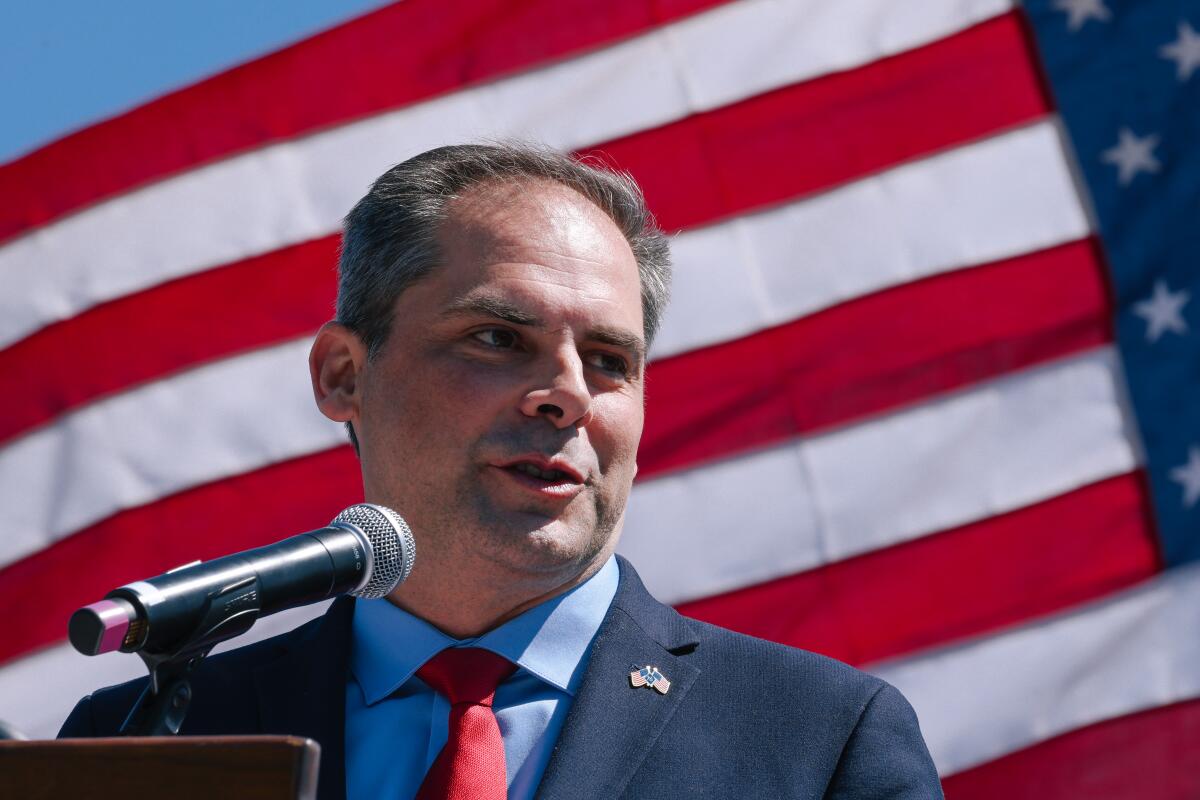
Rep. Mike Garcia is looking to keep the Antelope Valley seat he has held since 2020. The race will be crucial in determining whether Republicans maintain their House majority.
(Dania Maxwell / Los Angeles Times)
Whitesides calls Garcia a pro-Trump sycophant and highlights the congressman’s vote against certifying the 2020 presidential election results after the Jan. 6 insurrection, as well as his vote against President Biden’s $1-trillion infrastructure bill.
Whitesides also points to Garcia’s anti-abortion record. Garcia was among the GOP congressional members who signed an amicus brief urging the Supreme Court to overturn Roe v. Wade and, in 2021, co-sponsored the Life at Conception Act, which amounts to a nationwide abortion ban with no exceptions. (Garcia later indicated he could support such exceptions for rape, incest or threats to the mother’s health — a departure from the bill. He did not sponsor a reintroduced version.)
Garcia’s campaign did not respond to requests for comment for this story.
But his backers are trying to paint Whitesides as a far-left mega-donor trying to use his personal wealth to buy a congressional seat.
As a first-time candidate, Whitesides has no voting record to scrutinize. So, Republicans have zeroed in on his hundreds of thousands of dollars in contributions to progressive candidates and causes.
Ben Petersen, a spokesman for the National Republican Congressional Committee, said in a statement that Garcia, a former Navy pilot, “has led a life of service, from flying fighter jets in combat to his mission in Congress of lowering inflation and defending public safety.”
“Voters can easily spot the difference with extreme George Whitesides, who backed legislation raising the cost of living and bankrolled radical activists attacking police and dismantling law and order,” he added, referencing Whitesides’ support of Equality California, an LGBTQ+ rights organization that prominent conservative fundraisers have dubbed a defund-the-police group. (Whitesides has touted his endorsement by Equality California.)
About an hour’s drive north of solidly liberal downtown Los Angeles, the 27th Congressional District stretches from fast-growing Santa Clarita to the Kern County line. It includes the cities of Lancaster and Palmdale, as well as rural desert towns such as Acton and Pearblossom.
With its close proximity to Edwards Air Force Base, the region has deep ties to the military and aerospace industry, as reflected by the name of its recently disbanded Minor League Baseball team, the Lancaster JetHawks.
Once staunchly conservative, the district has become more favorable to Democrats, with the population growing younger and more diverse as L.A. residents moved in for more affordable housing. Redistricting after the 2020 census made CA-27 even bluer by excising conservative Simi Valley.
Just over 41% of registered voters are Democrats, and about 30% are Republicans. More than a fifth are independents, a wildcard that makes the district somewhat unpredictable.
The district voted for Biden in 2020. But in the 2022 gubernatorial race, it backed Republican state Sen. Brian Dahle over Democratic Gov. Gavin Newsom.

Though his district has more registered Democrats than Republicans, frustrations over California’s high cost of living have given GOP Rep. Mike Garcia an edge in earlier campaigns.
(Myung J. Chun / Los Angeles Times)
The district has been on the front lines of partisan warfare since Katie Hill, a millennial Democrat, unseated the Republican incumbent in 2018, only to resign less than a year later amid a sex scandal. Garcia won the seat in a special election and retained it in two subsequent elections, thrice defeating the same Democratic challenger, former state Assemblywoman Christy Smith.
In the 2020 general election, Garcia defeated Smith by just 333 votes. He won by 12,732 votes during the subsequent midterm election, when fewer people cast ballots.
The Cook Political Report, a nonpartisan election handicapper, calls this year’s election a toss-up.
“When you’ve run a company that launches humans into space on a test-flight program, you kinda get used to being involved in high-stakes things,” said Whitesides, the former chief executive of Mojave-based Virgin Galactic. “We’ve got to flip the House so we can protect all these hard-won gains in healthcare and climate and jobs.”
“The Republican caucus right now is totally dysfunctional,” he added. “I”m trying to bring, like, actually getting stuff done back into focus. Wouldn’t that be great? Make the Congress work again.”
Lawrence Becker, a political scientist at Cal State Northridge, said it’s “going to be a tough election for Garcia.”
Most voters “are going to the polls with the presidential election on their minds,” he added. Trump is deeply unpopular in California, and having him at the top of the ticket “becomes a bit of a headwind that Mike Garcia has to face.”
Still, frustrations over California’s high cost of living and gas prices — potent issues for the many residents in this district who make the long commute to L.A. for work — have previously given Garcia an edge. He easily won last spring’s three-way primary election with 55% of the vote, while Whitesides got 33%.
State GOP Chairwoman Jessica Millan Patterson said the fact that Republicans are able to be so competitive in a district where Democrats have a large registration advantage shows how much voters “are getting sick and tired of what California Democrats have been serving up to them.”
Both parties are pouring money into the race.
The Congressional Leadership Fund, a super PAC that supports Republicans running for the House, is planning an $18.2-million ad blitz in the L.A. area this fall, with a focus on the 27th district.
Courtney Parella, a spokeswoman for the super PAC, said Garcia has a unique biography that resonates in his district. As a Navy pilot, the congressman flew in more than 30 combat missions during Operation Iraqi Freedom before spending 11 years as an executive with the defense contractor Raytheon.
“California voters remain fed up with rising crime, chaos at our border and skyrocketing costs — all caused by Democrats’ progressive single-party rule,” Parella said in a statement. “The House majority runs through California, and CLF is committing significant resources here this fall.”

George Whitesides introduces himself to Sean and Megan Holst. “It’s supposed to be more affordable in the Antelope Valley,” Megan says. “I thought we had a decent income, and it’s still — it’s hard.”
(Zoe Cranfill / Los Angeles Times)
Meanwhile, Whitesides — who loaned his campaign more than $1 million — is outraising his opponent. As of June 30, Whitesides’ campaign had $3.9 million in the bank, according to the Federal Election Commission. Garcia’s campaign had $2.2 million on hand.
Whitesides’ campaign is seizing on accusations that Garcia hid his sale of up to $50,000 in Boeing stock in August 2020, just before the House Transportation and Infrastructure Committee, of which he was a member, released a scathing report about the company.
According to the Daily Beast, which first reported the sale, Garcia missed the 45-day deadline to disclose the sale and filed paperwork only after narrowly winning his election that November.
A spokesman for Garcia’s campaign told Politico that Garcia had not seen the report before it became public and that his failure to disclose his stock sale was an accident.
After leaving Rawley Duntley Park that late-July Saturday, Whitesides — who has embraced his nerdy-dad vibe — donned a white NASA ball cap and brandished a 50-SPF spray can of sunscreen for his canvass of the apartment complex.
In each brief interaction, he said that, while running Virgin Galactic, he created 700 local jobs and that he was centering his campaign around job creation.
Propped in one apartment window was a license plate that read, EPDMLGY. Whitesides bounded up to the door, saying, “Epidemiology! Come on, that’s my voter.”
“I’m a moderate Democrat,” he said when Nancy Welsh, a 63-year-old pharmaceutical administrative assistant, opened the door. “I worked for NASA, so I’m a big science and facts kind of person.”
When Whitesides asked what issues were important to her, she laughed and said: “Don’t get me started.”
He stopped Megan and Sean Holst, a married couple in their early 30s, as they walked their golden retriever, Cosmo. “I know you from my dad!” said Megan, whose father planted a Whitesides yard sign outside his home on a dirt road in Acton.
Megan said she supports abortion rights and did not like Garcia’s record on the issue. But the couple — she is a clinical lab scientist and he is a programmer — are pretty moderate, she said. Mostly, they care about local issues, such as crime and cost of living. They have lived in the apartment complex for years and hope to someday be able to afford a house.
“It’s supposed to be more affordable in the Antelope Valley,” she said. “I thought we had a decent income, and it’s still — it’s hard.”
Whitesides handed her his campaign flier. She said she would consider it.

The Supreme Court ruled 6-3 that President Trump could fire independent regulators for any reason. But the justices carved out an exception for the Federal Reserve, preventing the immediate removal of Lisa D. Cook, a Federal Reserve governor.
Politics
Emotion and feelings: How Democratic Socialists’ congressional insurgency could come back to bite them

NEWYou can now listen to Fox News articles!
Democratic Socialists of America are on the charge, running hot off their wins in the New York Democratic primaries last week. Their victories in multiple Congressional seats – felling both Reps. Adriano Espaillat, D-N.Y., and Dan Goldman, D-N.Y. – signals that the party is ready to move on from the same old, same old.
Espaillat chaired the Congressional Hispanic Caucus. Goldman was a key House staffer during the first impeachment of President Donald Trump.
“Even Dan Goldman’s not good enough for them,” said House Judiciary Committee Chairman Jim Jordan, R-Ohio, on Fox. “That is how radical it’s become.”
Some moderate Democrats are trying to distance themselves from the left.
MAMDANI-BACKED SOCIALISTS LOOK TO TAKE NEW YORK PLAYBOOK NATIONWIDE AFTER PRIMARY VICTORIES
The left flank of the Democratic Party has surged to the top of the nation’s most hotly-contested primaries. (Michael M. Santiago/Getty Images)
“That’s not the same brand of politics that we have. We’re not those type of Democrats,” said Rep. Tom Suozzi, D-N.Y., who represents a battleground district.
“There’s a new group of Democratic Socialists who are socialists who are not commonsense Democrats. Who are not interested in getting things done. They’re interested in throwing bombs. Not actually solving problems,” said Rep. Josh Gottheimer, D-N.J.
LURCHING LEFT: MAMDANI-BACKED CANDIDATES OUST ESTABLISHMENT DEMOCRATS
Some Democrats are worried how far left candidates command more attention than those in the middle. Rep. Kristen McDonald Rivet, D-Mich., worries that the outsized attention garnered by the left sends the wrong impression to voters.
“What they don’t want is divisiveness. They don’t want screaming and yelling,” said McDonald Rivet.
Mainstream Democrats feel trapped in the middle as the left – specifically the New York City left – wields an outsized media and political megaphone.
“Those candidates would not have won in Virginia where I live,” said Rep. Suhas Subramanyam, D-Va.
Rep. Tom Suozzi, D-N.Y., is among the moderate Democrats trying to distance themselves from the party’s insurgent wing. (Nathan Posner/Anadolu via Getty Images)
Republicans believe they are primed to nationalize the midterms. Republicans can do that by highlighting the extreme views of Democratic Socialists who captured primary victories in New York City. The GOP wants to portray their opponents as veering left.
“These are board-certified communists, right?” asked Sen. Roger Marshall, R-Kan. “They want no police. They want no private property.”
President Trump capitalized on the Democratic outcomes in his home city.
“The Democrat party is in big trouble because this isn’t stopping with New York,” he forecast.
VICTORIES BY MAMDANI-BACKED CONGRESSIONAL CANDIDATES SPOTLIGHTS GROWING RIFT IN DEMOCRATIC PARTY
This shakeup has progressive leaders demanding transformation at the top.
“You’re going to see, I think, people voting for new leadership and to change their representation,” said Rep. Alexandria Ocasio-Cortez, D-N.Y.
The Democratic Party tapped Sen. Elissa Slotkin, D-Mich., to deliver their official response to President Trump’s 2025 State of the Union speech. Slotkin is a moderate who won in a battleground race in 2024 – even as the President prevailed in the Wolverine State. But during an appearance on SiriusXM, Slotkin insists on a Democratic Party management switch.
“If people can’t understand that the game has fundamentally changed and they can’t adapt, then they need to let others,” said Slotkin. “The old models do not work for people.”
House Minority Leader Hakeem Jeffries, D-N.Y., is perceived by Republicans as vulnerable after his preferred candidates failed in their congressional primaries. (Roberto Schmidt/Getty Images)
Republicans believe House Minority Leader Hakeem Jeffries, D-N.Y., is vulnerable after the DSA elected their candidates over his preferred picks in New York City.
“I think Hakeem Jeffries’ friends and neighbors gave him a big middle finger,” said House Oversight Chairman James Comer, R-Ky. “If you lose three elections in your hometown, that’s a pretty big slap in the face.”
He added that Democrats “are going further and further to the left to the point where they are full-blown, card-carrying socialists.”
And then there is the anti-Israel, anti-Jewish, and in some cases, antisemitic take by some of these candidates. Rep. Greg Landsman, D-Ohio, is a moderate Democrat from a swing district. He’s Jewish and one of the most pro-Israel Democrats in the House.
“There are some on the left who use Israel the way that some on the right use immigrants or trans kids as a way to divide. And I think it’s terrible. It’s also just not what voters want us talking about,” said Landsman.
HOUSE DEMOCRAT LASHES OUT WHEN GRILLED ON WHETHER SOCIALIST VICTORIES WOULD THREATEN DEM UNITY
Yours truly tangled with Rep. John Larson, D-Conn. – who once chaired the House Democratic Caucus. I pressed him about what the party would do about some candidates “who are too far to the left.”
“What does that mean? That’s your statement. Did the people of New York vote?” queried Larson.
I assured him that they did.
“Is that democracy?” asked Larson.
“But if some of them are antisemitic,” I countered.
“Is that a democracy?” continued Larson.
“Will you stand by people if they have antisemitic views?” I followed up.
Larson finally addressed my inquiry. His answer crystallized the schism the Democratic Party now faces.
“I’m against antisemitism, if that’s your question,” Larson declared.
Rep. John Larson, D-Conn., got into a heated exchange with Fox News’ Chad Pergram over the views of some likely members of his party’s next freshman class. (Bill Clark/CQ-Roll Call, Inc via Getty Images)
The fact that Democrats are now facing this debate robs them of valuable time on economic issues.
Landsman argued that voters would prefer candidates to stick to groceries and the price of gas.
Gottheimer echoed Landsman on kitchen table subjects.
“We should be focused on ways to actually solve problems like that. Not coming in here and using tea party tactics and trying to divide up the country and pray to socialist ideals,” said Gottheimer.
So what is the party to do?
DEMOCRACY ’26: STAY UP TO DATE WITH THE FOX NEWS ELECTION HUB
“They’re our nominees. We’re going to support them. We’re going to welcome them. They’re going to be part of our caucus and we’re going to unite behind Leader Jeffries,” said Rep. Robert Garcia, D-Calif., the top Democrat on the Oversight panel.
But that doesn’t address the fissures. It doesn’t address how voters may perceive the party. And it doesn’t establish if these new Democratic nominees will work on behalf of the party to raise money and advocate for Democrats across the board. Or, will they become professional bomb throwers – ala what the right has endured for a while.
“It’s going to be a lot harder to get things done when you get more and more extreme candidates who are here because they’re interested in political celebrity. They are interested in fighting. They’re interested in making points,” asserted Rep. Dusty Johnson, R-S.D.
Republicans have had an abysmal week themselves – President Donald Trump and Sen. Bill Cassidy, R-La., for instance, got into a shouting match over Iran. (Chip Somodevilla/Getty Images; Tyler Kaufman/Getty Images)
Republicans suffered through an absolutely abysmal week. House GOP leaders had to yank multiple bills off the floor and send lawmakers home early because of internal disputes. President Trump and Sen. Bill Cassidy, R-La., got into a shouting match about Iran. And the president even threatened to veto a bipartisan housing bill. President Trump then refused to sign the bill at the Capitol, despite his aides touting the bill and House Republicans tricking out Statuary Hall for a signing ceremony.
The President characterized the housing bill as “a yawn.”
But the Democrats’ internal fractures may have superseded any internecine fighting among Republicans.
“While it’s not been a great week for Republicans, I think it’s been a much worse week for Democrats because of these primary elections,” observed Rep. Mario Diaz-Balart, R-Fla.
CLICK HERE TO DOWNLOAD THE FOX NEWS APP
Democrats will certainly run on economic issues and capitalize on statements by the President about basic issues like housing. But will a genuine policy debate outweigh fears about progressives nationwide?
Emotion and feelings rule in politics. And it could be a problem for Democrats if Republicans appropriate what happened in New York and Xerox it onto battleground districts across the country.

Anthropic teamed up with California to get more state workers to use its artificial intelligence assistant Claude as part of an effort to leverage technology to make the government more efficient.
Gov. Gavin Newsom, who announced the partnership on Monday, said state agencies will be able to access Claude at a 50% discount. Free training and other assistance will also be available to the workers. California’s local governments will also get the same discount under the agreement.
Government workers can use Claude to draft and summarize documents, analyze information and do other tasks.
Anthropic, an AI company based in San Francisco, has a version of its AI assistant for government clients that provides more security than what it provides other consumers.
The new partnership shows how AI is playing a bigger role at work as tech companies market their tools as ways to complete tasks more quickly. Last year, San Francisco made Microsoft 365 Copilot Chat, which is powered by OpenAI’s model, available to nearly 30,000 city employees.
Still, the rise of automation at work has heightened concerns that people will lose their jobs. There are also worries that there are not yet adequate guardrails in place to mitigate data privacy and security risks.
Anthropic and the governor said that they’re focused on the responsible use of AI.
“AI should not replace the human work of government; it should help our workers move faster, solve problems more effectively, and deliver better results for Californians,” Newsom said in a statement.
The remarks didn’t appear to comfort union leaders.
“Wow. Look local government, the Gov is giving you a 50% off coupon to give up your residents’ private data, outsource your jobs to big tech. Isn’t that cool? Because California basically invented AI slop!” said Lorena Gonzalez Fletcher, president of the California Federation of Labor Unions, AFL-CIO, in a post on X.
Anthropic has faced political hurdles as it pushes to get more companies and government agencies to use its products.
Most notable, it’s sparred publicly with the Trump administration, which ordered the company to cut off foreign access to its most powerful AI systems this month.
The Trump administration cited potential national security risks, but Anthropic disagreed with the findings. Last week, tensions decreased after the U.S. government gave Anthropic permission to restore access to its AI model Mythos to certain clients.
Valued at nearly $1 trillion, Anthropic has also signaled it plans to become a publicly traded company.
California has already started using Claude more in state government to develop tools to get the public to engage more in AI policy discussions and assist state workers, the governor’s office said in its news release.
State agencies, including the Department of Motor Vehicles, are also using AI to reduce wait times and improve customer service.
“As state employees, our goal is to provide our fellow Californians with the best possible service,” Government Operations Agency Secretary Nick Maduros said in a statement. “To do that, we need to make sure our teams have access to the best modern tools, including Claude and other emerging technologies.”
-

 New York24 minutes ago
Metropolitan Diary Challenge Day 2: How to Write Your N.Y. Story
-

 Los Angeles, Ca29 minutes ago
Company has weeks to complete cleanup of Boyle Heights warehouse fire, officials announce
-

 Detroit, MI51 minutes ago
18 New Kid-Friendly Places That Opened in Metro Detroit in 2026 (So Far!)
-

 San Francisco, CA1 hour ago
Anza expedition celebrates 250th anniversary in San Francisco
-

 Dallas, TX1 hour ago
Preston Hollow residents oppose proposed $800 million mixed-use development in Dallas, survey reveals
-

 Miami, FL1 hour ago
Bradley Beal to Miami Heat rumors draw skepticism
-

 Boston, MA1 hour ago
Boston Pops surprise travelers at Logan Airport with July 4th preview performance
-

 Denver, CO1 hour ago
Denver Broncos Crack Top 10 in NFL Uniform Rankings

