Lifestyle
My eyes are different sizes and colors. Will I ever find a date who doesn’t flinch?

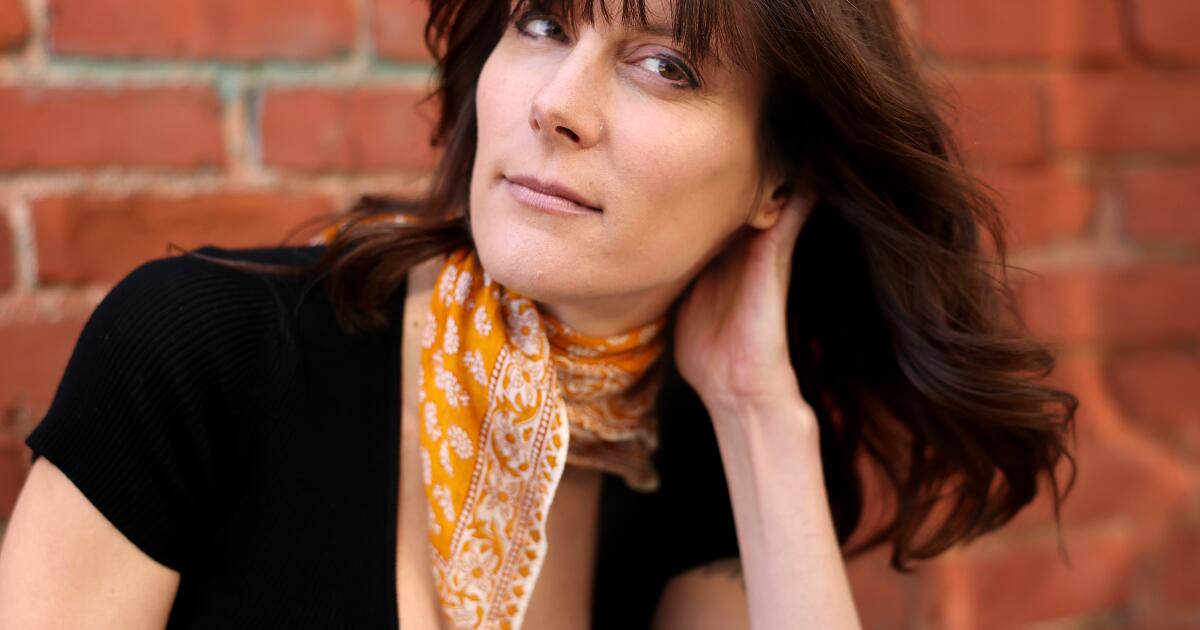
I’m sitting across from an orthodontist, sipping a lukewarm coffee and gliding through typical first-date banter about L.A. traffic. But as this Hinge experiment with his simp-y Harry Styles hair and $200 sweatpants tries to lock eyes with me, I’m still staring just past his shoulder at a fake eucalyptus plant. I am silently praying this passes for eye contact, because I know what’s coming when my gaze meets his. The flinch.
If this term isn’t in your immediate search history, the flinch is an inverse of the male gaze; a jaw-tightening, ball-shriveling squint usually directed at my face. It is a subtle move that says without question: We are not the same.
Because I’m blind, and he isn’t.
My brain crackles with anxiety. Now I’m thinking about all those nice folks with herpes and how they have medication to help keep everything under wraps for a while. Now, I’m longing to have herpes and a vast collection of Valtrex as I down my drink. I need to order another round. Do it — do it now. Before this man notes with absolute certainty that you do not have anything close to the deep brown eyes he thought he saw in your dating profile, before he excuses himself and that second drink never happens.
Dating, in theory, is fun. Meeting a stranger at a cafe covered in hipsters and Moroccan tile, sitting at a too-small table and pretending to be interested in the Americano-length version of someone else’s life, can be total fire. But if you’re me, dating mostly makes you want to haul it outta there like you were in an episode of “The Last of Us.”
Ayla Harrison developed the eye condition retinopathy of prematurity as a newborn.
My face is unfortunate. It is lopsided. My eyes are different sizes and colors. My right eye is lazy, shriveled and blind; it moves like an out-of-control marble circling a drain. My left eye suffers hemorrhages that can cause episodes of total blindness. The reason for my Picasso of a face is because of a retinal disease I snag after my mother goes into labor three months early. She looks that Medicaid doctor right in his very symmetrical face and says through grunts and gritted teeth: “My girl doesn’t like to wait.”
Doctors move me to an ICU and crank my oxygen levels to 100% to keep me stable. Later, a nurse with nicotine stains on her fingernails, tells my parents I have developed retinopathy of prematurity, an eye condition caused by all that one-hundo oxygen. The disease will open me up to a revolving door of vision issues for life.
Then there is rushing. More doctors. A surgeon barely salvages the sight in my left eye, but my right eye can’t be saved. They tell my parents I’ll be blind in that eye forever. A teeny tiny Cyclops. I weigh less than a pound. I am so small the surgeon can place my entire hand on his pinkie nail.
And for a moment, everyone is staring.
The first boy I love has a rat-tail. We’re both 8 years old. To win his affection, on a dare, I decide to eat a cockroach off the ground during recess. Kids point and lose their collective 8-year-old mind, but the attention makes me feel electric. Then he makes direct eye contact with me. I look down; my performance upended in an instant. He’s staring at me like someone asked him to find Waldo and he stops on my mismatched marble-y eyes. The baby fat in his jaw tightens. Then it happens. My first flinch.
I stop going to recess.
At dinner, I mention my eye contact problem to my mother. She nurses her third rum and Diet Coke and says: “Look boys in the eye like you want to steal their wallet.”
By the time I reach high school, I can’t address another person unless my eyes are glued to the floor.
In the teenage dating hierarchy, I am a hard pass. Boys in artfully shredded Abercrombie jeans flinch in a chain reaction of disgust as I pass them in the halls. Cheerleaders corner me and demand to know what is wrong with my eyes. The cheer captain shoves me into a locker. I latch onto her perfect French braids and pull down hard until my knuckles go white. Somewhere JV cheerleaders chant “Fight!” like it is a pep rally.
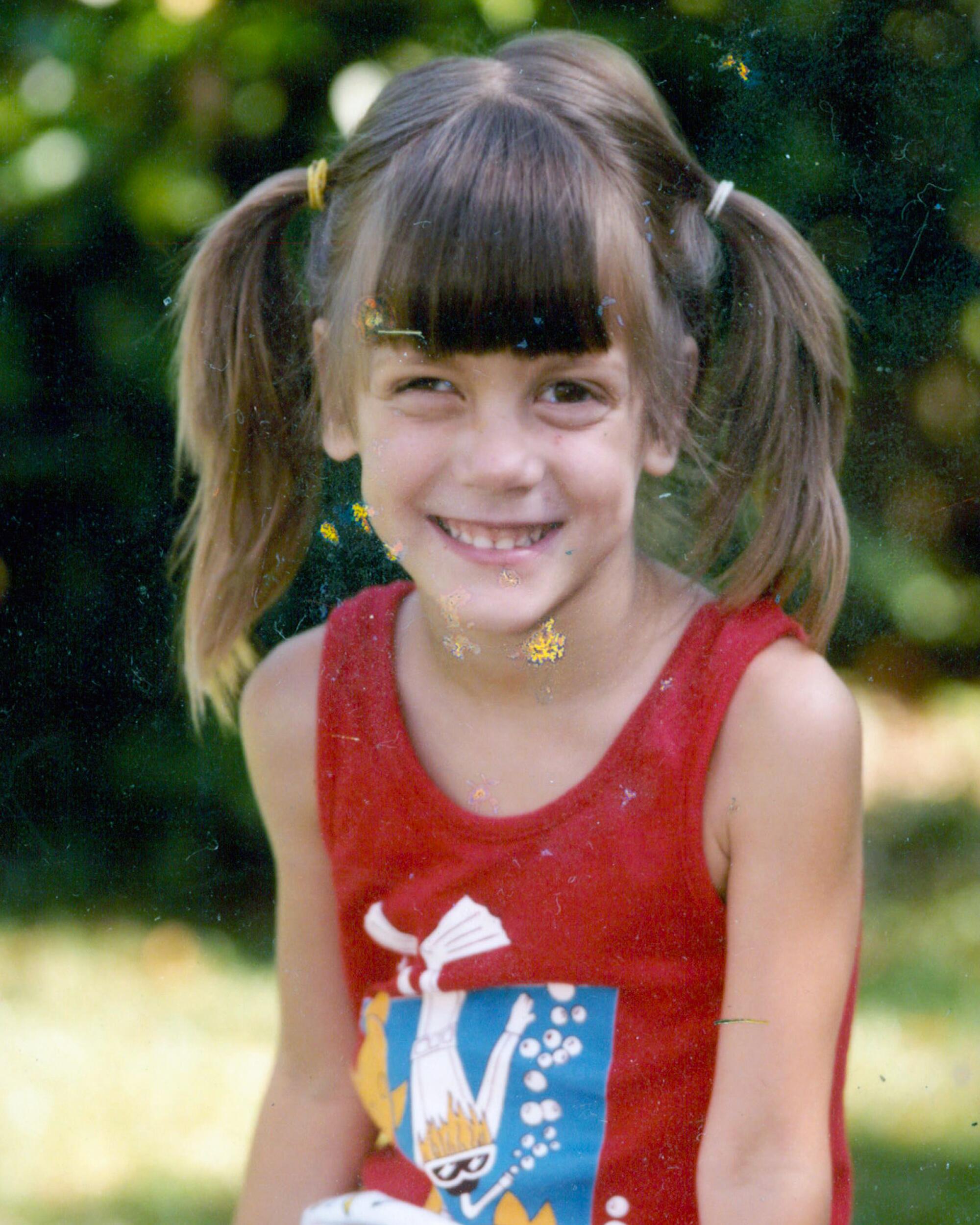
Harrison in a preschool photo.
(Ayla Harrison)
And for a moment, everyone is staring.
I walk home alone with a busted lip and decide teenagers in my small Southern town are just wolves in Adidas track pants.
Years happen. I leave my swampy hometown. Before I go, my childhood eye doctor warns me that I have the eyes of an 80-year-old. I ignore him because I am 22.
I avoid discussing my ROP with anyone, and instead, I diligently plaster my bangs to my forehead to hide my blind eye. It’s a trick I learn working as a waitress at a neon-tinged strip club in some blink-of-an-eye Florida town that pushes all-you-can-eat oysters and lap dances until 3 a.m. I mimic the dance moves of the strippers. Just like the girls swaying onstage in G-strings, I want to feel that burn-a-hole-in-your-pocket desire from men. A dancer, this oiled-up pole ballerina, tells me about a weekend trip she took to L.A. “Life there is like a buzzsaw knocked up a glitter bomb,” she says.
A month later, I move to Santa Monica. I slide into the rip current of L.A. men and let myself fall in love in the time it takes to change a channel. But the relationships either fade or split open like cantaloupe dropped on hot pavement. And then, on one random Wednesday, my left eye hemorrhages and fills with blood. And suddenly, I cannot see.
Again, more doctors — specialists this time. Their offices are in tall towers. And like in many niche areas of medicine, there are silence and bright lights and a lot of nodding. There are lasers and emergency surgeries. Eventually I can see again, but not without a lot of help from a perpetual weekly doctor appointment. I make friends with the 89-year-old nana-and-pop-pop set in the lobby. I am there so often my mother asks if this ophthalmologist gives out a rewards card like at Yogurtland.
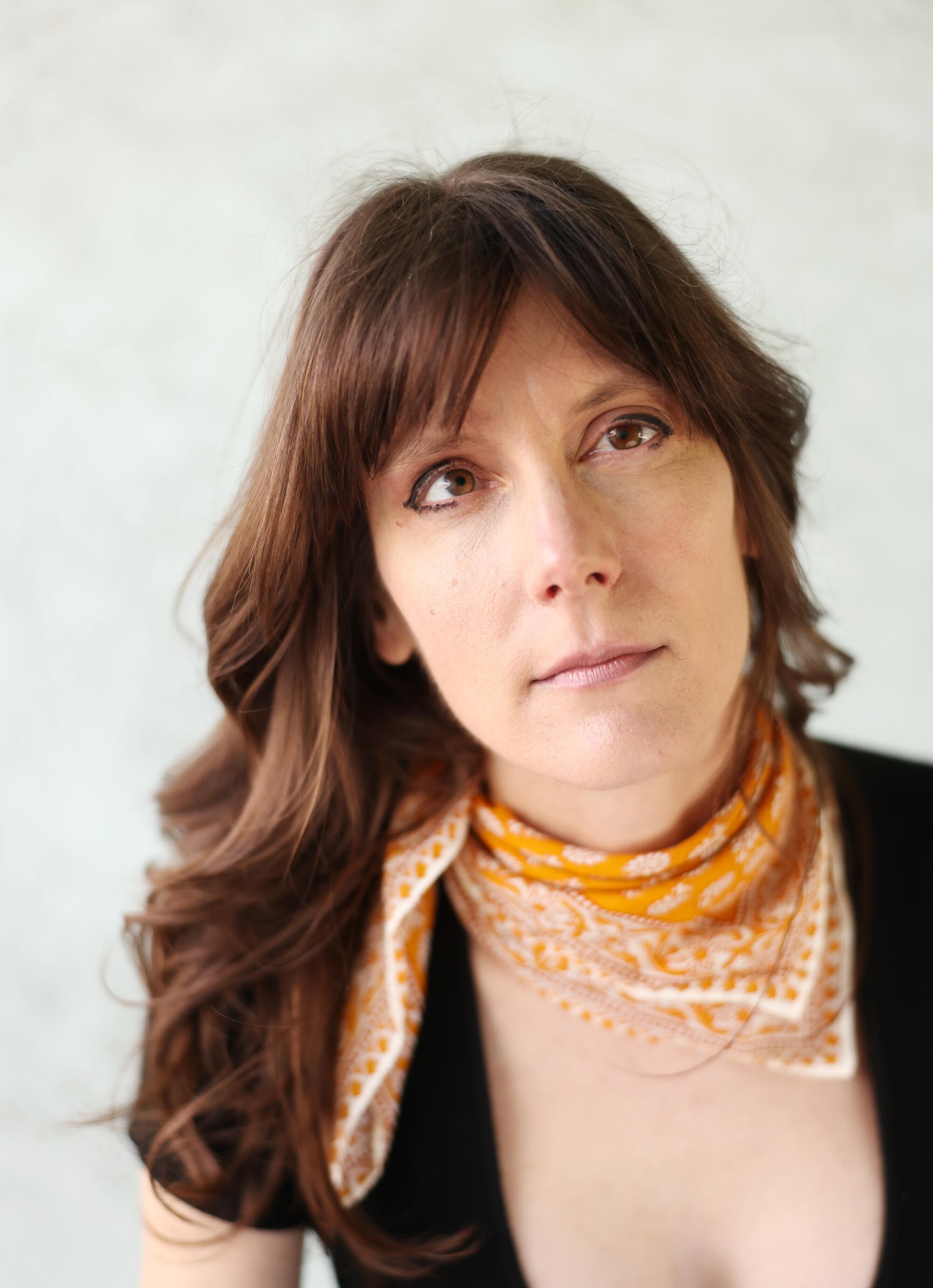
My eyes bleed while I’m in the shower and during yoga. My sight snaps off like a light while I’m at the supermarket. My episodes of blindness go on for months — and still — my mother asks: “When are you going to meet someone? And can you send artisanal doughnuts through the mail?”
This only reminds me of what’s coming: the flinch.
I need a new plan. Or a therapist. Instead, I call my ophthalmologist, a woman I’ve seen so many times I probably fund a fraction of her vacation house.
In the exam room, my ophthalmologist decides to fit me with therapeutic contact lenses. She explains these fancy lenses will protect my diseased eye and — bonus — they will make my eyes appear to be the same color. She finishes her adjustments, offers me a mirror like I’m in a Marvel movie, and waits for applause. I study my blind eye, tucked in its new costume, and opt for a late-night Google question instead: What if I got another procedure done on my eyes?
I suggest more surgeries — cutting-edge surgeries to fix my bad eye and its marble-y wobbling. My doctor pops a trained, reassuring smile and fires off a lecture on the dangers of continuing to rip open my eyes on the regular. The only thing all of those surgeries will do is make my condition worse, she tells me.
Two weeks later, in a different medical tower, I’m meeting with my retinal specialist this time. I hit him with my question about correcting my mismatched eyes. The response is identical — a list of horrors. He pauses to add, “But you are a single woman now. So maybe think about it,” and moves to a new patient without another word.
Tears hit me in a wet burst as my doctor shouts to an 82-year-old in the next room: “How are you doing today?” The door closes behind him.
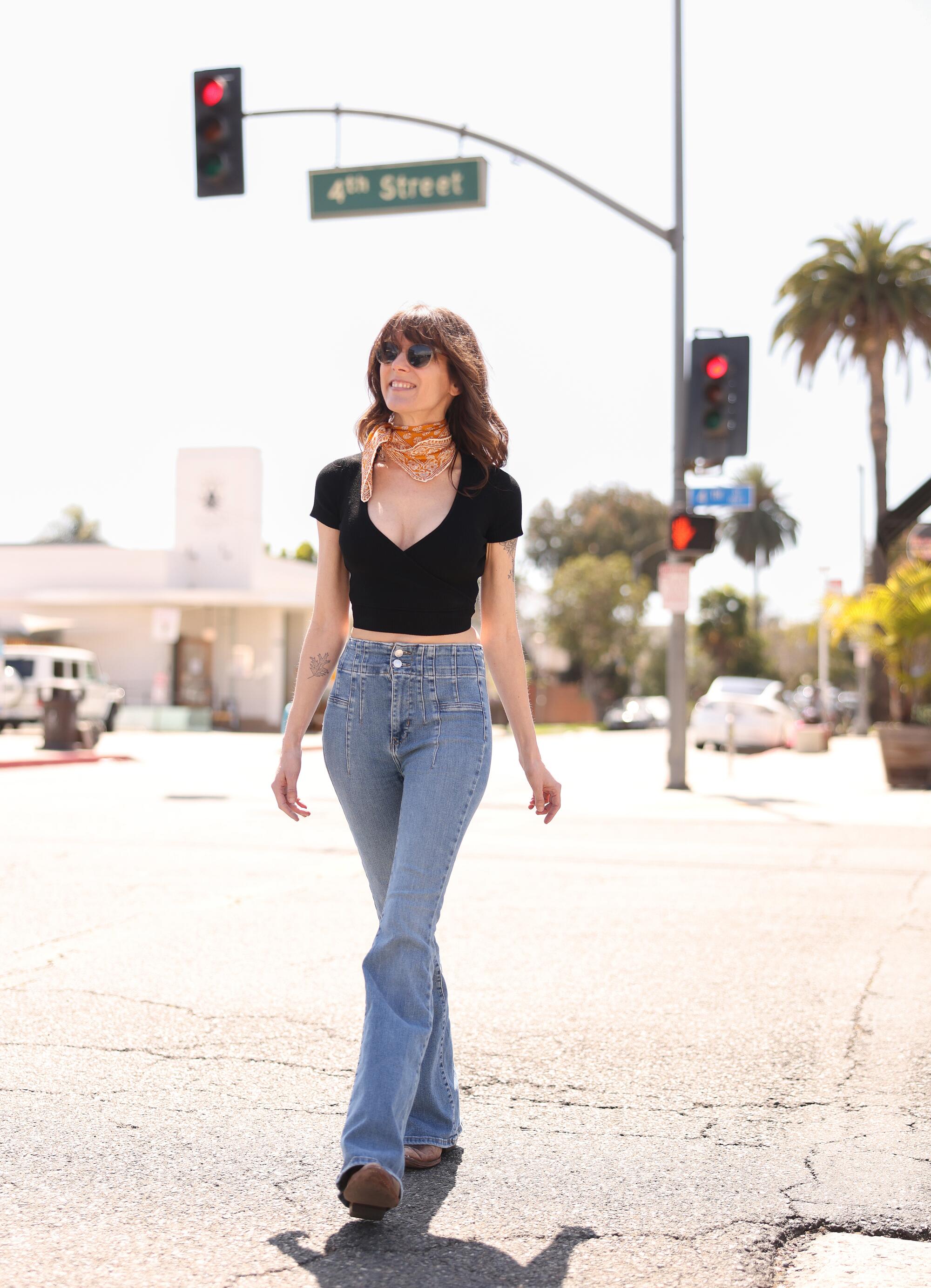
Harrison crosses 4th Street in Long Beach. She went on a date at a nearby Peruvian restaurant with a man who surprised her.
I call my mother between sobs. I manage to say, “I can’t wear this lens.” I stammer on about how the lens is just a fancy bandage; a device to hide the fact that my vision loss is a ticking time bomb just waiting to go off. And who’s going to love that? My mom patiently waits out my sobs. Finally she says, “What sight you have left could go before I finish this sentence, but no one needs to be OK with that except you.”
Then she asks me if I’ve seen Reese Witherspoon do that one dance on TikTok yet.
Weeks later, I go on a date with a man. I sit across from him at a too-small table at a Peruvian restaurant on 4th Street in Long Beach. His voice is a mix of Spanish slang and a SoCal surfer lilt. And I swear he never drops eye contact. Normally this would wreck me. But with my new lens, I feel an odd new confidence. So, I commit first-date seppuku and tell him about my lens and my vision loss. As I talk, my anxiety hijacks my thoughts, and I immediately regret opening my mouth. Because I’m waiting for the flinch — for that lightning-fast jolt of expected pain. And then I realize I am too busy future spiraling to notice that my date is ordering a second round of drinks.
I am too busy to notice that our date is still going.
It goes until ice melts into the dark amber whiskey in our sweaty cocktail glasses. It goes until it is the soft yellow of morning sunlight. It goes until he holds my hand on a crowded street, and I know it’s my turn to look him in the eye. At a crosswalk, I turn my head and stare at this man.
And for a solid three seconds, I have an overwhelming urge to steal his wallet. I smile. Somewhere, my mother is right.
Then he asks, “Can I kiss you?” I nod. He leans in and kisses me right on my diseased little eyes, right in the middle of that crowded street.
And for a moment, everyone is staring.
The author is a playwright and screenwriter based in L.A. She’s on Instagram: @outinthestacks

Lifestyle
Terry Tempest Williams on why women with big ideas get labeled ‘crazy’ : Wild Card with Rachel Martin
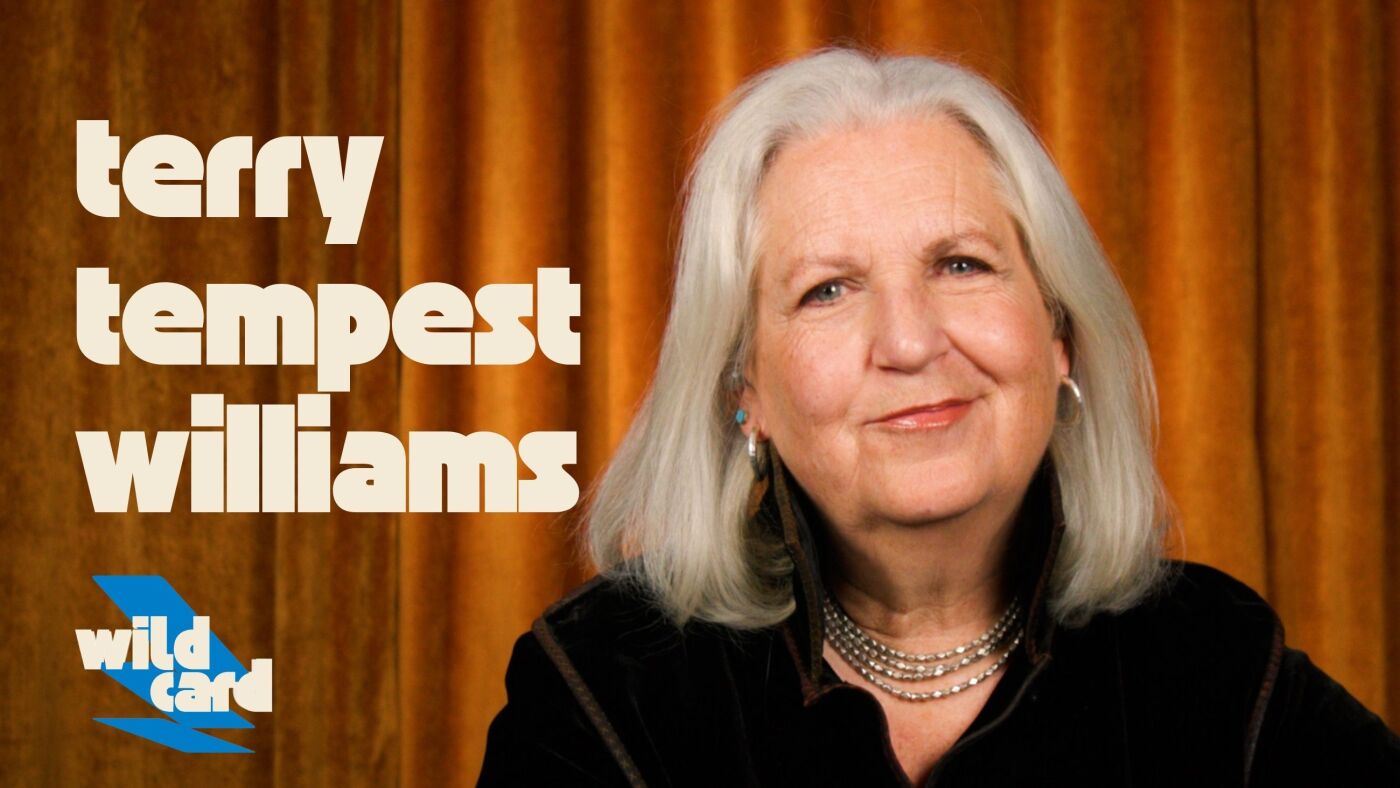
A note from Wild Card host Rachel Martin: I met Terry Tempest Williams about 25 years ago at a writer’s conference in Yosemite Valley. I was a young reporter who was there to do a story about how literature was addressing climate change and she made such a huge impression on me. I had never heard someone talk about the natural world the way Terry did and she had a spiritual depth I hadn’t encountered in my life at that point.
To this day, Terry’s writing always reorients me towards what is good, what is beautiful, and what is true. Her newest book is called “The Glorians.”

For its upcoming Los Angeles venue, experiential art firm Meow Wolf will focus on the art of storytelling, with a specific eye toward skewering our city’s moviemaking magic. To help bring that vision to life, Meow Wolf has entered into a creative partnership with Titmouse, one of L.A.’s most renowned independent animation houses.
The Hollywood-based studio behind popular series such as “Big Mouth” and “Star Trek: Lower Decks” will create animation that will be shown throughout the West L.A. venue, which is on target for a late 2026 opening at the Howard Hughes entertainment complex.
It’s a move that represents a shift for Santa Fe, N.M.-based Meow Wolf. Over the last decade-plus, the art collective has grown beyond its anything-goes, punk-meets-psychedelic roots into an organization with full-scale, maximalist installations in its hometown, Denver, Las Vegas, Houston and the Dallas suburbs. In the past, Meow Wolf kept most of its media in-house.
As part of its larger-than-life participatory art installations, Meow Wolf L.A. will feature a mix of live action and animation, the former filmed by Meow Wolf in its Santa Fe studio. Meow Wolf’s James Stephenson, a senior VP with the company and its creative director of emerging media, said the degree to which the L.A. exhibition will lean into various animation styles necessitated an outside partner. Titmouse’s work, in development by a number of directors with contrasting tones, will be shown on a variety of formats, ranging from cinema screens to full-room projections.
“I really believe in animation as an art form, and I know the Titmouse folks do too,” Stephenson says. “Animation is made by artists. It’s made by artists with their own hands. It’s something that is still very rooted in craft.”
Meow Wolf’s L.A. space is set in a former cinema complex, and will champion its location, taking guests on a journey through a converted movie house and beyond, into a sci-fi-inspired fantasyland with sentient spaceships and a 30-foot-tall mushroom tower. Meow Wolf creatives have spoken of the fantastical movie theater as one that will feature animated, self-aware candy before attendees enter the main exhibition space, making Titmouse’s work some of the first art guests will encounter. Titmouse co-founder Chris Prynoski has said the studio has lined up at least six directors for the exhibit.
An in-progress art installation destined for Meow Wolf L.A. at the art collective’s Santa Fe, N.M., headquarters. The L.A. exhibition will feature animation from Titmouse.
(Gabriela Campos / For The Times)
Titmouse, says Stephenson, is the right partner because “they’re known less for a house style, and more for a house vibe.” Over the years, Titmouse has been behind such diverse shows as “Scavengers Reign,” owning a Jean Giraud influence rooted in French and Spanish surrealism, the lively “Jentry Chau vs. the Underworld,” with an unique color palette that took inspiration from anime and Chinese mythology, the exaggerated comic book feel of Adult Swim’s “Metalocalypse,” and the approachable yet expressive tone of “Star Trek: Lower Decks.”
“Meow Wolf’s vibe is similar to Titmouse’s vibe,” Stephenson says. “It’s artist-first, artist-driven, independent and kinda edgy. They are always trying to find the edge of what’s possible. They try to see how far they can go, and it’s done for fun and in the spirit of taking risks.”
Prynoski says working with Meow Wolf will give Titmouse a sense of artistic freedom it doesn’t always have when delivering content for more traditional Hollywood partners. He says the multi-director approach is a callback to the early days of Warner Bros. Animation, when individual creators put their own stamp on Looney Tunes material.
“I use Bugs Bunny as an example,” Prynoski says. “You’ve got a Friz Freleng Bugs Bunny short. You’ve got a Chuck Jones Bugs Bunny short. You’ve got a Tex Avery Bugs Bunny short. They’re all different versions of Bugs Bunny, and people who are really paying attention can tell which director directed each one. Even though to the layman, these are all Bugs Bunny, but if you lined them up, they are drawing in different styles, sensibilities and techniques.”
Prynoski says that was a centerpiece of his pitch to Meow Wolf, noting that characters will reappear in multiple installations, each handled by a different artist. Meow Wolf L.A., in fact, will be the firm’s most character-driven exhibition, as guests will follow the storylines of three main protagonists throughout the space.
In announcing the partnership, Meow Wolf and Titmouse released an image from an animated work directed by Luca Vitale. It features a key character having a moment with a hummingbird and it’s done in an elegant, slightly anime-influenced style. It’s an image full of movement, reflecting a character in transition with inviting pastels and bold dashes.
“I like that image because I think it captures some of the sense of wonder that we want people to feel,” Stephenson says. “The character is having an encounter with the elusive nature of creativity and reality in a way that makes them have a different perspective of what’s possible.”
Other contributing animation directors to Meow Wolf L.A. include Space Dawg, Felix Colgrave, Alexander Vanderplank and Phimémon Martin, and Jun Ioneda.
Titmouse’s partnership with Meow Wolf will extend beyond the L.A. exhibition. The two will be working on the development of Meow Wolf New York, which is slated to open some time after Los Angeles, and are collaborating on a planned animated series, which Prynoski is spearheading.
Meow Wolf exhibits are the result of sometimes hundreds of disparate artists coming together in a shared space. Distilling that into a signature, singular style for a series could be a challenge. Stephenson pinpoints some guiding principles.
“You really need to feel the hand of the artist,” he says. “You need to feel a DIY aesthetic. You need to feel the materiality. Those are very specific to what we are.”

The Kennedy Center on June 28, with its facade signage still covered by a tarp and scaffolding.
Alex Wroblewski/AFP via Getty Images
hide caption
toggle caption
Alex Wroblewski/AFP via Getty Images
On Wednesday, a federal appeals court denied President Trump’s request to stop the removal of his name from Washington, D.C.’s Kennedy Center. The signage on the building has been covered with tarp and scaffolding since June 13, but in a court filing last month, the center’s current executive director said that Trump’s name has been removed.
In their decision, three judges from the U.S. District Court of Appeals for the District of Columbia Circuit said that the president had failed to prove that the arts center would be “irreparably injured” without Trump’s name attached to it.
NPR requested comment from the Kennedy Center, but did not receive an immediate reply.
This latest round of court decisions is part of the ongoing litigation filed by Rep. Joyce Beatty, D-Ohio, against President Trump and the board of the Kennedy Center. In a statement emailed Wednesday to NPR, Beatty said: “Today’s ruling again affirms that this administration’s efforts to rename the Kennedy Center were unlawful. His name no longer desecrates this sacred memorial, which belongs to the American people. Now it is time for the Trump administration to accept this, comply with the law, and take the tarps down.”
In previous court filings, Trump’s legal team had asserted that removing the president’s name from the arts complex, both on the physical building and in its digital materials, would inflict irreparable harm in both time and money already spent. In the denial, the three judges — Patricia Millett, Robert Wilkins and Gregory Katsas — wrote that since Trump’s name has already been removed, “a stay would not avert those harms.”
Furthermore, Trump had claimed that without his name attached, future fundraising would be threatened “and [will] contribute to the financial decline of the Center.” In response, the appeals judges wrote: “Appellants, however, have failed to support this assertion with any specific facts or evidence. They offer only the conclusory assertions of the Kennedy Center’s Executive Director that were made in a factually unsupported declaration.” The center’s current executive director, Matt Floca, specializes in physical plant management.
The presiding judge in the case, Christopher R. Cooper, has ordered that the center provide him a status report on the center’s operation and programming before the end of this month. As of Wednesday, the center’s calendar lists a small roster of programs, including outdoor free movie screenings, workshops for children, and five free live performances in July on its Millennium Stage. In the past, the Kennedy Center presented over 2,000 arts and education events each year, including free daily Millennium Stage performances.

-

 New Mexico6 minutes ago
Hidden gem in Cloudcroft, New Mexico has best BBQ in US
-

 North Carolina9 minutes ago
North Carolina Airport Looks to Expand Commercial Service | AirlineGeeks.com
-

 North Dakota14 minutes ago
San Francisco plots risky socialist bank modeled after controversial experiment
-

 Ohio21 minutes ago
Feeling itchy? Ohio leads nation with 6 cities on Orkin’s 2026 bed bug list
-

 Oklahoma24 minutes ago
Oklahoma’s Brent Venables named to 2026 Dodd Trophy Preseason watch list
-

 Oregon29 minutes ago
Ryan Reynolds-backed Aviation Gin shutters Oregon distillery
-

 Pennsylvania36 minutes ago
PA state rep. wants to force the York State Fair to change its name
-

 Rhode Island39 minutes ago
R.I. leading multi-state lawsuit against Trump administration housing policy – The Boston Globe

