Politics
Opinion: Trump 2.0 would be a disaster for the climate

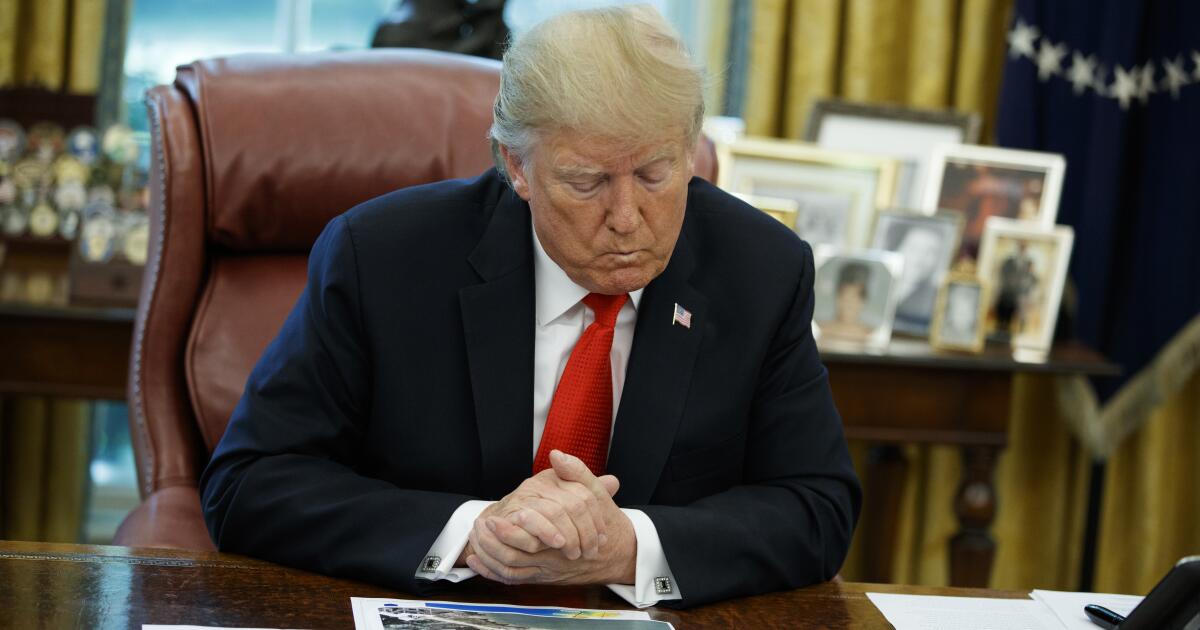
During Donald Trump’s first term as president we witnessed his administration’s efforts to curtail domestic environmental regulations and the United States’ withdrawal from the Paris climate agreement. But few people appreciate just how much worse and deeper the damage to environmentalist goals is likely to run should he win a second term.
The Trump administration was very friendly to oil and gas business interests, unleashing a regulatory rollback of long-standing restrictions on fossil fuel extraction and consumption. In addition to scrubbing all references to climate change from the White House and Environmental Protection Agency websites, it reversed an Obama-era ban on new oil and gas drilling in the Arctic National Wildlife Refuge and elsewhere. Trump also revoked safety regulations adopted after the Deepwater Horizon oil spill. (Both these efforts were later stopped or slowed in the courts.)
The first Trump administration also halted rules limiting air and water pollution. His EPA overturned bans on various pesticides, even when the agency’s own research demonstrated their harmfulness. Curtailment of air quality regulations between 2016 and 2018 resulted in a 5.5% increase in fine particulate air pollution, reversing the 25% decline that had taken place under Obama.
As bad as all this was for the environment, in a second Trump term the changes won’t just be related to policy. Trump’s loyalists will aim for wholesale institutional destruction of environmental regulatory capacity, not just suspending Biden-era funding for green infrastructure.
In other words, the goal won’t be to just change a policy here or there, but to fundamentally cripple the ability of environmental regulatory agencies to perform their designated functions to such an extent that if a later administration wished to impose stricter standards, officials would find it impossible to do so. The recent ruling by the Supreme Court overturning Chevron U.S.A. vs. Natural Resources Defense Council, which invalidated judicial deference to agency regulatory decisions, will only make this easier.
A series of tabletop scenario simulations run in May and June by the Brennan Center for Justice, a nonpartisan, pro-democracy research center based at New York University, made it clear that a second Trump administration is likely to aim at root and branch destruction of agency power in a variety of respects. The first step will be to revivify “Schedule F,” an executive order from October 2020 that removed protections for civil servants perceived as disloyal to the president, and use it to reclassify tens of thousands of such workers as political appointments. Then the administration will fire them and replace them with anti-regulator or industry cronies. Agencies’ legal offices and inspectors general, whose role is to prevent the implementation of unlawful orders and to root out corruption, will likely be among the first targets. The result will be systematic evisceration of the expertise, institutional memory and guardrails against malfeasance within these agencies.
In addition to going after employees at environmental agencies, the Trump administration will also seek to suspend research that provides evidence in support of environmental regulation, such as greenhouse gas emission monitoring conducted by the National Oceanic and Atmospheric Administration, which in addition to providing weather forecasts is one of the main climate change research entities within the federal government. If Trump cannot convince Congress to defund certain agencies, he may order them moved to remote corners of the country to push its employees to quit. Destroying the agencies will ensure that if Trump is ever replaced by a more environmentally friendly president, the new administration will be unable to reimpose sensible environmental regulation because the administrative capacity to do so will no longer exist.
The courts, now packed with Trump appointees, are unlikely to protect against such efforts as they did during his first term, when the judges were still mainly Obama and Clinton appointees. Litigation is anticipated to be very limited in its capacity to do more than slow down a second Trump administration, which is likely to be far more focused and strategic than the first one. (As one person in the Brennan Center simulations put it: “This time they’re going to know where the door handles are.”)
Finally, a second Trump administration will almost certainly pull back from international efforts that are essential to biodiversity preservation, greenhouse gas emissions mitigation, oceanic plastic abatement and space junk prevention. Even Trump’s ambition to set up trade barriers to protect American industrialists from foreign competition is likely to be destructive, because it will slow the global rollout of new technologies capable of addressing environmental concerns, such as solar panels and electric vehicles, if they happen to be produced in China or elsewhere overseas.
For Trump’s “America First” supporters that might sound like a feature rather than a bug. But four years of institutional vandalism would end American leadership on the world stage. The credibility built up since World War I would vanish as the world’s largest economy ignores the world’s largest problems.
Nils Gilman is the executive vice president of the Berggruen Institute.

Construction workers unfurled a large printed tarp to cover scaffolding installed at the White House’s front entrance. Doug Burgum, the interior secretary, said President Trump had ordered the repairs after noticing damage to columns.
Politics
WATCH: Trump’s Energy chief reveals what escalating Iran tensions could mean for gas prices

NEWYou can now listen to Fox News articles!
Energy Secretary Chris Wright is telling Americans not to be concerned about the possibility of another surge of sharp increases in gasoline prices as tensions with Iran have started to escalate once again.
Asked whether Americans should worry about higher prices at the pump and how the Trump administration is preparing to keep the economy stable if the conflict continues to worsen, Wright told Fox News Digital: “It has not been any good behavior from Iran that’s allowed oil to flow. It’s been the United States military.”
“That’s not changing,” he assured, speaking from the Great American State Fair on the National Mall this week.
US CLAWS BACK KEY CONCESSION TO IRAN AFTER FRESH ATTACKS ON COMMERCIAL SHIPS IN STRAIT OF HORMUZ
(Mario Tama/Getty Images) (Mario Tama/Getty Images)
With Iran striking three commercial vessels transiting the Strait of Hormuz on Monday and Tuesday, Wright doubled down in urging citizens to not credit Iran for the U.S. military’s work to ensure oil shipments continue flowing through the strait.
“Look, the U.S. Military has been the key asset here,” he said. “They have assured the flow of oil and gas through the Strait of Hormuz throughout. Not at the beginning of this conflict, but through the last six weeks.”
Wright said the administration is closely monitoring global oil supplies as the tentative ceasefire with Iran seemingly came to come to a halt, with President Donald Trump telling Secretary-General Mark Rutte the call for peace with Iran is “over” at the NATO Summit in Turkey on Wednesday.
But, he pointed to the continued shipping through the Strait as evidence that markets should remain stable.
TRUMP SAYS IRAN CEASEFIRE IS ‘OVER’ AFTER IRANIAN ATTACKS TRIGGER MASSIVE US RESPONSE
President Donald Trump speaks at the White House on Tuesday, April 22. (AP/Alex Brandon)
“We’re of course constantly watching the supply of oil, the supply of refined products and what’s going on there,” Wright said. “And I think still all positive trends.”
Beyond geopolitical concerns, Wright also praised the new chain of discounted gas stations across Pennsylvania and New Jersey, Freedom Fuel, which promises customers prices below the national average.
The Trump administration, though not involved with the network, has heavily endorsed the new chain and its 25 locations.
“We love it,” Wright said when asked about Freedom Fuel. “I mean, look, any mechanism we can to lower energy costs for Americans of all kinds, we’re all in on.”
“With Freedom Fuels, they’re just lowering it down to their wholesale price of gasoline,” Wright said. “So they’re not making any money selling gasoline, but they’ve got convenience stores. That’s how most gas stations make money.”
NEWSOM UNDER FIRE AS CALIFORNIA GAS TAX HIKE SENDS PUMP PRICES EVEN HIGHER
Gasoline costs are a known concern for many Americans, and amid surging prices there has been a considerable increase in those opting to purchase electric vehicles to save money long-term at the pump — with Tesla dominating the market for these types of models.
Wright argued one of the benefits to living in America is having the option to choose what type of vehicle you drive.
CLICK HERE TO DOWNLOAD THE FOX NEWS APP
“We just want people to buy what they would prefer,” he told Fox News Digital when asked his thoughts on increasing calls for support of the electrification of cars. “Consumer choice — you wanna buy an electric car, you wanna buy a gas powered car, diesel powered car, buy a big truck. That’s the choice.”
“That’s why you live in America. You get the choice of all those.”

In 2023, California regulators levied more than $100,000 in fines against the private operator of a federal immigration facility, kicking off a three-year battle over whether detainees who do work at the facilities should be considered employees.
The question went beyond semantics: If considered employees, the detainees would be subject to state worker protection laws.
A legal settlement announced this week now affirms that private immigrant detention facilities are subject to California’s workplace safety and health requirements.
“Every worker deserves a safe and healthy workplace and should be able to report workplace hazards without fear of retaliation,” said Denisse Gómez, spokesperson for the California Division of Occupational Safety and Health or Cal/OSHA.
“Individuals who perform work in these facilities are entitled to workplace safety protections, and this settlement reinforces Cal/OSHA’s commitment to enforcing those protections and safeguarding vulnerable workers,” she added.
Under the settlement between California and the GEO Group, a Florida-based private prison company, the company recently withdrew its legal challenges and agreed to pay more than $100,000 in the fines.
The GEO Group did not respond to requests for comment.
Back in 2023, Cal/OSHA issued $104,510 in fines against the GEO Group. The agency had found six violations of state code by the company after detainees complained about a lack of protective equipment and proper training while cleaning the facility for $1 per day.
Detainees alleged they routinely wiped black mold off shower walls at the facility, saw black dust spew from air vents and used cleaning solutions that lacked instructions during the COVID-19 pandemic.
The biggest fine levied against the GEO Group was for failure to establish and maintain “effective written procedures to reduce employee risk of exposure to aerosol transmissible disease.”
Advocates viewed Cal/OSHA’S recognition of the detainees as workers as a victory that could pave the way for future labor rights fights at other detention centers in the state.
But the GEO Group appealed, arguing that detainees participating in ICE’s voluntary work program make their own schedules and aren’t employees, so hazard exposure couldn’t be “as a result of assigned duties,” as California law states. Plus, the company argued, there wasn’t enough evidence that detainees were exposed to any hazard.
Early last year, the state’s Occupational Safety and Health Appeals Board rejected the GEO Group’s argument and found that detainees should be considered “affected employees.”
The GEO Group sued, but three days before a California Superior Court hearing in May, the company and Cal/OSHA reached the settlement.
Along with paying the fines, the GEO Group agreed to draft plans for avoiding aerosol transmissions at 12 secure and reentry facilities in California, including five detention centers that hold immigrants.
“GEO ensures detainees are afforded the necessary tools, equipment, and personal protective equipment … to safely and effectively perform any necessary tasks,” the settlement states.
Gómez said the settlement also leaves intact the appeals board’s ruling that civil immigration detainees who participate in work programs can participate in proceedings anonymously, “acknowledging the potential for retaliation when individuals raise workplace safety concerns.”
But the question of whether detainees are employees and deserve certain protections isn’t entirely resolved — at least not for the federal government.
Last month, U.S. Immigration and Customs Enforcement released new standards for detention facilities across the country. The revised guidelines “emphasize that detainee volunteers participating in the voluntary work program are not considered facility and/or government employees” and thus not entitled to labor regulations.
Attorney Mariel Villarreal said the timing of the new detention standards made her question whether the GEO Group had asked ICE to specify in its standards that detainees are not workers in response to its battle with Cal/OSHA.
“To me, it’s a reaction to this very settlement,” she said. Villarreal works for the California Collaborative for Immigrant Justice, which filed the original complaint on behalf of detainees who said they worked in unsafe conditions.
Villarreal pointed to a Washington Post report that GEO Group executives privately asked ICE to specify that detainees are not employees of the facilities where they work. Two top Trump administration officials, border czar Tom Homan and acting ICE director David Venturella, previously worked for the GEO Group.
New versions of ICE detention standards take effect as contracts are established or modified, so this year’s rules won’t immediately apply to every facility.
An ICE spokesperson did not comment about the settlement. The spokesperson, who did not provide their name in an emailed statement Wednesday, said the agency has begun transitioning detention facilities to meet the 2026 standards, “building on its longstanding commitment to safe, secure, and professional detention operations.”
“ICE has consistently implemented many of these best practices independently, reinforcing its role as the leader in detention operations,” the spokesperson added.
The GEO Group and other immigrant detention center operators have faced other legal battles over workers’ rights, including lawsuits in Washington, Colorado and California over the $1-per-day payment.
Villarreal said she’s confident that the Cal/OSHA settlement would continue to hold even if California facilities incorporated the new standards. But she said she believes the statements are an attempt by the GEO Group to “sidestep responsibility” and avoid the possibility of being fined under similar circumstances in other states.
“These statements in the new standards are a way for them to try and preserve profits as much as possible,” she said. “GEO and ICE are so intertwined at this point that they have the same motives.”
-

 Kentucky2 minutes ago
Affordable Care Act rates rate hikes could strain Kentucky families, WKAS warns
-

 Louisiana7 minutes ago
Moncus Park gets helping hand from 260 youth volunteers across Louisiana
-

 Maine14 minutes ago
Maine’s high court keeps transgender athlete referendum off 2026 ballot
-

 Maryland17 minutes ago
MD woman sentenced to 2 years, $6.8M restitution in multi-million-dollar laundering scheme
-

 Michigan29 minutes ago
Harmful algal blooms reported on 2 large West Michigan lakes
-

 Massachusetts32 minutes ago
Insider tips for navigating the Brimfield Antique Flea Market
-

 Minnesota37 minutes ago
Northwest Minnesota Foundation awarded $200,000 for child care economic development
-

 Mississippi44 minutes ago
Family of Mississippi teen Nolan Wells demand investigation into son’s death

