Business
Column: 99 years after the Scopes 'monkey trial,' religious fundamentalism still infects our schools

Almost a century has passed since a Tennessee schoolteacher was found guilty of teaching evolution to his students. We’ve come a long way since that happened on July 21, 1925. Haven’t we?
No, not really.
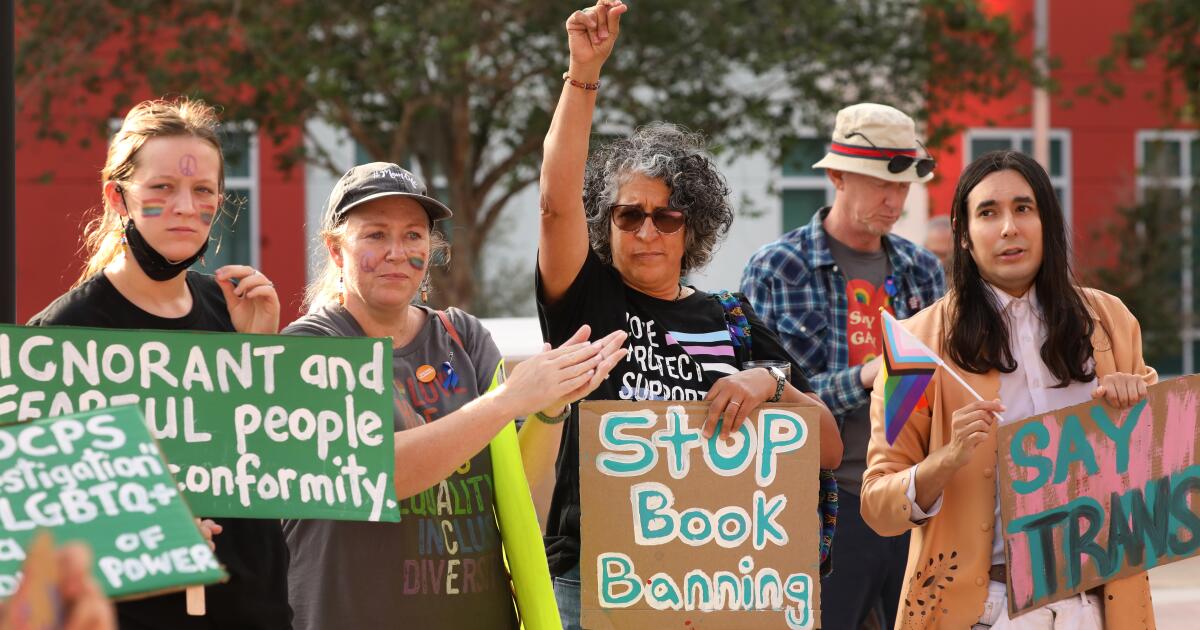
The Christian fundamentalism that begat the state law that John Scopes violated has not gone away. It regularly resurfaces in American politics, including today, when efforts to ban or dilute the teaching of evolution and other scientific concepts are part and parcel of a nationwide book-banning campaign, augmented by an effort to whitewash the teaching of American history.
I knew that education was in danger from the source that has always hampered it—religious fanaticism.
— Clarence Darrow, on why he took on the defense of John Scopes at the ‘monkey trial’
The trial in Dayton, Tenn., that supposedly placed evolution in the dock is seen as a touchstone of the recurrent battle between science and revelation. It is and it isn’t. But the battle is very real.
Let’s take a look.
The Scopes trial was one of the first, if not the very first, to be dubbed “the trial of the century.”
And why not? It pitted the fundamentalist William Jennings Bryan — three-time Democratic presidential candidate, former congressman and secretary of State, once labeled “the great commoner” for his faith in the judgment of ordinary people, but at 65 showing the effects of age — against Clarence Darrow, the most storied defense counsel of his time.
The case has retained its hold on the popular imagination chiefly thanks to “Inherit the Wind,” an inescapably dramatic reconstruction — actually a caricature — of the trial that premiered in 1955, when the play was written as a hooded critique of McCarthyism.
Most people probably know it from the 1960 film version, which starred Frederic March, Spencer Tracy and Gene Kelly as the characters meant to portray Bryan, Darrow and H.L. Mencken, the acerbic Baltimore newspaperman whose coverage of the trial is a genuine landmark of American journalism.
What all this means is that the actual case has become encrusted by myth over the ensuing decades.
One persistent myth is that the anti-evolution law and the trial arose from a focused groundswell of religious fanaticism in Tennessee. In fact, they could be said to have occurred — to repurpose a phrase usually employed to describe how Britain acquired her empire — in “a fit of absence of mind.”
The Legislature passed the measure idly as a meaningless gift to its drafter, John W. Butler, a lay preacher who hadn’t passed any other bill. (The bill “did not amount to a row of pins; let him have it,” a legislator commented, according to Ray Ginger’s definitive 1958 book about the case, “Six Days or Forever?”)
No one bothered to organize an opposition. There was no legislative debate. The lawmakers assumed that Gov. Austin Peay would simply veto the bill. The president of the University of Tennessee disdained it, but kept mum because he didn’t want the issue to complicate a plan for university funding then before the Legislature.
Peay signed the bill, asserting that it was an innocuous law that wouldn’t interfere with anything being taught in the state’s schools. The law “probably … will never be applied,” he said. Bryan, who approved of the law as a symbolic statement of religious principle, had advised legislators to leave out any penalty for violation, lest it be declared unconstitutional.
The lawmakers, however, made it a misdemeanor punishable by a fine for any teacher in the public schools “to teach any theory that denies the story of the Divine Creation of man as taught in the Bible, and to teach instead that man had descended from a lower order of animal.”
Scopes’ arrest and trial proceeded in similarly desultory manner. Scopes, a school football coach and science teacher filling in for an ailing biology teacher, assigned the students to read a textbook that included evolution. He wasn’t a local and didn’t intend to set down roots in Dayton, but his parents were socialists and agnostics, so when a local group sought to bring a test case, he agreed to be the defendant.
The play and movie of “Inherit the Wind” portray the townspeople as religious fanatics, except for a couple of courageous individuals. In fact, they were models of tolerance. Even Mencken, who came to Dayton expecting to find a squalid backwater, instead discovered “a country town full of charm and even beauty.”
Dayton’s civic boosters paid little attention to the profound issues ostensibly at play in the courthouse; they saw the trial as a sort of economic development project, a tool for attracting new residents and businesses to compete with the big city nearby, Chattanooga. They couldn’t have been happier when Bryan signed on as the chief prosecutor and a local group solicited Darrow for the defense.
“I knew that education was in danger from the source that has always hampered it — religious fanaticism,” Darrow wrote in his autobiography. “My only object was to focus the attention of the country on the programme of Mr. Bryan and the other fundamentalists in America.” He wasn’t blind to how the case was being presented in the press: “As a farce instead of a tragedy.” But he judged the press publicity to be priceless.
The press and and the local establishment had diametrically opposed visions of what the trial was about. The former saw it as a fight to protect from rubes the theory of evolution, specifically that humans descended from lower orders of primate, hence the enduring nickname of the “monkey trial.” For the judge and jury, it was about a defendant’s violation of a law written in plain English.
The trial’s elevated position in American culture derives from two sources: Mencken’s coverage for the Baltimore Sun, and “Inherit the Wind.” Notwithstanding his praise for Dayton’s “charm,” Mencken scorned its residents as “yokels,” “morons” and “ignoramuses,” trapped by their “simian imbecility” into swallowing Bryan’s “theologic bilge.”
The play and movie turned a couple of courtroom exchanges into moments of high drama, notably Darrow’s calling Bryan to the witness stand to testify to the truth of the Bible, and Bryan’s humiliation at his hands.
In truth, that exchange was a late-innings sideshow of no significance to the case. Scopes was plainly guilty of violating the law and his conviction preordained. But it was overturned on a technicality (the judge had fined him $100, more than was authorized by state law), leaving nothing for the pro-evolution camp to bring to an appellate court. The whole thing fizzled away.
The idea that despite Scopes’ conviction, the trial was a defeat for fundamentalism, lived on. Scopes was one of its adherents. “I believe that the Dayton trial marked the beginning of the decline of fundamentalism,” he said in a 1965 interview. “I feel that restrictive legislation on academic freedom is forever a thing of the past, … that the Dayton trial had some part in bringing to birth this new era.”
That was untrue then, or now. When the late biologist and science historian Stephen Jay Gould quoted that interview in a 1981 essay, fundamentalist politics were again on the rise. Gould observed that Jerry Falwell had taken up the mountebank’s mission of William Jennings Bryan.
It was harder then to exclude evolution from the class curriculum entirely, Gould wrote, but its enemies had turned to demanding “‘equal time’ for evolution and for old-time religion masquerading under the self-contradictory title of ‘scientific creationism.’”
For the evangelical right, Gould noted, “creationism is a mere stalking horse … in a political program that would ban abortion, erase the political and social gains of women … and reinstitute all the jingoism and distrust of learning that prepares a nation for demagoguery.”
And here we are again. Measures banning the teaching of evolution outright have not lately been passed or introduced at the state level. But those that advocate teaching the “strengths and weaknesses” of scientific hypotheses are common — language that seems innocuous, but that educators know opens the door to undermining pupils’ understanding of science.
In some red states, legislators have tried to bootstrap regulations aimed at narrowing scientific teaching onto laws suppressing discussions of race and gender in the classrooms and stripping books touching those topics from school libraries and public libraries.
The most ringing rejection of creationism as a public school topic was sounded in 2005 by a federal judge in Pennsylvania, who ruled that “intelligent design” — creationism by another name — “cannot uncouple itself from its creationist, and thus religious, antecedents” and therefore is unconstitutional as a topic in public schools. Yet only last year, a bill to allow “intelligent design” to be taught in the state’s public schools was overwhelmingly passed by the state Senate. (It died in a House committee.)
Oklahoma’s reactionary state superintendent of education, Ryan Walters, recently mandated that the Bible should be taught in all K-12 schools, and that a physical copy be present in every classroom, along with the Ten Commandments, the Declaration of Independence and the Constitution. “These documents are mandatory for the holistic education of students in Oklahoma,” he ordered.
It’s clear that these sorts of policies are broadly unpopular across much of the nation: In last year’s state and local elections, ibook-banners and other candidates preaching a distorted vision of “parents’ rights” to undermine educational standards were soundly defeated.
That doesn’t seem to matter to the culture warriors who have expanded their attacks on race and gender teaching to science itself. They’re playing a long game. They conceal their intentions with vague language in laws that force teachers to question whether something they say in class will bring prosecutors to the schoolhouse door.
Gould detected the subtext of these campaigns. So did Mencken, who had Bryan’s number. Crushed by his losses in three presidential campaigns in 1896, 1900 and 1908, Mencken wrote, Bryan had launched a new campaign of cheap religiosity.
“This old buzzard,” Mencken wrote, “having failed to raise the mob against its rulers, now prepares to raise it against its teachers.” Bryan understood instinctively that the way to turn American society from a democracy to a theocracy was to start by destroying its schools. His heirs, right up to the present day, know it too.

Business
Commentary: Puncturing the myth of Alan Greenspan, whose policies gave us the Great Recession

Noah Cross, the archvillain of the movie “Chinatown,” had the definitive line on how old age brings respectability. “‘Course I’m respectable,” he tells Jake Gittes. “I’m old. Politicians, ugly buildings and whores all get respectable if they last long enough.”
I wouldn’t necessarily slot former Federal Reserve Chairman Alan Greenspan into any of those categories, but the general reaction to his death Monday at age 100 puts the lie to Cross’ observation.
As much as he was revered during his nearly two decades as Fed chairman for protecting the stock market from a series of crashes and near-crashes, his obituaries take a more measured view. The headline on the Wall Street Journal’s main take on his legacy is: “The Myth of Alan Greenspan as ‘The Maestro.’”
Stripped of its academic jargon, the welfare state is nothing more than a mechanism by which governments confiscate the wealth of the productive members of a society to support a wide variety of welfare schemes.
— Alan Greenspan, writing as an Ayn Rand cultist (1966)
The Journal blames Greenspan for fostering “the great credit mania of the mid-2000s” and observes that “the music stopped in 2008, producing the panic that did so much harm to the free-market economy that Greenspan promoted.” That was the Great Recession, which started with the 2008 crash in the housing market and persisted into 2012.
That is from a publication that was more or less in accord with Greenspan’s goals of less regulation and lower taxes. His contemporary adversaries were harsher. “R.I.P. Alan Greenspan: You were charming, thoughtful, powerful, and wrong,” writes Robert Reich, who served as Bill Clinton’s Labor secretary while Greenspan led the Fed.
The Great Recession, “in which in which millions of Americans lost their jobs, their savings, and even their homes — resulted from the deregulation of Wall Street that Greenspan advocated,” Reich wrote. But he had to admit that Greenspan’s “iron grip” over Fed policy forced Clinton “to do exactly what Greenspan wanted — which was to reduce the federal budget deficit and thereby destroy much of the agenda Clinton ran on.”
It would be unfair to depict Greenspan’s influence as invariably pernicious. Social Security advocates still think highly of his work chairing the so-called Greenspan Commission of 1982-1983, which developed a series of changes in benefits and revenues for that program to address a looming, immediate fiscal crisis.
Greenspan led the bipartisan panel “masterfully,” recalls William J. Arnone, the former chief executive of the National Academy of Social Insurance, who witnessed its deliberations as a consultant to the New York Citizens Committee on Aging.
Before the commission’s formation, “Republicans and Democrats fiercely disagreed over underlying data,” Arnone told me. “Greenspan used his expertise as an economic empiricist to convince both sides to agree on a singular, shared set of actuarial facts. Quite an accomplishment.”
To the public, Greenspan was known for his impenetrably cryptic speaking style and for the relative tranquility in the American economy during his tenure, which has been termed “the great moderation” despite recurrent short-term crises.
Greenspan was the second-longest serving Fed chair. But he may have had the weirdest background. Having grown up in an affluent New York household, he was talented enough on clarinet and saxophone to have sat in with Stan Getz’s band and attended Juilliard for a time.
He began his economics education in 1945 at New York University and got as far as a master’s degree, but by then he was already working on Wall Street, where his skill at financial analysis propelled him toward the top echelons of high finance.
Somewhere along the line he fell in with the arch-libertarian Ayn Rand, becoming part of her inner circle of economic cultists. Referring to his dour mien and predilection for charcoal gray garb, Rand called him her “undertaker.”
Greenspan provided a veneer of rigorous economic analysis for Rand’s ideology, which lionized the rich and described them as fighting a ferocious battle with the lazy and grasping hoi polloi. He contributed three essays to her 1966 anthology “Capitalism: The Unknown Ideal.”
His association with Rand was seldom highlighted during his Fed tenure, but even a casual reading of those essays exposes the Randian underpinnings — and the Randian self-contradictions — of his Fed policies.
One essay defended the gold standard, which had been discredited in the 1930s. Greenspan blamed “welfare-state advocates” for the developed world’s abandonment of the gold standard.
He wrote, “Stripped of its academic jargon, the welfare state is nothing more than a mechanism by which governments confiscate the wealth of the productive members of a society to support a wide variety of welfare schemes…. Gold stands in the way of this insidious process. It stands as a protector of property rights” — language that could have come right out of the text of Rand’s “Atlas Shrugged.”
Another essay called for the dismantling of government regulators such as the Food and Drug Administration and the Securities and Exchange Commission. Greenspan’s argument was that the consumer was adequately protected by the businessman’s profit-seeking, which in turn depended on maintaining a reputation for honesty and fair-dealing.
For drug companies, he wrote, “the loss of reputation through the sale of a shoddy or dangerous product would sharply reduce the market value of the drug company.” The same goes for securities brokers — “The slightest doubt as to the trustworthiness of a broker’s word or commitment would put him out of business overnight.”
One might ask what inspired Greenspan’s faith in, well, the faithfulness of business enterprises, given centuries of proof otherwise. Anyway, he refuted his own argument. “The guiding purpose of the government regulator is to prevent rather than to create something,” he wrote. “He gets no credit if a new miraculous drug is discovered by drug company scientists; he does if he bans thalidomide.”
He didn’t bother to question why his trustworthy drug companies had tried to market as a morning-sickness drug in the U.S. a formulation that already had been shown to produce severe birth defects in the children of mothers who took it overseas. (American families were largely saved from this tragedy by Frances Oldham Kelsey, who blocked its importation as an official of, yes, the FDA.)
To stock market investors, Greenspan’s chief legacy was the “Greenspan Put.” This was an implicit commitment by the Fed to counteract sharp declines in the market by pumping liquidity into the economy through the mass purchase of Treasury bonds.
The term comes from the options market, in which a “put” gives the holder the right to sell the underlying stock at a set price in the future, even if the market price has fallen below that price. In effect, it establishes a floor to the investor’s losses in a downturn.
The Greenspan put first appeared on Oct. 19, 1987, when the stock market suffered its greatest one-day percentage crash ever, 20.47%. Greenspan had been in office for only a few weeks, but his Fed issued a statement promising to inject liquidity into the system and cut interest rates. “We will back you,” he told bankers in a series of phone calls.
In truth, Greenspan had no legal authority to make that pledge. In any event, the market recovered the next day, and the Fed’s image as a willing bulwark against market declines was born.
The problem was that the idea that the Fed would act in a market crisis encouraged ever more flagrant risk-taking on Wall Street.
The harvest was a series of crises, notably the 1998 collapse of the hedge fund Long Term Capital Management, which was founded by Nobel economics laureates to pursue abstruse arbitrage trades. It was brought low by market moves that confounded their projections. LTCM was so deeply embedded in Wall Street trading it had to be saved with a $3.6-billion bailout the Fed orchestrated.
The Greenspan put, like so many other such grand schemes, worked well right up until it stopped working. That moment came in 2008, with a crash and a long, throbbing hangover.
Testifying to Congress in 2008, Greenspan acknowledged that maybe self-regulation, that watchword of his economic worldview, didn’t work.
“I made a mistake in presuming that the self-interest of organizations, specifically banks and others, were such that they were best capable of protecting their own shareholders and their equity in the firms…. Something which looked to be a very solid edifice, and, indeed a critical pillar to market competition and free markets, did break down.”
That, he said, “shocked me.” It was a rare admission of blame by a man who, as my former colleagues Thomas S. Mulligan and Don Lee reported in their Greenspan obituary, had told CNBC a few months earlier that he had “no regrets” about his policies.

San José tech company Cisco plans to cut 471 workers in three Bay Area offices, according to layoff notices filed to a state agency.
The company, which provides networking devices along with other services including video conferencing and cybersecurity, told employees in May that it was going to cut fewer than 4,000 jobs or less than 5% of its workforce.
The notices, processed by the California Employment Development Department this week, provide more details about what jobs Cisco will cut in California.
The artificial-intelligence boom has fueled more investments in data centers, commercial real estate and other areas. But advancements in AI tools have also been reshaping jobs, especially in Silicon Valley, the epicenter of the tech industry.
Cisco’s layoffs in California impacted workers in its San José, Milpitas and San Francisco offices. The company cut a variety of roles in software engineering, product management, design, business operations and other areas, the notices show.
Cisco said it didn’t have anything additional to share beyond what it published in May about its restructuring plans.
Tech companies have been citing various reasons for layoffs including prioritizing investments in artificial intelligence. As workers use AI-powered tools to generate code, words and other content, some executives have said they don’t need as many employees. There’s also skepticism, though, about how big a role AI is playing at companies with a large amount of workers globally.
From January to May, U.S. technology companies announced 123,653 cuts, up 66% from the same period in 2025, according to a June report from global outplacement and executive coaching firm Challenger, Gray & Christmas. The firm said that AI was the leading reason companies cited for cuts but it still isn’t the “jobpocalypse some predicted.”
Meta, Snap, Block, Oracle and Amazon are among tech companies that have announced mass layoffs this year.
Cisco markets itself as a company that “provides critical infrastructure for the AI era” and has benefited from the AI boom, reaching a record revenue of $15.8 billion in the third quarter this year. The company’s net income grew 35% to $3.4 billion year-over-year during that quarter.
Cisco Chief Executive Chuck Robbins told employees in May it’s cutting costs in certain areas while prioritizing other investments. That includes employee use of AI across the company.
He said Cisco will be among winners in the AI era, but that means “making hard decisions — about where we invest, how we’re organized, and how our cost structure reflects the opportunity in front of us.”
As of July 2025, Cisco had roughly 86,200 employees, according to its annual report.

Social media company Snap is being sued by the parents of a girl who was raped when she was 12 years old by a man she met on disappearing messaging app Snapchat.
The 111-page lawsuit, filed this week in a Missouri Circuit Court, alleges that Santa Monica-based Snap “enabled and facilitated the grooming, exploitation, and sexual abuse” of the minor who is referred to as “J.F.”
The company failed to disable or warn users about “dangerous” features that predators use on the app to find and abuse their victims, according to the lawsuit.
Missouri resident Gabriel Joel Valentin-Rios, who was 25 years old at the time, raped the girl in September 2021 after she sneaked out of her house, the lawsuit alleges. The parents are also suing the attacker, who pleaded guilty to sexually assaulting the girl and is serving 18 years in prison, according to the Social Media Victims Law Center.
The center and the Holland Law Firm announced Thursday they filed the lawsuit on behalf on the victim’s family.
“This assault did not happen in a vacuum — it happened because Snapchat’s product design made it easy for a predator to reach and manipulate an unsuspecting child,” said Matthew Bergman, founding attorney of the Social Media Victims Law Center, in a statement. “Snap executives have long known that their features create a perfect environment for predators to exploit children, yet they have repeatedly failed to make the platform safe.”
A Snap spokesperson said in a statement the company cares “deeply about the safety and well-being of all Snapchatters.”
“Our teams have worked for years to build safeguards, launch safety tutorials, partner with experts, and work with law enforcement to help prevent the misuse of our platform,” the spokesperson said in a statement.
The lawsuit is the latest legal hurdle facing Snap. Multiple parents who lost their children have previously sued the company, alleging that Snap failed to provide enough safeguards on the messaging app. Parents and child safety groups have voice concerns about how the app can be used to connect young people with drug dealers and child predators.
Other tech companies such as gaming platform Roblox, Google-owned YouTube and Facebook parent company Meta have also faced lawsuits over safety and mental health issues.
In March, a Los Angeles jury found that Meta-owned Instagram and YouTube were liable for the suffering of a California woman who alleged the platforms were built to addict young users. Snap settled that lawsuit before the trial started.
The latest lawsuit against Snap highlights safety concerns surrounding several features on the messaging app including “Quick Add,” which suggests users to connect with on Snapchat. Valentin-Rios used that feature to connect with the girl along with others to disguise his identity and groom her into sending explicit photos, the lawsuit said. The company’s “Snap Maps” feature allowed him to find the girl’s home address. And he used a cartoon avatar known as Bitmoji on Snapchat to conceal his age and present himself as a “a young, innocuous, and friendly looking boy.”
Families have faced challenges holding tech companies accountable for safety issues because a U.S. law shields platforms from being held liable for content posted by its users.
The lawsuit against Snap, though, says that it seeks to hold the company liable for the design and marketing of “unreasonably dangerous social media products.” It alleges that Snap co-created content such as Bitmojis abused by child predators and it designed the app to entice users to spend more time messaging others.
The lawsuit accused Snap of consistently turning a “blind eye” to underage users of its app. Snapchat requires users be at least 13 years old to sign up for an account, but J.F. started using the app when she was 11 years old. Snapchat was popular among her peers and friends so J.F. downloaded the app, which was presented as lighthearted and entertaining platform, without her parents’ knowledge or consent. The company failed to warn users about potential dangers, verify the ages of minors and lacks adequate parental controls, the lawsuit alleges.
Snapchat has a “family center” where parents can see their teen’s friends, view time spent and other insights about how their children are using the app. But the lawsuit said it isn’t enough because parents can’t restrict teens from sending private messages and children can create accounts without their parents’ knowledge.
The plaintiffs’ counsel also tested Snap’s “Quick Add” feature in 2023 and found that many of the usernames “generated by Snap’s recommendation algorithm appeared on their face to belong to predatory users,” the lawsuit said.
Valentin-Rios was also able to create a second Snapchat account with the username “Nocits21g” to connect with J.F. and to conceal the activity from his girlfriend, according to the lawsuit.
The rape victim, who was diagnosed with PTSD, anxiety and depression, started to engage in self-harm and expressed suicidal thoughts, the lawsuit states.
The lawsuit seeks a jury trial and financial damages for the harm allegedly caused by the company to the family.
“J.F. feels embarrassed and ashamed, but she is also angry that Snap facilitated this by design, and angrier still that Snap continues to operate its platform in the same manner today,” the lawsuit said.
-

 Delaware2 minutes ago
Delaware ranks among top ice cream-loving states, study finds
-

 Florida9 minutes ago
Missing Florida diver found after multi-agency search
-

 Georgia12 minutes ago
Heat wave expected to bring potential dangerous conditions to South Georgia
-

 Hawaii17 minutes ago
University of Hawaii study finds San Andreas Fault stress at 1,000-year high | Honolulu Star-Advertiser
-

 Idaho24 minutes ago
Idahoans left to deal with rat problem in the Treasure Valley for another year
-
 Illinois27 minutes ago
Illinois in the trenches again to protect fair housing
-

 Indiana32 minutes ago
How to watch Indiana Fever vs Los Angeles Sparks: Time, channel
-

 Iowa39 minutes ago
After two decades, Iowa Events Center could get a new operator

