California
California’s summer vibe is post-COVID. The data are not


Good morning. It’s Wednesday, July 17. Here’s what you need to know to start your day.
COVID is crashing California’s summer
The summer COVID bump is not stopping, unlike many of our concerns about getting infected from summers past.
I’ll include myself in that group.
During a journalism industry event I attended over the weekend, I shared a banquet room with hundreds of people, plus smaller rooms for panel discussions. I saw only one person wearing a mask and it stood out; there was someone being cautious at a level I no longer am in daily life.
If I hadn’t spotted that mask, I don’t know that COVID would have crossed my mind. I’ve been getting my boosters. I don’t mask up in my day-to-day anymore, but I still have masks on hand for air travel. Like many Californians and Americans, my guard is mostly down.
A Pew Research Center survey conducted in March found that just 20% of U.S. adults consider the coronavirus a major public health threat. Just 10% said they felt very concerned about getting COVID and having to be hospitalized because of it, while 12% reported feeling very concerned they might unknowingly spread the virus to others.
Shoppers with and without masks at Santee Alley in July 2022.
(Irfan Khan / Los Angeles Times)
We’re now in our fifth summer living with COVID, and we’re over it — even as the data show the virus continues to mutate and spread more easily. The subvariants known as FLiRT now dominate the U.S. caseload, as my Times colleague Rong-Gong Lin II reported this week:
“For the two-week period that ended July 6, an estimated 70.5% of COVID specimens nationwide were of the FLiRT subvariants — officially known as KP.3, KP.2 and KP.1.1 — up from 54.9% a month earlier.”
California is one of seven states with “very high” COVID levels in its wastewater, according to the CDC, and estimated to be significantly higher than last summer.
According to state health data, the seven-day positivity rate reached 13% on July 8. Of course, that’s an undercount, since it does not include at-home tests or the people who catch COVID but don’t test at all.
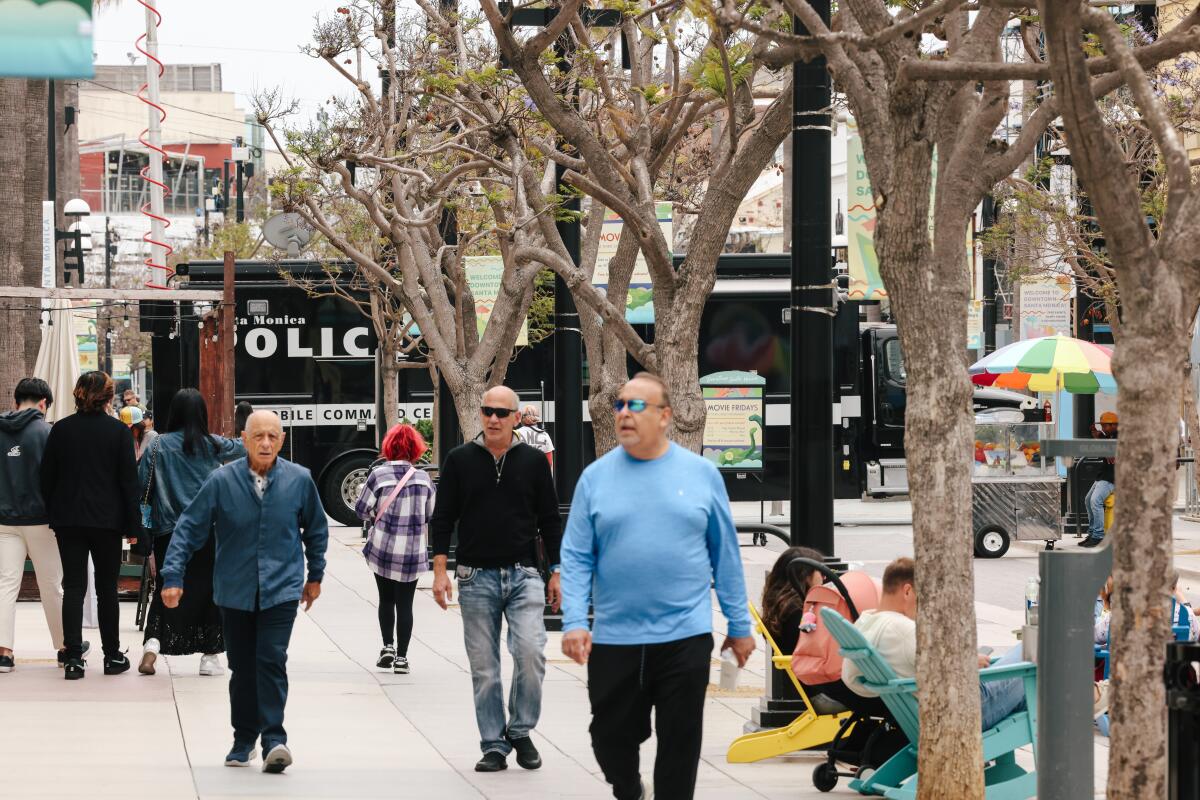
But look around and you’ll probably notice that we’re traveling, gathering and partying like it’s 2019.
“Certainly, people are trying to get back to whatever life was like before the pandemic,” Dr. Elizabeth Hudson, regional chief of infectious disease at Kaiser Permanente Southern California, told Rong-Gong. “We’re in a different place than we were before. … However, good common sense shouldn’t go out the window.”
The simplest safeguard tries to employ some of that common sense: If you’re sick, stay home and isolate. And get tested to have a better sense of what you’re dealing with.
COVID symptoms vary, but often include fever, aches, sore throat, chills, fatigue, cough, runny nose and headaches. Although vomiting, diarrhea and stomachaches are less common, they can still be the result of a COVID infection.
Health officials advise people to wear masks for five days after their symptoms improve to protect others. To keep the elderly, immunocompromised and other high-risk people safe, L.A. County recommends anyone infected steer clear for 10 days after a positive test or the start of symptoms.
As COVID continues to rise this summer, we want to hear from you, newsletter readers:
How concerned are you about COVID right now? How often is it on your mind in daily life?
How have the precautions you take changed over time — or have they not? Do you think the average person is taking it more or less seriously than you are?
Share your concerns (or lack thereof) by taking this survey and you might see your and fellow readers’ responses in a future edition of Essential California.
More on COVID:
Today’s top stories

Former President Trump is surrounded by Secret Service agents on stage at the campaign rally in Butler, Pa., where he was shot.
(Evan Vucci / Associated Press)
California and the 2024 election
Elon Musk v. California
L.A. politics
Sports
More big stories
Get unlimited access to the Los Angeles Times. Subscribe here.
Today’s great reads

An artist’s rendering of the proposed $1.5-billion stadium the Oakland Athletics are planning to move into in 2028.
(Negativ via Associated Press)
MLB players with Vegas roots are skeptical of A’s relocation: ‘It’s a terrible idea’ Athletics owner John Fisher says moving to Las Vegas will improve the franchise, but Paul Sewald, Bryce Harper and other players don’t see it that way.
Other great reads
How can we make this newsletter more useful? Send comments to essentialcalifornia@latimes.com.
For your downtime
(Dania Maxwell / Los Angeles Times)
Going out
Staying in
And finally … a great photo
Show us your favorite place in California! We’re running low on submissions. Send us photos that scream California and we may feature them in an edition of Essential California.

The colorful cliff faces at Torrey Pines State Beach in San Diego.
(Christopher Reynolds / Los Angeles Times)
Today’s great photo is from staff photographer Christopher Reynolds of the colorful cliff faces at Torrey Pines State Beach in San Diego. It’s on our new list of the 50 best beaches in SoCal.
Have a great day, from the Essential California team
Ryan Fonseca, reporter
Christian Orozco, assistant editor
Karim Doumar, head of newsletters
Check our top stories, topics and the latest articles on latimes.com.



Hilton, Becerra lead California governor primary results
Vote counting continued after California’s primary election for governor with just over half of the results in.
Although results from California’s primary election began rolling in on Tuesday, June 2, it could take days or even weeks before the final counts are certified.
“This is normal … We have a process that by law ensures both voting rights and the integrity of elections, so I would call on all Californians to be patient,” Secretary of State Shirley N. Weber said in a June 2 news release.
The Golden State’s lengthy vote-counting process has “become a national narrative about California elections,” according to Thad Kousser, a professor of political science at the University of California, San Diego.
“In California, it takes a long time to certify votes, to verify the signatures, to then count the ballots; all of that process takes a while,” Kousser said in an interview last week. “It may take a while for us to learn who the top candidates who emerge are.”
Here are some factors behind California’s lengthy vote-counting process.
Mail-in ballots come with added verification step
With each mail-in ballot cast, elections officials must compare the signature on a returned vote-by-mail envelope to the voter’s signature on their voter registration card. Various factors go into determining whether the signatures match, including the slant of the signature, whether it is printed or written in cursive, and the size, proportions, or scale.
Vote-by-mail ballots were Californians’ preferred voting method in both the 2024 primary and general elections, with drop-off locations — such as ballot drop boxes and voting centers — the most popular way to return mail-in ballots.
During California’s 2024 primary, more than 7.7 million votes were cast statewide, and 90 percent of those were mail-in ballots. This means election officials had to verify the signatures on more than 6.8 million ballots before they could be counted. For the November 2024 general election, 80% of cast ballots, or about 13 million, were vote-by-mail.
Reviewing conditional voter and provisional ballots
California also allows for same-day voter registration, also known as conditional voter registration. Voters who need to register, or re-register, within 14 days of an election can do so at their county elections office, polling place, or vote center. These ballots will be processed and counted after the county elections office has completed the voter registration process.
In addition to conditional voter ballots, there are provisional ballots that must be verified before they are counted. Voters cast provisional ballots for a wide array of reasons, including if their name does not appear at a polling place or if they’ve made a mistake on their ballot. After a voter casts a provisional ballot, it will not be counted until election officials have confirmed that the voter is registered to vote in that county and has not already voted in that election.
Vote-by-mail ballots can be sent on Election Day
Though state officials recommend voters mail their ballots sooner rather than later, state law allows vote-by-mail ballots postmarked by Election Day to be counted if they arrive within a specified window afterward, thereby extending the tallying process.
For the primary, ballots needed to be postmarked on or before June 2 and received by county elections office no later than June 10.
California is, well, big
California is the most populous state in the nation. And, as of May 18, a record total of 23,155,447 Californians were registered to vote.
While not all registered voters are expected to have voted, county election officials estimate that more than 5 million ballots were cast statewide.
When to expect final results
Under state law, county elections officials are required to report the results for most ballots by June 15, or 13 days after the election, according to Weber. However, some ballots can take counties up to 30 days to count every ballot and then conduct a post-election audit.
State law requires county elections officials to report final official results to state officials July 3. State officials then have until July 10 to certify the results of the election.
California
California’s race for governor and other key primaries remain unsettled as vote count continues

California’s crowded, protracted gubernatorial primary is going to take a little more time to settle.
The race remained too early to call Wednesday morning with 50% of the expected vote counted, according to NBC News’ Decision Desk. Three main candidates — former Fox News host Steve Hilton, a Republican, and two Democrats, former Health and Human Services Secretary Xavier Becerra and billionaire activist Tom Steyer — are competing for two spots in the general election, with the candidate in fourth place, Republican Riverside County Sheriff Chad Bianco, running well behind.
Hilton had 27% support in the all-party primary with about half of votes still left to count, while Becerra had 26% and Steyer had 20%. Bianco was the only other candidate in double digits, at 11%.
In California, all candidates run on the same primary ballot in the primary and the top two vote-getters, regardless of party, move on to the general election.
It’s difficult to say when it will be clear which two candidates advance to the November general election, however, due to the state’s protracted vote counting.
And with millions of ballots left to count, other key races in California remain uncalled as well, including the second runoff spot to face Los Angeles Mayor Karen Bass one on one in November, several House races that could help determine the majority next year, and more.
In the governor’s race, all three candidates rallied supporters around the state as the evening drew on.
“We’re not there yet, but it’s looking good,” Hilton told allies. “It looks very much as if Californians really will have the chance to vote for change in November and take our state in a new direction, a fresh start for our state, which is long overdue.”
But while Hilton was narrowly in first place when he spoke, Democratic candidates were capturing the majority of the votes.
Becerra looked back at his own “underdog story,” from his immigrant relatives to his bid for governor, which took some time to catch fire.
“Almost immediately, he’s counted out, an afterthought, overlooked by many, outspent by a ton, even called along the way to drop out and save us the trouble,” Becerra recounted to his supporters. “Well, guess what? The underdog stayed in the fight. Like my parents, I never gave up.”
Steyer struck a hopeful note in his election night speech despite a deficit in the vote count.
“It might take some time to figure out where this is going, we’re going to wait till every ballot is counted, we’re going to give democracy a time to work, and we know we finished really strong,” Steyer said.
Major battleground districts
GOP Rep. David Valadao’s district has been one of Democrats’ top targets for years, but two Democrats are locked in a close race for the second spot in the November general election against the incumbent.
School board member Randy Villegas, who won support from national progressives, has a slight lead over state legislator Jasmeet Bains, 30% to 26%, with less than half of the expected vote tallied in the 22nd District. Valadao is comfortably in first place.
And in Northern California’s 6th District, Rep. Kevin Kiley — who was elected as a Republican and switched to become an independent this election cycle, as he runs in another newly redrawn district — is bunched up in a tight race that includes Democrat Richard Pan, a former state legislator, and Republican Michael Stansfield. Currently, Stansfield is running ahead of Pan; they spent much of Tuesday night and Wednesday morning trading the lead, which could have significant general election implications.
Meanwhile, outside California, Democrats think they might be able to challenge for one of Montana’s red-tinted congressional districts this fall, after Rep. Ryan Zinke decided to retire. But less than 2 percentage points separate Democrats Sam Forstag and Ryan Busse with more than 85% of the expected vote tallied in their primary in Montana’s 1st District.
Read more about Tuesday’s House primaries here.
A safe seat battle to watch
Plenty of other House districts in California — and a few elsewhere — still have unsettled primaries, but one attracted particular attention due to how nasty the campaign got.
In Southern California, where two Republican incumbents are facing off in one district due to redistricting, Rep. Ken Calvert has advanced to the general election, but Rep. Young Kim is still battling for the second spot. She leads Democrat Esther Kim-Varet in the race for second, 22% to 16%, with about half of the vote in.
Who will face Bass in Los Angeles?
While Bass is projected to advance to a November runoff in Los Angeles, it’s not yet clear whether she’ll face Republican Spencer Pratt or Democrat Nithya Raman.
Bass has about 37% of the vote to 29% for Pratt and 21% for Raman so far, with approximately half of the expected vote tallied.
Speaking to supporters on election night, Raman, a member of the Los Angeles City Council, said that “tonight may not give us a final answer on this race.”
“Many thousands of votes will be counted in the days ahead, and we may not get an answer we like, but regardless of what happens next, nobody, nobody can take away what all of us have built together,” she continued.
Pratt, meanwhile, was looking ahead to a potential matchup with Bass when he spoke to reporters.
“Now I have five months to get deep into every community that hasn’t heard my message to make them safe,” said Pratt, a former reality TV star. “So I’m actually very excited, because I felt very rushed. It’s a big city, and I was not able to talk to as many people as I look forward to talking to.”
Bass also projected optimism, telling her backers, “We got a lot more to go, but so far it’s looking good.”
California
Midterm primaries 2026 live: results and reaction after six states including California and Iowa cast ballots

Lucy Campbell
Millions of voters across the country are heading to the polls today in crucial primaries in a slew of key gubernatorial, Senate and House races.
Here’s a quick rundown of what we’re watching:
California
Voters are casting ballots on who should lead the nation’s most populous state (and the world’s fourth largest economy), where there is no clear leader among candidates vying to advance in the race to succeed term-limited Democratic governor Gavin Newsom. The race for Los Angeles mayor is also on the ballot, along with a series of high-stakes US House contests in the state’s newly redrawn congressional districts – which are set to play an outsized and potentially decisive role in the battle for power in Washington in November’s midterm elections. My colleague Lauren Gambino has more:
Iowa
Per my colleague Chris Stein, with Trump’s approval ratings deep underwater, gas prices high and historical political trends favoring the party out of power, Democrats this year are considering a comeback in Iowa, putting the state at the center of their campaigns to win back control of both the US House and the Senate. That effort for a “once-in-a-generation” breakthrough in the GOP-dominated state is being led by pro-hunting Democrat Rob Sand, who is running for governor. Chris wrote about him below. Democrats also believe they have a shot at winning three of the state’s US House seats and a competitive chance at securing a US Senate seat, where the GOP frontrunner recently called Trump’s war on Iran a “political liability”.
New Jersey
One of this year’s most closely watched House midterms will take place in the battleground district currently represented by now-infamous Republican Tom Kean Jr, who has drawn public scrutiny and concern after missing more than 100 House votes due to an undisclosed illness. Voters are deciding which Democrat will run against him in November – and the seat is a must-win for the party. The frontrunner, veteran army trauma surgeon and political newcomer Adam Hamawy, has secured endorsements from the likes of Bernie Sanders, Alexandria Ocasio-Cortez and Ilhan Omar. My colleague Joseph Gedeon has more:
New Mexico
Contests in the state include primaries for congressional seats, a US Senate seat and a long list of statewide offices, but the governor’s race is the main event. Deb Haaland, who was Joe Biden’s interior secretary, is running for the Democratic nomination, which could put her on a historic path for Native American leaders.
Montana
In Montana, a five-way Democratic fight is under way for the retiring Republican senator’s seat. Independent Seth Bodnar, former president of the University of Montana, is outraising them all at the moment but they’re refusing to step aside, Politico reports this morning.
South Dakota
The race is on for state governor, Sioux Falls mayor, a US Senate and House seat, a Republican primary for local lawmakers. The incumbent GOP governor Larry Rhoden faces three primary challengers in his first run for a full term. He stepped up into the role from the lieutenant governorship when the former governor, the since-ousted Kristi Noem, left to lead the Department of Homeland Security.
The Associated Press contributed reporting
Key events Joseph Gedeon
On the day Donald Trump endorsed him as a tireless advocate for New Jersey’s seventh district, the representative Tom Kean Jr was, as he has been since early March, nowhere to be found.
Kean, a New Jersey Republican, was last seen when he cast a House floor vote on 5 March, and he is running unopposed in Tuesday’s Republican primary. The Democratic race in his district, meanwhile, has attracted multiple candidates and ample fundraising.
In late April, his office said he was dealing with a “personal medical issue” and would be back “very soon”. He told the New Jersey Globe last month he expected to return within “the next couple of weeks”. In the meantime, Kean’s social media accounts have continued posting regularly, with staff attending ribbon-cuttings and graduation ceremonies on his behalf. In my home state of New Mexico, voters from both parties will nominate candidates to become the next governor, as Michelle Lujan Grisham is set to step down from the seat she’s filled since 2019. Increasingly recognized as a solidly blue state, the Democratic nominee is likely to win the general election.
Democratic voters will choose to nominate either Deb Haaland, who served as Joe Biden’s interior secretary, or Sam Bregman, the Bernalillo County district attorney. Haaland has polled safely in the lead in the run-up to the election. Her win would be a victory for Native American advocates across the country and a rebuke of the Trump administration.
A single, working mother, Haaland came on the national scene in 2018 when she was elected to Congress alongside a wave of freshman, female lawmakers known as “The Squad” who’d run in reaction to Donald Trump’s election in 2016. Haaland resigned from the House of Representatives in 2021 when Joe Biden chose her to lead his interior department, making her the first Native American to serve in the roll, which includes overseeing much of the nation’s public lands and the Bureau of Indian Affairs.
During her time in congress, Haaland – who is from Laguna Pueblo – introduced legislation to stem the crisis of Missing and Murdered Indigenous People, and as interior secretary she oversaw the formation of a new Missing & Murdered Unit (MMU) within the Bureau of Indian Affairs. Last year, New Mexico became the fourth state in the country to create its own law enforcement alert system for missing Indigenous people. Haaland also launched a historic effort to investigate the legacy of Native American boarding schools.
If elected in the November general election, Haaland would become the first Native American woman governor elected in the country. Haaland has campaigned as a fierce critic of Donald Trump, saying in campaign ads that, “Governors are the first line of defense against the horrific policies of the Trump administration.” Since Trump returned to office, New Mexico has been one of few Democratic strongholds in the south-west – with the state working to shore up protections for abortion patients, transgender people and SNAP and Medicaid recipients.
California’s primary elections, including its fiercely fought gubernatorial contest, will be at the mercy of a notoriously slow vote-counting system after the polls close on Tuesday, and it could be days or even weeks before the outcomes of the tightest races become clear.
Voting experts expect the state’s 58 county elections offices to be deluged with last-minute absentee ballots, as they have been in the last few election cycles, and spend weeks undertaking a painstaking ballot-by-ballot verification process. That presents a procedural problem whenever races are close, as they tend to be in the state’s most competitive congressional districts, and the whole country is left waiting – as it was in 2020, 2022 and 2024 – to find out which party controls the House of Representatives.
Knocking on strangers’ doors on a warm May afternoon in Trenton, New Jersey, Adam Hamawy did not seem fazed when more than a few went unanswered.
It’s his first time running for office, but this is an area where he has experience. After returning from a medical mission in Gaza in 2024, Hamawy went to Washington to describe the crisis – which he viewed as a US-funded genocide – to lawmakers, only to encounter “too many doors that were closed, that didn’t even want to listen”.
“I could only define it as a genocide, because I saw the bodies of the people that came in,” the veteran army trauma surgeon and political newcomer reflected, while walking between houses. “And it wasn’t an accident. You can’t have an accident, every single day for three years.
Rob Sand, the best known Democrat in Iowa, is running to lead a state that Republicans have come to dominate under Donald Trump, and Democrats believe his candidacy for governor could be the breakthrough needed to win key Iowa offices in the November midterm elections. With Trump’s approval ratings deep underwater, gas prices high and historical political trends favoring the party out of power, Democrats this year are considering a comeback in Iowa, putting the state at the center of their campaigns to win back control of both the US House of Representatives and the Senate. On Tuesday, voters will cast ballots in primary elections that set the stage for months of what is likely to be fevered campaigning by candidates of both parties.
“I think this is a once-in-a-generation opportunity for us to be able to win here in Iowa. I mean, this is a state that has completely hit the bottom,” said Josh Turek, a state representative who is one of two Democrats vying to represent Iowa in the US Senate.
Voters in six states have been casting their ballots in the US midterm election primaries. Here are some of the images from polling stations that have dropped on the news wires today:
Fabiola Cineas
A wave of Democratic doctors, scientists and public health professionals across the country are seeking office in the midterm elections in a rebuke to Donald Trump and Robert F Kennedy Jr’s health policies. They share a diagnosis of what ails American governance – disinformation, funding cuts and the rollback of research, among other things – and the belief that their clinical and scientific training equips them to treat it.
They have watched the Trump administration’s health policies play out in their exam rooms, their labs and the communities they serve, and they want to stop the bleeding.
Uwa Ede-Osifo
In California, voters can select any candidate among the long list of gubernatorial hopefuls, regardless of which party they have registered with.
The system was put in place under former governor Arnold Schwarzenegger, who supported the open primary, or “jungle primary”, as a way to create more competition in races that Democrats won year after year. Schwarzenegger, who left office in 2011, was the last Republican elected to statewide office in California. In a crowded race like this year’s gubernatorial primary, the system could cause some unexpected results – such as the possibility that emerged earlier this year of two Republicans advancing to the general election in deep blue California.
That situation now appears unlikely, but the possibility has prompted some Democrats to push to overhaul the way the state votes.
Lucy Campbell
Millions of voters across the country are heading to the polls today in crucial primaries in a slew of key gubernatorial, Senate and House races.
Here’s a quick rundown of what we’re watching: California Iowa New Jersey New Mexico Montana South Dakota The Associated Press contributed reporting
Explained: what is California’s ‘jungle primary’?
Voters are casting ballots on who should lead the nation’s most populous state (and the world’s fourth largest economy), where there is no clear leader among candidates vying to advance in the race to succeed term-limited Democratic governor Gavin Newsom. The race for Los Angeles mayor is also on the ballot, along with a series of high-stakes US House contests in the state’s newly redrawn congressional districts – which are set to play an outsized and potentially decisive role in the battle for power in Washington in November’s midterm elections. My colleague Lauren Gambino has more:
Per my colleague Chris Stein, with Trump’s approval ratings deep underwater, gas prices high and historical political trends favoring the party out of power, Democrats this year are considering a comeback in Iowa, putting the state at the center of their campaigns to win back control of both the US House and the Senate. That effort for a “once-in-a-generation” breakthrough in the GOP-dominated state is being led by pro-hunting Democrat Rob Sand, who is running for governor. Chris wrote about him below. Democrats also believe they have a shot at winning three of the state’s US House seats and a competitive chance at securing a US Senate seat, where the GOP frontrunner recently called Trump’s war on Iran a “political liability”.
One of this year’s most closely watched House midterms will take place in the battleground district currently represented by now-infamous Republican Tom Kean Jr, who has drawn public scrutiny and concern after missing more than 100 House votes due to an undisclosed illness. Voters are deciding which Democrat will run against him in November – and the seat is a must-win for the party. The frontrunner, veteran army trauma surgeon and political newcomer Adam Hamawy, has secured endorsements from the likes of Bernie Sanders, Alexandria Ocasio-Cortez and Ilhan Omar. My colleague Joseph Gedeon has more:
Contests in the state include primaries for congressional seats, a US Senate seat and a long list of statewide offices, but the governor’s race is the main event. Deb Haaland, who was Joe Biden’s interior secretary, is running for the Democratic nomination, which could put her on a historic path for Native American leaders.
In Montana, a five-way Democratic fight is under way for the retiring Republican senator’s seat. Independent Seth Bodnar, former president of the University of Montana, is outraising them all at the moment but they’re refusing to step aside, Politico reports this morning.
The race is on for state governor, Sioux Falls mayor, a US Senate and House seat, a Republican primary for local lawmakers. The incumbent GOP governor Larry Rhoden faces three primary challengers in his first run for a full term. He stepped up into the role from the lieutenant governorship when the former governor, the since-ousted Kristi Noem, left to lead the Department of Homeland Security.
-
 Kansas6 minutes ago
Kansas City, Missouri, police searching for missing 11-year-old girl
-

 Kentucky9 minutes ago
Kentucky Lottery Cash Ball, Pick 3 Evening winning numbers for June 3, 2026
-

 Louisiana14 minutes ago
DHS watchdog finds use-of-force issues and safety and sanitation concerns at Louisiana ICE center
-

 Maine21 minutes ago
‘I could die here’: Photographer recalls Maine wedding stabbing
-

 Maryland24 minutes ago
Full-length Replay: Maryland | FOX Sports
-

 Michigan29 minutes ago
Michigan Lottery Daily 3, Daily 4 results for June 3, 2026
-

 Massachusetts36 minutes ago
Mass. House votes to set new rules for DiZoglio’s audit
-

 Minnesota39 minutes ago
Minneapolis considers closing dog park sitting on Indigenous land

