Entertainment
Exclusive: Michael Mann unveils his in-depth, behind-the-scenes Archives project

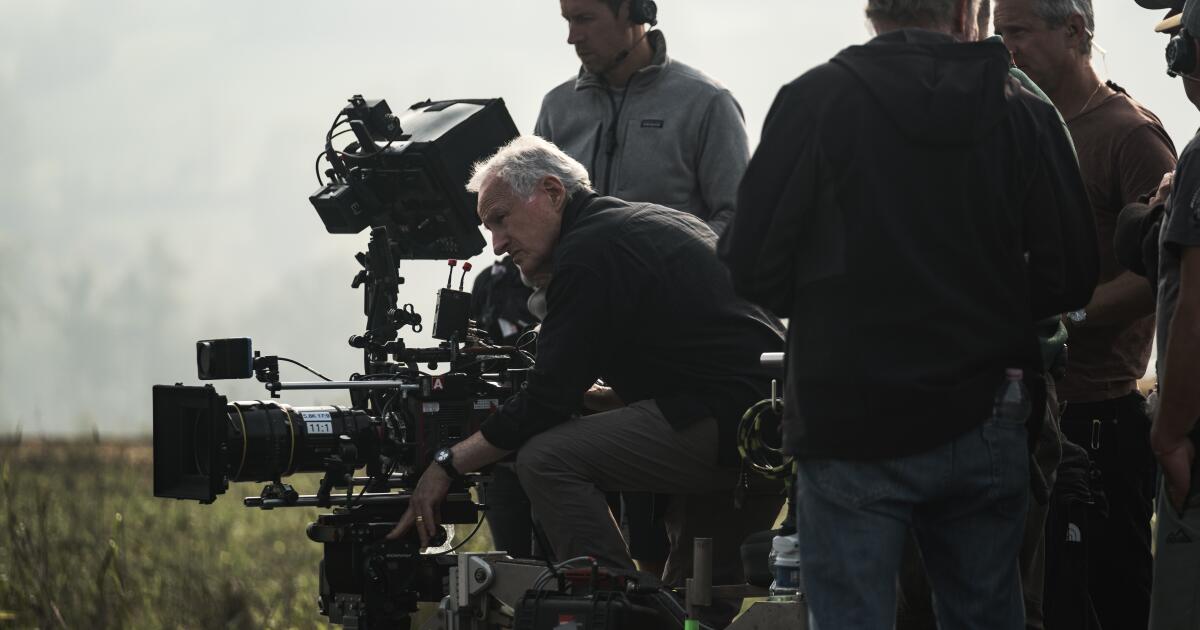
Filmmaker Michael Mann is known for his exacting research and exhaustive preparation, work that goes into such moody, existential portraits as “Heat,” “The Insider,” “Ali,” “Miami Vice,” “Blackhat” and the recent “Ferrari.”
Mann is now giving audiences an unprecedented glimpse into his artistic process via the website michaelmannarchives.com. Launching today at noon Pacific time, the website kicks off with a deep dive into the making of “Ferrari,” including 20 video pieces specifically created for the site, previously unseen photographs, annotated script pages and production paperwork including Mann’s working notes, many in his own handwriting.
Access to the “Ferrari” site will cost $65. Following the initial launch, there are plans to eventually continue working through Mann’s filmography, with future pages focused on other films. (Users will need to purchase access to each film’s archive individually.) Fervent online fandom for titles such as “Heat” or “Miami Vice” presumably would generate great interest for this kind of behind-the-scenes exploration.
On a recent afternoon at his longtime offices in West Los Angeles, Mann met with The Times, sitting with the youngest of his four daughters, Becca Mann, who worked closely with her father in organizing the archives.
Mann’s notoriously hard-charging demeanor seems softened by the presence of his daughter; he appears energized by their work together. In conversation, Mann recalls — with startling detail — decades-old pieces of research or specific moments from the production of his older films.
The existence of Mann’s extensive personal archive was the initial impulse behind the online project, the simple fact that all this material was there for the posting. From there, though, it began to take on a larger purpose.
“It is a spectacular, rewarding, creative act to direct a motion picture,” says Mann, 81. “It’s a very large endeavor. The movie is two hours — making it is a year and a half. So much goes into deciding, thinking through what you are going to do.”
Continuing, Mann speaks to something deeper. “Directors have no idea how any other director makes a movie,” he says. “And so we each evolve our own particular process. This is an opportunity to pass that on, convey something I’m just very enthusiastic about. I think it is the best work that any man or woman can do, period. And I’ve thought that since I was 20 years old. And my enthusiasm for it is absolutely unwavering and unremitting.”
Clip from a behind-the-scenes website by the filmmaker Michael Mann. (Michael Mann Archives)
“Ferrari,” set in Italy in 1957, tells the story of a turbulent period in the life of Enzo Ferrari, the Italian automaker who created the famed brand. Played by Adam Driver, Ferrari is seen scrambling to keep his business afloat and put together a winning auto racing team all while juggling a personal life that finds him caught between his estranged wife, Laura (Penélope Cruz), still grieving the untimely death of their son Dino, and another woman, Lina Lardi (Shailene Woodley), with whom he secretly has a young son, Piero.
The new website is structured around six scenes in “Ferrari,” including two that Mann describes as the “most pivotal” in the movie, a sequence in which the characters attend an opera performance and a volcanic argument between Enzo and Laura Ferrari at home.
Other sections of the site deal with the re-creation of the Mille Miglia auto race and the horrific, fatal 1957 crash at Guidizzolo, exploring everything from the re-creation of vintage racing cars to the special camera rigs used to capture the stunts.
Some of the most remarkable documents on the site are Mann’s personal handwritten notes, in which he can be seen working through layer upon layer of meaning and intention. “The most critical person for me to direct is myself,” he says.
Those free-flowing comments are then filtered into more formal documents for distribution to other people in the production, as ideas are refined and honed. The continuity of the process is all the more noteworthy in that the date from one page to the next can sometimes jump a number of years. (Mann’s interest in “Ferrari” dates back to the 1990s.)
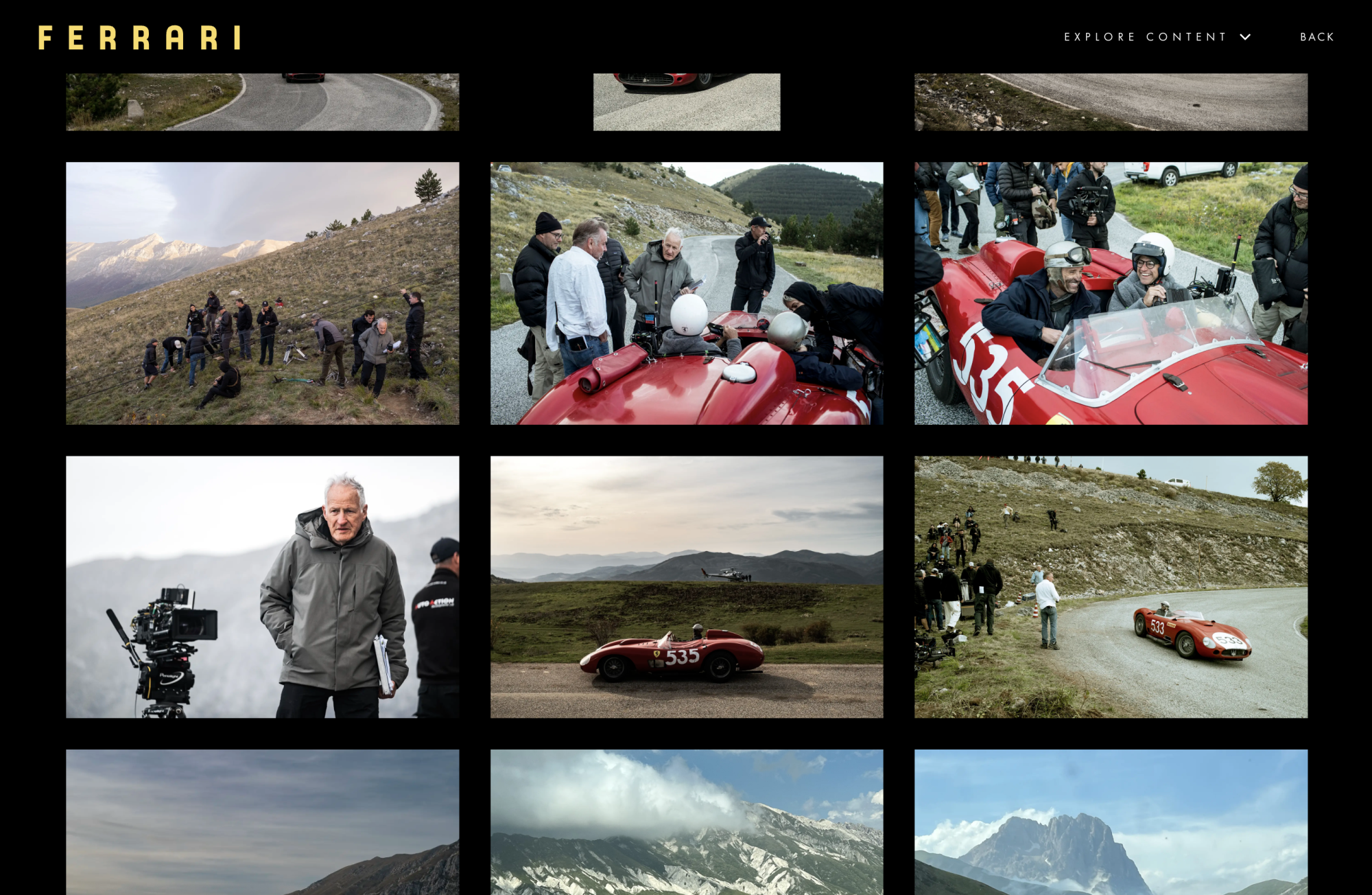
A gallery of behind-the-scenes “Ferrari” photos as seen on the website Michael Mann Archives.
(Michael Mann Archives)
The site’s video pieces are more extensive and in-depth than those that typically accompany a movie’s promotion. They may toggle between rehearsal footage of Driver and Woodley and the final filmed version of the same scene. Audio sources come from Mann’s rough preproduction recordings, such as when he and Cruz discuss Laura and Enzo’s relationship long before the film’s shoot. (Mann’s preproduction photographs of Cruz in the Ferrari family’s actual apartment may be among the most striking imagery on the entire site.)
Mann‘s archival material has, up to now, been stored in multiple locations, divided among paperwork, film elements and physical objects. Becca Mann began working as an archivist for her father around 10 years ago, at first just to check that the materials were being stored properly, and then saw her involvement grow over time.
“This is what happens if you hang around with him,” Becca Mann, 43, says with an affectionate smile. “I go visit storage to see if it’s dusty and then —”
“In 25 words or less, it turned into this,” adds her father with a laugh.
Becca Mann recalls making discoveries of items that she was personally fascinated by, and knew that other people would appreciate the opportunity to see them too.
“We’d run across some kind of crazy, beautiful document that’s covered in coffee stains and it’s got the whole crux of ‘Heat’ on one page,” she says. “That’s where wheels started turning about how to share it — what’s the best and most appropriate and also most direct thing to do with the stuff.”
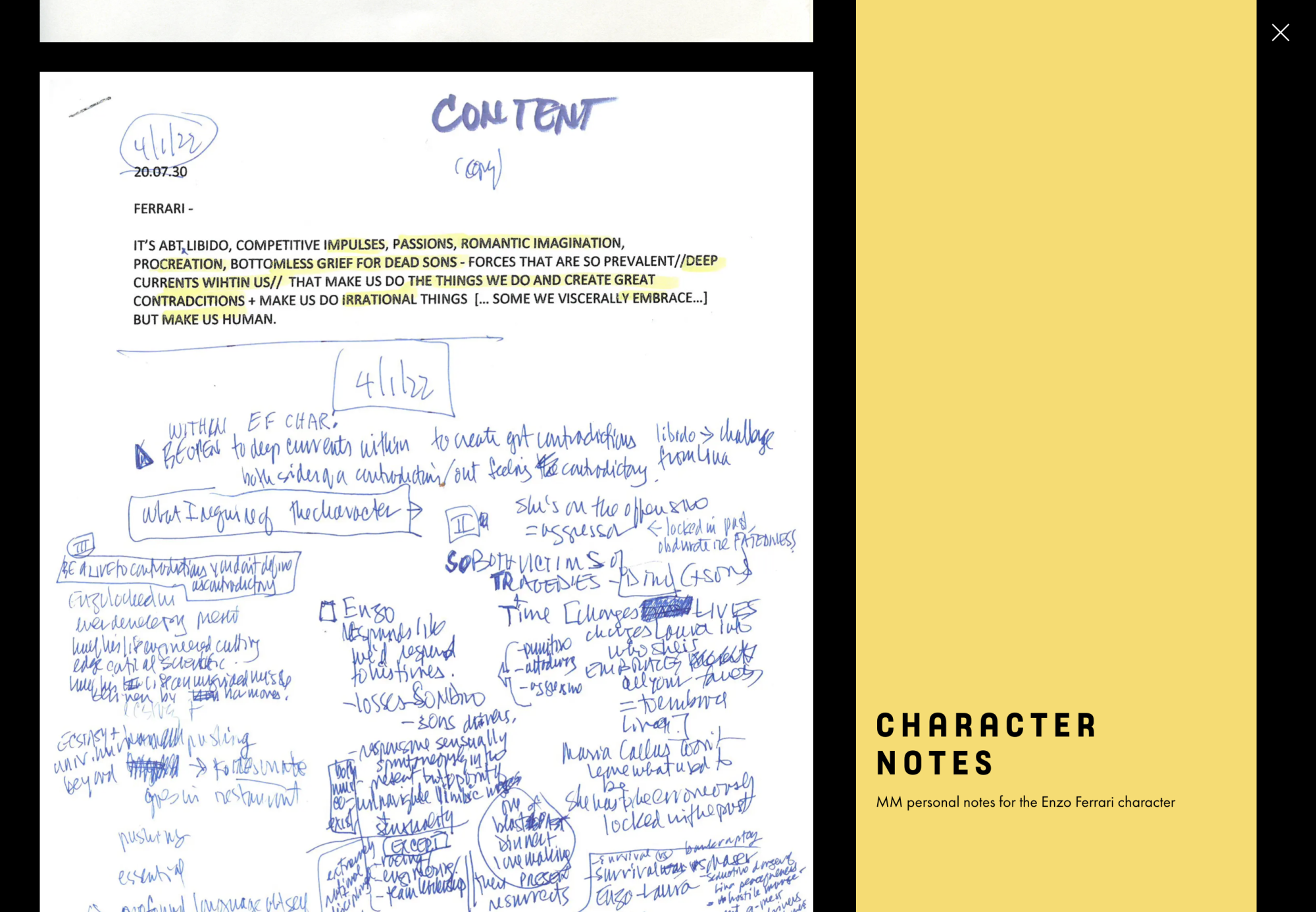
An image of Michael Mann’s annotated notes from “Ferrari” as seen on the website Michael Mann Archives.
(Michael Mann Archives)
Becca Mann notes that, as one goes further back in time, there tends to be less material on each film, which may be challenging for further iterations of the archive website. Mann himself frequently uses his archive for research on projects. For “Ferrari,” Mann’s working process was the same as it has been on previous movies, with the exception that there was even more attention paid to documenting the work along the way.
In explaining his interest in the archives project, he reflected on how other filmmakers have inspired his evolving practice over the years. He cites the deep and ongoing influence of Russian director Sergei Eisenstein, as well as what he learned about storytelling from his friend, filmmaker Sydney Pollack, who collaborated on early versions of the “Ferrari” project.
While working as an assistant to George Cukor in London in the late 1960s on a film that was never made, Mann saw the director of “The Philadelphia Story,” “A Star Is Born” and “My Fair Lady” give an adjustment to an actor during a rehearsal.
“I don’t know what he said, but it lasted about 10 or 15 seconds and he walked away and the performance went from A to Z,” Mann said. “And that instilled in me that if you want to direct, you have to be able to do that. You have to know what to say to get inside a very determined, hardworking actor.”
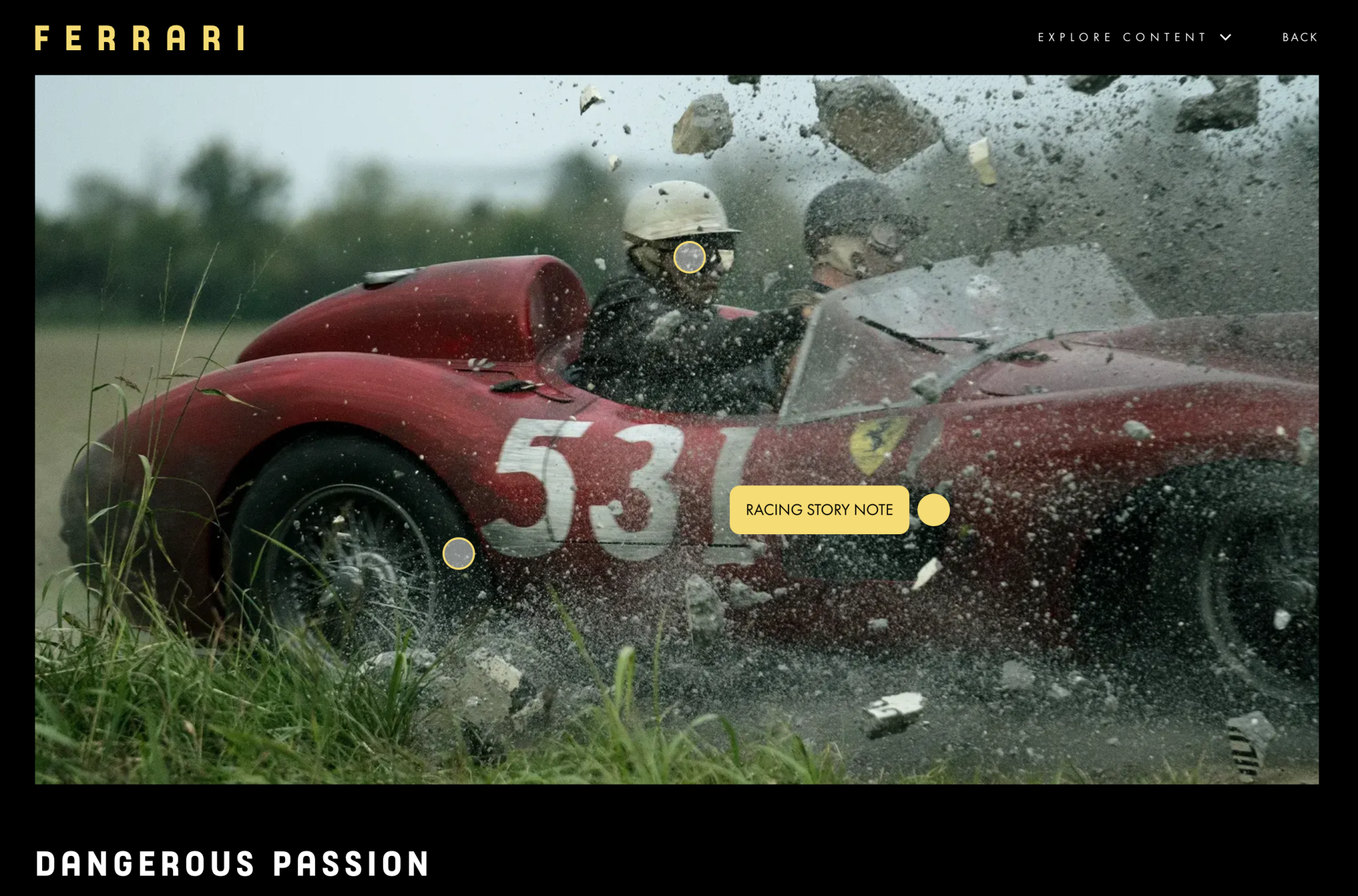
Multiple entry points on each interface page take a user to other destinations on the site.
(Michael Mann Archives)
“Ferrari” was seen as a box office failure, making just over $42 million worldwide on a reported budget of $95 million and earning no major awards recognition. Yet that hasn’t diminished Mann’s feelings toward the decades of work that went into creating it.
“I’m confident in the film’s long-term relevance,” Mann says. “I believe it’s a good film. I think Adam’s work is great. Penélope’s work is great. Shailene. The writing by Troy [Kennedy Martin] is quite terrific. No doubt about that.”
Many of Mann’s films have had a long tail, finding passionate and supportive audiences over time. Just look at recent screenings of “Miami Vice” in New York and Los Angeles or the enthusiasm around a recent 4K disc release of “Blackhat.”
“That’s not a mystery to me,” Mann says of why some of his films take longer to catch on with audiences than others, citing the complex “contrapuntal” ending of “Heat.”
“It’s emotionally conclusive, but it doesn’t leave you with: OK, that’s over, where are we gonna get a pizza?’ It’s not fast food. There are a lot of layers to these things.”
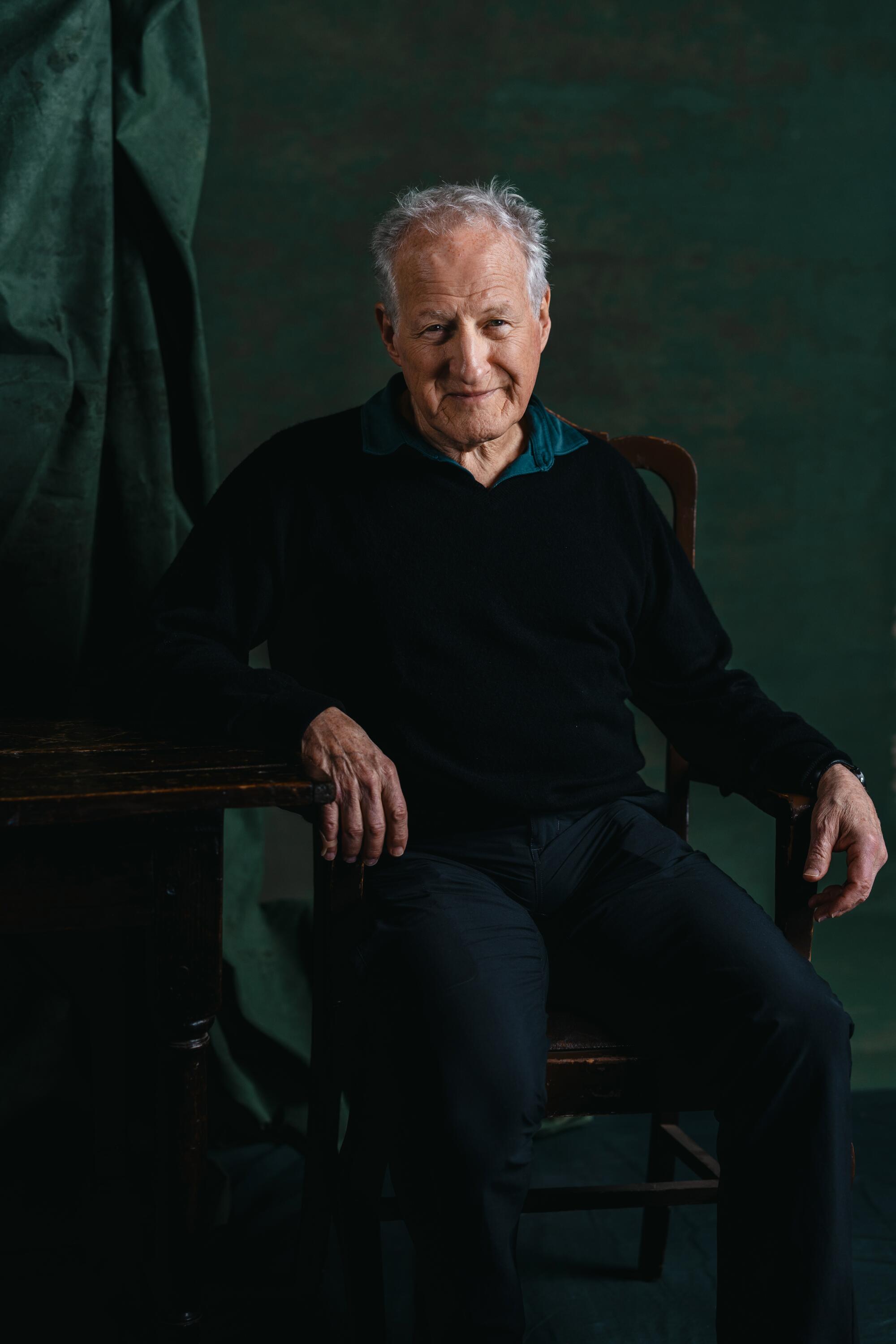
Michael Mann, photographed as part of The Times Envelope Directors Roundtable in 2023.
(Jason Armond / Los Angeles Times)
Which Mann classic will the archive explore next? “We don’t know what we want to do next,” Becca Mann says. “We’ll learn a lot about what people respond to. This project has an enormous amount of material in it. The objective is to do something activating and alive with the archive.”
Meanwhile, Mann notes he is deep into writing the screenplay adaptation of his novel “Heat 2,” with a desire to begin shooting at the end of this year or beginning of 2025. On those casting rumors involving the likes of Driver and Austin Butler to step into roles originally played by Robert De Niro and Val Kilmer, Mann says simply, “I can’t talk about that.”
The Michael Mann Archives project provides unique insights into the distinctive working methods of a director who has been at the forefront of Hollywood for more than four decades. Allowing audiences under the hood, as it were, only deepens one’s appreciation for the intensity of work that goes into making one of his films.
“I wouldn’t want to make a movie any other way,” Mann said. “If somebody said, ‘Here’s $20 million, show up three weeks before we start shooting,’ that would not be for me. ‘Make it up as you go’ is not for me.”

Movie Reviews
‘Night Nurse’ Review: A Caretaker Explores Her Kink for Elder Abuse in the Year’s Strangest Erotic Thriller

There are any number of erotic thrillers in which rich old men are robbed blind and/or left for dead, but Georgia Bernstein’s admirably bizarre “Night Nurse” might be the first movie of its kind where elder abuse is the source — and possible subject— of its erotic thrills. If there are others, I’m not sure I want to know.
But this woozy debut feature doesn’t rely on its audience being turned on by the relationship between a nubile caretaker and her dementia-addled patient. Their psychosexual bond, meanwhile, hinges on cold-calling vulnerable old people under the guise of a grandchild in financial distress. (“I’m in trouble, nana, send me $10,000 or I’ll be left to rot in jail!” That sort of thing). With its slim wisp of a premise stretched into a Strickland-esque dreamscape that substitutes kink for conflict, the film itself hardly seems convinced by its own wrinkled lust — all desperate kisses and non-touching poses of subservience. More important to Bernstein is what that lust reveals about her characters’ deepest needs, specifically how their need to care and be cared for can be as easily perverted as any other form of desire.

As moody and weightless as the noir-accented score that blows through the movie like a curlicue gust of wind in an old cartoon (credit to musicians Sam Clapp and Steven Jackson), “Night Nurse” lacks the pulse required for its stray feelings to come alive. Still, the film ambiently taps into the latent eroticism of teasing out the distance between how you see yourself and who you really are. Bernstein plays with that distance like a telephone cord wrapped around her fingers, and Eleni — played by the excellent newcomer Cemre Paksoy, powerfully helpless — only frays even more as the receiver is brought near the hook. “Everything I did before today wasn’t me,” the nurse tells co-worker Mona (Eleonore Hendricks) after starting a new job at an Illinois retirement home. “It was somebody else.”
What she did before today remains unexplored (specifically, what she did to get herself fired from her last gig), but I’m guessing she’s probably changed less than she thought. There’s a faraway flicker in her eyes the moment she catches the vibe between Mona and Douglas (a ribald and elusive Bruce McKenzie), a white-haired seventysomething who shows early signs of dementia but still commands an undiminished sexual energy. “I’m not an invalid,” he coos as Mona bathes him in the tub, to which she replies, “yes, you are,” in a supplicant tone that hints at a rich history of power games between them.
Later that same night, Douglas will force Eleni to call a stranger, pretend that she’s their granddaughter, and ask for money — he’ll wrap the phone cord around the nurse’s body as she talks and shove her against the wall as they kiss. She’s into it. So into it that he has to clarify the terms of his whole deal: “If you’re looking for a pogo stick, I’m really not your guy.” But Eleni isn’t looking for anything to bounce on. She just wants to be needed, and maybe to need someone in return. Someone who will see her for who she really is and allow her the fantasy of pretending she isn’t being herself when she cons vulnerable strangers out of their money — when she exploits how enthralled those strangers are by the care they have for their loved ones.
“Night Nurse” doesn’t belabor the psychology, as Bernstein prefers to express her story through heavy-lidded suggestion. Somnambulating from the moment it starts, the film moves through a series of beautifully arranged poses that stretch their latent meaning thin across the surface (Lidia Nikonova’s cinematography lacquers every shot with a seductive dreaminess). We see Douglas smoking in a lawn chair with Mona and Eleni curled around his feet. Eleni riding in the backseat of a convertible as the wind blows through her curls. The full staff of nurses — all of them under Douglas’ sway — stumbling around his condo in a state of zonked out bliss as they roll on the prescription drugs they’ve stolen from the residents.
Once you’ve seen one shot of this movie, you’ve practically seen them all, at least until things escalate during a rushed and unsatisfying third act that forces Eleni into an honest confrontation with herself. People will do just about anything to feel needed — they’ll give whatever degree of care allows them to receive it in return. “Night Nurse” understands that desire, but remains far too numb to treat it.
Grade: C+
The Independent Film Company will relase “Night Nurse” in theaters on Friday, July 10.
Entertainment
Lucas Museum to give free annual passes to South L.A. neighbors, host community preview day

The Lucas Museum of Narrative Art, which is moving at light speed toward its Sept. 22 opening, announced Thursday that it will give free annual passes to its South L.A. neighbors living in the 90037 ZIP Code. The 300,000-square-foot, $1-billion museum located in Exposition Park will also host a special community preview day on Sept. 13, more than a week before the general public gets to step inside.
The 90037 ZIP Code has a population of more than 65,000 and is bordered roughly by the 110 Freeway to the west, Slauson Avenue to the south, Central Avenue to the east and Martin Luther King Jr. Boulevard to the north. Residents can register for passes at lucasmuseum.org/lm37 and will be alerted in August when the program launches. Pass holders can reserve tickets for themselves and one guest.
Tickets for non-pass holders go on sale July 21. They cost $25 for adults and $21 for seniors. Kids 17 and under are free.
“Storytelling has the power to bring people together and create a sense of community,” said Lucas Museum Chief Executive Tracey Bates in a news release about the program. “Through LM37, we are inviting our South Los Angeles neighbors to make the museum part of their lives and take their own path of discovery through the art, programs and experiences that will help shape this new cultural hub for Los Angeles.”
The community preview day is designed to give local business owners, community partners, civic leaders and registered LM37 pass holders a sneak peak of the 10,000 square feet of exhibition space, as well as the expansive gardens with 11 acres of park space.
The opening programming, curated by co-founder George Lucas, features 20 inaugural exhibitions across more than 30 galleries, including one titled “Star Wars in Motion,” containing vehicle designs, high-speed racers, flying vessels, props, costumes and illustrations from the first six films in the beloved franchise.
More than 1,200 objects will be on display from Lucas’ personal collection of narrative art. Highlights include work by Norman Rockwell and Dorothea Lange, as well as a variety of manga, children’s book illustrations and comics.

Last year’s “Superman” ended with Iggy Pop singing “Because I’m a punk rocker, yes I am” — an ironic coda for a superlatively square hero. But it rings straightforwardly true for Superman’s cousin.
Milly Alcock’s Kara Zor-El, or Supergirl, sports not a spandex suit but a Blondie T-shirt. When we meet her in Craig Gillespie’s “Supergirl,” she’s been on an interstellar bender for days. She’s more Courtney Love than Clark Kent.
Nonchalant and sarcastic, Kara is also a little Han Solo-ish, you might say, given that she moves capriciously through the galaxy in her junky spaceship while getting in fights in extraterrestrial bars. She’s a welcome, jagged riff on more buttoned-up superheroes, and Alcock is terrific in the role. If only “Supergirl” was as good as she is.
While the latest DC release, and second under James Gunn’s stewardship, has its moments, “Supergirl” struggles to match Kara’s punk-rock energy with an equally spirited supporting cast and story.
Skepticism seems to have gathered for “Supergirl” ahead of its release. Many fans have argued it wasn’t the right next step for DC Universe. But I’m not so sure. Alcock’s breezy cameo in “Superman” was one of that movie’s highlights. Handing the follow-up to her, and her faithful floating dog Krypto, strikes me as an extremely natural next step. When in doubt, follow the dog.
And much of “Supergirl” is winning. It resides almost entirely in space, touching down only momentarily on Earth. In its consistently creative production design, clever needle drops and underdog story arc, “Supergirl” resides a little closer to Gunn’s “Guardians of the Galaxy” movies than other DC entries. Its outer space is filled with cosmic detritus, mean characters and cute critters. Seth Rogen as the voice of a tiny alien co-piloting a space bus is an inspired concoction, as is a shabbier sci-fi realm with rest stops along the intergalactic highway.
-

 Milwaukee, WI5 minutes ago
Milwaukee leaders condemn ICE arrests as agency ignores City mask ordinance
-

 Atlanta, GA8 minutes ago
Georgia Secretary of State opens investigation into voter registration mailers sent to deceased residents
-

 Minneapolis, MN13 minutes ago
Minneapolis chief communications officer Adam Fetcher out amid possible criminal charges
-

 Indianapolis, IN20 minutes ago
Indiana Workforce Pell Grant options limited so far
-

 Pittsburg, PA23 minutes ago
Pennsylvania leaders take new approach to cracking down on robocalls
-

 Augusta, GA28 minutes ago
Augusta domestic violence shelter faces shortfall after Georgia funding veto
-

 Washington, D.C35 minutes ago
Why Gov. Kim Reynolds turned down previous request to send National Guard to D.C.
-

 Cleveland, OH38 minutes ago
LGBTQ+ Ohio Nonprofit Guide

