World
Swing-state Democrat Casey walks a fine line between his own campaign and turmoil surrounding Biden


HARRISBURG, Pa. (AP) — Pennsylvania Sen. Bob Casey has a fine line to walk.
He and other Democrats fighting to hang on to hotly contested Senate seats have seemed jittery about the turmoil surrounding President Joe Biden after his disastrous debate performance. In many cases they’re trying to minimize any damage to their own races by saying as little as possible about it in public.
But with control of the Senate on the line, the drama is an unavoidable and unwelcome development for Democrats. They are defending far more Senate seats than Republicans this year, including in the presidential swing states of Pennsylvania, Wisconsin, Michigan, Nevada and Arizona.
Incumbents in Republican-leaning Montana and Ohio appear nervous, too, and there’s an unexpected challenge in the Democratic stronghold of Maryland from former Republican Gov. Larry Hogan.
The turmoil surrounding Biden is especially delicate for Casey, long seen as one of the safest Democratic bets in battleground races. He has defended Biden, but in the halls of the Capitol this week, even Casey brushed aside questions about how Biden’s predicament might affect his race.
“I’ve got work I got to do as a senator and as a candidate,” he told The Associated Press. “I’m not going to be a pundit or an analyst. Obviously voters can make up their own minds.”
What to know about the 2024 Election
Casey grew up on the same street as Biden in Scranton. Their families have known each other for decades, and he’s campaigned with Biden countless times, including this year. Biden — a Delaware resident but a Pennsylvania native, as is first lady Jill Biden — has long claimed Pennsylvania as his own.
When Casey’s mother died last year, Biden came to Scranton to pay his respects.
On Sunday, Casey greeted Biden in Philadelphia on the president’s campaign swing through Pennsylvania, attending worship services with him at a predominantly Black church there. Answering reporters’ questions during his own campaign events, Casey has maintained that he supports Biden and was not concerned about his debate flop.
Still, Casey’s backing has lacked the gusto of Pennsylvania’s other Democratic senator, John Fetterman, who told Biden supporters in Pennsylvania that Biden is “the only person that’s ever kicked Trump’s ass in an election.”
Other Democratic incumbents have been less hesitant to set themselves apart from Biden, before and after the debate. Democratic Sens. Jacky Rosen of Nevada, Tammy Baldwin of Wisconsin, Jon Tester of Montana and Sherrod Brown of Ohio have offered little public support for the president since the debate.
Tester and Brown — prime GOP targets in states that Republicans have dominated in recent years — have been distancing themselves from Biden for quite some time.
For Tester, a centrist lawmaker representing a fossil fuel-friendly state, steering clear of national Democrats has long been crucial to his political survival. Most recently, he pushed back against the administration over new pollution rules that could hurt Montana’s energy industry.
Yet Tester has also said that the president himself was doing a good job — comments that his opponent, Republican Tim Sheehy, resurrected in an online campaign ad after Biden’s shaky debate performance.
In a statement this week, Tester adopted a more skeptical stance. He said Biden must “prove to the American people — including me — that he’s up to the job.”
Montana voter Kathryn Natzel, a self-described moderate Democrat, supports Tester for his position on women’s reproductive rights and is clear about her reasoning.
“Don’t tell me what to do with my family,” she said.
But the 29-year-old stay-at-home mother from Billings worries younger voters who cringe at Biden’s age could also turn against Tester as he seeks a fourth term.
“It’s kind of a point against him for younger people,” Natzel said, noting that Tester’s political career spans almost her whole life.
Brown, the Ohio incumbent, was asked repeatedly about Biden on a conference call with reporters Wednesday. The subject of the call was federal rules for hydrogen hubs, but the questions focused heavily on Biden.
Brown acknowledged there are “legitimate questions” about whether Biden should continue his campaign. The senator wouldn’t answer when asked what he told colleagues privately about Biden or if he thought having Biden on the ballot hurts other Democrats, including him. He even refused to answer directly when asked if he supported the president.
“I’m not talking about politics on this call,” Brown said. “I’ve said enough.”
On a campaign swing through Wisconsin, Baldwin told reporters that the “bottom line” is that it’s Biden’s decision on whether to run and that she’s heard a lot from voters and “passed those onto the White House.”
In Pennsylvania, for the most part, Casey has brushed aside questions about how Biden’s predicament might impact his race. But his opponent, former hedge fund CEO David McCormick, is highlighting Casey’s support for Biden. In digital ads, McCormick’s campaign calls Casey the “one man who will never leave Biden.” Clips of Biden calling Casey “one of my best buddies,” “one of my closest friends” and “Bobby Casey” drive home the point.
When he has talked about it, Casey has acknowledged that Biden had a bad night. But at a recent appearance with Biden in Harrisburg, e asserted that voters would ultimately side with Democrats, even in the race for the presidency. He said it comes down to whether candidates support reproductive rights for women, working families rather than billionaires, and voting rights over an insurrection.
“I do think people across the country, they have real a sense of what’s at stake in this race,” he said.
___
Associated Press writer Mary Clare Jalonick in Washington contributed to this report. Brown reported from Billings, Montana.



As Israel’s war on Lebanon rages, hundreds gather in Rmeileh by Sidon Gate to watch the 2026 World Cup. Organised by influencer Bilal Haddad, the fan zone offers food trucks, shisha and family activities, giving people a rare chance to relax. Al Jazeera’s Justin Salhani went to check it out.
Published On 20 Jun 2026

WASHINGTON (AP) — Mark Schiefelbein has been based in Washington, D.C., with AP for about three years, and before that spent a decade in Beijing at AP’s China bureau.
Here’s what he had to say about this extraordinary photo.
Why this photo?
This was an event that had never happened before in the 250-year history of the United States and may never happen again: a night of mixed martial-arts cage match brawls on the South Lawn of the White House, with bloodied competitors battling it out in front of the president, vice president, and other leaders of the country. AP had other photographers ringside at the event focusing more on the fights themselves. So I felt my role was to capture the context of the evening — the location, the people in attendance, the environment.
How I made this photo
A small group of other photographers and I, the White House press pool, had been allowed to photograph part of the evening from a position in the stands directly opposite the White House. I was carrying four cameras with a variety of lenses from 12 mm to 300 mm. This let me capture everything from ultra-wide views of the “claw” structure built for the fights, to close-ups of leaders and celebrities in attendance. I had been following Diego Lopes with my longest lens as he moved around the ring celebrating his win over Steve Garcia. When I saw him start to climb onto the cage, I immediately realized there might be a possibility of a picture like this and zoomed out to capture more of the scene.
An octagon on the White House lawn for Trump’s 80th birthday and the nation’s 250th, in photos
Why this photo works
The White House is surely one of the most recognizable buildings in the world. The columns of the South Portico, the fighter standing with arms and legs spread wide in celebration, and the octagon padding of the UFC ring tell an entire story as your eyes move from top to bottom of the frame. With Lopes standing with his back to the camera, facing the White House, it becomes less a photo of him and more about the evening, the event, and the spectacle. It was fortunate that it was after nightfall, so things that might have been distracting, like the Marine Band and spectators seated behind the ring, are mostly in the dark. Only the key elements – the White House, Lopes, and the ring are lit up.
—
For more extraordinary AP photography, click here.
World
British Prime Minister Keir Starmer faces potential leadership challenge from newly-elected Andy Burnham

NEWYou can now listen to Fox News articles!
Andy Burnham has officially won his special election and regained a seat in Parliament, setting him up to challenge the deeply unpopular Keir Starmer as the leader of the Labour party and as prime minister.
Burnham, currently the mayor of Greater Manchester in northwest England, won a seat in Makerfield and came away with 55% of the vote in a field of more than a dozen candidates, according to The Associated Press. The runner-up was Rob Kenyon of Reform UK, a right-wing populist party, who received more than 9,000 fewer votes than Burnham.
Burnham last served as a member of Parliament in 2017 but strongly implied in his victory speech that he is returning with the intention to lead the United Kingdom.
“Everyone knows that politics isn’t working. Everyone can feel that the country isn’t where it should be. Tonight could, just could, be the turning point,” he said, according to the AP. “This result will bring about a country that works fairly for everywhere and for everybody.”
TRUMP ALLY NIGEL FARAGE DEALS MAJOR BLOW TO STARMER IN LOCAL UK ELECTIONS AS RESIGNATION CALLS MOUNT
Britain’s Labour party candidate Andy Burnham speaks to supporters after the Makerfield by-election in Ashton in Makerfield, England, on Friday, June 19, 2026. (Jon Super/AP)
This special election, called by-elections in Britain, was unusually significant because the area’s Labour MP, Josh Simons, intentionally resigned to allow Burnham to win the seat and pursue leadership.
The potentially outsized impact of this election was juxtaposed with the strange scene that unfolded when all the candidates gathered on Friday morning to hear the results. Burnham stood in between an independent candidate dressed in a fox costume and another candidate known as “Count Binface”.
As his name suggests, “Count Binface,” whose real name is Jonathan David Harvey, was wearing a trash can on his head and regularly runs in U.K. elections to advocate for increased voter turnout.
Starmer congratulated Burnham in a social media post on X, saying voters “chose Labour’s campaign of hope and optimism over division and hate.”
When asked about Burnham’s intentions to oust him as leader, Starmer said he will fight to remain prime minister, a position he has held for nearly two years.
“I’ve said repeatedly I’m not going to walk away from that,” Starmer told reporters.
Labour party candidate Andy Burnham, center, stands with other candidates on the podium at the Edge Wigan, awaiting the Makerfield by-election result announcement in Wigan, England, on Friday, June 19, 2026. (Jon Super/AP)
AS EPSTEIN-LINKED APPOINTMENT SPARKS BACKLASH, UK PM STARMER FACES PARTY REVOLT AMID RESIGNATION CALLS
Starmer led the Labour party to a landslide victory in July 2024 and ever since, his popularity has been eroding thanks to a persistently high cost of living, an anemic economy and a scandal over his willingness to accept gifts from wealthy donors.
Last September, Starmer was slammed for appointing Peter Mandelson as the British ambassador to the United States, when it was known as early as 2019 that Mandelson had a friendship with convicted child sex offender Jeffrey Epstein. Following an enormous public backlash, Mandelson was quickly dismissed from his post.
With Starmer as leader, Labour is increasingly losing liberal-minded voters to the Green Party, while also facing stronger challenges by Reform UK, a Nigel Farage-led party that advocates against mass migration and in favor of tighter border controls. Farage, an ally of U.S. President Donald Trump, said he was disappointed by Burnham’s victory.
Burnham is expected to head to London to be sworn in as soon as Monday. Under the British parliamentary system, the governing party can hold leadership elections in the middle of the term. The winner of such a contest can become prime minister without there having to be a national election.
British Prime Minister Keir Starmer awaits Switzerland’s Federal President Guy Parmelin on the sidelines of the G7 summit, in Evian-les-Bains, France, on Tuesday, June 16, 2026 (Isabel Infantes/Pool Reuters via AP)
CLICK HERE TO DOWNLOAD THE FOX NEWS APP
Under Labour rules, a lawmaker can challenge the leader if they win the backing of a fifth of their party’s members in the House of Commons. Burnham has enough lawmakers on board to trigger a leadership contest, according to a report from The New Statesman.
According to the AP, Culture Secretary Lisa Nandy said Burnham and Starmer will “have a conversation about what comes next” in the next few days.
The Associated Press contributed to this report.
-

 Sports7 minutes ago
World Cup Red Cards: 2026 Has More Red Cards Than Each Of Last 2 World Cups
-

 Technology10 minutes ago
China’s brain chip breakthrough raises big questions
-
 Business15 minutes ago
Ranch lovers can soon travel with a TSA-friendly kit of the popular American dressing
-
 Entertainment22 minutes ago
At the Fonda, Jane Remover’s violent yearning heralds a new kind of stardom
-
 Lifestyle25 minutes ago
Beer, with a twist? SoCal dads find solidarity through an unexpected activity
-
 Politics30 minutes ago
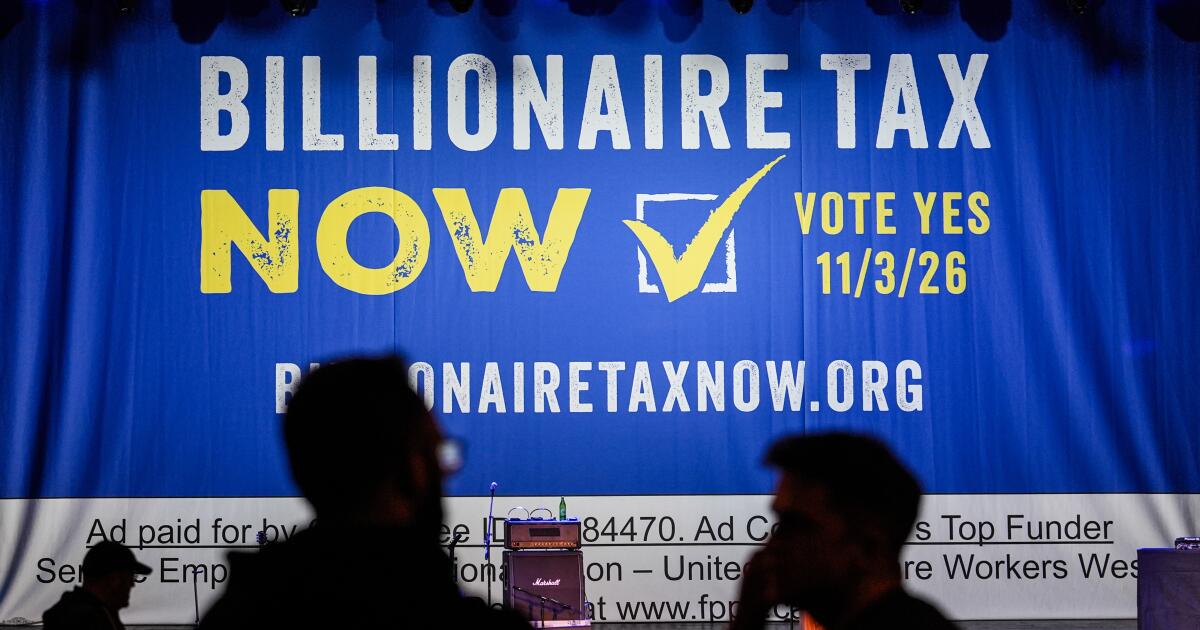
Billionaire tax proposal faces hurdles as it moves closer to November ballot
-
 Science37 minutes ago
Here’s why the Lincoln Memorial Reflecting Pool went green so fast
-
 Sports40 minutes ago
Shohei Ohtani out of Dodgers’ lineup vs. Orioles for birth of his second child

