Entertainment
'House of the Dragon': As Rhaenys battled, Eve Best channeled Hillary Clinton

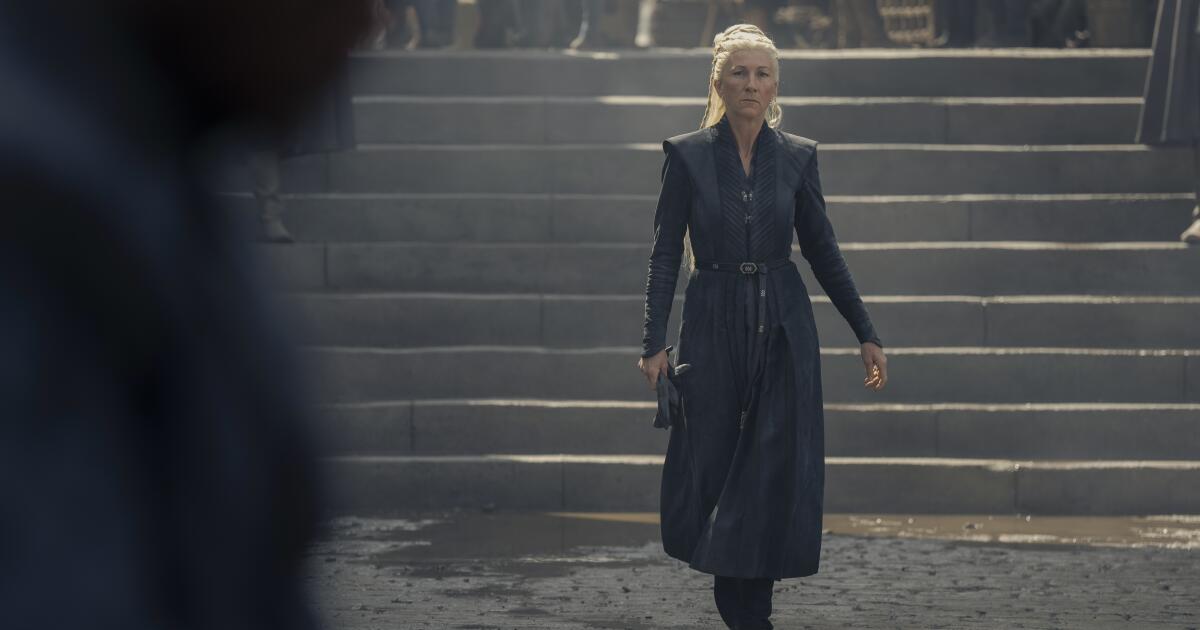
This story contains spoilers from “House of the Dragon” Season 2, Episode 4, “The Red Dragon and the Gold.”
The Queen Who Never Was is no more.
In Sunday’s episode of “House of the Dragon,” “The Red Dragon and the Gold,” Princess Rhaenys Targaryen (Eve Best) volunteers to take her dragon, Meleys, into battle at Rook’s Rest, which is besieged by the Greens’ army, led by Ser Criston Cole.
She encounters two other dragon-riding Targaryens: Aegon and his beast Sunfyre, who are quickly downed, and Aemond and the ferocious Vhagar, who prove to be more formidable opponents. Vhagar deals a fatal blow to the much smaller Meleys, who falls from the sky. With a look of peaceful resignation on her face, Rhaenys plummets to certain death.
Her fate — and Aegon’s uncertain future — marks what is sure to be an escalation in the Targaryen family civil war known as the Dance of the Dragons. Rhaenys, who was passed over in the line of succession in favor of King Viserys (Paddy Considine) because of her gender — only to see him name his daughter Rhaenyra (Emma D’Arcy) as his heir — was a rare voice of restraint and caution in the harsh world of Westeros, breaking out the fiery beasts only when absolutely necessary.
Rhaenys’ demise also means “House of the Dragon” viewers will be deprived of Best, a regal actor who infused the role with steely poise and quiet wisdom. Best has some experience with playing women in close proximity to the throne, having starred as Carole Middleton in the final season of “The Crown” and Wallis Simpson in “The King’s Speech.” From her home in Italy — where birds could be heard chirping in the background — she spoke with The Times about her character’s farewell, and the real-world inspiration she drew from a certain female politician.
Presumably you had some idea that things would end this way for Rhaenys. But how did you react when you read the script?
It’s the nature of the beast. If you’re part of the “Game of Thrones” franchise, the strong likelihood is that there’s going to be a sticky end at some point. I knew [Rhaenys was going to die], I just didn’t know exactly when.
I was devastated on her behalf. I think she’s such a magnificent character and a magnificent woman. There’s that wonderful film “The Last Samurai.” There’s similar territory with Rhaenys. I said to Ryan [showrunner Ryan J. Condal] at the end of last season, “I want her to go full samurai when when things kick off,” because up until that moment in Season 1, when she breaks through her own glass ceiling on the dragon so fantastically, she stayed very neutral. She’s trodden very lightly through the minefield.
When you see these noble characters, these warriors with truth and goodness on their side, [dying], it’s agony. In the context of this world, it’s such a tremendous loss. In Westeros, as in our world, enlightened feminine role models are vital and much needed. That’s absolutely the role that she plays, particularly in Season 2 — this beacon, like an instruction manual to Rhaenyra. This is what a good ruler does. This is how you lead. That’s something that’s always struck me about the nature of this particular story, the backbone of it being these women being thrust into the midst of a patriarchal system that is in disarray.
What Rhaenys represents is someone with absolute authority, power, wisdom, intelligence, expertise, political savvy and utter compassion — a constant awareness of [the need for] collaboration and making a choice for love, as opposed to destruction.
Eve Best as Princess Rhaenys Targaryen and Steve Toussaint as Lord Corlys Velaryon in “House of the Dragon.”
(Ollie Upton / HBO)
Did you think about any real–world figures, whether historical or contemporary, in relation to this character? There have been a lot of Rhaenys-like women.
Absolutely, 100%, almost every single great woman you can think of [has] an element of [Rhaenys]. Sara Hess, who’s the one of the executive producers and the lead writers for the show, said to me on the first day, “There’s so much of Hillary Clinton [in Rhaenys].” God knows you couldn’t compare Viserys to the other one [former President Trump], but the similarities are very clear — to see that the person who is absolutely, hands down, best suited for the job is sidelined simply because she’s a woman, and then has to somehow find her way.
One of the things that gave me the most respect for Hillary Clinton was in the aftermath of [the 2016 election], how she navigated her role/non-role and brilliantly maintained her dignity, self-respect and leadership. That felt like territory that Rhaenys was treading.
I felt keenly aware of how extremely difficult that is, that particular dance — to not let the inevitable human disappointment turn to darker feelings of revenge, resentment, blame, to let none of it fester, as we see it is starting to taint choices that [Rhaenyra and Alicent] are making. We see them both going down these rabbit holes of potential disaster because of their personal circumstances. Rhaenys somehow manages to stay above it all in spite of every single blow that’s thrown at her. The poetry of her literally coming to an end in the sky on her dragon and letting go into eternity is perfect.
Why do you think Rhaenys ultimately sided with Rhaenyra and Daemon, despite everything that happened to her children because of them (and her own claim to the throne)?
The decision to side with them is really tough, but yet again, she takes the personal out of the equation. The bigger picture is that Rhaenyra is absolutely the heir to the throne. Rhaenys has such a strong feeling of “not again on my watch can this story be told. This is not going to happen again. Literally over my dead body.”
It’s very clear that [Rhaenyra] is the infinitely more sensible choice than Aegon. On all fronts, it’s the right thing to do. It’s almost like Rhaenys is programmed to do the right thing. She puts away her personal feelings, which is so hard to do. It’s such a strong temptation to scratch her eyes out or just go off back to Driftmark with Corlys, sit looking at the sunset and wash her hands of all of them.
We’ve seen Rhaenys urge restraint over and over again. Why does she decide to use deadly force this time?
It’s reached the moment when it’s actually necessary. There’s a point of no return. She’s tried everything, she’s argued for restraint, collaboration and communication. She [told Rhaenyra] to go talk it out with Alicent, sister to sister, because these two women love each other and they have the power to heal.
The Black Council spends a lot of time debating whether or not to unleash the dragons. When we were rehearsing, I said, “What’s the context? How can we relate to this?” And Ryan said, straightaway, “Nuclear war.” Nuclear war is inevitable [in this world], and she knows 100% that she’s the last grown-up in the room, and the only person that can make that take that action.
The moment when she says, “Send me,” was changed at the last minute. Sara Hess, one of the writers, suggested that we change it to, “You must send me,” which is so brilliant, because it’s an instruction, almost like her last piece of guidance. She knows that she’s sacrificing herself, effectively. She knows that it’s the red button, and if anybody’s going to have the responsibility for pressing that red button and dealing with the appalling, devastating weight of that action, it has to be her, because she’s the one who can cope with it, not just physically, but emotionally. I think she knows damn well that it is a kamikaze mission and is downplaying it.
Tell me about shooting the battle sequence. What’s the hardest part of riding a dragon?
Technically, it’s incredibly demanding and exhausting. I certainly feel my age, I don’t think this is my comfort zone at all. I kept having to ask for many more cushions. It was two weeks solid, just me, all morning and evening, all afternoon, doing quite a lot of physical stuff. That was a challenge. But the more challenging part was the emotional story. The moment of their joint demise was my penultimate shot. The buildup to it was quite intense. I was feeling a lot of pressure to make a good death, to do the character justice.
Ryan very sweetly came to set and gave a lovely speech, saying goodbye. The spotlight on this moment just became more and more unbearable. It was complicated to do the camera angles, and they had to prep for everything. I was standing about, waiting and feeling more anxious. By the time [we got to it], I was a pressure cooker ready to explode. I was strapped on — and it was over in a flash. We did two takes, and that was it, which was perfect. In that moment, what was key about it for her was this absolute, letting go and acceptance. This is exactly what one goes through as an actor: In the end, you have to just let go and accept because you’re not in control.

Movie Reviews
‘Night Nurse’ Review: A Caretaker Explores Her Kink for Elder Abuse in the Year’s Strangest Erotic Thriller

There are any number of erotic thrillers in which rich old men are robbed blind and/or left for dead, but Georgia Bernstein’s admirably bizarre “Night Nurse” might be the first movie of its kind where elder abuse is the source — and possible subject— of its erotic thrills. If there are others, I’m not sure I want to know.
But this woozy debut feature doesn’t rely on its audience being turned on by the relationship between a nubile caretaker and her dementia-addled patient. Their psychosexual bond, meanwhile, hinges on cold-calling vulnerable old people under the guise of a grandchild in financial distress. (“I’m in trouble, nana, send me $10,000 or I’ll be left to rot in jail!” That sort of thing). With its slim wisp of a premise stretched into a Strickland-esque dreamscape that substitutes kink for conflict, the film itself hardly seems convinced by its own wrinkled lust — all desperate kisses and non-touching poses of subservience. More important to Bernstein is what that lust reveals about her characters’ deepest needs, specifically how their need to care and be cared for can be as easily perverted as any other form of desire.

As moody and weightless as the noir-accented score that blows through the movie like a curlicue gust of wind in an old cartoon (credit to musicians Sam Clapp and Steven Jackson), “Night Nurse” lacks the pulse required for its stray feelings to come alive. Still, the film ambiently taps into the latent eroticism of teasing out the distance between how you see yourself and who you really are. Bernstein plays with that distance like a telephone cord wrapped around her fingers, and Eleni — played by the excellent newcomer Cemre Paksoy, powerfully helpless — only frays even more as the receiver is brought near the hook. “Everything I did before today wasn’t me,” the nurse tells co-worker Mona (Eleonore Hendricks) after starting a new job at an Illinois retirement home. “It was somebody else.”
What she did before today remains unexplored (specifically, what she did to get herself fired from her last gig), but I’m guessing she’s probably changed less than she thought. There’s a faraway flicker in her eyes the moment she catches the vibe between Mona and Douglas (a ribald and elusive Bruce McKenzie), a white-haired seventysomething who shows early signs of dementia but still commands an undiminished sexual energy. “I’m not an invalid,” he coos as Mona bathes him in the tub, to which she replies, “yes, you are,” in a supplicant tone that hints at a rich history of power games between them.
Later that same night, Douglas will force Eleni to call a stranger, pretend that she’s their granddaughter, and ask for money — he’ll wrap the phone cord around the nurse’s body as she talks and shove her against the wall as they kiss. She’s into it. So into it that he has to clarify the terms of his whole deal: “If you’re looking for a pogo stick, I’m really not your guy.” But Eleni isn’t looking for anything to bounce on. She just wants to be needed, and maybe to need someone in return. Someone who will see her for who she really is and allow her the fantasy of pretending she isn’t being herself when she cons vulnerable strangers out of their money — when she exploits how enthralled those strangers are by the care they have for their loved ones.
“Night Nurse” doesn’t belabor the psychology, as Bernstein prefers to express her story through heavy-lidded suggestion. Somnambulating from the moment it starts, the film moves through a series of beautifully arranged poses that stretch their latent meaning thin across the surface (Lidia Nikonova’s cinematography lacquers every shot with a seductive dreaminess). We see Douglas smoking in a lawn chair with Mona and Eleni curled around his feet. Eleni riding in the backseat of a convertible as the wind blows through her curls. The full staff of nurses — all of them under Douglas’ sway — stumbling around his condo in a state of zonked out bliss as they roll on the prescription drugs they’ve stolen from the residents.
Once you’ve seen one shot of this movie, you’ve practically seen them all, at least until things escalate during a rushed and unsatisfying third act that forces Eleni into an honest confrontation with herself. People will do just about anything to feel needed — they’ll give whatever degree of care allows them to receive it in return. “Night Nurse” understands that desire, but remains far too numb to treat it.
Grade: C+
The Independent Film Company will relase “Night Nurse” in theaters on Friday, July 10.
Entertainment
Lucas Museum to give free annual passes to South L.A. neighbors, host community preview day

The Lucas Museum of Narrative Art, which is moving at light speed toward its Sept. 22 opening, announced Thursday that it will give free annual passes to its South L.A. neighbors living in the 90037 ZIP Code. The 300,000-square-foot, $1-billion museum located in Exposition Park will also host a special community preview day on Sept. 13, more than a week before the general public gets to step inside.
The 90037 ZIP Code has a population of more than 65,000 and is bordered roughly by the 110 Freeway to the west, Slauson Avenue to the south, Central Avenue to the east and Martin Luther King Jr. Boulevard to the north. Residents can register for passes at lucasmuseum.org/lm37 and will be alerted in August when the program launches. Pass holders can reserve tickets for themselves and one guest.
Tickets for non-pass holders go on sale July 21. They cost $25 for adults and $21 for seniors. Kids 17 and under are free.
“Storytelling has the power to bring people together and create a sense of community,” said Lucas Museum Chief Executive Tracey Bates in a news release about the program. “Through LM37, we are inviting our South Los Angeles neighbors to make the museum part of their lives and take their own path of discovery through the art, programs and experiences that will help shape this new cultural hub for Los Angeles.”
The community preview day is designed to give local business owners, community partners, civic leaders and registered LM37 pass holders a sneak peak of the 10,000 square feet of exhibition space, as well as the expansive gardens with 11 acres of park space.
The opening programming, curated by co-founder George Lucas, features 20 inaugural exhibitions across more than 30 galleries, including one titled “Star Wars in Motion,” containing vehicle designs, high-speed racers, flying vessels, props, costumes and illustrations from the first six films in the beloved franchise.
More than 1,200 objects will be on display from Lucas’ personal collection of narrative art. Highlights include work by Norman Rockwell and Dorothea Lange, as well as a variety of manga, children’s book illustrations and comics.

Last year’s “Superman” ended with Iggy Pop singing “Because I’m a punk rocker, yes I am” — an ironic coda for a superlatively square hero. But it rings straightforwardly true for Superman’s cousin.
Milly Alcock’s Kara Zor-El, or Supergirl, sports not a spandex suit but a Blondie T-shirt. When we meet her in Craig Gillespie’s “Supergirl,” she’s been on an interstellar bender for days. She’s more Courtney Love than Clark Kent.
Nonchalant and sarcastic, Kara is also a little Han Solo-ish, you might say, given that she moves capriciously through the galaxy in her junky spaceship while getting in fights in extraterrestrial bars. She’s a welcome, jagged riff on more buttoned-up superheroes, and Alcock is terrific in the role. If only “Supergirl” was as good as she is.
While the latest DC release, and second under James Gunn’s stewardship, has its moments, “Supergirl” struggles to match Kara’s punk-rock energy with an equally spirited supporting cast and story.
Skepticism seems to have gathered for “Supergirl” ahead of its release. Many fans have argued it wasn’t the right next step for DC Universe. But I’m not so sure. Alcock’s breezy cameo in “Superman” was one of that movie’s highlights. Handing the follow-up to her, and her faithful floating dog Krypto, strikes me as an extremely natural next step. When in doubt, follow the dog.
And much of “Supergirl” is winning. It resides almost entirely in space, touching down only momentarily on Earth. In its consistently creative production design, clever needle drops and underdog story arc, “Supergirl” resides a little closer to Gunn’s “Guardians of the Galaxy” movies than other DC entries. Its outer space is filled with cosmic detritus, mean characters and cute critters. Seth Rogen as the voice of a tiny alien co-piloting a space bus is an inspired concoction, as is a shabbier sci-fi realm with rest stops along the intergalactic highway.
-
 Idaho4 minutes ago
Brush fire prompts GO NOW evacuations near Mesa in Adams County
-

 Illinois11 minutes ago
Illinois waives tax penalties for 11 counties hit by storms, including Stephenson and Winnebago
-

 Indiana13 minutes ago
Attempted murder suspect arrested in Indianapolis for Bloomington shooting
-

 Iowa18 minutes ago
Iowa WWII veteran approaching 100th birthday honored in Cedar Rapids
-

 Kentucky23 minutes ago
Exantus may be subject to involuntary hospitalization due to Kentucky law
-

 Louisiana34 minutes ago
Parasitic stomach illness that can cause explosive diarrhea rises in Louisiana
-

 Maine41 minutes ago
Is prison in play for Graham Platner?
-

 Maryland44 minutes ago
Office building in Glen Burnie evacuated after shift in parking garage floor

