When Becket Harris started college at the University of Utah, the school’s LGBT center quickly became the most important spot on campus for her — a place where she studied, made friends and never had to worry about how people would react to learning she was transgender.
Utah
Utah law targeting DEI leads university to close LGBT, women’s centers


“What am I going to do without my space on campus? How’s my friend group going to stay together?” said Harris, who finished her sophomore year this spring. “It’s attacking a space that’s very personal to me.”
Across Utah, public schools, universities and government agencies must make shifts to comply with the law, which goes into effect Monday. The state becomes the latest where Republican legislators have restricted DEI programs, amid a broader conservative effort to limit what is taught in schools and make diversity programs a flash point in the nation’s political debate.
Laws in other states have forced some universities to eliminate programs and jobs and, more commonly, to change hiring practices, such as ending requirements for diversity statements from job candidates. Some type of change to diversity requirements or programs has been made at 164 college campuses in 23 states since January 2023, according to a tally by the Chronicle of Higher Education.
At the University of Utah, administrators said they have had less than two months — the bill was passed in January, but the state higher education office’s guidance about how to comply with the law came down in May — to make final decisions about how to reorganize their staff and services. The school won’t lose its student services and will continue holding cultural events, but complying with the law will require a significant change in approach, administrators said.
“This definitely is having a profound impact,” said Lori McDonald, vice president for student affairs.
The Utah law labeled services for different communities — racial, ethnic, religious, gender-based or sexuality-based — as “discriminatory.”
Although it left their funding in place, it effectively directed schools to reorganize those services, such as mental health, career and scholarship help, under generalized campus centers catering to all students. Furthermore, the state’s guidance indicated those services couldn’t operate in centers that also did cultural programming.
At the University of Utah, school officials said that means closing its specialized centers in favor of two umbrella offices: one for all cultural programming and another for all student services. The school’s Division of Equity, Diversity and Inclusion has been eliminated. About 45 staff were affected, many of whom will be reassigned to the two new centers.
“This is not the path we would have chosen,” University Provost Mitzi Montoya wrote in a note to deans and faculty Thursday. “But … it is our calling to rise to the challenges of the day and find a better way forward.”
On Friday, a farewell was planned for the university’s LGBT Resource Center, which asked supporters to “join us to laugh, cry and celebrate” its 21-year run. An Instagram post advertising the goodbye party drew dozens of comments and broken-heart emojis.
“I’m starting school in the fall and am so upset this won’t be a resource for our community,” one person wrote. Another said, “Every single person in this building made me feel at home.”
Added a third, “I found support here [when] there was nowhere else.”
Along with the LGBT Resource Center, the university’s Women’s Resource Center and the Center for Equity and Student Belonging will close. Both the women’s center and the Center for Equity and Student Belonging, previously known as an ethnic student affairs center, had been in operation for more than 50 years, Montoya noted.
The law doesn’t mandate the closure of student centers, allowing them to stay open as cultural centers as long as they don’t also provide student services. Utah state Rep. Katy Hall (R), the bill’s House sponsor, said some universities had chosen to close centers “to better meet the goals” of the law.
The idea of leaving the centers open without providing the services they were created to house felt disingenuous, McDonald said, and university officials weren’t sure enough staff would be left to run them after some employees move to the student services center.
The university plans to keep its Black cultural center open; staff are working on how it will operate under the law as a gathering place, McDonald said. Those plans will have to be approved by the state, university officials said.
The law does not affect classroom instruction, academic freedom or academic research, the Utah System of Higher Education said in its guidance.
This spring, lawmakers in Alabama and Iowa passed similar bills to restrict DEI programs, and Wyoming removed state funding for the state university’s DEI office, forcing its closure. In mid-June, Republican members of Congress introduced a bill proposing to end all federal diversity, equity and inclusion programs and pull funding from government agencies, schools and others with DEI programs.
The law’s passage in Utah played to the more conservative wing of a divided Republican Party, said Michael Lyons, a political science professor at Utah State University. In an election year, Gov. Spencer Cox (R) and other GOP lawmakers faced the need to win over party delegates in Utah’s caucus-based nominating process.
“It’s not surprising to see them take very conservative positions,” he said.
Upon signing the bill, Cox said it offered a “balanced solution” by repurposing funding “to help all Utah students succeed regardless of their background.” His office did not respond to a request for comment from The Post this week.
Hall, the bill’s sponsor, said on the House floor that the measure came about because she had heard “serious concerns about the landscape at our higher education institutions” from “students and many professors.”
“I hope that students who benefited from these centers in the past know that the expectation is that they will still be able to receive the services and support that they need to succeed,” Hall told The Post.
Utah House Minority Leader Angela Romero (D) said she feared the bill would end up erasing people and identities, noting in a floor debate that she might not have succeeded at the University of Utah if not for the support of the ethnic students’ center. Free-speech advocates have also said such laws have a chilling and censoring effect on campuses.
Utah State University said this month it would reassign programs and clubs that had been housed under the school’s Inclusion Center and would ensure that its Latinx Cultural Center and a proposed Native American center comply with the law. The school said it would create a new center for community and cultural matters. Weber State University in Ogden, Utah, has closed its Division of Equity, Diversity and Inclusion and identity-based centers and reorganized staff positions.
At the University of Utah, where staff members are still working out plans for the new centers, Harris, the student, remembered the LGBT center as a cozy place that made college much easier — and worried about what the changes might mean for future students.
“I could just walk into a space,” Harris said, “and I knew that everyone there was safe to talk to.”



SALT LAKE CITY (KUTV) — Utah law enforcement agencies are increasingly using facial recognition technology to identify criminal suspects, but state law limits its use to specific circumstances and imposes some of the strictest safeguards in the nation.
Under Utah law, facial recognition technology may only be used for certain law enforcement purposes, including felony investigations, violent crimes, threats to human life, and efforts to identify deceased, incapacitated or at-risk individuals.
The technology recently came under scrutiny in the case of Brad Johnston, who faced a felony charge related to the vandalism of an Uber driver’s vehicle after a facial recognition match linked him to the case. Johnston maintained he was not involved.
“The only way I can describe it was just terrifying,” Johnston said.
MORE: Facial recognition AI misidentifies Utah man in felony vandalism case
The match was generated from surveillance video taken from inside the Uber ride, but Johnston insisted investigators had identified the wrong person. After months of court proceedings, the case was ultimately dismissed.
According to the most recently available data, Utah law enforcement agencies submitted 1,191 facial recognition requests between July 1, 2024, and June 30, 2025. Of those, 706 resulted in probable matches, a rate of about 59%.
State law requires all facial recognition requests to be processed through the Utah Department of Public Safety.
Tanner Jensen, chief of investigations for the department, said requests from law enforcement have increased over the past five years.
Jensen said the system will analyze biometric data and measurements and two people manually review each image submitted for comparison. The process results in one of two outcomes: a possible match or no result. Once findings are returned to the requesting agency, the department’s involvement ends.
“If they do both feel like the match is viable, they’ll send that to the officer for further investigation with a disclaimer that this is an investigative lead and not necessarily something that’s part of the evidence,” Jensen said.
Most identifications are generated through comparisons with a driver’s license photographs. Jensen said biometric characteristics remain consistent over time, but human review is still critical.
“You may get a percentage below 90%, but that’s not to indicate that that’s not the individual,” Jensen said. “Or you may get a percentage that’s above 90% and we still don’t feel confident that that would be the individual. It really comes down to the human-in-the-loop aspect.”
Retired Salt Lake City Police Chief Chris Burbank said law enforcement agencies have adapted quickly to emerging technologies, much as they did when body-worn cameras were introduced.
“The technology is just moving so fast and furious,” Burbank said. “One of the things is the availability of AI to analyze a large database.”
Burbank said strong policies must guide the use of technology in policing.
“We need to ensure, again, is this policy sound for the public or is it just good for policing?” he said.
_____

SALT LAKE CITY — Although likely not in contention for the Utah Jazz with the No. 2 overall pick, Illinois guard Keaton Wagler is a name to remember in this year’s draft cycle.
As somewhat of a late-bloomer, Wagler dazzled with his offensive game in just one season with the Fighting Illini. But would the combo guard fit well with the Jazz?
Below is a full breakdown of his game, strengths, weaknesses, and potential fit in Utah.
Keaton Wagler: NBA Draft Snapshot
School: Illinois
Position: Guard
Age: 19
2025–26 stats
- 17.9 points
- 5.1 rebounds
- 4.2 assists
Shooting splits
- 44.5% FG
- 39.7% 3PT
- 79.6% FT
Strengths
- Positional size
- Shooting & shot-making
- Creation & pace
Weaknesses
- Defense
- Athleticism
- Strength
What Makes Keaton Wagler A Top Prospect In The NBA Draft?
The projected top ten in the upcoming draft is littered with guards, especially once you get past the first four. Of those guards, Wagler has arguably the best positional size.
Standing at 6-foot-6 with an unconfirmed wingspan of 6-foot-9, the Illinois freshman burst onto the scene with his smooth offensive game.
Maybe most impressively about Wagler is his ability to control the pace and tempo with the ball in his hands, a trait mastered by superstars in the NBA like Luka Doncic and Shai Gilgeous-Alexander.
What sticks out to me most with Keaton Wagler is his pace/tempo with the ball in his hands.
His ability to control the game offensively is impressive for a college freshman.
— Chandler Holt (@CHoltSports) April 24, 2026
Wagler demonstrated plenty of craft and control to get to his spots on offense, and he was just as prolific when it came to finishing the play.
He shot a blistering 39.7 percent on threes with a 59.6 true shooting percentage, both of those marks around or above the 80th percentile in college basketball.
It got to the point where other teams opted to foul Wagler instead of letting him pick apart their defense. He finished the season with 11 free throw attempts a night (89th percentile), and he shot a respectable 79.6 percent from the stripe.
When he wasn’t scoring or getting sent to the line, Wagler showed decent playmaking chops, dishing out 4.2 assists per game with a very solid 2.4 assist-to-turnover ratio.
His passing game is at a base level right now. He has the ability to find the open man and make the right play, but there weren’t many eye-popping, “How did he see that?” passes across his 37 games with the Fighting Illini.
Illinois freshman Keaton Wagler on the road at #4 Purdue:
39 MIN
46 PTS (most ever by a visitor at Mackey Arena)
4 AST
13-17 FG
9-11 3PT
11-13 FTLegitimately one of the single greatest performances in college basketball history…🔥🔥 pic.twitter.com/yNbB0LAywX
— MBB Performances (@mbbperformances) January 26, 2026
There is a real argument for Wagler as one of the best shooters in the class. He has a lot to flesh out on both ends, but having the jumpshot as a fallback keystone skill could be very important for his development.
As a best-case scenario, Wagler could be a do-it-all combo guard offensively whose length lends him to be a passable perimeter defender. Think 18-5-5 averages with the ability to pop off for 30 points with five made threes on any given night.
Why Drafting Keaton Wagler Is Somewhat Of A Gamble
Wagler is somewhat of a late bloomer physically. It was reported that he stood at 5-foot-8 as a high school freshman and joined the Illinois program at a measly 168 pounds.
The silver lining is that he put on 14 pounds in just one summer of training on campus. With the assistance of an NBA strength training regimen, it is fair to project growth in that area.
Also, despite being outmatched physically most nights, Wagler showed no hesitation in driving into traffic and throwing his body around. Although he finished the season with zero dunks, and just one attempt.
Often, he struggled when the opposing team had either a daunting rim protector or physical point of attack defenders.
Illinois freshman guard Keaton Wagler – ranked No. 5 in ESPN’s Top 100 – has declared for the 2026 NBA draft, his agency ProMondo Sports tells me and @JeremyWoo. Wagler led the 28-9 Fighting Illini to the Final Four for the first time since 2005. pic.twitter.com/EPenhAQcz3
— Shams Charania (@ShamsCharania) April 11, 2026
As could be expected, his lack of strength and athleticism showed most on the defensive end.
With 1.3 stocks per game and just about average advanced defensive metrics, it’s unclear how much blame can be placed on the fact that he is underdeveloped physically.
He has great feel and basketball IQ on offense. Optimistically, that could eventually extend to the defensive end. But reality could see him evolve into a mostly one-sided player.
How Would Keaton Wagler Fit With The Utah Jazz?
From a positional and skillset view, Wagler could fit in well with the Jazz. As an off-guard, he could slide in as the two alongside Keyonte George, while also not interfering with the loaded frontcourt rotation.
He would likely come off the bench for the first few seasons of his career, with the opportunity to join the first five as he grows and matures.
It is worth noting that two of Utah’s recent first-round picks, Cody Williams and Ace Bailey, also came in needing to put on weight. Williams struggled early, while Bailey had enough offensive talent to negate the clear need for physical progression.
As the Jazz move toward playoff contention, the path for development isn’t as unobstructed as that of other teams in the lottery. Still, Wagler would have ample opportunity to become an effective rotational piece with enough time to make the necessary improvements.
Chandler Holt is a Utah Jazz insider for KSLSports.com and co-host of the Jazz Notes podcast. Follow Chandler on X for Jazz and NBA updates.
Take us with you, wherever you go.
Download the new & improved KSL Sports app from Utah’s sports leader. You can stream live radio, video and stay up to date on all of your favorite teams.

Candidate handouts are displayed at an event for candidates running to represent Utah’s new Democratic-leaning congressional district in Taylorsville, Utah on March 21. While some candidates have since dropped out, four remain including former Rep. Ben McAdams and state Sen. Nate Blouin.
Hannah Schoenbaum/AP
hide caption
toggle caption
Hannah Schoenbaum/AP
In the past, a Democrat running for Congress in Utah would typically face an uphill battle. But, for the first time in modern history, Utah has a safe Democratic congressional seat that could help determine the makeup of the House majority come November.
The outcome is a result of a mid-decade redistricting process that had nothing to do with President Trump and everything to do with a years-long legal battle to prevent partisan gerrymandering. The legal battle ended with Utah’s four congressional districts redrawn.
Cook Political Report labels the newly redrawn 1st Congressional District as +12 points for Democrats, though some argue it’s even bluer, based on the percentage of its population that voted for former Vice President Kamala Harris. The new map concentrated the capital and largest city Salt Lake City, the bluest dot in a red sea, into one seat and included many of the more Democratic-leaning suburbs. The opportunity to elect a Democrat has generated enthusiasm among the Utah Democratic Party in an era when sentiment for the national party is floundering.
It’s also created one of the most competitive Democratic primary election races Utah has ever seen. In a crowded field, voters will pick between four candidates who are all different flavors of Democrat, ranging from moderate to much more progressive and aligned with the Democratic Socialists of America.
“Democrats are the odds on favorites to win this district. The question has shifted from can a Democrat win to the question of which Democrat will win,” said Damon Cann, professor of political science at Utah State University.
The top three candidates, Democratic state Sen. Nate Blouin, former Democratic Rep. Ben McAdams and the political newcomer and Utah Democratic convention winner Liban Mohamed, are all presenting different messages to voters.
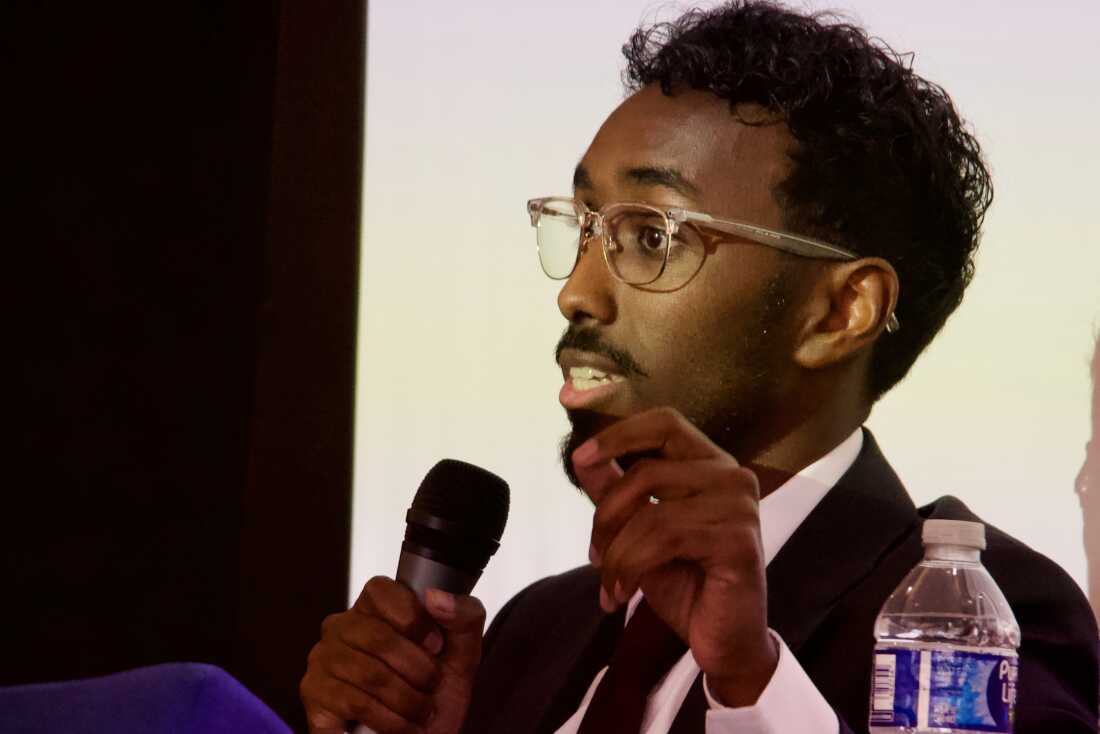
Liban Mohamed won more than 51% of the delegates at the Utah Democratic Party’s nominating convention in April, though the primary will decide the final nominee. In this file photo, Mohamed speaks on a panel of candidates running to represent Utah’s new Democratic-leaning congressional district in Taylorsville, Utah on March 21.
Hannah Schoenbaum/AP Photo/Hannah Schoenbaum/AP
hide caption
toggle caption
Hannah Schoenbaum/AP Photo/Hannah Schoenbaum/AP
Why Utah’s race matters nationally
The new district is the biggest opportunity Utah Democrats have ever had for Congressional representation, especially when the majority margin in Congress is miniscule.
“We have the ability to add to the body and the Democrats in the House of Representatives in a way that may swing that chamber back to Democratic control,” said Brian King, the chair of the Utah Democratic Party.
It’s also a pocket of blue energy during a time when excitement for the national Democratic party is low. The moment the district was solidified, King said candidates were immediately jumping in the race and participation at the Utah Democratic Convention hit a record turnout.
He said Utah is a successful example of why the national party should be investing in flipping red states and not just focusing on purple districts and areas they know they can win.
“Democrats, if they’re going to be successful across this country, they have to figure out how to speak, to reach and change the hearts and minds of voters in red areas,” he said.
Democratic factions on display

Former Rep. Ben McAdams, seen here in a campaign photo, argues the new district isn’t as blue as its rating might suggest and that a more moderate, pragmatic lawmaker makes sense.
Ben McAdams for Congress
hide caption
toggle caption
Ben McAdams for Congress
The candidate with the most name recognition is former Rep. Ben McAdams. In 2018, McAdams flipped a purple district when he beat a Republican incumbent.
While he’s widely considered a moderate, he calls himself a “pragmatic” Democrat that is keen on working across the aisle to get stuff done.
“I’m a candidate who can bring people from across the spectrum and rally them together and win tough elections. I’ve won tough elections before,” McAdams told NPR. “I’m somebody who has built coalitions to tackle some of our most difficult issues.”
He’s also presented by his opponents as the safe establishment choice. There have been questions about whether McAdams is too moderate for such a safely blue district. During his time in Congress, one analysis tagged him the most conservative Democrat in the caucus.
But McAdams believes the district isn’t as blue as people think it is. There is a significant percentage of Republicans and independents in the district. He is targeting those voters as well.
“Democrats aren’t going to win this district by appealing only to Democrats. We’re going to have to build a bigger coalition. We’re going to have to bring in the independents and unaffiliated. We’ll even have to bring in some Republicans,” McAdams said. “That’s the nature of the way things are in Utah.”
What voters want
Knocking on doors in a neighborhood right outside of Salt Lake City, state Sen. Nate Blouin made his case to voters as to why he should represent the new solidly blue congressional district in deep red Utah.
“I’m a progressive Democrat really focused on addressing people’s real material concerns,” Blouin told a prospective constituent who disclosed their loved one was battling cancer. “We’ve got to take on the big money in politics and actually find ways to reinvest in our communities. You know, affordable housing [and] Medicare for all are big proposals that I’m going to fight for in D.C.”

Utah state Sen. Nate Blouin is endorsed by Sen. Bernie Sanders and says his progressive message will win over Democratic voters. Before April’s nominating convention, Blouin, here in a campaign photo, was seen as the main challenger to McAdams.
Nate Blouin for Congress
hide caption
toggle caption
Nate Blouin for Congress
Blouin gained a reputation for being a rabble rouser during his time in the Utah state legislature as a vocal critic of controversial conservative legislation. But being outspoken can also backfire on him. More than a decade ago, he made lewd, disparaging remarks online about Latter-day Saints, the predominant religion in Utah, and sexual assault victims. Blouin has since apologized for his comments.
Meanwhile, 27-year-old political newcomer Liban Mohamed has gained an enormous amount of momentum after he won 51% of the delegate vote at the Utah Democratic convention. He’s the son of Somali immigrants. While the delegate win is important, the party will decide its candidate in Tuesday’s primary election.
Mohamed quit a job at TikTok where he lobbied against the U.S. ban of the social media platform and made the decision to run for office. Mohamed considers himself a progressive but has been called a Democratic Socialist over his political priorities.
“I’m focused on a platform to educate and advocate for the things that are going to help people have a roof over their head after working long hours, to be able to afford their health care, to be able to not have to choose between their paycheck or the well-being of their child,” Mohamed told NPR. “Most people might call this democratic socialism, progressive politics. I call it a working class, focused politics, people-centric politics.”
The fourth candidate on Tuesday’s ballot is another progressive, tax attorney Michael Farrell.
What the primary election outcome can message to the party
With both Blouin and Mohamed on the ballot, plus Farrell, there is a good chance the progressive vote will split, handing the victory to McAdams. But if both candidates combined win 50% or more of the vote, Damon Cann, the Utah State University political science professor said that is a persuasive argument about the direction Democratic candidates should be heading in the area.

“It would be wise for future candidates to read this as a matter of a majority of the district looking for a more progressive option,” Cann said. “It’s really just the field of candidates and the way votes broke down among them that led to this particular election outcome.”
Since the candidates are articulating different goals and ambitions, Cann said it signals the broad spectrum of what it means to be a Democratic in the U.S.. It can also inform the direction, the tone and policy priorities of the national Democratic Party.
In Utah, Cann believes the race in the 1st Congressional District lays out the choice facing Democrats across the country: whether voters want a party that will stand its ground on policy priorities, even if that means the needle doesn’t move quickly, or a party that aims for collaboration — even if that means compromise.
-

 North Dakota6 minutes ago
Grand Forks man appeals manslaughter conviction
-
Ohio9 minutes ago
Ohio Lottery Powerball, Pick 3 Midday winning numbers for June 22, 2026
-

 Oklahoma14 minutes ago
Oklahoma captures third MCWS title, defeating North Carolina 13-2
-

 Oregon21 minutes ago
Gray whale carcass washes ashore in Gearhart on Oregon coast
-
Pennsylvania24 minutes ago
From peace talks to Pennsylvania: Trump visiting Mack Truck facility
-
Rhode Island29 minutes ago
RI Lottery Powerball, Numbers Midday winning numbers for June 22, 2026
-
 South-Carolina36 minutes ago
What to know about a cold storage warehouse fire in Los Angeles
-
South Dakota39 minutes ago
SD Lottery Powerball, Lotto America winning numbers for June 22, 2026


