Michigan
Michigan lawmakers approve $82.5B state spending plan for 2025


LANSING — Michigan lawmakers early on Thursday passed an $82.5 billion state budget for the 2025 fiscal year, with just over $59 billion going to support state government agencies and about $23.4 billion going toward education.
After a session that spanned 19 hours, the spending plan was approved at 5:10 a.m. with immediate effect, despite nearly unanimous Republican opposition, and sent on to Gov. Gretchen Whitmer, who is expected to sign it into law.
It’s a bigger budget than the $80.7 billion spending plan Whitmer proposed in February, but state revenues and fund balances have improved somewhat since then.
The biggest drama surrounding the final budget plan related to school funding. The budget’s freezing of the K-12 per-pupil grant for 2025 at this year’s level of $9,608 created a split with sectors of the public school education community that has been one of Whitmer’s staunchest allies. Groups such as the Michigan Association of Superintendents and Administrators and the K-12 Alliance of Michigan spoke out strongly against the funding plan Wednesday and said it would result in layoffs. That’s despite the fact Whitmer’s administration insisted schools would have more money to spend in the classroom in 2025 than they did this year, due to a major cut in what school districts will have to pay to the school employee retirement fund.
Without assurances that the one-time cut in retirement expenditures will be permanent, the budget “provides no long-term funding relief and will lead to layoffs this fall and in the future, as the funding for our schools will not be enough to keep up with inflation, rising health care costs, and the ending of federal relief dollars,” the association of superintendents and administrators said in a Wednesday action call to its members.
Charter schools, which don’t pay into the Michigan Public School Employees’ Retirement System, would receive a 3.9% increase to their per-pupil grants, according to an analysis of House Bill 5507 prepared by the House Fiscal Agency.
The education budget passed the House early Thursday in a 56-54 party-line vote and hours later passed the Senate 20-18, also along party lines. Senate Republicans did not try to fight immediate effect for the two budget bills, as they could have done, since neither had the required two-thirds support.
The Democratic-led House also passed Senate Bill 911, which would reduce school district contributions to the employee retirement fund not just for 2025, but for future years. Democrats say the reduction is justified because post-retirement health care for teachers is now fully funded, though other shortfalls in the pension fund continue.
“Teachers and school employees have more than met their obligation to retiree health care and deserve to have their hard-earned dollars back,” said Rep. Regina Weiss, D-Oak Park, chair of the House Appropriations Subcommittee on School Aid and Education. “This legislation ends a decades-long policy that resulted in underfunded classrooms and a loss of pay for teachers.”
The main state government bill passed the Senate in a 20-17 vote, shortly before 4:30 a.m., with only Sen. Ed McBroom, R-Vulcan, joining Democrats in voting yes. The House then approved the spending plan in a 56-54 party-line vote.
Together, the bills fund the 2025 state fiscal year, which runs from Oct. 1, 2024 through Sept. 30, 2025.
The Whitmer administration and Democratic legislative leaders have framed the overall budget as one that continues her administration’s emphasis on improving education while reducing costs for Michigan families, takes steps to make Michigan more attractive for major manufacturing projects, and improves the equity of state government spending priorities to better benefit communities that have historically been underserved. Sen. Sarah Anthony, D-Lansing, chair of the Senate Appropriations Committee, said the budget is “fiscally responsible and also looks out for every Michigander.” State Budget Director Jen Flood has also characterized the budget as a return to normal after several years of sharply increased revenues, largely as a result of federal COVID-19 relief funding.
Republicans denounced the budget as bloated and accused Democrats of raiding retirement funds to find more dollars to spend, after quickly burning through a $9-billion state surplus. “They’ve created an unsustainable state budget and they want to play shell games to simply tread water,” said Sen. Thomas Albert, R-Lowell.
As one would expect for a governor who enjoys a Legislature controlled, albeit narrowly, by members of her own party, Whitmer got much of what she wanted in the final budget plan. But she didn’t get everything.
Whitmer’s proposed $25 million Michigan Vehicle Rebate Program was among the budget items that ended up on the committee room floor, according to a summary of Senate Bill 747 prepared by the House Fiscal Agency. It would have provided point-of-sale rebates of $2,000 for the purchase of new electric vehicles and $1,000 rebates for the purchase of internal combustion vehicles, with an extra $500 thrown in for vehicles that were union-made.
Also not making the cut in the final budget plan was Whitmer’s controversial proposal to raise an extra $80 million by massively increasing Michigan’s landfill tipping fees to $5 per ton, up from 36 cents per ton. The extra money would have been used in part to hire more people in the Department of Environment, Great Lakes, and Energy to clean up the state’s contaminated sites.
The conference committee also axed a Whitmer proposal to raise extra money by requiring motorists to “opt out” of getting a recreation passport for state parks when they renew their vehicle registrations, rather than “opting in” for the extra charge, as they do now. Had it gone ahead, the change was expected to raise a little more than $17 million extra per year.
And Whitmer’s call in her January State of the State to accelerate Michigan’s move toward universal publicly funded pre-kindergarten, by removing all income requirements for families to qualify, didn’t quite get there, either. Under the budget, 4-year-olds in all Michigan families, regardless of income, are eligible for free pre-kindergarten. But in the event there is a shortage of spaces, priority will be given to families with incomes at or below 400% of the federal poverty level.
Among the items included in the budget are:
- $100 million to help the Michigan State Housing Development Authority increase housing stock and affordability through the construction of new single-family and multi-unit homes, renovation of existing units, and improvement of energy efficiency. This marks a $50 million reduction from what Whitmer called for in February.
- $65.1 million to increase child care provider pay rates by 15%. This marks an increase from Whitmer’s February budget proposal, which called for a 10% pay hike, but it’s less than the 20% increase in child care provider rates in the version of the budget passed earlier by the Senate.
- Creation of a Michigan Innovation Fund, assuming required state legislation is passed and signed into law, to support Michigan startups, including through direct funding, technical assistance and other services. The fund was initially proposed at $60 million.
- An extra $15 million for the Pure Michigan tourism promotional campaign on top of the $25 million it received this year, with $14 million of the extra funding coming from remaining federal COVID-19 funding.
- Close to $2.1 billion transferred to local road agencies from the Michigan Transportation Fund, which is an increase of $110 million from this year.
- A 2.5% increase for operating costs at Michigan community colleges and public universities.
- $45.5 million to assist businesses locating or expanding in Michigan, specifically around workforce needs. The money would also be used to support development of “customized talent solutions to help fill identified needs in certain industries.” This reflects an increase of the $20 million proposed for this purpose in Whitmer’s February budget proposal. Also, neither the House nor the Senate included any money under this line item in the budgets each passed earlier this year. Separately, the budget includes $2 million to increase the amount of high-tech talent in Michigan through various programs.
- $335 million in one-time “enhancement grants,” including: $12.5 million for the planned Pine Rest Pediatric Behavioral Health Center of Excellence in Grand Rapids; $10 million for the Frankenmuth Youth Sports Complex; $10 million for Potter Park Zoo in Lansing; $7 million for Detroit Zoo infrastructure; $5 million for Mt. Clemens downtown redevelopment; $5 million for Plaza Roosevelt Park improvements in Grand Rapids; and $4 million for the Jim Crow Museum in Big Rapids.
- $18 million in grants to museums, including $5 million to the Motown Museum in Detroit, $2 million to the Lakeshore Museum Center in Muskegon, $1 million to the Chaldean Cultural Center in West Bloomfield, and $1 million to the Michigan Flight Museum near Belleville. Another $9 million would be awarded on a competitive basis to museums and nonprofits that operate educational programs at museums or provide other support to them.
- $6 million for Michigan orchestras, with $750,000 allocated for the Detroit Symphony Orchestra and the balance going to other orchestras through a needs-based program.
- $1.5 million for renovation costs of a township hall in Brownstown Township.
- $10 million to support minority-owned businesses, with funds to be awarded in a “geographically diverse” manner.
Soon after approving the budget, lawmakers adjourned for a summer break. They are next scheduled to meet at the end of July.
Contact Paul Egan: 517-372-8660 or pegan@freepress.com. Follow him on X, @paulegan4.



FLINT, Mich. – On June 8, 1953, disaster struck the north side of Flint and the northern suburb of Beecher when the Flint-Beecher tornado, Michigan’s worst natural disaster in terms of deaths and injuries, tore through the area.
The Flint-Beecher tornado remains the only tornado to strike Southeast Lower Michigan rated F5 on the Fujita scale.
According to the National Weather Service, an F5 tornado produces “incredible damage,” with winds estimated between 261 and 318 mph — powerful enough to level strong frame houses, hurl automobile-sized debris more than 100 meters and debark trees.
The scale of the storm was staggering. At 800 yards wide, the tornado didn’t just destroy homes — it erased entire blocks, entire neighborhoods, entire chapters of people’s lives in the span of minutes. Winds are believed to have exceeded 200 mph.
The tornado traveled 27 miles at approximately 35 mph, killing 116 people and injuring 844 others in its path.
For those in its way, there was little warning and almost nowhere to go.
It stands as the deadliest natural disaster in Michigan history and the 10th deadliest in United States history.
The aftermath
So many people were killed that the National Guard Armory and other buildings were temporarily converted into morgues. More than 100 people — families and friends of victims — waited outside in the rain for hours before they could enter to identify the bodies.
State Police Captain James Berardo warned the people outside that the tornado had horribly battered some victims and that the scene inside would be gruesome.
The Flint-Beecher tornado claimed lives ranging from as young as 5 months to as old as 80.
Of the 116 killed, 55 were under 20 years old — and five of those were less than a year old. Of the 844 injured, the last two survivors to be hospitalized were not discharged until five months after the tornado.
At least 20 families reported losing more than one member. The Gensel and Gatica families each lost five people.
Community response
In the wake of the disaster, state troopers, the National Guard and the Red Cross quickly mobilized to assist. Within 12 hours of the tornado, they provided first aid, food and clothing to survivors.
The National Weather Service noted in their Beecher 50th Anniversary Commemoration that the Flint-Beecher Tornado was one of eight tornadoes that occurred that evening across the eastern portion of the Lower Peninsula, resulting in an additional nine deaths and 52 injuries.
The tornado destroyed nearly 340 homes, with 107 sustaining major damage and 153 experiencing minor damage. An additional 50 businesses and other buildings were damaged, totaling an estimated $19 million — nearly a quarter of a billion dollars in today’s money.
Rebuilding the community
Beecher was able to rebuild thanks to the broader Flint community, which rallied around a “Red Feather” campaign to gather relief and rebuilding funds. Combined with Red Cross support, the effort helped the community get back on its feet.
In the late summer of 1953, a community-supported “Builder Bees” project brought volunteers together to help rebuild homes lost in the tornado.
Copyright 2026 by WDIV ClickOnDetroit – All rights reserved.


Is it legal? Clarifying Michigan laws for everyday life
“Is it Legal?” is a weekly feature on freep.com that answers reader questions about Michigan laws. Topics covered include car window tinting regulations, permissible ways to deal with groundhogs, and whether it’s legal to record conversations in Michigan.
If a landlord isn’t making repairs in a rental home, can a tenant withhold their rent?
In short, yes, but it’s complicated.
A lease is essentially a contract between the landlord and tenant, saying the former will keep the property in good repair while the latter will pay rent, said Donovan McCarty, director of Michigan State University College of Law’s Housing Justice Clinic.
“If there are repairs, that means that the landlord has breached that contract, so the tenant then will often withhold rent,” McCarty said. But that is typically treated as a defense, meaning that once a landlord takes a tenant to court for nonpayment, the tenant can raise the issue of repairs and tell the judge that is why they were withholding payments. The money must be set aside in a separate escrow account.
Here’s what else to know:
What Michigan law says about withholding rent
Both tenants and landlords are responsible for maintaining a property, according to a guide for tenants and landlords by the state of Michigan’s Legislative Service Bureau. Michigan law requires landlords to keep properties in “reasonable repair” during the lease term and ensure the premises and common areas are fit for the intended use. These are referred to as “covenants of habitability and fitness,” or promises, from the landlord.
The law does not define “reasonable repair,” however. That means it is up to the discretion of a judge or jury if it’s brought before a court, the Legislative Service Bureau guide notes.
Michigan’s housing law is a floor, McCarty said, and municipalities can protect their residents beyond state law as needed. Detroit has its own rental ordinance. Ann Arbor has a housing code that outlines rules for rentals.
What can a tenant do if their landlord isn’t making repairs?
If a tenant needs repairs, they should let their landlord know as soon as possible and put it in writing, according to the Michigan Legal Help website, which is funded, in part, by the Michigan Supreme Court. If the landlord doesn’t respond, renters may withhold their rent by putting it into an escrow account or pay for the repairs themselves and deduct it from their rent.
The escrow account should be separate and hold only the rent money, the Michigan Legal Help website notes. The tenant should let their landlord know in writing that they’ve put the money into escrow. If a tenant decides to pay for the repairs, they should keep the receipts.
“Either should be done carefully and deliberately, ideally with advance notice (and an opportunity to cure the repair problems) to the landlord,” Jim Schaafsma, a housing attorney with the Michigan Poverty Law Program, said in an email. A renter can also make a complaint to their local building, housing or code enforcement agency.
How long should a tenant wait before putting their rent in escrow? How much rent can a tenant withhold pending repairs?
There’s no clear answer to either question, MSU’s McCarty said. There are, however, a couple of questions renters should consider: How would a judge — someone who is a neutral arbiter of the facts — view the action? In this case, is the act of withholding rent reasonable?
The city of Detroit is reworking its escrow program following a change in the rental ordinance, which meant administration of the program moved from the Buildings, Safety, Engineering, and Environmental Department to the Housing and Revitalization Department, and now the new Department of Human, Homeless and Family Services. The new program is expected to roll out by summer. The city is working with partners on the administration, rules and technology of the program, according to the city of Detroit’s Chelsea Neblett. The 36th District Court in Detroit has a process for accepting escrow payments but only if there is a pending case and order for escrow. Renters can also set up their own account.
For more information, go to Michigan Legal Help michiganlegalhelp.org/resources/housing/tenant-rights-and-responsibilities or refer to the Legislative Service Bureau’s Practical Guide for Tenants and Landlords at www.legislature.mi.gov/Publications/tenantlandlord.pdf.
Reach reporter Nushrat Rahman at nrahman@freepress.com.
Is it legal?
“Is it Legal?” is a recurring feature on freep.com that aims to help readers understand laws in Michigan and in their communities.
Do you have a question about what’s legal and what isn’t in Michigan? Email isitlegal@freepress.com and we’ll look into it for you.

The NEXT Weather Team is tracking Florida-like humidity and some storm chances for Southeast Michigan this week.
Monday will be the most comfortable day of the week, with dew points in the mid-50s to low 60s and high temperatures in the low to mid-80s under partly cloudy skies. Expect dry conditions and light winds as high pressure holds over the region.
A low pressure system from the High Plains will start moving in late Monday, bringing lots of moisture. Dew points are projected to rise sharply into the mid-60s to low 70s by Tuesday evening.

Showers and storms may start moving into Southeast Michigan overnight Monday and most of the Lower Peninsula is at moderate risk for excessive rainfall on Tuesday.

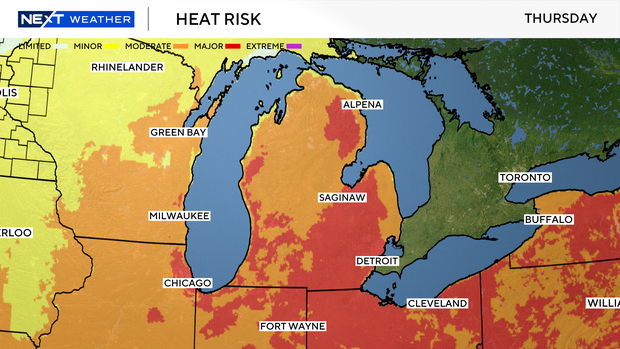
An extended stretch of heat and humidity is expected Wednesday through Friday with high temperatures between the upper 80s and low 90s and peak heat index values solidly in the upper 90s, with a chance of those values reaching 100.
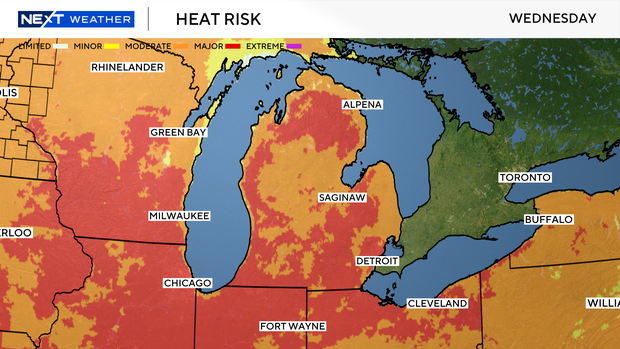
Thursday is a NEXT Weather Alert Day as there could be either the highest and most dangerous heat index numbers or strong to severe storms. If storm chances increase, widespread heat impacts would be lessened. However, moderate to major heat impacts are possible, so be prepared by having a location for adequate cooling, limiting time outdoors and staying hydrated.
Pets should not be left outside for extended periods of time and may require extra water.
A cold front is expected to move through the state late Friday, bringing the heat and humidity down to more comfortable levels for the weekend.
-

 Washington2 minutes ago
Impaired Washington driver dies after striking utility pole off Oregon highway, police say
-

 Wisconsin7 minutes ago
Wisconsin Lottery Powerball, Pick 3 results for June 8, 2026
-

 West Virginia14 minutes ago
Justices argue debt enforcement efforts are hurting The Greenbrier – WV MetroNews
-

 Wyoming17 minutes ago
Election Q&A: Neil Jeske for Wyoming House District 59
-

 Crypto22 minutes ago
Top 100 Bitcoin Treasuries Now Hold 1.26M BTC
-

 Finance29 minutes ago
Rockford’s finance and personnel committee rejects lone bid for a program meal service
-

 Fitness32 minutes ago
Jennifer Aniston, 57, says she’s stronger now than in her 20s – and credits one simple training shift
-

 Movie Reviews44 minutes ago
‘Jean-Michel’ Review: Jean-Michel Basquiat Finally Gets the Fantastic Documentary He Deserves

