Lifestyle
Can this trendy ingredient in Erewhon's drink aisle really boost your mood or help your anxiety?

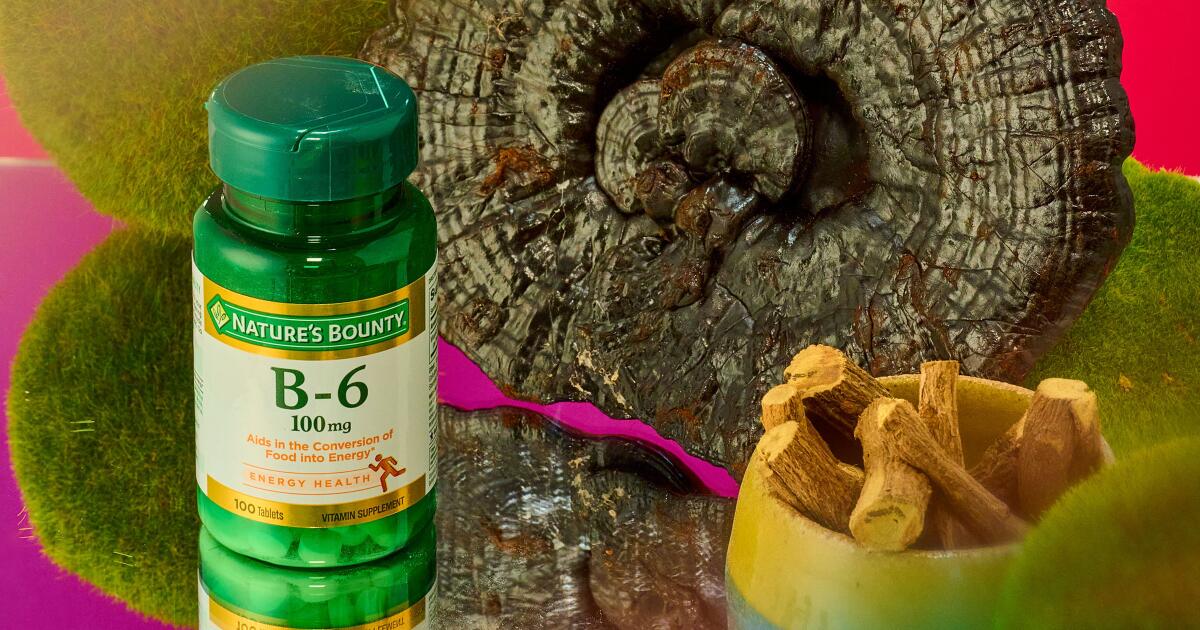
Licorice root, reishi mushrooms and vitamin B-6 are often among the ingredients listed in various adaptogenic drinks.
(Rebecca Peloquin / For The Times)
It’s not enough for a drink just to taste good anymore. Most specialty grocery or liquor stores now offer colorful cans and bottles that advertise so-called adaptogens, ingredients that beverage companies claim can help you manage stress, enhance creativity and sharpen focus. With packaging printed with bright colors and trendy fonts, these drinks are designed to pop on the shelves and on your social media feed — a subtle health flex for the aesthetically conscious and sober-inclined.
You can find them in trendy superettes around the city. Silver Lake’s Soft Spirits’ adaptogenic section includes a Spritz Italiano from L.A.-based De Soi (founded by Katy Perry and Morgan McLachlan), a concoction containing Reishi mushroom, which the company claims is “a stress soothing, brain boosting botanical often referred to as ‘the herb of immortality.’” At Bristol Farms across the city, you can pick up Bonbuz, a blood red tonic that promises to “heighten your senses and transport you to a deeper mind-body experience” with ingredients like pyridoxine-HCL (a vitamin-b6), ginger root and rhodiola rosea. Or you can grab a hemp-infused chili margarita by Aplos at the Dream Hotel in Hollywood that says it can “elevate mood, stimulate brain function and boost energy.” In Erewhon, you can’t throw a gluten-free turmeric chicken tender without hitting a canned beverage touting its adaptogenic qualities.
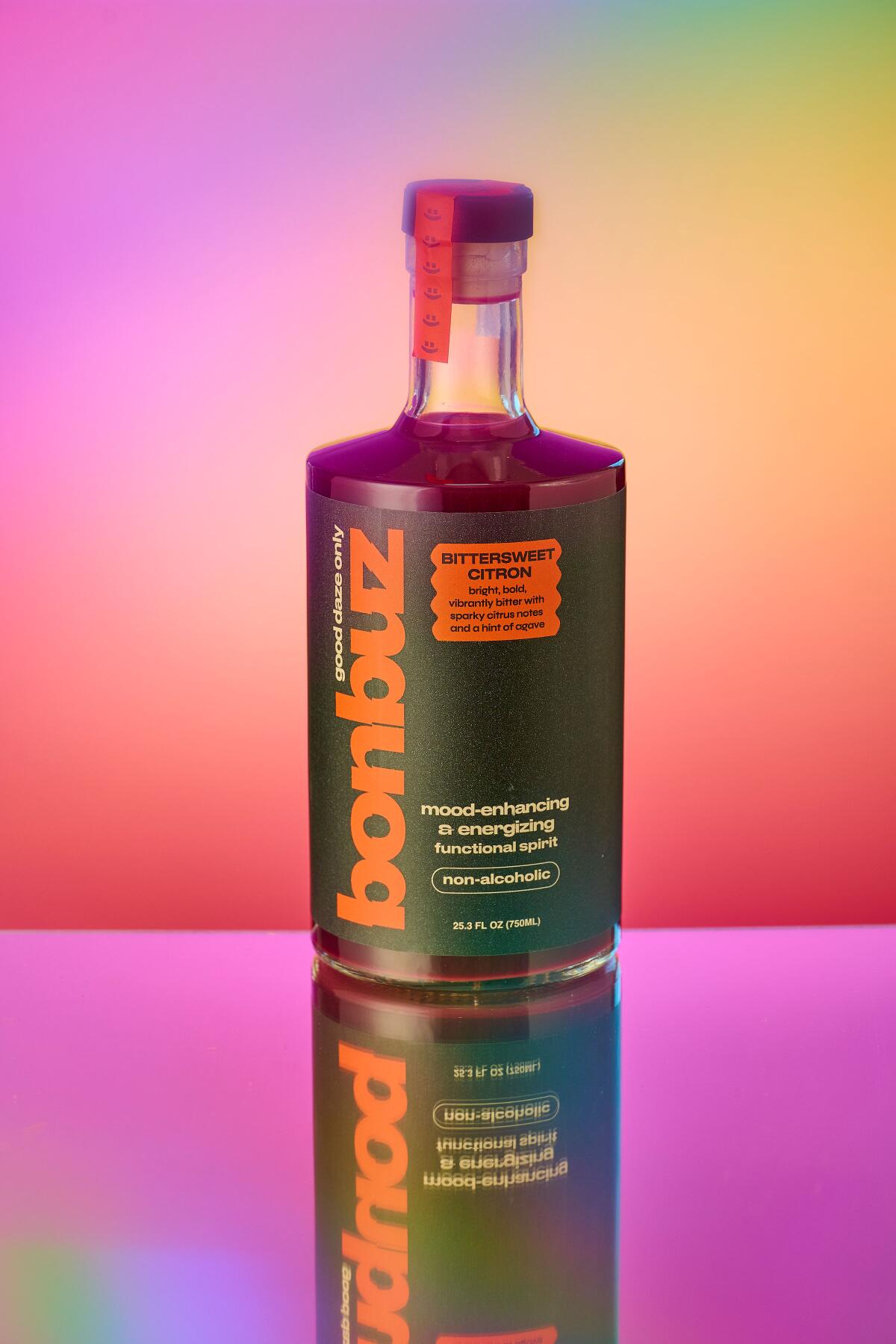
Bonbuz Bittersweet Citron, a non-alcoholic spirit with citrus, ginger and gentian.
(Rebecca Peloquin / For The Times)
But the appeal for consumers goes beyond smart marketing and playful design. The adaptogenic drink market is booming, as research shows that young people are less and less interested in alcohol and seek healthy alternatives. (Gen-Z drink 20% less than millennials, which is perhaps why Anheuser-Busch InBev projects one-fifth of their sales to be from non- and low-alcohol beers by 2025). The global market for these beverages is set to reach $1.2282 billion by 2024, with the projected valuation increasing to $2.4168 billion in 10 years.
A TikTok video from last fall that highlights different types of adaptogenic drinks has been viewed over 1.2 million times. In the comments, viewers ask where they can buy them and share their experiences.
“I love these drinks,” one user writes. “I have horrible anxiety and some of them calm me and make me feel warm and fuzzy lol.”
Though adaptogenic drinks are relatively new to Western consumers, the term “adaptogen” has been around since 1947, when it was coined by the Soviet scientist Nikolai Lazarev who was searching for stimulating substances during the Cold War.
“Adaptogens are made from herbs, roots, and other plant materials that may help our bodies deal with and manage stress or restore homeostasis after stressful situations,” said Dana Ellis Hunnes, a senior clinical dietitian at UCLA Medical Center and assistant professor at UCLA Fielding School of Public Health, in an email. “Some of these stressors can be physical (a small burn), physiological (burnout from work and the toll that takes on our bodies) or psychological (emotional stress).”
Examples of common adaptogens are ingredients like rhodiola (a root promoted to increase stamina), ashwagandha (a shrub promoted to reduce stress and fatigue), licorice and reishi mushrooms, which have been used as traditional Chinese and Ayurvedic medicines for centuries.
Today, those same ingredients are showing up in adaptogenic supplements and beverages, but their medical value is debated. In the Food and Drug Administration’s book, adaptogens are categorized as supplements and thus not regulated the same way drugs are. For that reason, it’s hard for medical experts to make blanket statements about their efficiency or even their safety.

Licorice root, reishi mushrooms and vitamin B-6 are often among the ingredients listed in various adaptogenic drinks.
(Rebecca Peloquin / For The Times)
“It’s unknown whether the dose that most people can buy of adaptogens on the market are high enough to produce a medicinal effect,” Ellis said. ”So, what you think you’re buying, may not actually contain as much [or may sometimes contain more] than you think.”
Depending on the person, some adaptogens may even cause nausea and stomach problems. (Those who are taking specific medications, pregnant or breastfeeding should first seek guidance from their healthcare provider before consuming them.) Clarity about adaptogens’ efficacy is further muddled due to the fact that most research on these ingredients comes from animal or in-vitro studies that Nicholas B. Tiller, a senior researcher at the Institute of Respiratory Medicine & Exercise Physiology, noted in an email “are not necessarily applicable to the real world.”
“The few human studies [on adaptogens] are largely disappointing,” he said. “It’s going to require a lot more high-quality evidence before these herbs and other natural products are extensively incorporated into medical practice.”
But do most adaptogenic drink consumers see their consumption of these beverages as explicitly medicinal, or are they simply weighing their options and picking something less altering than a beer and more novel than a seltzer?
“When we initially opened our doors [in 2021], a lot of customers asked ‘what’s the point?’ and had a difficult time wrapping their heads around why anyone would want a cocktail without alcohol,” said Jillian Barkley, Soft Spirits Founder & CEO, in an email. She found these beverages — although harder to acquire back then — hugely helpful when she stopped drinking five years ago.
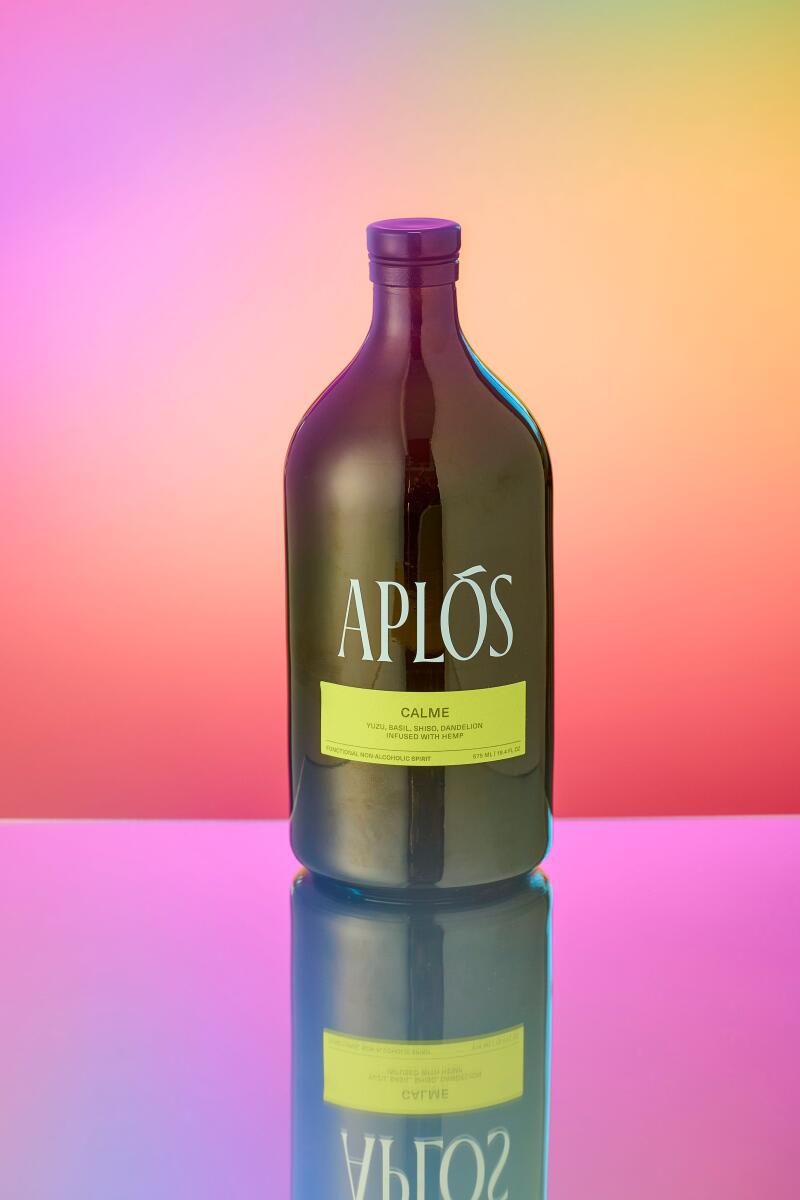
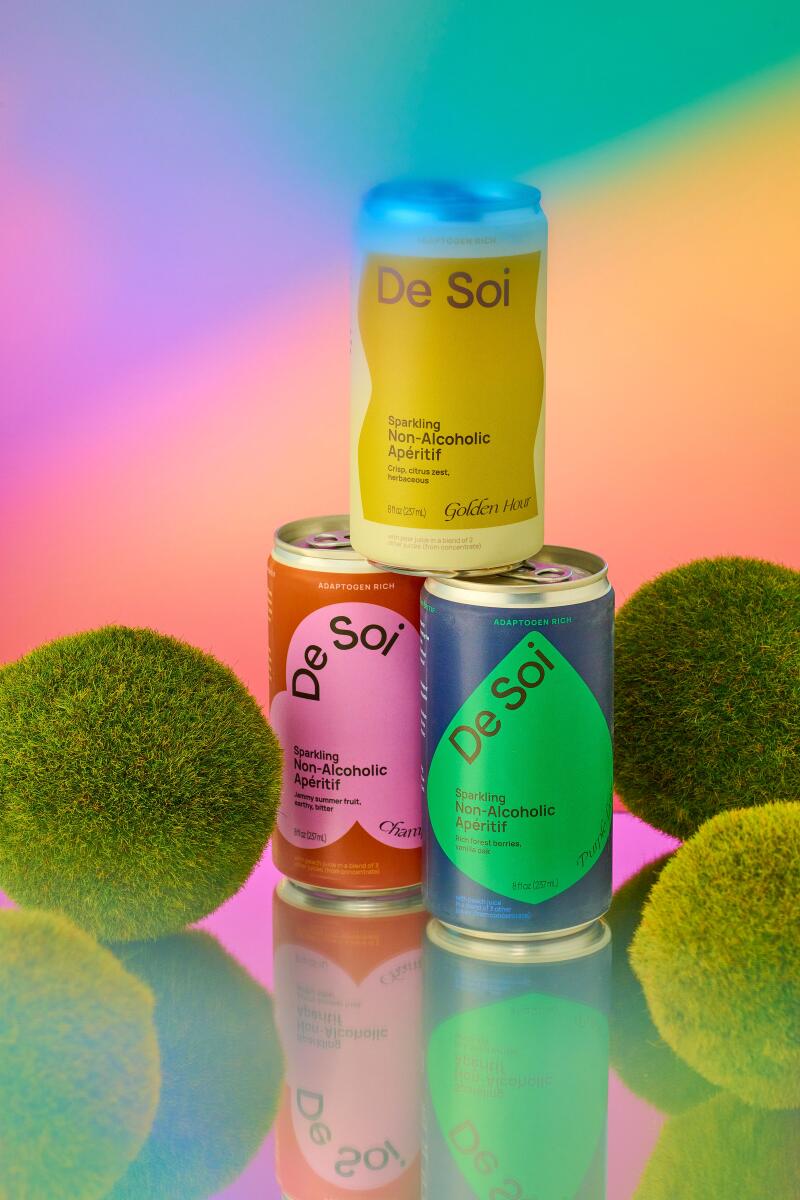
Aplos Arise, a non-alcoholic spirit infused with adaptogens. De Soi, a non-alcoholic aperitif made with natural adaptogens. De Soi is a company co-founded by Katy Perry and Morgan McLachlan. (Rebecca Peloquin/For The Times)
“Shopping at Erewhon and buying Kin makes you a part of a certain in-crowd, and people are seeking belonging.”
— Nikita Walia, brand strategist
“For those folks, the possibility of a physical effect tends to be enticing,” she said. “‘So you’re telling me I can drink this nightcap and it will help me feel relaxed, but I won’t be intoxicated?’ Yep!”
Nikita Walia, brand strategist and founder and CEO of BLANK, thinks the popularity of adaptogenic beverages will only gain more steam with consumers as our culture puts a higher premium on health and wellness.
“Having a beverage that is a social tonic, well-branded and aesthetically pleasing as a stand-in for alcohol is a perfect substitute,” Walia said in an email. She adds that many of these drinks are expensive and seen as luxury items only adds to their appeal.
“Shopping at Erewhon and buying Kin makes you a part of a certain in-crowd, and people are seeking belonging.”
In other words, whether adaptogenic drinks can actually elevate your mood might not matter — as long as they can elevate your social status.


Matthew Rhys was nominated for his role in Widow’s Bay.
Apple TV
hide caption
toggle caption
Apple TV
The 2026 Emmy nominations are here. We’re unpacking the record-breaking nominations for Hacks, plus a big day for Widow’s Bay, The Pitt, and The Bear. We’ll also talk about the snubs and make some early predictions of who will win.
Connect with Pop Culture Happy Hour:
Letterboxd / Facebook
Our weekly newsletter
Support Pop Culture Happy Hour+


Can you say no to a friend’s wedding?
Getty Images/Getty images
hide caption
toggle caption
Getty Images/Getty images
Are we spending too much on other people’s weddings?
Going to a friend’s weddings can be so fun and meaningful… but it can also really hurt your wallet. A survey by LendingTree found that 31% of people who had been to a wedding in the past five years had accrued debt to attend. So what’s driving up the cost of weddings for guests? And what makes it so hard to say no to these expenses?
Brittany breaks it down with Allyson Rees, senior analyst at trend forecasting firm WGSN, and Annie Joy Williams, assistant editor at The Atlantic.
This episode was produced by Liam McBain, with additional support from Corey Antonio Rose. It was edited by Neena Pathak. Our Supervising Producer is Cher Vincent. Our Executive Producer is Barton Girdwood. Our VP of Programming is Yolanda Sangweni.
-

 Maryland5 seconds ago
Maryland man sentenced to 15 years for attempting to join ISIS
-

 Michigan3 minutes ago
Sherrone Moore’s former assistant sues University of Michigan over alleged FOIA violations
-

 Massachusetts8 minutes ago
Max McColgan and Joseph Lenane share stroke play medals at 118th Massachusetts Amateur Championship – The Boston Globe
-

 Minnesota15 minutes ago
Man seriously injured in north Minneapolis shooting; no arrests
-

 Mississippi18 minutes ago
Ben Crump seeks independent autopsy in Nolan Wells death
-

 Missouri23 minutes ago
Missouri politicians champion unity, diversity on America’s 250th
-

 Montana30 minutes ago
Montana signs onto data center energy cost protection pledge
-

 Nebraska33 minutes ago
Gov. Jim Pillen calls for budget cuts, hiring freeze in new memo

