Science
Mexico may legalize magic mushrooms. Will this traditional medicine lose its meaning?

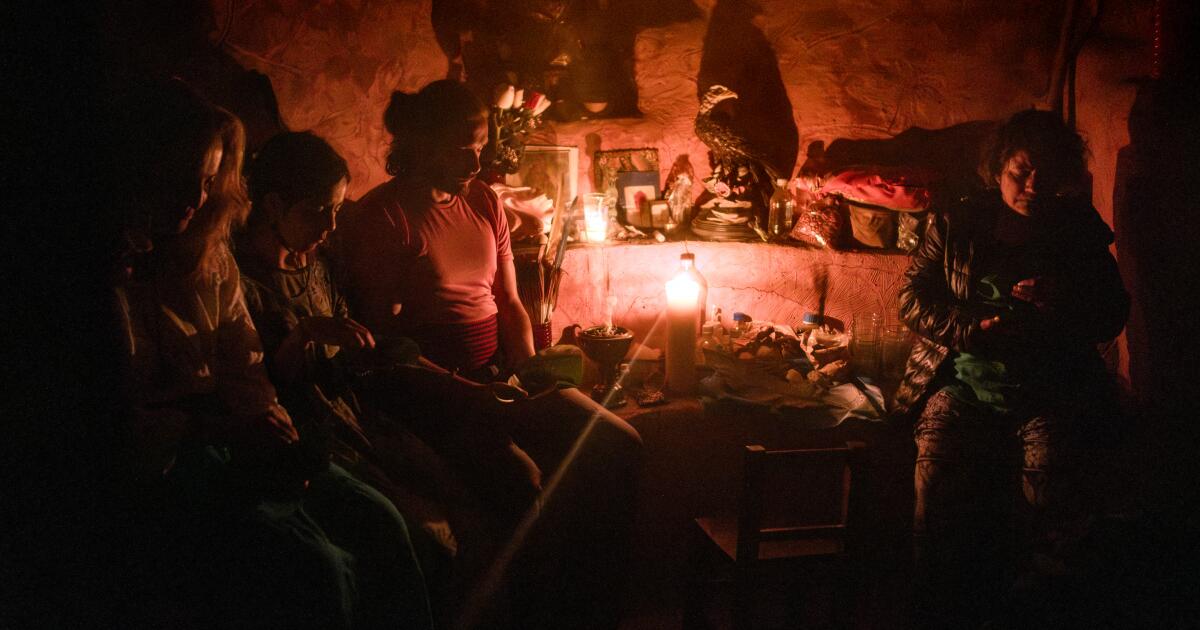
Alejandrina Pedro Castañeda opened a brown paper package and pulled out a handful of magic mushrooms, which many residents of this Indigenous Oaxacan town tenderly refer to as “child saints” or “the little ones that sprout.”
Then she handed each of her six visitors — who had driven seven hours from Mexico City and paid up to $350 apiece for a healing retreat — a generously sized portion, prompting a few dubious looks.
It was nighttime, and the guests were sitting in a hut that was barely illuminated by two candles, making it difficult for them to see what they were about to eat.
Pedro Castañeda has used mushrooms in her healing practice for years and was comfortable stepping outside as the group crunched slowly in silence.
One person said the fungi tasted like stale popcorn. Another tasted dirt.
The healer returned a few minutes later.
“Now we’re starting the trip,” she said. “Let’s go to work.”
Indigenous communities in Mexico have long considered psychedelic mushrooms to be intermediaries to the spiritual world. But their growing popularity outside of Mexico has spurred a debate over who should have access to them and whether science and Indigenous medicine can or should be reconciled.
Magic mushrooms have been used in Mesoamerican religious rituals since pre-Hispanic times. But it wasn’t until the 1950s that a New York banker and mushroom enthusiast named R. Gordon Wasson made them famous — perhaps too famous — in the Western world.
(Alejandra Rajal / For The Times)
Some Indigenous healers are courting tourists. Scientists interested in their chemical properties have been studying mushrooms in hopes of developing treatments for depression and other mental health problems. And growing demand from recreational users has fueled a thriving black market.
Currently, the fungi can only be used in Indigenous rituals or in government-approved research. But a senate bill proposes making psilocybin, a psychedelic compound in the mushrooms, more widely available.
In addition to making psilocybin available to anyone with a doctor’s prescription, the bill would permit therapy that uses the actual mushroom that a government office of traditional medicine would help regulate. It also calls for scientific research on Indigenous medicine and providing compensation to Indigenous people for “patents” involving their traditions.
The bill’s supporters say that they’re trying to protect Indigenous medicine by making sure the traditional use of magic mushrooms is enshrined into law.
But the prospect of expanding the availability of magic mushrooms has created friction within Indigenous communities that have used them for centuries. Will the spirituality associated with this traditional medicine be lost?
::
Magic mushrooms have been used in Mesoamerican religious rituals since pre-Hispanic times. A mural from the ancient city of Teotihuacán, just outside Mexico City, shows the Toltec rain god Tlaloc with two figures alongside him holding mushrooms that have risen from where his raindrops fell. A Franciscan missionary documenting 16th century life in New Spain referred to the mushrooms as the “flesh of the gods.”
But it wasn’t until the 1950s that a New York banker and mushroom enthusiast named R. Gordon Wasson made Mexico’s magic mushrooms famous — perhaps too famous — in the Western world.
On a trip to Huautla, in southern Mexico, he ate mushrooms with Indigenous Mazatec healer María Sabina and wrote about the experience in a 1957 article for Life magazine titled “ Seeking the Magic Mushroom.” The story inspired thousands to travel to Huautla — some seeking out Sabina. The Mexican press described the foreigners as addicts, and the military ultimately set up a checkpoint on the road to Huautla to try to block the outsiders.
In July 1970, Reuters reported: “Hundreds of hippies are braving imprisonment and fines to penetrate this mushroom paradise in the State of Oaxaca, where the authorities are conducting a drive against mushroom eaters.”
Wasson said he felt guilty about the crowds in a New York Times op-ed published later that year. A “humble out-of-the-way” town had been overrun by “a torrent of commercial exploitation of the vilest kind.”
“The old ways are dead,” he wrote, “and I fear that my responsibility is heavy, mine and María Sabina’s.”
In an interview toward the end of her life, Sabina described how some outsiders would take the mushrooms “at whatever time and whatever place” and “don’t use them to cure themselves of a sickness.”
“From the moment the foreigners arrived to search for God,” she said, “the saint children lost their purity.”
In the mid-20th century, psilocybin was classified as a Schedule I substance in the U.S. — which put the kibosh on research. But interest in scientific research on mental health and psilocybin was rekindled in the 1990s.
::
Psilocybin is thought to boost neuroplasticity, the brain’s ability to form new neural connections, and research indicates that it may be successful in treating depression, anxiety and substance abuse. Parts of the United States have legalized or decriminalized the substance. (Oakland decriminalized magic mushrooms in 2019.)
“That plasticity enhancement may allow people to shift how their brain is functioning into a mode that’s more helpful, more adaptive, that’s going to promote mental health,” said Greg Fonzo, who co-directs the Center for Psychedelic Research & Therapy at the Dell Medical School at the University of Texas at Austin.
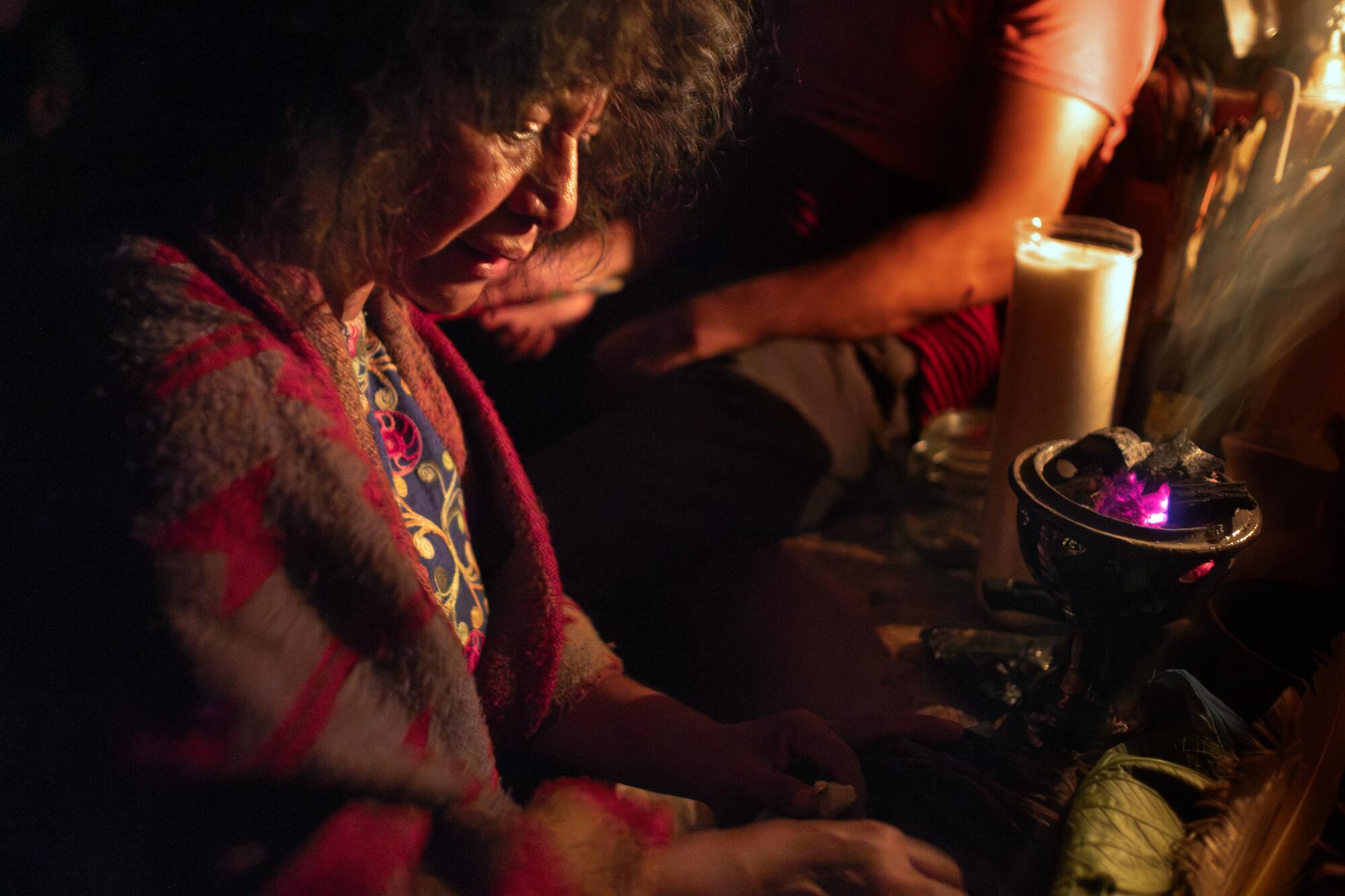
Alejandrina Pedro Castaneda, who has used mushrooms in her healing practice for years, hosts a mushroom ceremony once or twice a week.
(Alejandra Rajal / For The Times)
Some people who ingest magic mushrooms report overwhelming feelings of joy or the presence of family. Others have said they feel deeply sad or that they are having an out-of-body experience.
The risk of a lethal overdose is considered very low, Fonzo said. What’s more common is having a difficult experience or a “bad trip” due to anxiety.
Pedro Castañeda, who compares the bill with a birth certificate, supports the legislation, insisting the world must not forget that the Mazatecs, as well as other Indigenous communities, have preserved rituals with magic mushrooms for centuries.
“The medicine is not protected now. It’s out of control,” she said. “Everyone has it in their home, like cannabis,” she said, referring to black market purchases. “What we need is a record that says the Mazatecs are the custodians, the Mazatecs are the ones that for millennia have defended the medicine.”
But other Mazatecs in Huautla are worried about appropriation and misuse, that traditions associated with Indigenous culture will be disrespected as increasing numbers of people rush to pick up their prescriptions.
In an Indigenous mushroom ceremony, the healer will use mushrooms to communicate with their spiritual world to inquire about a patient’s illness. A patient may also experience revelations.
If the bill passes, “It’ll be taken like an aspirin,” said Isaias Escudero Rodriguez, a local doctor. It will no longer have the “spirituality that it carries for us.”
::
The push to legalize magic mushrooms in Mexico dates back to the early days of the pandemic. Alejandra Lagunes, 52, a senator in Mexico’s national congress, started to experience anxiety attacks that were reminiscent of the severe depression she suffered in her 20s. The depression from decades ago, she said, was resolved after she took ayahuasca — a psychoactive brew made from the Amazonian Banisteriopsis caapi vine — with an Indigenous healer.
Lagunes researched psychedelics and introduced legislation in November to increase access to magic mushrooms while recognizing the long tradition of Indigenous medicine. She hopes it opens the door for non-Indigenous Mexicans to learn from Indigenous practices.
The initiative has supporters at Mexico’s National Institute of Psychiatry, where scientists have government permission to investigate the potential therapeutic effects of magic mushrooms.
Jesús María González Mariscal, a clinical psychologist in Mexico City who has advised the senator, said much can be learned from traditional medicine, including the importance of companionship in Mazatec mushroom ceremonies. These ceremonies occur at night under the guidance of a healer with candles, flowers, incense and an altar with Catholic images. A patient’s family members may accompany them.
The result, Mariscal said, “is a space of care and protection so a person can explore their inner world in a context that’s safe, trustworthy and ethical” — and that’s what Mexico City psychotherapist Oscar O’Farrill is trying to teach his students.
O’Farrill runs a master’s and doctoral degree program affiliated with the National School of Psychologists and Experts of Mexico where his approximately dozen students listen to Indigenous guest speakers talk about traditional medicine. He schedules group therapies in his home, a two-story house where a large container on his kitchen counter has powder from lion’s mane, a non-psychedelic mushroom, that he takes with his morning coffee. Indigenous healers have led his students through ceremonies with mushrooms, peyote and bufo, the smoked secretions of a Sonoran desert toad.
“Psychiatry in this moment can’t understand what psilocybin is if it doesn’t understand all the aspects of the customs of Indigenous people,” he said. “Like it or not, the mushrooms have a spirit.”
But Eros Quintero, a biologist who co-founded the Mexican Society of Psilocybin in 2019, said he would have preferred that Indigenous communities were not singled out in the bill, that psilocybin simply be reclassified.
Indigenous people, he said, may not view illness through the prism of Western science. In Mazatec culture, for example, people may believe that a person fell ill because they walked through a cave where spirits are thought to reside or broke a communal rule.
“They have their own traditions and their own way of seeing things, and what we see is that there are few who are interested in what we’re interested in with psilocybin,” he said.
::
Huautla presents itself as a place for the mushroom-seeker.
Taxis decorated with images of small mushrooms speed up and down narrow mountain roads that are lined with tin-roofed houses. In the summer, when mushrooms are in season, locals wait by a bus terminal to offer the fungi to tourists. Prices vary, but a dozen pairs of mushrooms (they’re sold by the pair) may cost $25 and a ceremony can cost $90 or more. After mushroom season, the fungi are often preserved in jars with honey.
Several signs announce the home of the family of María Sabina — who died in poverty in 1985 but whose life has since been celebrated in Mexican culture. Her descendants, who live on the property where Sabina once resided, maintain a small museum filled with portraits of the healer and sell mushroom-themed crafts.
Anselmo García Martínez, a farmer and a great-grandson of Sabina, says he was about 6 when he tried mushrooms for the first time during a ceremony with relatives who were accompanying a sick family member. (Many other locals say they first consumed mushrooms as children.)
Like some other residents, he said he didn’t mind if mushrooms are allowed outside Indigenous rituals because the general public already has access to them through the black market.
But he issued a reminder: “For us, for the Mazatecs, it’s something sacred.”
Lagunes said she’s invited Indigenous people to the forums she has sponsored, and last year she posted a video on the social media platform X that showed her with several healers and indigenous people in Huautla. They presented her with a baton that she said she’d carry to “bring the voice and knowledge of ancestral medicine to the place that it deserves.”
But some opponents have said that the Mazatec people haven’t been properly consulted on whether the bill should move forward, reminding supporters that, for the moment, there is no infrastructure to make it happen. Santos Martínez, one of the founders of Caracol Mazateco, a civil society group focused on preserving Mazatec culture, agrees there hasn’t been enough outreach to the Mazatecs.
Martinez said his experiences with magic mushrooms transformed his life. As a medical student working at a clinic in the state of Puebla, he fell into a depression after seeing patients suffer from inadequate care. He returned to his community in Huautla, where he participated in mushroom ceremonies, hoping they would help him find direction in his life.
During the ceremonies he felt happy and had visions of family members, including his grandfather. “It was as if he was saying, ‘adelante, hijo,’” he said, or, “go forward, son.”
Francisco Javier Hernandez García, a Huautla healer who leads mushroom ceremonies for tourists almost daily at some points of the summer, fears that mushrooms will “lose respect” if they are legalized for therapy outside of the Indigenous context.
Like others, he spoke about mushrooms as carrying wisdom.
“They sprout because they are waiting for that person,” he said, referring to the one who will eat them. “They already know who carries problems.”
::
In mid-April, O’Farrill organized a trip for six people — including himself — to visit Pedro Castañeda for the healing retreat. Two people, a man who works for a Wall Street asset management firm and a woman training to guide people during mushroom trips, had flown in from the U.S. A mother and daughter, both psychologists, and a literary editor were from Mexico.
They spent three days at the home of Pedro Castañeda, who lives with eight dogs in a house that has several floors under construction. She hosts a mushroom ceremony for locals or tourists once or twice a week and said that the “great spirit” tells her how many mushrooms to give each person.
The members of O’Farrill’s group had individual therapy sessions with Pedro Castañeda in which she asked them about their insecurities. After her guests ate mushrooms, Pedro Castañeda asked several of them to sing. At one point, the editor began to suddenly cry, and the younger psychologist said she felt pain, prompting the healer to rigorously brush her with a feather in a cleansing ritual. A few minutes later, the psychologist said she was having visions of “injustice in jail.”
The next morning, the group hiked — mostly barefoot — the Mountain of Adoration, which the Mazatecs consider sacred.
At the top of the mountain, which overlooked Huautla, the healer gave each person cacao beans to leave as an offering, giving thanks for the previous night. They placed them on a tower of rocks jutting out from the mountain, next to many little mounds of cacao left earlier by other visitors.


new video loaded: NASA Announces Artemis III Crew
transcript
transcript
NASA Announces Artemis III Crew
NASA announced the crew of Artemis III mission, which will fly to low-Earth orbit to test rendezvous and docking maneuvers with one or two lunar landers.
-
“I am excited to welcome you as the next crew in the Artemis journey to successfully return to the moon — this time to stay.” “I’m honored by the role that I’ve been given. I’m also very humbled by the task in front of us. But first and foremost, I’m grateful.” “So with that, the Artemis II crew, comrade, hands you the baton. You got the controls.” “As you know, we had a significant anomaly at our Launch Complex 36A on May 28. We’ve redoubled our efforts and are moving forward.”
By Alisa Shodiyev Kaff
June 9, 2026
Science
Santa Monica Mountains’ last steelhead trout survived the Palisades fire — and even had babies

Scientists feared the Santa Monica Mountains’ last remaining steelhead trout were dead, smothered by debris flows unleashed by the Palisades fire.
But the endangered fish surprised them: A team of biologists recently spotted 30 of the rare trout — and 21 babies — in Topanga Creek.
“There was a lot of happy dancing in the creek,” said Rosi Dagit, principal conservation biologist for the Resource Conservation District of the Santa Monica Mountains, which works with public and private landowners to conserve natural resources.
That’s because the steelhead here are endangered, at both the state and federal levels. Once, they swam in most streams of the Santa Monicas, but their numbers plummeted amid overfishing and coastal development. Increasingly frequent wildfire has further stressed their habitat. Topanga Creek, a biodiversity hot spot, is home to their last known population in the mountains that stretch from the Hollywood Hills to Point Mugu in Ventura County.
The trout that were spotted, including this one, are part of a distinct Southern California population that’s listed as endangered at the state and federal levels.
(RCDSMM Stream Team)
The California Department of Fish and Wildlife spearheaded a complex mission to rescue trout threatened by the Palisades fire that sparked in January 2025.
Time was of the essence. The fire hadn’t yet been fully contained. But rain was on the way, which would sweep massive amounts of sediment from the denuded hillsides into the water. Fish are often killed this way.
Crews stunned the fish with electricity, scooped them up in buckets, trucked them to a hatchery and ultimately moved them to Arroyo Hondo Creek in Santa Barbara County.
Within days, Topanga Creek was choked with mud. Some assumed the fish left behind were goners.
But in March, the conservation district’s team found four. The following month, when water conditions were clearer, they saw more.
“These fish continue to amaze me,” said Kyle Evans, environmental program manager for the state Department of Fish and Wildlife, who had seen the damage to the creek. “I had seen populations get wiped out in similar situations. So when I heard, I was thrilled.”
Evans surmises the fish that survived were in an area of the creek where less charred material and sediment were swept in.
“These fish likely hunkered down, were hiding under some rocks or places to try to get away from the main concentration of flow,” he said. “And luckily they weren’t buried.”
The ones that were spotted were fairly small, around 6 to 14 inches. Rainbow trout and steelhead trout are the same species, but with different lifestyles. If the fish remain in freshwater, they’ll be considered rainbows. However, they can migrate to the ocean and become steelhead, where they typically grow larger before returning to their natal waters to spawn.
Topanga Creek hasn’t fully recovered from the damage it sustained, but scientists say it’s looking better. Surveys last year were “so depressing,” Dagit said, with very few animals, and stretches that were essentially transformed into flat roads from all the sediment buildup. Some of the riparian canopy burned right down to the creek.
Then came 32 inches of rain over the last nine months, scouring out and moving sediment, creating deeper pools. Dagit said they recently found newt egg masses for the first time in years, as well as a few adult newts and many frogs. Plants that provide cover are starting to recover.
She provided photos comparing certain pools last year and this year, some dramatically transformed. In September 2025, the Shrine Pool could have been an overgrown hiking trail. This April, it was filled with shallow water.

The Shrine Pool in September 2025, left, and the same location in April 2026, right, with RCDSMM’s Isaac Yelchin donning a wetsuit.
(RCDSMM Stream Team)
Topanga Creek is home to another endangered fish, the small but hardy northern tidewater goby, often described as cute. Not long before the trout operation, Dagit led a rescue of hundreds of these fish too. Many were repatriated to the lagoon at the mouth of the creek in a moving ceremony last June.
There’s still the matter of what to do with the trout that were moved to Santa Barbara County last year. Evans would like to bring them home to the Santa Monicas at some point, but isn’t sure if it will happen. On one hand, they could bolster the small, genetically isolated surviving population. On the other, they might inadvertently bring in a disease or bacteria. There is some time to decide. Evans estimates the creek still needs to recover for two to three more years.
For now, the fish are functioning fine in their adopted creek. Experts worried the trauma wrought by the move would disrupt their spawning process, but they had babies that spring. This year, they spawned again.

The Pacifica Municipal Pier was shut down and taped off Thursday after city workers noticed cracks running through the landmark structure and concrete chunks falling into the ocean.
It’s just one of many coastal California structures that have recently crumbled under pressure from a rising and relentless ocean.
Officials from the small, beach city south of San Francisco said the pier was closed due to “cracking, separation, and displacement of the concrete walkway and structural elements.”
It will stay closed while structural engineers asses its safety.
Photos taken by city employees show a wide crack that runs from top to bottom and across the structure as well. Other photos show a large horizontal crack under the foundation of a small restaurant on the pier, the Chit Chat Cafe.
The cafe was also shut down.
This is not the first time the 53-year-old pier has shown signs of stress. In 2021, part of it was shut down after handrails along the edge collapsed. And in 2023, after a series of storms pummeled the Central California coast, damaging parts of the pier, the structure was partially closed for more than year.
Those same storms caused extensive damage in Aptos and Capitola, 70 miles south, where piers and waterfront infrastructure were swept away or damaged.
In 2024, a 150- to 180- foot section of the Santa Cruz wharf was ripped off by powerful waves.
At least 10 of the state’s dozens of coastal public piers were closed for part or all of 2024 due to structural damage sustained in winter storms since 2022. At least five others have longer-term upgrades planned to address structural issues.
“These things are costly to maintain,” said Zach Plopper, senior environmental director at Surfrider. “They are a part of our California coastal culture in many ways, but we’re going to need to reckon with, one, the state that they’re in, and two, the continuous and worsening threats they’re going to experience,”
He said most of the piers were constructed in the early 1900s, and they weren’t built to withstand decades of rough seas, storms and rising sea level.
“With this incoming El Niño, which is forecasted to be significant, and this marine heat wave we’re in the midst of, we’re kind of in uncharted waters as far as what this winter could bring in terms of storms and swells to the California coast, and we’re likely going to see a lot more damage,” he said. “Not just piers, but roads and other coastal infrastructure up and down the state.”
There was no storm in Pacifica earlier this week, so no single event could be blamed for the destruction.
However, a 2025 report from an outside engineering firm, GHD, found that several sections of the pier were in “poor” or “serious” condition, and they recommended closure before anticipated storms or events that could “subject the piles to high winds, swells and large waves.”
The firm found several areas of the pier where concrete was missing and rebar was exposed and corroding.
“The pier has continued to experience high winds and large waves in a harsh marine environment,” the engineers wrote in the report, noting that continuous exposure to seawater or marine spray was “detrimental” to the structure.
A 2023 city report estimated it would cost $19 million to repair.
That same year, a state law was enacted to require local governments along the California coast to plan for sea level rise in the coming decades.
Sea level has risen some 8 inches, on average, along the coast in the past 150 years, Plopper said, and researchers anticipate another foot in the next 25 years.
“We’re going to see profound shifts on our coastline, none that we have ever experienced before, and building static structures on the coast just doesn’t work all that well,” he said. “We’re going to have to make some really hard decisions.”
-

 Vermont2 minutes ago
Vermont Green FC plays Canada’s national soccer team in World Cup tuneup – VTDigger
-

 Virginia5 minutes ago
Navy sailor sentenced to 44 years for killing fellow service member Angelina Resendiz in his Virginia barracks room
-

 Washington10 minutes ago
Where to watch Washington Nationals vs San Francisco Giants: TV channel, start time, streaming for June 10
-

 Wisconsin17 minutes ago
Chris Borland heads back to Wisconsin as Hall of Fame inductee
-

 West Virginia20 minutes ago
West Virginia Democrats re-elect Mike Pushkin, elect new leadership team – The Real WV
-

 Wyoming25 minutes ago
Wyoming’s Most Treasured Views: Grand Teton National Park
-

 Crypto32 minutes ago
‘De-Worsified, Not Diversified’: Robert Kiyosaki Warns Investors on a Hidden Risk
-

 Finance35 minutes ago
The Future of Finance Jobs In The Age Of AI

