Arizona
Does Arizona have enough water? Phoenix-area cities are spending big to make sure it does

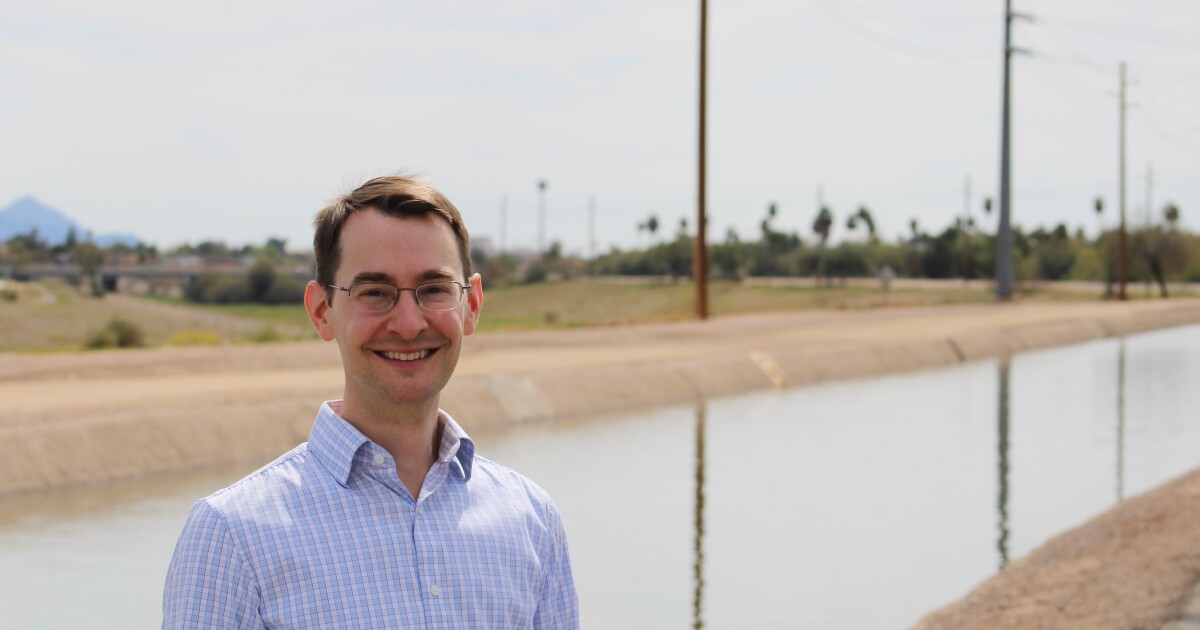
Brett Fleck does not have an easy job. He manages water for a city in the desert. He has to keep taps flowing while facing a complicated equation: The city is growing — attracting big business and thousands of new residents every year — but its main source of water is shrinking.
Standing on the edge of a sun-baked canal with palm trees lining its banks, Fleck watched water flow into the pipes that supply the Phoenix suburb of Peoria, Arizona.
“We’re really having a complete changeover in how people view the Colorado River from a reliability standpoint,” he said.
Get top headlines and KUNC reporting directly to your mailbox each week when you subscribe to In The NoCo.
The river, which accounts for about 60% of the city’s supply, is stretched thin. Its water is used by 40 million people from Wyoming to Mexico. Climate change is shrinking its supply, and the federal government is scrambling to boost depleted reservoirs. The Biden Administration has poured money on the problem, allocating $4 billion from the Inflation Reduction Act for Colorado River projects.
Across the seven U.S. states that use its water, that money has been used to save water in a number of ways — from patching up leaky canals to paying farmers to pause crop planting. A relatively small chunk of that money has gone to cities, but it’s being welcomed with open arms in the Phoenix metro area.
Peoria’s water department is one of seven in Arizona getting paid by the federal government to leave some of its supplies in Lake Mead, the nation’s largest reservoir. In May 2023, the Biden Administration announced it would set aside $157 million for a handful of Arizona cities and one mining company to cut back on their take from the Colorado River.
Following that money and seeing how cities are spending the federal cash reveals a major trend in Arizona’s water management.
The Biden administration framed the spending effort as “water conservation,” but Arizona’s municipal water leaders aren’t using it to make changes traditionally thought of as conservation. Instead of paying for small tweaks to water use – like encouraging residents to install low-flow showerheads or rip out their thirsty lawns – many are thinking bigger, putting their multimillion dollar checks towards billion dollar infrastructure projects that are aimed at keeping taps flowing for decades to come.
Basically, cities like Peoria are planning to engineer their way out of the problem.
“When you don’t have that reliability,” Fleck said, “You have to make additional investments for alternatives, backup supplies, etc. That’s what it really takes to make sense of the world that we live in now.”
A changing mindset
Much ink has been spilled about the future of life in Phoenix. The sprawling metro area – referred to by locals as “The Valley” – is home to about 5 million people. A booming economy and strikingly wide suburban sprawl are pushing its borders further into once-unoccupied dusty expanses in nearly every direction. Meanwhile, climate change has inspired growing skepticism about the long-term sustainability of that growth.
Scorching temperatures, which consistently peak above 110 degrees in the summer, and much-publicized threats to its major sources of water, have accelerated calls in the national media for central Arizona to pump the brakes on expansion.
But on the ground, the people that run water departments in cities and suburbs project optimism.
“We have to plan ahead and say, ‘It’s not enough to have enough water to live this year, this month, two years, or five years,” said Cynthia Campbell, a water management advisor for the City of Phoenix. “We plan for 100, and that’s the way we’ve approached it in Arizona. That, I think, is the secret sauce that keeps us sustainable.”

Campbell described shifting attitudes in Phoenix-area water management. Dwindling water supplies have, for years, forced those cities to do more with less. She explained how Phoenix uses less water now than it did two decades ago, despite significant population growth. The city mostly chalks that up to more efficient water use by homes and businesses, specifically highlighting water that was conserved through more efficient outdoor watering for lawns and plants.
But now, those practices are getting closer to the ceiling in terms of how much water they can save, and new residents keep arriving.
“At some point in time, there does have to be a recognition of the scope of the problem,” Campbell said. “You just can’t conserve your way out of it.”
That mindset has put one word on the lips of many water managers in central Arizona: augmentation.
Engineering a way to more water
The word “augmentation” has different definitions depending on who you ask, but it generally means water departments are focused on adding new water supplies, rather than just using less of the water they already have.
Peoria and Phoenix water leaders highlighted two expensive infrastructure projects that fall into the augmentation category. The first is a massive renovation of a nearby dam that would make its reservoir bigger, allowing cities in the area to store more water during wet winters.
The Bartlett Dam holds back a reservoir about an hour’s drive northeast of Phoenix. Over time, the reservoir has gotten shallower, as sediment in the water settles to the bottom and piles up, reducing the amount of water storage. Bartlett Reservoir and nearby Horseshoe Reservoir have lost a combined 45,000 acre-feet of their total holding capacity. By comparison, Peoria, a city of nearly 200,000 people, gets a total of 35,000 acre-feet of water delivered each year.
Because the reservoirs reach capacity more quickly, water managers have been forced to release excess water instead of storing it for dryer times. A proposed expansion of the dam would make it easier to store that water by making Bartlett Dam about 100 feet taller. Peoria and Phoenix are among 22 cities, tribes and farm districts that are interested in chipping in for the project, which is projected to cost about $1 billion.

Michael McNamara
/
Salt River Project
The dam holds back water from the Salt River, whose supplies are managed separately from the Colorado River. But increasing the amount of stored Salt River water could help cities ease up on their Colorado River reliance.
A second idea that falls into the augmentation category represents an entirely different way of “adding” water to the system, and it’s part of a regional trend: cleaning up sewage and making it drinkable again.
Water managers refer to the practice as “advanced water purification,” or “wastewater recycling,” and it’s stirring up a lot of excitement – and big investment – in a number of places that share similar anxieties about shrinking supplies from the Colorado River.
Small cities are eyeing the expensive new technology for the future, and big ones are already putting shovels in dirt.
In Phoenix, the city council greenlit a $300 million construction project to revive a shuttered water treatment plant in the city’s far northern reaches, which officials said would lay the groundwork for installing equipment to turn wastewater into clean drinking water.
Elsewhere in the Colorado River basin, big cities are forging ahead with the practice. In the Los Angeles Metro area, the main water distributor proposed a $3.4 billion wastewater recycling facility, and has rallied hundreds of millions of dollars in support from out-of-state water agencies that could buy California’s unused Colorado River water if the new facility is a success. In Colorado, the state government passed first-of-its-kind legislation that would make it easier for cities to bring the new water treatment tech online, and some cities say they’re 3-5 years away from building it.
Beneath the surface
Phoenix-area water managers have to keep a lot of balls in the air at once. The water flowing through their pipes comes from a few sources, each with very different challenges.
The Colorado River, which mostly begins as snowmelt in the faraway Rocky Mountains, comes to the metro via the Central Arizona Project, a 336-mile canal that cuts through the desert. The Salt and Verde Rivers bring snow and runoff from a watershed that covers the colder, higher-altitude parts of Arizona. And one source starts much closer to home: groundwater.
That last water source, at least recently, has proven the trickiest to manage. Groundwater use and management have become hot-button political issues in Arizona as experts raise alarm about underground stores of water that are shrinking fast, including some that, once drained, would take generations to refill.
Water experts say all of the most pressing water issues facing Arizona cities – the shrinking Colorado River, the overtaxed underground aquifers, and work to augment existing supplies – are all smaller pieces of a bigger puzzle.
Kathryn Sorensen, a former director of Phoenix’s water department, said Colorado River shortages will probably turn up the pressure on groundwater.
“Our aquifers, while large and plentiful, are also fossil aquifers, so if we pump them out too quickly, then it’s just gone,” said Sorensen, who now researches water policy at Arizona State University. “So these types of things like advanced water purification, augmentation, additional conservation efforts, those all play into avoiding the use of those fossil groundwater supplies.”
Sorensen described the groundwater supplies – and whether or not they’re managed sustainably – as pivotally important to Arizona’s long-term future.
“If we’re going to continue to have the sort of economic opportunities we have here and the quality of life that we have here a few generations from now,” she said, “It’s really of utmost importance that we protect groundwater today.”
‘There’s not a lot of gambling going on here’
Groundwater has become the latest issue to help fuel a wave of national attention on the long-term viability of Phoenix as a place for people to live.
Articles with headlines like “How long can the world’s ‘least sustainable’ city survive?” have helped to crystalize nationwide skepticism about central Arizona’s future. In 2023, state officials put a pause on some new subdivisions because they couldn’t draw enough water from underground. The announcement launched a flurry of news coverage. The New York Times framed it as “the beginning of the end” for development around Phoenix.
In that article, Katie Hobbs, Arizona’s governor, is quoted as saying, “We are not out of water and we will not be running out of water.”

Hobbs and other leaders in the state have been forced into a bit of a juggling act. Some are trying to advocate for policies that respond to the Phoenix area’s water supply crunch while simultaneously trying to tamp down any fears that the city and suburbs might not be a good place to live and work.
Campbell, who advises Phoenix’s political leaders on water decisions, said she’s confident that people who buy a house or open a business in Phoenix will have water in the future, because those policymakers are feeling a lot of pressure to make sure growth is sustainable.
“They know that the moment there’s a crack in the armor,” she said, “The moment that we have to turn off a tap, every national media outlet will cover it, and it will have a devastating effect on our economy. So there’s not a lot of gambling going on here.”
What ‘sustainable’ growth looks like
Sustainable growth certainly weighs on the mind of water manager Brett Fleck in Peoria.
The city itself touted its status as one of the nation’s top “boomtowns,” growing by 19% in the five-year stretch between 2016 and 2021. It recently paved the way for a massive, $2 billion microchip operation. Amkor Technology’s 56-acre facility in Peoria is set to be the nation’s largest semiconductor packaging and test facility, and will likely use a massive amount of water.
“Do I think Arizona can continue to grow sustainably? As long as we continue to make the investments and plan, absolutely,” he said. “The day that we stop making those investments in our sustainability is the day that we probably shouldn’t be growing anymore.”
Fleck said his city is working with Amkor to create a system that brings recycled water to the facility, so the semiconductor operation doesn’t draw from the drinking supply.

At a relatively small water treatment plant on Peoria’s western edge, the city’s water system is getting upgraded in real time and the facility is quickly expanding its footprint.
“This water reclamation facility is really the start of Peoria’s water future,” Fleck said as workers in hard hats crisscrossed the dirt expanse behind him.
Treated water from the plant could see a few fates, Fleck said. It may be pumped into underground storage, sent to the giant new microchip facility, or maybe even purified to drinking standards and sent back into pipes. The latter is probably a decade from reality.
“It’s all based on funding,” Fleck said.
Now that cities around Arizona are seeing the promise of new technology and methods to get more out of their endangered water supplies, the massive cost of those projects stands as the biggest hurdle to their implementation. Fleck said the billions of federal dollars being sent to remedy the Southwest’s water woes pale in comparison to the tens or hundreds of billions needed to build needed infrastructure.
“Unfortunately, it’s a drop in the bucket,” he said. “However, at least we’re headed in the right direction. So at least we’re making those investments, and we’re recognizing that we need to make those investments to pivot away from our very large reliance on Colorado River supplies.”
Armed with a combination of federal, state, and local money, cities all around the Phoenix area are moving in that direction. Tempe, for example, has similar plans to Peoria and plans to open a water recycling facility by 2025. Nearby Scottsdale hosts one of only three water treatment facilities in the nation that is part of a pilot program for advanced water purification, and is poised to bring it into regular use.
An uncertain future
Arizona’s city leaders say they’re doing all they can to fend off anxiety about an uncertain future for water supply. Two big factors, largely out of those cities’ hands, mean that anxiety is justified.
The first is funding. Large-scale, high-tech water projects that come with nine- or ten-figure price tags benefit greatly from federal help. The Biden Administration has spent an amount of money that one water expert called, “the largest investment in drinking water infrastructure and water supply infrastructure that we’ve seen in a generation.”
Future administrations might not be so spendy.
“Federal funding is always a dicey proposition,” said Sorensen, the ASU water researcher. “Relying on annual appropriations, it can be hinky, especially when you have to compete with other very worthy federal priorities.”
The second big cause for uncertainty is the messy, ongoing negotiation process that will result in new rules for sharing the Colorado River. The current rules for divvying up its water expire in 2026, and the people in charge of writing new ones are stuck in a heated standoff.
Those people are negotiators from the seven states that use its water. Despite their differences, they generally agree that climate change has shrunk the amount of water in the river, and states need to cut back on demand accordingly.

Their disagreements, though – sometimes rooted in century-old rivalries between states – mean that it’s not clear exactly how much water, if any, each state should lose.
But every proposed cutback plan, even the one co-signed by Arizona itself, puts more of Arizona’s water on the chopping block than any other state.
That is due to a system called prior appropriation, which serves as the bedrock of Colorado River management. In short, it means that the first person to use water will be the last to lose it in times of shortage. And when it comes to Colorado River use, Arizona sits in a more vulnerable legal position.
The canal that carries water to central Arizona from the Colorado river was authorized in 1968, and the users who depend on its water are first in line to have their water taken away when reservoirs are low.
Sorensen said that fact is a major motivator for Arizona’s water leaders to make sure they manage supplies in a sustainable way.
“We’ve known since 1968 that our water was first to be cut when there wasn’t enough to go around, and that has made us prepare very methodically for those cuts,” Sorensen said. “The pressure has certainly been turned up, but it’s pressure that’s always existed.”
This story is part of ongoing coverage of the Colorado River, produced by KUNC and supported by the Walton Family Foundation. It was produced in partnership with The Water Desk, an independent initiative of the University of Colorado Boulder’s Center for Environmental Journalism.


Believe it or not, the 2026 All-Star Game voting process has already begun, as of Wednesday. Fans who want to see their favorite members of the Arizona Diamondbacks take the field in the midsummer classic this season can begin voting for their stars.
There are certainly some deserving players on this Diamondbacks club, which is currently 32-28 and occupying the third Wild Card sport in the National League.
Here’s how and where you can vote for your hometown heroes:
How to vote for Diamondbacks players to make All-Star Game
Fans can utilize the following link to vote for members of their team on dbacks.com. Fans are permitted to fill out and submit as many as five ballots per day, selecting as many or as few players as they choose.
This period of the fan vote constitutes Phase 1 of All-Star voting, which will run from Wednesday, June 3 through Thursday, June 25 at 9:00 a.m. Arizona time (12:00 p.m. Eastern time).
Following Phase 1, the two overall top vote-getters will receive automatic berths into the All-Star lineups. If those two are not Shohei Ohtani and Aaron Judge once again, that would be an upset.
When and where is the 2026 All-Star Game?
The 2026 All-Star Game will take place at Citizens Bank Park, home of the Phillies in Philadelphia. All-Star week begins on June 10, with a full slate of activities, before the game is played on Tuesday, July 14 at 8:00 p.m. Eastern time (5:00 p.m. Arizona time).
The full schedule of events are as follows:
- Friday, July 10: HBCU Swingman Classic
- Saturday, July 11: 2026 MLB Draft
- Sunday, July 12: All-Star Sunday, MLB Futures Game, MLBx All-Star 3-on-3
- Monday, July 13: T-Mobile Home Run Derby (8:00 p.m. ET)
- Tuesday, July 14: All-Star Red Carpet, All-Star Game
Which Diamondbacks are deserving All-Stars?
| Mark J. Rebilas-Imagn Images
So, who should Diamondbacks fans vote for? Obviously, you may fill out the ballot however you choose. That can include a full roster of Diamondbacks, regardless of their stats or notoriety this season.
Still, here are some of the top performing D-backs who might have a leg up on an All-Star berth:
OF Corbin Carroll
Corbin Carroll is having another All-Star worthy season. He’s hitting .289/.380/.545 with a .925 OPS and eight home runs, while playing good right field defense. He has the eighth-most bWAR (2.7) among position players, fifth-most in the National League, and third-most among all pure outfielders.
2B Ketel Marte
If Marte wins the NL second base fan vote, it will be his third straight season starting the All-Star game. Despite such a slow start to the year, that feels possible again. Marte is hitting .259/.315/.456 with 10 homers and is playing the best defense of his career.
3B Nolan Arenado
Nolan Arenado is quietly putting together one of his better seasons of the 2020s, slashing .269/.351/.467 with eight homers and flashing his elite third base glove at nearly as good a pace as ever. His name still carries a lot of weight in third base conversations; he’ll get some votes, no matter what.
1B Ildemaro Vargas
Vargas’ bat has cooled down quite a bit since his historic start to 2026. He’s still hitting a sturdy .290/.318/.454, but feels more likely to be considered as a reserve selection than a leading vote-getter.
Honorable Mention: LHP Eduardo Rodriguez
Pitchers are not selected by the fan vote. They are selected by player ballots and the All-Star Game managers. The National League’s manager will be Dave Roberts of the Dodgers, again.
The National League has quite a few talented pitchers, but Eduardo Rodriguez currently holds the fifth-best starting pitcher ERA (2.24) among NL hurlers. It’s going to be difficult to dethrone Christopher Sanchez or Jacob Misiorowski, but Rodriguez could find his way into the pitching pool, especially after his WBC heroics for Team Venezuela.
 Add us as a preferred source on Google
Follow

Arizona State has added Michael White to its coaching staff for the upcoming 2026-2027 season. White will join the program as an assistant coach and recruiting coordinator.
“I am incredibly honored to return to my home state and join this elite program,” White said. “I’m proud to say that I am coming home. I can’t thank Coach Herbie enough for the opportunity to join his incredible staff and help these young athletes grow and develop into the best individuals they can be. There are so many friends and mentors who have left their mark on this program, and I’m excited for the opportunity to leave mine and help take this program to new heights. Go Devils!”
White arrives with the Sun Devils after most recently spending the last three seasons with Alabama as an assistant. The Alabama women finished 11th at the 2026 NCAA Championships while the men were 24th.
Prior to arriving at Alabama, White spent the 2022-2023 season as a volunteer assistant at Wisconsin. He primarily coached the freestyle, breaststroke and distance groups for the Badgers. In addition to coaching the Badgers, he also was an assistant senior coach with the Madison Aquatics Club for the year. He began his coaching career at Juniata College in Pennsylvania as a volunteer assistant from 2019-2021.
White spent his collegiate career at St. Bonaventure in New York. There he was a 7x individual Atlantic-10 champion and swam to three school records as a senior with a 1:47.30 200 IM, 3:52.18 400 IM, and a 1:47.70 200 fly. He also was team captain for two season and helped the team capture the 2014 A-10 team title.
The Scottsdale, Arizona native will return to his home state. He was a 2012 AIA Division I state champion in the 100 breast and 200 IM as a senior for Dobson High School.
White joins the coaching staff led by head coach Herbie Behm, who is already known to be an innovative coach. Behm spoke of White’s innovation as well saying, “Mike is one of the best young coaches in the NCAA. His interview blew me away with the innovative ideas he presented. I can’t wait to start implementing those ideas and continue our growth at ASU.”
Arizona State swept the 2026 Big 12 team titles, and the men went on to finish 4th at 2026 NCAAs while the women were 37th. Rising senior Ilya Kharun captured the NCAA title in the 200 fly with a 1:37.66.

Arizona is ranked 18th in the nation when it comes to racial equality in the classroom, according to WalletHub.
The personal finance website compiled its 2026 list of Best States for Racial Equality in Education by looking at differences between Black and white students when it comes to test scores, college attainment and high school graduation rates.
The rankings are based on a weighted average of six metrics, but did WalletHub not provide a breakdown of each category.
However, statistics from the Center for the Future of Arizona support the idea that Arizona has work to do when it comes to racial equality. African American students in Arizona have an average college attainment rate of 38%, while white students have an average rate of 54%.
That difference is also evident in other education areas, with a gap of 11 percentage points between Black and white high schoolers in graduation rate.
WalletHub analyst Chip Lupo called the high school graduation rate the most “alarming” data set for the Arizona. He said if the study included the state’s large Hispanic population, the results might have been different.
“It would be interesting, if those numbers were included, where the gaps would be. Again, Arizona has a high Hispanic population, as [does] New Mexico, and New Mexico was at number three. So maybe Arizona could take a look at what their neighbors are doing there to kind of bridge those gaps,” he said.
How can Arizona increase racial equality in the classroom?
Lupo said Arizona can boost its ranking and improve racial equality in schools by increasing the representation and funding for public education.
“One thing [to] do is to build more diversity within the school system. More Black administrators and more Black teachers kind of create more of a familiarity for Black students and more mentors. … Increased funding and a more concerted effort to increase diversity among the school systems, I think, would go a long way in bridging that gap,” he said.
WalletHub ranked Wyoming, West Virginia and New Mexico as the best states for racial equality in the classroom, with New Jersey, Connecticut and Wisconsin at the bottom of the list.
Funding for this journalism is made possible by the Arizona Local News Foundation.
-
 Sports5 minutes ago
‘SNL’ star Marcello Hernández to host 2026 ESPYs as show leaves L.A. for New York
-

 World15 minutes ago
US House passes Iran war powers resolution in rare moment of Trump backlash
-

 News42 minutes ago
House votes to rein in Trump on Iran as war loses GOP support
-

 Los Angeles, Ca2 hours ago
Police investigate deadly stabbing in Tarzana; suspect in custody
-

 Detroit, MI2 hours ago
Detroit Tigers sweep Tampa Bay Rays in win as Dillon Dingler stays hot
-

 San Francisco, CA3 hours ago
Retired San Francisco firefighter dies from lung cancer after Blue Shield denies treatment claims
-

 Dallas, TX3 hours ago
Trackdown: Dallas 7-Eleven robbery suspect wanted
-

 Miami, FL3 hours ago
This new Italian restaurant in Brickell only has 10 items on the menu

