News
A Florida family is suing NASA after a piece of space debris crashed through their home


A robotic arm at the International Space Station is seen releasing a pallet packed with batteries in 2021. NASA says a metal alloy stanchion from that flight equipment is what landed in a Florida home.
NASA
hide caption
toggle caption
NASA
A Florida family is suing NASA after a piece of metallic space debris belonging to the agency fell to Earth and tore through their Naples home earlier this year, leaving a hole in the roof.
The March incident was a startling rare instance of man-made material from orbit making its way back to our planet’s surface intact and landing in a populated area, and it raised questions about who is responsible when space debris causes damage on Earth.

“Space debris is a real and serious issue because of the increase in space traffic in recent years,” the family’s attorney, Mica Nguyen Worthy, said in a statement. “My clients are seeking adequate compensation to account for the stress and impact that this event had on their lives.”
Worthy noted that the 19-year-old son of homeowner Alejandro Otero was in the house at the time of the incident but was a few rooms away from the impact and was unharmed. “They are grateful that no one sustained physical injuries from this incident, but a ‘near miss’ situation such as this could have been catastrophic.”
The claim against NASA, which was filed last month, seeks damages including non-insured property damage loss, emotional and mental anguish and other damages.
NASA did not immediately reply to a request for comment.
The agency said in a blog post in April that a “space object” recovered from the Oteros’ home was involved in a March 2021 operation aboard the International Space Station.
At that time, NASA released a 5,800-pound cargo pallet of old nickel hydride batteries that it expected to orbit Earth for two to four years before burning up in the atmosphere.
But the agency said it believes the material that landed in Florida was a 1.6-pound metal alloy stanchion from “NASA flight support equipment.”
“NASA remains committed to responsibly operating in low Earth orbit, and mitigating as much risk as possible to protect people on Earth when space hardware must be released,” the agency said in April.
Worthy said NASA would be held responsible for damage caused by its space debris in any other country under the international agreement known as the Space Liability Convention.
But space law expert Mark Sundahl told NPR in April that the law is less clear when material belonging to NASA lands on U.S. soil, making it a domestic legal issue.


new video loaded: Graham Platner Wins Maine Senate Primary
transcript
transcript
Graham Platner Wins Maine Senate Primary
Graham Platner, a progressive oyster farmer, won the Democratic nomination for Senate in Maine on Tuesday. He is set to face Senator Susan Collins, a five-term Republican, in November.
-
Together, we will win back this Senate seat. It is deeply humbling to stand here as your Democratic nominee. I’ve made mistakes in my life, mistakes that I regret… But every day I wake up and I try to be a little bit better and a little bit kinder than I was the day before. Thank you, Maine.
By Shawn Paik
June 10, 2026

Democratic Attorney General Aaron Ford, left, will face Republican Gov. Joe Lombardo, right, in Nevada’s race for governor this November.
Charles Krupa/AP, Ethan Miller/Getty Images
hide caption
toggle caption
Charles Krupa/AP, Ethan Miller/Getty Images
RENO, Nev. — The stage is set for what could be one of the most closely watched gubernatorial elections in the country. According to a race call by The Associated Press, Democratic voters in Nevada have selected two-time state Attorney General Aaron Ford as their party’s nominee to challenge incumbent Republican Gov. Joe Lombardo.
Ford, who was elected as the state’s AG in 2018, defeated five other Democrats to claim the nomination. He focused his primary campaign on Lombardo, pointing to the rising cost of groceries, gas, housing and healthcare as failures of the one-term governor.
He’s also done everything he can to tie Lombardo to President Trump, who endorsed Lombardo and who has seen his popularity decline since winning the state by 3 points two years ago. That’s setting up a tough race for Lombardo. The Cook Political Report, which tracks elections, rates the race a toss-up.
Lombardo faced six primary challengers of his own, but sailed to victory Tuesday night. That was thanks in part to his relative success in the state legislature, despite Democratic majorities in both chambers. Among his top accomplishments are a bipartisan bill that looked to hold school districts more accountable, tightening criminal justice reforms enacted after George Floyd’s killing in 2020, and efforts to make housing more attainable. He also helped secure a public financing deal for a new stadium for Major League Baseball’s A’s, formerly of Oakland.
The governor has secured a sizeable war chest heading into the general election, but money alone isn’t enough to carry an election in the Silver State. Messaging and voter contact matter, and that’s where Ford may have an advantage. The state’s incredibly powerful Culinary Union, which represents hospitality workers across Nevada, officially endorsed Ford last month. The union, which claims as many as 60,000 members in Nevada alone, has become a voter turnout machine. It has integrated polling sites into casinos and resorts dedicated to hospitality workers.
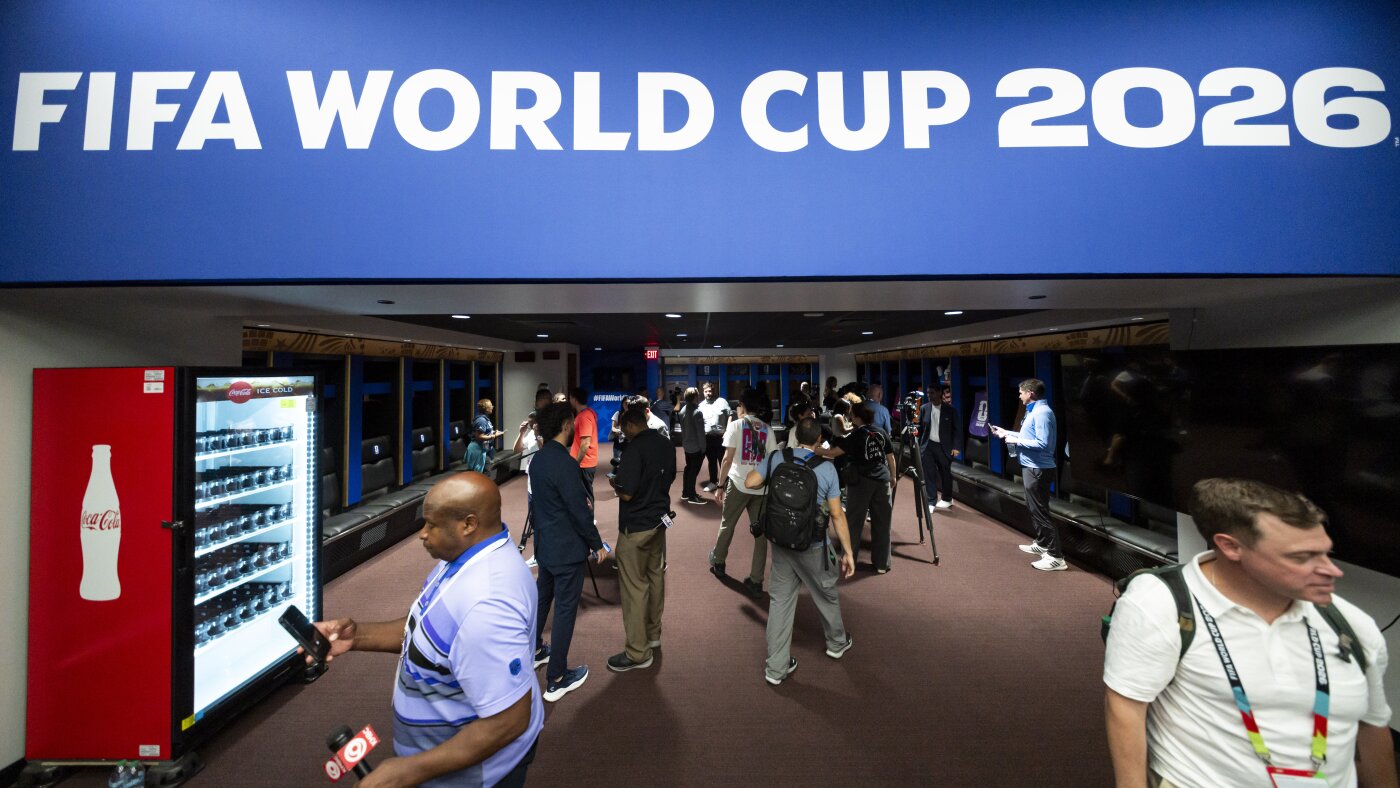
Media members tour the locker rooms at Kansas City Stadium ahead of the FIFA World Cup 2026 on June 8 in Kansas City, Mo.
Jay Biggerstaff/Getty Images
hide caption
toggle caption
Jay Biggerstaff/Getty Images
President Trump’s restrictive immigration policies are already impacting this year’s 2026 FIFA World Cup.
At least one referee from Somalia and one Iraqi team staff member were denied entry at U.S. airports in recent days, and dozens of fans from countries such as Morocco have been denied travel visas, despite being ticket holders.

“I view the 2026 World Cup as a massive paradox,” said Jules Boykoff, a professor and the author of Red Card: The 2026 World Cup, Sportswashing and the FIFA Greed Machine. “On one hand, it has more teams than ever participating. On the other hand, because of the policies of the Trump administration, it looks more like a World Cup of exclusion than inclusion.”
Boykoff, who is also a former professional soccer player, told NPR he worries the restrictive immigration policies also will shape the experience of fans in the U.S., who might be anxious about potential tense interactions with immigration agents outside of stadiums.
Boykoff’s concerns echo those of other policy experts and soccer fans who for months have warned about the influence of President Trump’s immigration policies on the tournament.
The White House did not respond to NPR’s request for comment.
In a statement to NPR, Customs and Border Protection said “all travelers seeking entry into the United States, including athletes, coaches, and staff, are subject to CBP inspection and vetting.”
The agency said “admissibility determinations are made on a case-by-case basis using law enforcement, national security, and immigration information available at the time of inspection.”
Denied entry to the U.S.
There are 39 countries who are under either a full or partial U.S. travel ban. For 19 of those countries, the State Department has suspended issuing all visas. The Trump administration has said the move is to “ensure that individuals approved for a visa do not endanger national security or public safety.”
Four countries in those lists — Iran, Haiti, Côte d’Ivoire, and Senegal — are expected to play in the World Cup.
On Saturday, decorated FIFA World Cup referee Omar Abdulkadir Artan, of Somalia, was denied entry to the U.S. after landing at the Miami International Airport.
In a statement, CBP said Artan was “determined to be inadmissible due to vetting concerns and was denied entry.” CBP did not say what concerns were.
Andrew Giuliani, the executive director of the White House Task Force for the World Cup, said Tuesday the denial was “for very good reasons,” but he didn’t provide any further explanation.
Artan did not respond to NPR’s request for comment.
Meanwhile, a player for Team Iraq was questioned for hours at Chicago O’Hare International Airport. He was allowed into the U.S., but a photographer for the team was denied entry due to “vetting concerns,” CBP said.

David Niven, a University of Cincinnati professor who teaches a course on sports and politics, told NPR these immigration issues are a self-inflicted wound.
“When you insert politics into the competition, it’s no longer the competition it was,” Niven said. “In some ways (it’s) very tangibly when a referee is missing or a player is delayed.”
The team from Iran — a country at war with the U.S. and Israel — was forced to relocate its lodging to Mexico after the U.S. government said players and staff were banned from staying overnight.
Visas for team members were approved last week, but more than a dozen support staff did not get approval, including Mehdi Taj, the president of the Iranian football federation.
In response to a social media post by U.S. Ambassador to Turkey Tom Barrack, the Iranian Embassy in Turkey said the U.S.’s conduct “violates FIFA regulations and breaches the United States’ host obligations.”
The Iranians also accused the U.S. of “politically biased interference in sport.”
“The U.S. government in practice is depriving Iran’s national team of its right to play in the World Cup under normal conditions and without undue pressure and stress,” the post on X said.
Fans face travel restrictions
Fans come from all over the world to attend the World Cup and cheer on their teams. Their chants and songs add to the excitement and vibrancy of the games.

But some fans and policy experts worry this year’s tournament may lose some of that exuberance because of U.S. visa denials.
According to the Moroccan news website Hespress, more than 40 members of multiple Moroccan football team supporter associations have been denied visas to attend the tournament. Many had tickets to the games and hotel bookings.
Gianni Infantino, FIFA’s president, in 2025 pushed against what he called “misconceptions” and said “everyone will be welcome in Canada, Mexico and the United States for the FIFA World Cup next year,” and that the U.S. was committed to a smooth travel process, so fans from all over the world will be welcome.”
But in response to Artan being denied entry to the U.S., a spokesperson for FIFA distanced the organization from the immigration issues. “FIFA is not involved in host country immigration processes, including visa adjudications, and has been informed by authorities that Mr. Artan’s status will not be changed at present,” FIFA said in a statement to NPR. “In line with previous FIFA events, a host government ultimately determines who receives a visa and who is admitted into their country.
Niven called FIFA’s new position “striking.”
“FIFA has raised the surrender flag on this question,” Niven said. “They’ve taken this situation and basically deferred to the United States and said the United States can do as they see fit.”
-

 Vermont43 seconds ago
Vermont Green FC plays Canada’s national soccer team in World Cup tuneup – VTDigger
-

 Virginia4 minutes ago
Navy sailor sentenced to 44 years for killing fellow service member Angelina Resendiz in his Virginia barracks room
-

 Washington9 minutes ago
Where to watch Washington Nationals vs San Francisco Giants: TV channel, start time, streaming for June 10
-

 Wisconsin16 minutes ago
Chris Borland heads back to Wisconsin as Hall of Fame inductee
-

 West Virginia19 minutes ago
West Virginia Democrats re-elect Mike Pushkin, elect new leadership team – The Real WV
-

 Wyoming24 minutes ago
Wyoming’s Most Treasured Views: Grand Teton National Park
-

 Crypto31 minutes ago
‘De-Worsified, Not Diversified’: Robert Kiyosaki Warns Investors on a Hidden Risk
-

 Finance34 minutes ago
The Future of Finance Jobs In The Age Of AI

