Lifestyle
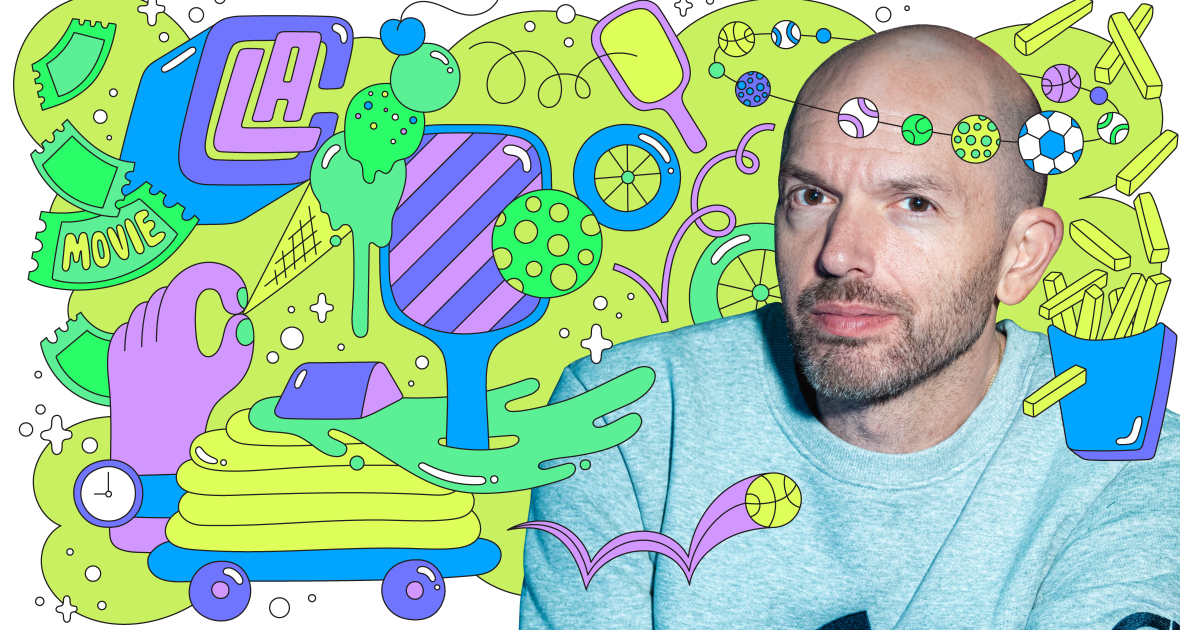
How to have the best Sunday in L.A., according to Paul Scheer
Paul Scheer’s memoir, “Joyful Recollections of Trauma,” is not just a collection of harrowing — and often humorous confessions — but also a reminder that to persevere, we must strive to maintain our passions. Scheer’s first loves come through in prose, and also on his pair of podcasts — “How Did This Get Made?” with his wife, June Diane Raphael, and friend Jason Mantzoukas, and “Unspooled” with film critic Amy Nicholson. Both explore Scheer’s appreciation of Hollywood.

In Sunday Funday, L.A. people give us a play-by-play of their ideal Sunday around town. Find ideas and inspiration on where to go, what to eat and how to enjoy life on the weekends.
“As a kid, my escapes were movies and TV shows,” Scheer says. “I wanted to be in scenes with those characters. I don’t even know if I wanted to be actor as much as I wanted to live in those worlds. I wanted to be in the ‘Different Strokes’ apartment. I wanted to ride that train on ‘Silver Spoons.’”
The former New Yorker, whose credits include “The League,” “Black Monday” and “Star Trek: Lower Decks,” gushes about a recent appearance on “Night Court” as a “full circle moment,” noting the original series was one he watched ardently as a child.
Today, film figures heavily into Scheer’s downtime. While the Los Feliz resident notes that his Sundays are primarily focused on his children, who are 10 and 7, they are also an opportunity to share other aspects of his fandom with his family, particularly sports.
This interview has been lightly edited and condensed for length and clarity.
7 a.m.: A cold plunge and pancakes
No coffee will treat me as well as a nice cold plunge. I have an inflatable cold plunge. The first thing I do is I pop that chiller on and get that water down to 50 degrees. I get in there for about six minutes.
Sunday is also a day I get to enjoy take-in from my favorite restaurants. If I have my druthers, I would love to order in pancakes from Du-par’s. I think they’re the best. Even though I live far away from them, I will get them and pop them in the oven and get them back to their deliciousness.
7:30 a.m.: Double-check the kids’ sporting schedules
My weekends are devoted to my kids. I am going nonstop from 7 a.m. to 9 p.m. but it’s nothing anyone else can be doing. I’m at an AAU tournament in Seal Beach, then I’m driving to Beverly Hills for a soccer thing. I’m coaching that team. It’s great, but it’s not relaxed. It’s not like we get a bagel from Courage Bagels and then figure things out.
8:30 a.m.: Take the family for a ‘street hike’
We don’t go in the fashionable places. We’re not going to go up to Runyon Canyon. We hike in our neighborhood — an urban hike, a street hike. We have our dog Bingo and go for a street hike.
9:30 a.m.: Pickleball on the driveway or bike to a tennis court
Normally, what we’ve been doing on Sundays — it’s one of my favorite things — my family has really gotten into pickleball. We play that at our house, or we go to Vermont Canyon, which is right by the Greek Theatre, and we will play tennis. We ride our bikes over to the Vermont Canyon tennis courts after we’ve navigated the impossible parks and recreation website to reserve those courts, and we will play for about an hour.
11 a.m.: Hit a driving range
We are an active family. Neither June nor I are golfers, but we do have drivers and clubs and we’ll go to a driving range with the kids and hit balls around. As a parent, this day is longer than you think. You need to have a Swiss Army tool of things to do. We’re lucky to live near Griffith Park, which gives us a multitude of options. We’ve become active because the kids want to be active, so that translates to finding yourself at Dave & Buster’s on a Sunday afternoon because June has gotten really into football and the kids can be playing games.
12:30 p.m.: Hope there’s a Clippers game
If it’s a perfect Sunday, it means there’s a 12:30 p.m. Clippers game; however, this [was] the last year of the 12:30 p.m. games. [Editor’s note: The Clippers are moving into their own venue, and therefore will likely no longer need to schedule the early afternoon games that were a necessity when sharing an arena.] If you know anything about the Clippers, 12:30 p.m. games are probably some of our worst outings as a team, but it’s also the only time I can bring the entire family to a Clippers game.
So I would change my season tickets to get these Sunday tickets, and my family would head down to Crypto.com — I have a hard time saying that name — and stock up on snacks and supplies. I’d hit a LudoBird. My kids do Blaze Pizza. Then, we either watch a two-hour amazing game, or we leave disheartened, but no matter what, we will come out with some sort of merch that we didn’t quite need.
3 p.m.: Treat the kids to a movie
I’m always trying to get the family out to see a movie. The New Beverly often has really fun weekend family programming, and the Vista also does interesting weekend programming. I try to convince the family — ‘Let’s go see Fred MacMurray in the ‘The Absent Minded Professor.’ Sometimes it works really great. I showed them ‘Raiders of the Lost Ark’ for the first time on an afternoon at the New Bev, and it was amazing. I showed them ‘Jason and the Argonauts,’ and it didn’t go as great, even for me.
If we want to see a new movie, we go to the Alamo Drafthouse. That’s where my kids fall in love with movies because they get to eat like pigs for 90 minutes straight. As long as they have a shake in front of them, they’re having a great time, but I try to upgrade their interests. I love the programming at Vidiots. They show amazing afternoon films that are geared toward families. They’re fun movies you woudn’t necessarily think about. It’s not necessarily ‘School of Rock.’ It’s a little more left of center. I like to get my kids’ minds open by seeing older movies.
3 p.m. Have an alternate plan: trampolines
If it’s a rainy day, or my kids are in a bad mood, there’s one place we can go. One place that turns a frown upside down that’s affordable to all families. It’s called Sky Zone. It’s a trampoline park. It is basically a world of trampolines. Trampoline basketball. Trampolines on the wall. You go over foam pits. You battle with these swords that look like they’re from ‘American Gladiators.’ Sky Zone is our go-to Sunday Funday spot. It is an accident waiting to happen. My pediatrician is like, ‘Don’t go there.’ I once went and tore a glute muscle. But I keep going back.
5:30 p.m. Hunt down fresh takes on chain-restaurant staples
The next big plan of the day is dinner, and I like to take my dinner seriously. I have to pick something that everyone is going to like. I can’t go to a cool restaurant. I have to get the full family on board. I love this [pop-up] restaurant called Chain. It’s a celebrity chef making your favorite fast food items in a way that’s extremely delicious. They’ll do a re-creation of a Taco Bell taco with Wagyu. They just had this thing where they made old-school McDonald’s fries.
One of the best nights I ever had there they re-created Pizza Hut pizza. They rebuilt the entire place to look like an old Pizza Hut, with a salad bar and sneeze guard. Chain is a hit with the family because you get great food but you also get food your kids want to eat. It makes me feel like a kid all over again. I love that vibe. It’s like, to me, when my parents brought me to Bennigan’s.
8 p.m. Wind down with pie
There will often be a call for ice cream, some stop on the way home. The kids dictate it. But I’m lactose intolerant so I’m going to hit up Magpies. I love their pies. They make these amazing slices. We are all eating our own slice of these frozen yogurt pies. The strawberry one is unbelievable. We often just sit in the car and all eat a slice of our pie.

Lifestyle
L.A. Affairs: I loved someone who felt he couldn’t be fully seen with me
He always texted when he was outside. No call, no knock. It was just a message and then the soft sound of my door opening. He moved like someone practiced in disappearing.
His name meant “complete” in Arabic, which is what I felt when we were together.
I met him the way you meet most things that matter in Los Angeles — without intending to. In our senior year at a college in eastern L.A. County, we were introduced through mutual friends, then thrown together by the particular gravity of people who recognized something in each other. He was a Muslim medical student, conservative and careful and funny in the dry, precise way of someone who has always had to choose his words. I was loud where he was quiet, messy where he was disciplined. I was out. He was not.
I understood, or thought I did. I thought that I couldn’t get hurt if I was completely conscious throughout the endeavor. Los Angeles has a way of making you feel like the whole world shares your freedoms — until you realize the city is enormous, and not all of it belongs to you in the same way.
For months, our world was confined to my apartment. He would slip in after dark, and we’d stay up late talking about his family in Iran, classical music and the particular pressure of being the son someone sacrificed everything to bring here. He told me things he said he’d never told anyone, and I believed him.
The orange glow from my Nesso lamp lit his face while the indigo sky pressed against the window behind him. In our small little world, we were safe. Outside was another matter.
On our first real date, I took him to the L.A. Phil’s “An Evening of Film & Music: From Mexico to Hollywood” program. I told him they were cheap seats even though they were the first row on the terrace. He was thrilled in the way only someone who doesn’t expect to be delighted actually gets delighted — fully, without guarding it. I put my arm around his shoulders. At some point, I shifted and moved it, and he nudged it back. He was OK with PDA here.
I remember thinking that wealth is a great barrier to harm and then feeling silly for extrapolating my own experience once again. Inside Walt Disney Concert Hall, we were just two people in love with the same music.
Outside was still another matter.
In February, on Valentine’s Day, he took me to a Yemeni restaurant in Anaheim. We hovered over saffron tea surrounded by other young Southern Californians, and we looked like friends. Before we went in, we sat in the parking lot of the strip mall — signs in Arabic advertising bread, coffee, halal meats, the Little Arabia District — hand in hand. I leaned over to kiss him.
“Not here,” he said. His eyes shifted furtively. “Someone might see.”
I understood, or told myself I did, but I was saddened. Later, after the kind of reflection that only arrives in the wreckage, I would understand something harder: I had been unconsciously asking him to choose, over and over, between the people he loved and the person he loved. I had a long pattern of choosing unavailable men, telling myself it was because I could handle the complexity. The truth was more embarrassing. I thought that if someone like him chose me anyway — chose me over the weight of societal expectations — it would mean I was worth choosing. It took me a long time to see how unfair that was to him and to me.
We went to the Norton Simon Museum together in November, on the kind of gray Pasadena day when the 210 Freeway roars in the background like white noise. He studied for the MCAT while I wrote a paper on Persian rugs. In between practice problems, he translated ancient Arabic scripts for me. I thought, “We make a good team.” Afterward, we walked through the galleries and he didn’t let go of my arm.
That was the version of us I kept returning to — when the ending came during Ramadan. It arrived as a spiritual reflection of my own. I texted: “Does this end at graduation — whatever we are doing?”
He thought I meant Ramadan. I did not mean Ramadan.
“I care about you,” he wrote, “but I don’t want you to think this could work out to anything more than just dating. I mean, of course, I’ve fantasized about marrying you. If I could live my life the way I wanted, of course I would continue. I’m just sad it’s not in this lifetime.”
I was in Mexico City when these texts were exchanged. That night I flew to Oaxaca to clear my head and then, after less than 24 hours, flew back to L.A. No amount of vacation would allow me to process what had just happened, so I threw myself back into work.
My therapist told me to use the conjunction “and” instead of “but.” It happened, and I am changed. The harm I caused and the love I felt. The beauty of what we made and the impossibility of where it could go. She gave me a knowing smile when I asked if it would stay with me forever. She didn’t answer, which was the answer.
I think about the freeways now, the way Joan Didion called them our only secular communion. When you’re on the ground in Los Angeles, the world narrows to the few blocks around you. Get on the freeway and you understand the whole body of the city at once: the arteries, the pulse, the scale of the thing.
You understand that you are a single cell in something enormous and moving. It is all out of your control. I am in a lane. The lane shaped how I drive. He was simply in a different lane, and his lane shaped him, and those two facts can coexist without either of us being the villain of the sad story.
He came like a secret in the night, and he left the same way. What we made in between was real and complicated and mine to hold forever, hoping we find each other in the next life.
The author lives in Los Angeles.
L.A. Affairs chronicles the search for romantic love in all its glorious expressions in the L.A. area, and we want to hear your true story. We pay $400 for a published essay. Email LAAffairs@latimes.com. You can find submission guidelines here. You can find past columns here.
Lifestyle
The Nerve Center of This Art Fair Isn’t Painting. It’s Couture.
The art industry is increasingly shaped by artists’ and art businesses’ shared realization that they are locked in a fierce struggle for sustained attention — against each other, and against the rest of the overstimulated, always-online world. A major New York art fair aims to win this competition next month by knocking down the increasingly shaky walls between contemporary art and fashion.
When visitors enter the Independent art fair on May 14, they will almost immediately encounter its open-plan centerpiece: an installation of recent couture looks from Comme des Garçons. It will be the first New York solo presentation of works by Rei Kawakubo, the brand’s founder and mastermind, since a lauded 2017 survey exhibition at the Metropolitan Museum of Art’s Costume Institute.
Art fairs have often been front and center in the industry’s 21st-century quest to capture mindshare. But too many displays have pierced the zeitgeist with six-figure spectacles, like Maurizio Cattelan’s duct-taped banana and Beeple’s robot dogs. Curating Independent around Comme des Garçons comes from the conviction that a different kind of iconoclasm can rise to the top of New York’s spring art scrum.
Elizabeth Dee, the founder and creative director of Independent, said that making Kawakubo’s work the “nerve center” of this year’s edition was a “statement of purpose” for the fair’s evolution. After several years at the compact Spring Studios in TriBeCa, Independent will more than double its square footage by moving to Pier 36 at South Street, on the East River. Dee has narrowed the fair’s exhibitor list, to 76, from 83 dealers in 2025, and reduced booth fees to encourage a focus on single artists making bold propositions.
“Rei’s work has been pivotal to thinking about how my work as a curator, gallerist and art fair can push boundaries, especially during this extraordinary move toward corporatization and monoculture in the art world in the last 20 years,” Dee said.
Kawakubo’s designs have been challenging norms since her brand’s first Paris runway show in 1981, but her work over the last 13 years on what she calls “objects for the body” has blurred borders between high fashion and wearable sculpture.
The Comme des Garçons presentation at Independent will feature 20 looks from autumn-winter 2020 to spring-summer 2025. Forgoing the runway, Kawakubo is installing her non-clothing inside structures made from rebar and colored plastic joinery.
Adrian Joffe, the president of both Comme des Garçons International and the curated retailer Dover Street Market International (and who is also Kawakubo’s husband), said in an interview that Kawakubo’s intention was to create a sculptural installation divorced from chronology and fashion — “a thing made new again.”
Every look at Independent was made in an edition of three or fewer, but only one of each will be for sale on-site. Prices will be about $9,000 to $30,000. Comme des Garçons will retain 100 percent of the sales.
Asked why she was interested in exhibiting at Independent, the famously elusive Kawakubo said via email, “The body of work has never been shown together, and this is the first presentation in New York in almost 10 years.” Joffe added a broader philosophical motivation. “We’ve never done it before; it was new,” he said. Also essential was the fair’s willingness to embrace Kawakubo’s vision for the installation rather than a standard fair booth.
Kawakubo began consistently engaging with fine art decades before such crossovers became commonplace. Since 1989, she has invited a steady stream of contemporary artists to create installations in Comme des Garçons’s Tokyo flagship store. The ’90s brought collaborations with the artist Cindy Sherman and performance pioneer Merce Cunningham, among others.
More cross-disciplinary projects followed, including limited-release direct mailers for Comme des Garçons. Kawakubo designs each from documentation of works provided by an artist or art collective.
The display at Independent reopens the debate about Kawakubo’s proper place on the continuum between artist and designer. But the issue is already settled for celebrated artists who have collaborated with her.
“I totally think of Rei as an artist in the truest sense,” Sherman said by email. “Her work questions what everyone else takes for granted as being flattering to a body, questions what female bodies are expected to look like and who they’re catering to.”
Ai Weiwei, the subject of a 2010 Comme des Garçons direct mailer, agreed that Kawakubo “is, in essence, an artist.” Unlike designers who “pursue a sense of form,” he added, “her design and creation are oriented toward attitude” — specifically, an attitude of “rebellion.”
Also taking this position is “Costume Art,” the spring exhibition at the Costume Institute. Opening May 10, the show pairs individual works from multiple designers — including Comme des Garçons — with artworks from the Met’s holdings to advance the argument made by the dress code for this year’s Met gala: “Fashion is art.”
True to form, Kawakubo sometimes opts for a third way.
“Rei has often said she’s not a designer, she’s not an artist,” Joffe said. “She is a storyteller.”
Now to find out whether an art fair sparks the drama, dialogue and attention its authors want.
Lifestyle
They set out to elevate karaoke in L.A. — and opened a glamorous lounge that pulls out all the stops
Brothers Leo and Oliver Kremer visited karaoke spots around the globe and almost always had the same impression.
“The drinks weren’t always great, the aesthetics weren’t always so glamorous, the sound wasn’t always awesome and the lights were often generic,” says Leo, a former bassist of the band Third Eye Blind.
As devout karaoke fans, they wanted to level up the experience. So they dreamed up Mic Drop, an upscale karaoke lounge in West Hollywood that opens Thursday. It’s located inside the original Larrabee Studios, a historic 1920s building formerly owned by Carole King and her ex-husband, Gerry Goffin — and the spot where King recorded some of her biggest hits. Third Eye Blind band members Stephan Jenkins and Brad Hargreaves are investors of the new venue.
Inside the two-story, 6,300-square-foot venue with 13 private karaoke rooms and an electrifying main stage, you can feel like a rock star in front of a cheering audience. Want to check it out? Here are six things to know.
The Kremer brothers hired sculptor Shawn HibmaCronan to create an 8-foot-tall disco-themed microphone for their karaoke lounge.
1. Take your pick between a private karaoke experience or the main stage
A unique element of Mic Drop is that it offers both private karaoke rooms and a main stage experience for those who wish to sing in front of a crowd. The 13 private rooms range from six- to 45-person capacity. Each of the karaoke rooms are named after a famous recording studio such as Electric Lady, Abbey Road, Shangri La and of course, Larrabee Studios. There is a two-hour minimum on all rentals and hourly rates depend on the room size and day of the week.
But if you’re ready to take the center stage, it’s free to sing — at least technically. All you have to do is pay a $10 fee at the door, which is essentially a token that goes toward your first drink. Then you can put your name on the list with the KJ (karaoke jockey) who keeps the crowd energized throughout the night and even hits the stage at times.
Harrison Baum, left, of Santa Monica, and Amanda Stagner, 27, of Los Angeles, sing in one of the 13 private karaoke rooms.
2. Thumping, high sound quality was a top priority
As someone who toured the world playing bass for Third Eye Blind, top-tier sound was a nonnegotiable for Leo. “Typically with karaoke, the sound is kind of teeny, there’s not a lot of bass and the vocal is super hot and sitting on top too much,” he says. To combat this, he and his brother teamed up with Pineapple Audio, an audio visual company based in Chicago, to design their crisp sound system. They also installed concert-grade speakers and custom subwoofers from a European audio equipment manufacturer called Celto, and bought gold-plated Sennheiser wireless microphones, which they loved so much that they had an 8-foot-tall replica made for their main room. Designed by artist Shawn HibmaCronan, the “macrophone,” as they call it, has roughly 30,000 mirror tiles. “It spins and throws incredible disco light everywhere,” says Leo.
Karaoke jockeys Sophie St. John, 27, second from left, and Cameron Armstrong, 30, right, get the crowd involved with their song picks at Mic Drop.
3. A concert-level performance isn’t complete without good stage lighting and a haze machine
Each karaoke room features a disco ball and dynamic lighting that syncs up with whatever song you’re singing, which makes you feel like you are a professional performer. There’s also a haze machine hidden under the leather seats. Meanwhile, the main stage is concert-ready with additional dancing lasers and spotlights.
Brett Adams, left, of Sherman Oaks, and Patrick Riley of Studio City sing karaoke together inside a private lounge at Mic Drop.
4. The song selection is vast, offering classics and new hits
One of the worst things that can happen when you go to karaoke is not being able to find the song you want to sing. At Mic Drop, the odds of this happening are slim to none. The venue uses a popular karaoke service called KaraFun, which has a catalog of more than 600,000 songs (and adds 400 new tracks every month), according to its website. Take your pick from country, R&B, jazz, rap, pop, love duets and more. (Two newish selections I spotted were Raye’s “Where Is my Husband” and Olivia Dean’s “Man I Need,” which both released late last year.) In the private karaoke rooms, there’s also a fun feature on Karafun called “battle mode,” which allows you and your crew of up to 20 people to compete in real time. KaraFun also has an entertaining music trivia game, which I tested out with the founders and came in second place.
The design inspiration for Mic Drop was 1920s music lounges and 1970s disco culture, says designer Amy Morris.
5. The interiors are inspired by 1920s music lounges mixed with ‘70s disco vibes
A disco ball hangs from the ceiling.
If you took the sophisticated aesthetic of 1920s music lounges and mixed it with the vibrant and playful era of 1970s disco culture, you’d find Mic Drop.
When you walk into the lounge, the first thing you’ll see is a bright red check-in desk that resembles a performer’s dressing room with vanity lights, several mirrors and a range of wigs. “So much of karaoke is about getting into character and letting go of the day, so we had the idea to sell the wigs,” says Oliver. As you continue into the lounge, the focal point is the stage, which is adorned with zebra-printed carpet and dramatic, red velvet curtains. For seating, slide into the red velvet banquettes or plop onto a gold tiger velvet stool. Upstairs, you’ll find the intimate karaoke studios, which are decorated with red velvet walls and brass, curved doorways that echo the building’s deco arches, says Mic Drop’s interior designer, Amy Morris of the Morris Project.
Sarah Rothman, center, of Oakland, and friend Rachel Bernstein, left, of Los Angeles, wait at the bar.
6. You can order nontraditional karaoke bites as you wait for your turn to sing
While Mic Drop offers some of the food you’d typically find at a karaoke lounge such as tater tots, truffle popcorn and pizza, the venue has some surprising options as well. For example, a 57 gram caviar service (served with chips, crème fraîche and chives) and shrimp cocktail from Santa Monica Seafood. For their pizza program, the Kremer brothers teamed up with Avalou’s Italian Pizza Company, which is run by Louis Lombardi who starred in “The Sopranos.” He’s the brainchild behind my favorite dish, the Fuhgeddaboudit pizza, which is made with pastrami, pickles and mustard. It might sound repulsive, but trust me.
As for the cheeky cocktails, they are all named after famous musicians and songs such as the Pink Pony Club (a tart cherry pomegranate drink with vodka named after Chappell Roan), Green Eyes (a sake sour with kiwi and melon named after Green Day) and Megroni Thee Stallion (an elevated negroni named after Megan Thee Stallion).
-
Sports3 minutes agoOlympic legend Kaillie Humphries signs with activist sportswear brand XX-XY Athletics amid political rise
-
Technology9 minutes agoFCC router rule raises questions about future updates
-
Business15 minutes agoCalifornia’s jet fuel stockpile hits two-year low as war strangles oil supplies
-
Entertainment21 minutes agoStagecoach 2026: How to watch Friday’s livestream with Cody Johnson, Ella Langley, Bailey Zimmerman
-
Lifestyle26 minutes agoL.A. Affairs: I loved someone who felt he couldn’t be fully seen with me
-
Politics33 minutes agoContributor: Carlson’s cautious apology does little to repair Trumpism’s damage
-
Sports45 minutes agoCancer left him blind. When his son was diagnosed, ex-USC long snapper found Trojans had his back again
-
World57 minutes agoOrbán-style vetoes undermine EU democracy, Kallas tells Euronews