Business
Fast food chains launch 'value menu' war after cost complaints. Will it last?

Millions of American families are hitting the road to start summer vacation, and ordering food on the run tends to be par for the course. It couldn’t come at a better time. Fast food joints are in the midst of a budget-meal war, offering promotions to lure customers back to their restaurants despite inflation woes and a minimum-wage increase in California and other states.
Starting June 25, McDonald’s will offer a month-long deal featuring a combo meal —either a McChicken, a McDouble or four-piece chicken nuggets, small fries and a small drink — for $5.
After McDonald’s announcement last month, other fast food restaurants followed suit. Wendy’s announced its $3 limited-time breakfast combo meal and Burger King trumpeted that it planned to bring back its $5 Your Way Meal.
In addition, fast food mobile apps continue to offer deep discounts.
App relief
Earlier this week, a Big Mac with medium fries and medium drink cost $11.79 before tax at a McDonald’s in Santa Ana. That same meal ordered via a mobile app for pickup at the same location cost $6.50 before tax, a savings of $5.29.
But the prices and deals tend to vary depending on the user.
Diners have taken to complaining on Reddit about the McDonald’s mobile app. Some say the deals decrease with use. Others say their friends or partners were getting a better deal on the app than they were getting. A few mentioned that they could find better deals by just walking in and ordering at their local McDonald’s.
The plethora of promotional deals come after diners blasted fast food companies on social media earlier this year for rising prices.
In response, Joe Erlinger, president of McDonald’s USA, said in an open letter last month that the average price of McDonald’s menu items is up an estimated 40% since 2019.
The McDonald’s restaurant logo and golden arch is lit up in Chicago. McDonald’s plans to introduce a $5 meal deal in the U.S. in June 2024 to counter slowing sales and customers’ frustration with high prices.
(Jeff Roberson / Associated Press)
“Recently, we have seen viral social posts and poorly sourced reports that McDonald’s has raised prices significantly beyond inflationary rates. This is inaccurate,” Erlinger wrote.
“The average price of a Big Mac in the U.S. was $4.39 in 2019,” he said. “Despite a global pandemic and historic rises in supply chain costs, wages and other inflationary pressures in the years that followed, the average cost is now $5.29. That’s an increase of 21% (not 100%),” as unsubstantiated claims allege on social media.
Quick-service restaurants said the increases were in response to rising inflation and labor costs — partly due to hikes in minimum wage not just in California but throughout the country.
It’s true that quick-service restaurants such as McDonalds have had to contend with increased costs, but they are by no means hurting, said Shubhranshu Singh, an associate professor at Johns Hopkins University who specializes in quick-service marketing.
“They are not struggling,” Singh said. “Inflation is going up. Wage rates are going up. But profit for McDonald’s is also going up.”
Global comparable sales for McDonald’s grew nearly 2% in the first quarter of the year, according to the latest statistics made available by the company. The fast-food giant described this profit increase as having “benefited from average check growth driven by strategic menu price increases.”
Price-weary diners have taken notice and become fed up with the price hikes, choosing to eat less fast food and protesting on social media that their go-to budget meals were no longer wallet-friendly, Singh said.
Several diners took aim at McDonald’s, griping on TikTok about the company charging more for food that’s supposed to be affordable.
“This is $3 worth of food,” said a customer who held up a hash brown. “Something doesn’t seem right here.”
“McDonald’s has gotten too cocky,” said another customer. “Y’all not supposed to be expensive.”
One diner called it “absurd” that she’d paid $4.59 for a medium order of french fries.
And then there was the uproar over a McDonald’s location in Connecticut charging $18 for a Big Mac combo meal. The photo sparked a nationwide debate on soaring fast-food prices.
Making choices
Most McDonald’s in the United States are independently franchised, so prices vary depending on where one visits.
Increased fast food prices ultimately led to slower-than-expected sales at various quick-service restaurants, such as McDonald’s, Starbucks and Pizza Hut.
“Consumers are always making choices,” said restaurant analyst Sara Senatore at Bank of America. “When the value proposition starts to diminish, consumers will make other choices.”
Up until fairly recently, consumers were willing to pay more for quick-service food. When fast food prices started to soar in 2022, consumers just went along because prices everywhere had surged due to inflation, Senatore said.
But now inflation has lessened. Grocery prices have fallen and budget-conscious consumers may no longer see fast food as the clear-cut affordable choice, she said.
Enter the value meals.
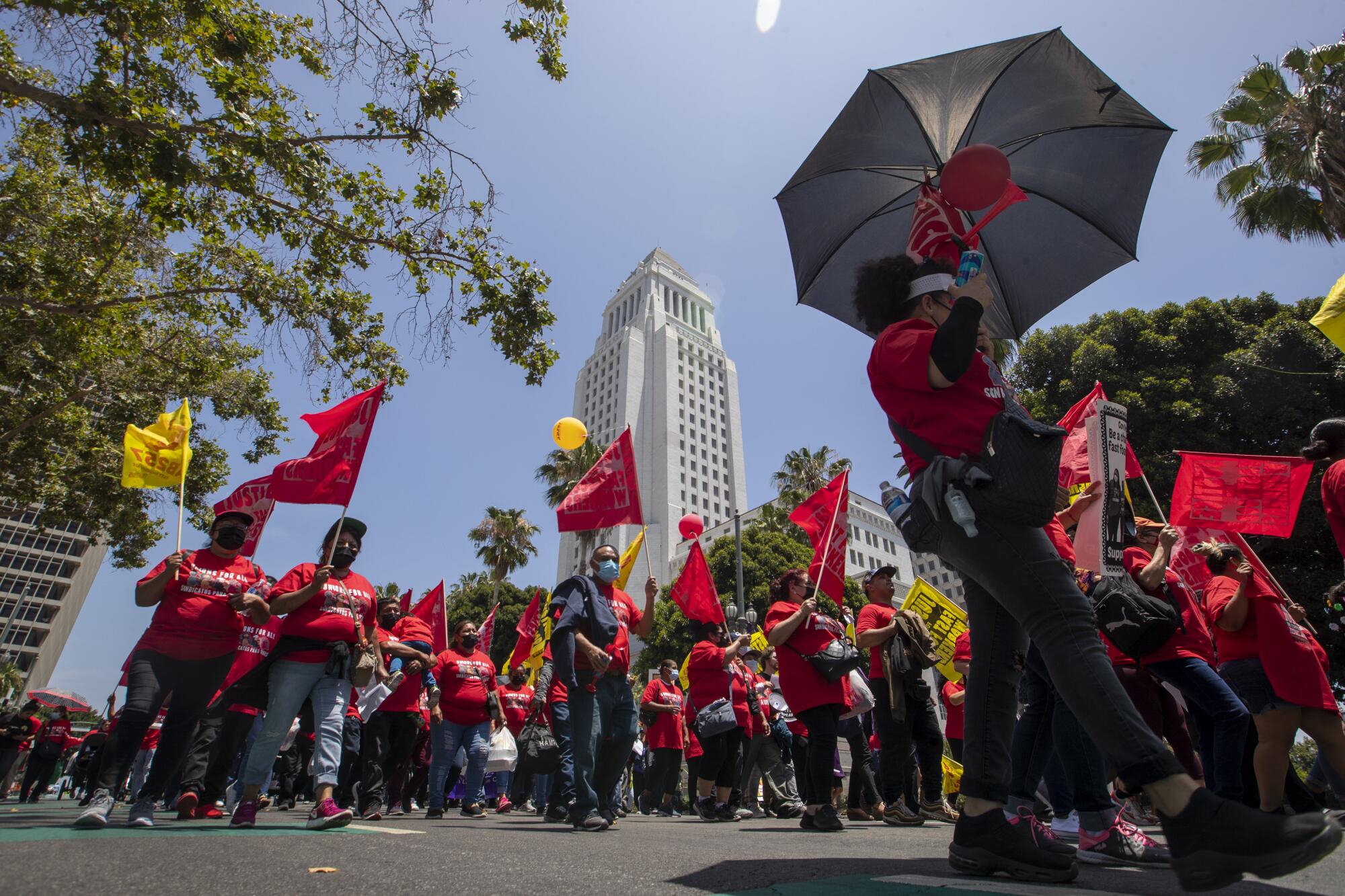
Fast food workers rally in favor of a proposed minimum wage increase outside Los Angeles City Hall in 2022. The approved increase went into effect on April 1 and was considered a victory for organized labor.
(Brian van der Brug / Los Angeles Times)
Budget meals aren’t new. In the 1980s, McDonald’s, Wendy’s and Burger King engaged in a series of advertising campaigns known as the Burger Wars competing for customers in the then-flourishing fast food market.
“The hope is that the consumer will go there and maybe buy something additional to the value meal and then want to return even when there is no deal,” Singh said.
But the promotions, analysts warned, can’t last forever.
“It’s not sustainable,” Singh said. “I don’t expect any of these deals to stay.”

Business
Newsom and L.A. declare state of emergency as Boyle Heights fire continues spewing smoke across region

Gov. Gavin Newsom and L.A. city officials on Saturday declared a state of emergency as firefighters continue to battle a stubborn warehouse fire in Boyle Heights that has sent plumes of irritating smoke across the region.
“While the [Los Angeles Fire Department] continues making progress, this is a major, multi-jurisdictional incident,” Mayor Karen Bass said in a statement. “I’m issuing an emergency declaration to ensure the city has the resources it needs as this operation continues and to keep the community safe.”
The declaration activates the city’s emergency response structure, directs departments to assess damages and costs, and requests state assistance to support firefighting, cleanup, environmental monitoring and community recovery efforts.
Newsom’s declaration, issued at about 9 p.m., allows state agencies to ramp up support for firefighting efforts in Los Angeles.
“While local officials continue to lead this response, the State of California is prepared to help safeguard public health, support emergency operations, and assist impacted residents,” Newsom said in a statement.
The state will deploy technical experts and make ready 5.5 million respirator masks for distribution, along with commercial-grade air purifiers, bottled water and enhanced air-quality monitors.
Los Angeles Fire Department Chief Jamie Moore at a Saturday morning news conference described the blaze that broke out Wednesday as a “very unique fire, a very unique challenge for the Los Angeles Fire Department, for the city of Los Angeles, but also for the County of Los Angeles.”
The 500,000-square-foot commercial building at 1400 S. Los Palos St. stores 85 million pounds of frozen food “like a giant cooler,” he said. The corrugated steel walls are filled with dense foam that is burning slowly and emitting gases despite ongoing water drops from helicopters.
The building is also topped with solar panels that have caught fire.
A Los Angeles Fire Department captain wears a respirator while watching the fire in Boyle Heights on Saturday.
(Myung J. Chun / Los Angeles Times)
Moore cautioned people with lung issues or smoke sensitivity to avoid outdoor activities, but said crews have mitigated hazardous materials at the site, including ammonia. However, officials remain concerned about biohazards potentially posed by spoiled food, including bread, poultry, pork and beef.
“Imagine the food inside your refrigerator with no power, no refrigerant, starting to rot, and then opening up your refrigerator door, that’s about where we are now,” Moore said. “So, once we get this fire put out, the challenge that we have before us is the removal of all that product.”
A shelter-in-place order for residents was lifted on Friday, but many across the region on social media reported smoke smells, haze and poor air quality in the San Gabriel Valley, Northeast Los Angeles, Glendale, Burbank, downtown Los Angeles and many other areas.

-
Share via
Some said the smoke was as bad, if not worse, as during the Eaton fire that burned in Altadena in January 2025.
The city opened a smoke respite shelter at Pecan Recreation Center at 145 S. Pecan St., while the county opened one in City Terrace Park at 1126 N. Hazard Ave.
Bass, who joined Moore and other local officials at two the City Terrace Park press conferences, said she had reached out to Newsom for additional support.
Lineage Logistics is the tenant-operator of the building. In a statement issued late Friday night, company officials said they believe the fire began while third-party contractors were testing the solar array on the roof.
“Lineage’s top priority is the health and safety of the community, and we are continuing to work closely with the Los Angeles Fire Department and other agencies to provide any assistance we can,” the statement said. “We are grateful to Los Angeles’ remarkable firefighters for their ongoing and brave efforts.”
The company said the facility is not used for the storage of hazardous materials, and that there have been no measurable ammonia concentrations recorded in the community since the fire started. Additionally, “Lineage has proactively taken additional steps to pump out the ammonia and transport it offsite, removing the possibility of ammonia posing a risk to the community.”
L.A. County health officer Muntu Davis said the main public health concern was smoke and fine particles that can cause irritation of the ear, nose, throat and lungs, as well as exacerbate heart and lung conditions.
Sensitive individuals were encouraged to wear well-fitting N95 and P100 masks, and to register for emergency notifications at alertla.org.
Will Barrett, assistant vice president for nationwide clean air policy with the American Lung Assn., told The Times that it can be hard to pinpoint exactly what is in the smoke while crews are still working to contain the evolving health risk, but that the most important thing is to avoid exposure.
“Much like recent industrial and wildfire incidents, the makeup of the smoke can include toxic chemicals, fine particles and other serious risks to lung health depending on fire conditions and what is burned,” he said.
On its own, particle pollution can increase the risk of asthma attacks, heart attacks and other medical emergencies, and other chemicals in the air can cause both near- and long-term harms, he said.
Another concern is the possibility that there were lithium-ion batteries within the structure. Batteries are often used to store energy produced by solar panels, although officials could not immediately confirm whether that was the case in Boyle Heights. However, they said the building does house about 60 forklifts that run on lithium-ion batteries, although those are “currently unburned.”
Low-level toxic fumes measured on Thursday included hydrogen fluoride, a byproduct produced by burning lithium-ion batteries, LAFD spokesperson Lyndsey Lantz told The Times.
“It is likely that there were some involved at some point,” she said. “We just don’t have confirmation of where they were or what part of the building they were responsible for.”

A LAFD helicopter surveys the fire at Lineage Logistics cold storage in Boyle Heights on Saturday.
(Myung J. Chun / Los Angeles Times)
The multiday effort has been full of challenges for firefighters with fiery flare-ups.
The fire initially grew into a huge inferno, creating a pillar of thick, black smoke that could be seen for miles. It then reached an ammonia line, triggering several small explosions and a dramatic image of flames shooting through the building’s roof as crews evacuated the area to avoid the fumes.
That caused officials to announce a shelter-in-place order, which was lifted, only to be reinstated on Thursday after a different section of the building caught fire. That new shelter-in-place order was lifted Friday just before 11:30 a.m.
The smoke from the fire also triggered a special particle pollution advisory from the South Coast Air Quality Management District. It was to remain in effect until 12:30 p.m. Saturday.
AQMD officials said they have dispatched air quality inspectors to the area and have been responding to public complaints. The district has also deployed stationary monitors at Eastman Avenue Elementary and Robert Louis Stevenson Middle School to measure hourly particulate matter concentrations.
Additionally, the U.S. Environmental Protection Agency is deploying specialized monitors at various locations around the facility and in the community to measure volatile organic compounds and various other air toxins.
“Residents have lived through days of smoke, shelter-in-place orders, disruptions to daily life, and ongoing questions about what this means for their health and well-being,” Councilmember Ysabel Jurado, who represents Boyle Heights, said during the afternoon press conference. She said she will continue pushing for resources and support for the community. “Boyle Heights deserves clear information, direct support, and full accountability throughout the response, cleanup and recovery process.”
Chief Deputy Jon O’Brien with the Los Angeles County Fire Department said Saturday that deep pockets of smoldering fire remain buried under structural debris and solar panels.
“Our city firefighting brothers and sisters are executing a meticulous, deeply challenging operation to bring the fire under control,” he said.
Last month, Southland residents experienced an industrial incident involving an overheated storage tank of methyl methacrylate at the GKN Aerospace facility in Garden Grove, triggering fears of an explosion or toxic release.
The event led to the evacuation of about 50,000 people.
The near-disaster was a reminder of Southern California’s long history of industrial development, and how close many such facilities are to homes and communities throughout the region.
Assemblymember Jessica Caloza (D-Los Angeles), who represents East L.A., pointed out during the press conference that East L.A. also experienced an oil spill last month.
It occurred when a crew laying fiber-optic cable ruptured a pipeline carrying crude oil from Kern County to the Port of Los Angeles, causing a hazardous-material incident, The Times reported.
“Communities like East L.A., like Boyle Heights, immigrant Latino communities — hardworking, everyday working-class people — bear the brunt of air pollution, of environmental hazards, of all these things that for some reason keep happening in the same neighborhoods,” she said.
At 8 p.m. Saturday, the Los Angeles Fire Department announced it had stopped aerial water drops for the night, but that ground crews would continue fighting the blaze overnight, with the help of the department’s firefighting robot.
The department described the fire as “a complex, long-duration incident that will require sustained operations.”
Times staff writer Richard Winton contributed to this report.
Business
This startup wants to bring driverless freight trucks to California’s roads, but drivers are pushing back

A Bay Area startup is trying to reinvent the semitruck by making the gas-guzzling giants electric, autonomous and designed for efficiency.
Humble Robotics, founded last year in San Francisco, has raised $24 million to develop a cabless freight truck that lacks a steering wheel, gas pedal and driver’s seat.
The company says its reimagined truck could move freight across California and other states while saving money and reducing carbon dioxide emissions.
Humble Robotics emerged from stealth in April with seed funding led by Eclipse Capital, a Palo Alto-based venture capital firm, and Energy Impact Partners.
A rendering of the Humble Hauler, an electric, autonomous freight truck under development by the San Francisco startup Humble Robotics.
(Eyal Cohen)
The company is looking to capitalize on new regulations in California that could pave the way for autonomous trucks to hit public roads in the near future.
But the technology still faces hurdles, experts said, and labor groups including the Teamsters are raising alarms over safety and availability of jobs.
“We’re building an electric autonomous platform for moving freight, and when we were conceiving the company, the goal was to move freight at the lowest possible cost,” said Eyal Cohen, founder and chief executive of Humble Robotics. “We just want to bring everybody along into modernizing this technology.”
Cohen, who has spent nearly two decades working on electric and autonomous vehicles at companies including Uber, Apple and Waabi, said Humble’s driverless truck dubbed the Humble Hauler could begin customer pilots within the year.
In April, the California Department of Motor Vehicles revised its regulations for autonomous vehicles and lifted a ban on autonomous trucks weighing 10,001 pounds or more. Heavy-duty autonomous vehicles, however, are required to begin testing with a human safety driver and must complete 500,000 miles of testing at each stage of certification.
Humble Robotics has not yet applied for a California DMV autonomous vehicle permit and was originally planning testing operations in Texas. Cohen said the company will adapt to the new regulations in California.
“Our focus is now shifting back to our home state of California given these recent changes,” Cohen said. “We look forward to working with the DMV to understand the requirements of these changes and plan our operations in this state.”
Humble Robotics faces competition from other autonomous trucking companies including Pittsburgh-based Aurora and Bay Area-based Kodiak.
Both Kodiak and Aurora are developing self-driving trucks with traditional driver’s components like a steering wheel. By forgoing the front cab, Humble Robotics could face additional regulatory hurdles, said Dan Sperling, founding director emeritus of the Institute of Transportation Studies at UC Davis.
“At what point they would approve a truck without a steering wheel or pedals and without a cab in the vehicle, that’s probably going to be a little longer,” Sperling said. “Without a cab, that means what happens when something goes wrong, you can’t get someone in there to drive it.”
Heavy-duty vehicles without a cab known as automated guided vehicles already exist in controlled environments like marine ports. These vehicles are not fully autonomous, but independently follow a predetermined route.
Cohen said Humble Robotics is working to make cabless vehicles applicable to public roads, particularly those surrounding the busy ports of Los Angeles and Long Beach.
“Humble aims to partner with ports, terminal operators, and intermodal shipping companies for initial deployments,” Cohen said. “We’ve been impressed by the Long Beach Container Terminal’s embrace of state-of-the-art technology.”
The company employs fewer than 50 people and relies on technology similar to what’s used in self-driving cars, including radar, lidar and cameras that provide a 360-degree view around the vehicle. The truck will also use AI to make driving decisions with “intelligent reasoning that adapts to any scenario,” the company’s website says.
“What’s unique at Humble compared to past endeavors is that cameras are the primary mechanism that we use for doing the work, where lidar and radar are more of a backup,” Cohen said.
The company declined to share the production or sale price of the vehicle, and would not disclose its finances.
The Humble Hauler is a Class 8 vehicle, the same group as semitrucks, and has a universal carrying platform that can accommodate typical cargo containers or other loads like a concrete mixer. The truck will have an electric range of 200 miles and a max speed of 55 miles per hour.
Though the Hauler is in the same class as long-haul trucks, Cohen said its primary use case will be for shorter, back-and-forth journeys. Long-haul electric trucks are harder to scale because they require a large, expensive battery.
As of last year in California, nearly one in four new trucks, buses and vans were zero-emission. Zero-emission vehicles made up around 23% of new medium- and heavy-duty truck sales in the state in 2024, according to a release from Gov. Gavin Newsom’s office.
Earlier this year, California’s clean-truck voucher program reserved $165 million to subsidize Tesla’s planned electric semitruck.

A rendering of the Humble Hauler, an electric, autonomous freight truck under development by the San Francisco startup Humble Robotics.
(Eyal Cohen)
“For a lot of moves that we do in freight, like moving back and forth from two points that are only a few miles apart, electric is a really great technology,” Cohen said.
California is among the largest markets for freight trucking, employing more than 130,000 drivers. Eight out of every 1,000 jobs in California belong to a truck driver, according to Fremont Contract Carriers.
That means taking away human driver jobs could be particularly detrimental in the state. Teamsters California, which represents 250,000 workers across dozens of industries, strongly opposed the DMV’s move to lift the ban on autonomous trucks.
“The DMV’s decision to rush forward with driverless heavy‑duty trucks is reckless, and we will use every tool necessary to stop it,” Teamsters California said in a statement. “These rules put our streets, our highways, and our jobs in jeopardy.”
Cohen said he does not believe automated trucking will fully replace human jobs any time soon.
“Obviously people are concerned about autonomous freight and what it means,” he said. “There are millions of Class 8 trucks out there and it’ll take a very long time for all those to become automated. A truck driver today will have a job for the rest of their career.”
Communities in California and beyond are gradually warming up to self-driving cars with the arrival of Waymo and Zoox robotaxis. But autonomous trucks are likely to face more scrutiny, Sperling of UC Davis said.
“There’s an optics issue, and that is if you are driving down the road and see this massive truck next to you with no driver, you’re going to freak out,” Sperling said. “If something goes wrong, the repercussions are massive.”

WASHINGTON — In congressional races across the country, a new crop of super PACs is taking to the air with millions of dollars worth of advertisements to sway voters.
“President Trump said it best, ‘Celeste Maloy will never let you down,’” says one advertisement supporting the Utah Republican representative in her upcoming primary election.
“Standing up to big pharma, fighting for local jobs, Val Hoyle doesn’t back down,” says an ad backing the Oregon Democratic representative ahead of her primary victory last month.
The super PACs have nondescript names — such as Jobs and Democracy PAC and American Mission — and the text is so generic that it almost seems to have been created by artificial intelligence.
That isn’t so far off the mark. The AI industry has funded the ads.
One network of super PACs is linked to Anthropic, maker of the popular AI tool Claude, and the other to Open AI, maker of ChatGPT.
They have been among the most prolific political spenders so far in the 2026 midterm elections, splashing out more than $37 million to date to influence races across the country and making the groups among the biggest outside spenders so far in congressional races. That number could grow exponentially as campaign season heats up closer to the November election — and as the Silicon Valley giants prepare initial pubic offerings that are poised to raise billions of dollars for the companies and their executives.
The AI political spending boom comes as emerging technology companies have become increasingly “comfortable with using their power to achieve a political goal,” said Adam Kovacevich, a former Google public policy executive and founder of Chamber of Progress, a technology trade group with a progressive orientation.
The leading AI companies have a history.
Anthropic was formed by former OpenAI employees who were concerned that the company was less focused on its original mission to safely harness the power of AI.
The companies are now the leading drivers of the burgeoning AI industry, and their competing views about how the technology should be regulated are playing out in a wide-ranging political ad spending war that has targeted congressional races in big cities and rural areas alike.
OpenAI thinks AI should be regulated solely at the federal level.
Anthropic calls for more stringent regulation and supports efforts by states such as New York and California that have passed more aggressive AI laws.
The groups spending in these races are super PACs, which are able to raise and spend unlimited amounts of money in federal races thanks to the 2010 Citizens United Supreme Court decision.
In some races, the AI-backed political groups have spent more than the candidates they are backing.
“There was no way as a grassroots person that I could compete with that kind of money,” said Al Olszewski, whose opponent in a Montana Republican congressional primary beat him by 30 points after getting a boost from $877,000 in ads from a super PAC backed by OpenAI’s co-founder. “I got crushed.”
The AI behemoths have emphasized that they are independent from the political groups.
One group counts $25 million in support from OpenAI co-founder Greg Brockman and his wife, Anna, alongside $100 million tied to one of Silicon Valley’s biggest venture capital firms, which holds a large stake in OpenAI. The global policy chief for OpenAI was reportedly involved in conceiving the group.
The other side has gotten $20 million from Anthropic and millions more from donors whose identities are not public.
This anonymous political cash is commonly known as dark money, and its prevalence is growing.

(Los Angeles Times photo illustration; source photos courtesy of the Tech Oversight Project)
“This has become very normalized now,” said Brendan Glavin, director of insights at OpenSecrets, which tracks campaign spending. “In 2024, we tracked over $1 billion in dark money.”
That total was $350 million higher than the previous presidential election.
The crypto playbook
The political activity of these AI companies and executives reflects a dramatic shift from how emerging technology companies have historically engaged with politics.
Google, for example, didn’t hire its first in-house Washington lobbyist until after the company had gone public in 2005.
“I think that for a long time, the tech industry lobbying strategy was just ‘leave us alone,’” Kovacevich said.
He sees the spending by these AI-linked super PACs as following the recent playbook developed by the cryptocurrency industry, which has funded the only network of political groups that has spent more on congressional races this year than those linked to OpenAI.
“I think what the crypto industry realized was that there’s no substitute for building up political power,” Kovacevich said.
The political stakes for these technology companies are significant.
“AI policy is far from settled,” said Asad Ramzanali, the former deputy director for strategy in the White House Office of Science and Technology Policy during the Biden administration and the director of artificial intelligence and technology policy at the Vanderbilt Policy Accelerator.
Earlier this month, the Trump administration banned foreign nationals from using the most powerful AI model developed by Anthropic — and even banned the company’s own employees from it — which forced the company to restrict access for all users.
Manhattan matchup
The two super PAC networks have largely shied away from producing ads that mention AI and have mostly chosen to avoid competing against each other in the same races.
There’s one big exception.
In the marquee Manhattan Democratic congressional primary to replace retiring Rep. Jerry Nadler (D-N.Y.), each side has spent millions of dollars.
While the field includes Kennedy scion and social media star Jake Schlossberg and former Republican turned Trump critic George Conway, the target of all the AI-backed spending has been Alex Bores, a former Palantir data scientist who now serves in the New York state Assembly.

New York congressional candidate sponsored a state measure Bores requiring major AI companies to be transparent about their safety protocols and promptly report safety incidents.
(Yuki Iwamura / Associated Press)
That’s because Bores sponsored a state bill, known as the RAISE Act, that requires major AI companies to be transparent about their safety protocols and promptly report safety incidents. The bill was signed into law in December 2025.
The ads sponsored by the group tied to OpenAI, which has spent more than $7.5 million in the race, paint Bores as someone who can’t be trusted.

They cite his support from other tech billionaires, including former crypto mogul and convicted financial fraudster Sam Bankman-Fried, whose super PAC spent $100,000 to support Bores in 2022 when he first ran for New York Assembly.
“Is that really who should be shaping AI safety for our kids?” one ad asks.
An ad sponsored by the Anthropic-backed network, which has also spent more than $7.5 million supporting Bores, makes the case that the bill he sponsored is exactly why he should be elected.
“As a computer engineer, Alex Bores saw how dangerous unregulated AI could be and he wrote New York’s RAISE Act to put real safeguards on A.I. and hold big tech accountable,” the ad says.
The AI ad barrage in New York has even included what might be considered a kumbaya moment in the ad wars — another super PAC created to support Bores is most heavily backed by both an employee of Anthropic and an employee of OpenAI, who both focus on AI safety.
The group, Dream NYC, has spent more than $1.7 million supporting Bores.
Bores and fellow New York State Assemblymember Micah Lasher have been atop the most recent polls in the race ahead of the June 23 primary.

A general view of businesses in St. George, Utah, on Wednesday.
(Ian Maule / For The Times)
Rural Republicans
For voters in many parts of the country, the debate over AI policy has played out locally as a debate over the massive data centers required to power the technology.
In Utah, a proposed data center in Box Elder County, backed by “Shark Tank” television personality Kevin O’Leary, has generated controversy because of questions about its impact on resources in the drought-prone state and its environmental effect on the nearby Great Salt Lake.
In the state’s most competitive Republican congressional primary — the vast, newly drawn 3rd Congressional District — both candidates expressed concerns about how the project has been developed and called for greater transparency in this plan and for future data centers in the state.

Utah congressional candidates Phil Lyman and Celeste Maloy in a debate on June 1. A super PAC backed by Anthropic has spent more than $920,000 to support Maloy.
(Rick Egan / Pool / The Salt Lake Tribune Via Associated Press)
Despite their similar position on the project, a super PAC backed by Anthropic has spent more than $950,000 to support Maloy, who is running in the new district after the boundaries of her old district changed.
“It’s a lot of money to throw at a race,” said her opponent, Phil Lyman, a former conservative Republican state Representative who ran to the right of Utah Republican Gov. Spencer Cox in an unsuccessful primary challenge in 2024.
Lyman insists he is no AI skeptic.
“I’m not anti data centers, I’m pro-transparency,” he said. “I think the future is bright with AI.”
The group said it is backing Maloy because it sees her as “someone who’s worked the issue” of AI regulation and who “has demonstrated leadership” with Republicans in Congress.
Maloy’s campaign didn’t respond to request for comment.
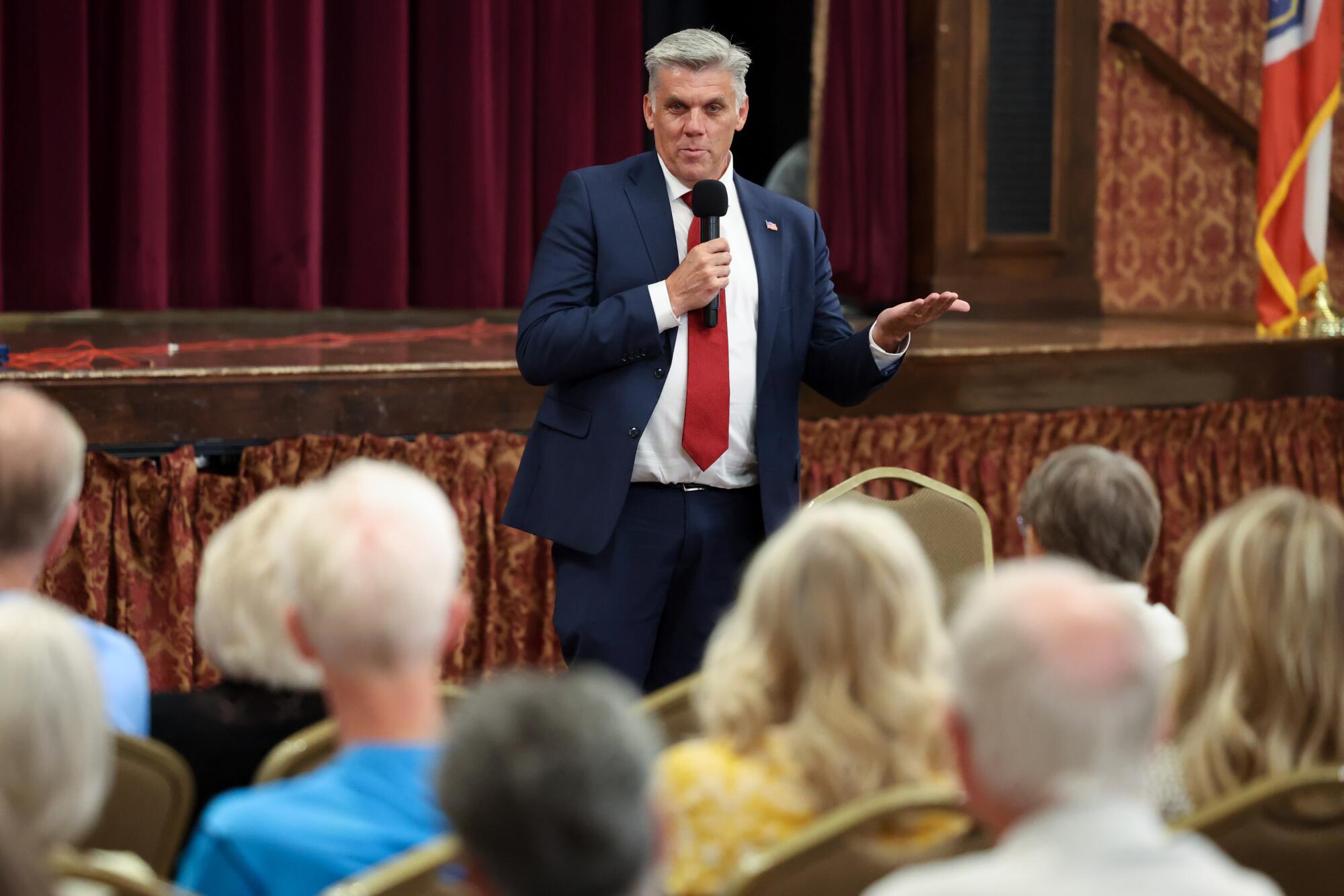
Utah congressional candidate Phil Lyman speaks during a Cottage Meeting at the SunRiver Community Center Ballroom in St. George, Utah, on Wednesday.
(Ian Maule / For The Times)
But Lyman suspects the group’s support for Maloy ahead of their June 23 primary has more to do with old-fashioned politics than any emerging technology.
One of the two co-founders of the political group is Chris Stewart, Maloy’s predecessor in Congress.
“Everything that they’re doing feels very coordinated,” Lyman said. “It makes you wonder if he’s still really controlling that seat.”
-

 Nebraska3 minutes ago
Four-star wide receiver picks up offer from Nebraska
-

 Nevada10 minutes ago
Arizona wildfires burn thousands of acres as Nevada smoke reaches Kanab
-

 New Hampshire13 minutes ago
Officials respond to 'unknown substance' spill at Sunapee Harbor
-

 New Jersey18 minutes ago
World Cup match to impact NJ Transit service during rush hour
-

 New Mexico20 minutes ago
Stables at Tamaya kick-off annual rodeo season featuring rescue horses
-

 North Dakota28 minutes ago
‘North Dakota 250 Road Trip’ exhibit opens July 1
-

 Ohio33 minutes ago
Central Ohio lakes offer strong fishing for summer anglers
-

 Oklahoma40 minutes ago
What channel is Oklahoma vs North Carolina on today? Time, TV schedule for CWS finals

