Politics
Column: A California crackdown on 'diet weed' could devastate patients who rely on CBD

You may have heard the extraordinary story of Charlotte Figi, the little Colorado girl who was dying from unrelenting, violent seizures until her parents decided to try cannabidiol, or CBD, a non-psychoactive ingredient of cannabis and hemp that helped other ailing children.
CBD, it turned out, did for Charlotte what all the pharmaceuticals in the world could not: It saved her life.
For nine years, until she died at 13 in 2020, Charlotte was virtually seizure-free. Her story was chronicled by CNN’s Sanjay Gupta, who said Charlotte’s experience had completely changed his view of cannabis and its medical potential.
Gupta’s 2013 special on the subject, “Weed,” gave much-needed hope to Beth Sahyoun, a Reseda nursery school teacher whose son Armand, then 20, had suffered relentless seizures for six years.
“I was totally reluctant,” Sahyoun told me. “I am not familiar with cannabis. We had been part of the medical establishment, and this felt very, very uncomfortable, but when you are desperate, you go into uncharted territory. You have to.”
She soon found Dr. Bonni Goldstein, a Los Angeles pediatrician and leading cannabis doctor who has helped Armand use CBD to stay nearly seizure-free for nine years.
I met Goldstein years ago while writing about Proposition 64, the 2016 ballot measure that legalized recreational marijuana in California. She reached out to me recently, distressed that the California Legislature appears to be on the verge of making it impossible for her patients to obtain the CBD products they need to lead normal lives.
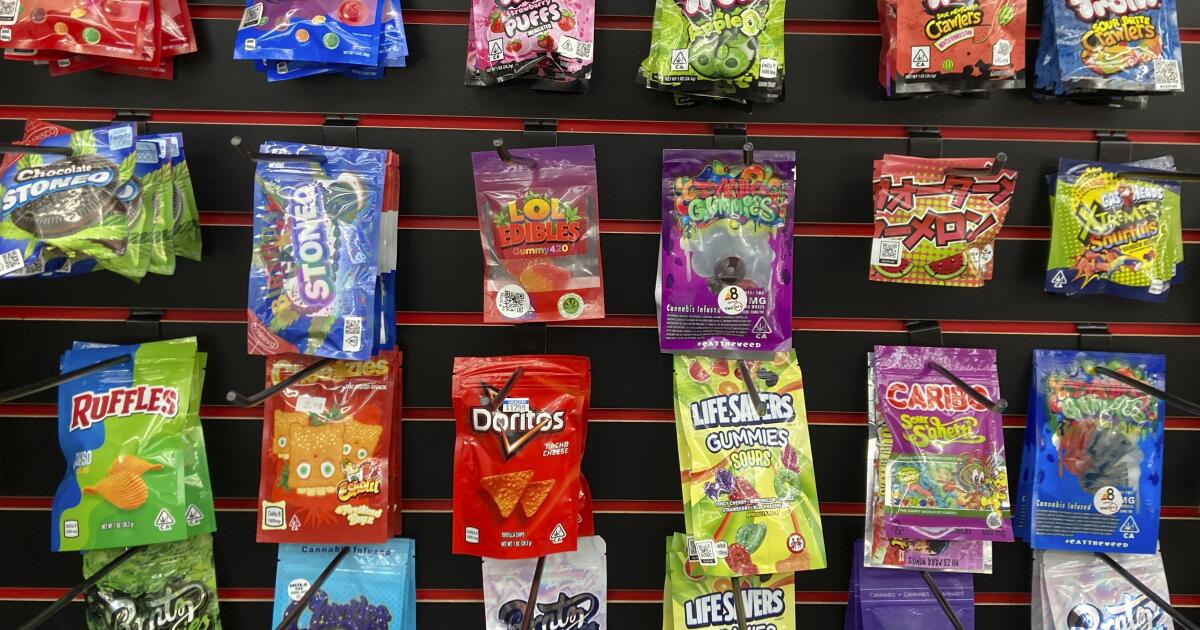
The legislation at issue, Assembly Bill 2223, is a well-intentioned attempt to close a loophole in the state’s cannabis laws that has allowed unregulated, intoxicating, hemp-derived products to flood the market. It has already passed the Assembly with bipartisan support and is now before the Senate.
The federal government legalized commercial production of hemp, a form of cannabis typically cultivated for non-intoxicating uses, in 2018. Under federal law, hemp can contain no more than 0.3% tetrahydrocannabinol, the psychoactive ingredient of marijuana known as THC, by weight. If that percentage is exceeded, the plant is considered cannabis, which, unlike hemp, is highly regulated, tested and taxed and can be legally sold only by dispensaries.
Here’s the loophole: A synthetic form of THC can be extracted from hemp-derived CBD. That substance, called delta-8 THC, is psychoactive. Because it is said to pack a softer punch than the THC in cannabis, delta-8 products are often called “weed lite” or “diet weed.” And because hemp is not regulated the way cannabis is, delta-8 products can be purchased by anyone online or in gas stations and convenience stores. A distressing number of teenagers report having used the product, which hasn’t undergone any systematic evaluation of its safety.
“During the conversion of CBD,” Goldstein said, “you get unintended byproducts. When you buy an unregulated, untested delta product, you are taking your health into your own hands.”
Dr. Bonni Goldstein, a pioneer in the use of CBD for pediatric patients, at Hesse Community Park in Los Angeles last week.
(Zoe Cranfill / Los Angeles Times)
Legal cannabis dispensaries, whose owners have jumped through almost unthinkable bureaucratic and financial hoops, are understandably unhappy about a product that seems to both undercut their business and endanger the public.
Assembly Majority Leader Cecilia Aguiar-Curry, a Yolo County Democrat, is the author of AB 2223, which would outlaw these “weed lite” products. The bill would ban any hemp products that contain more than 1 milligram of THC per container.
“The bottom line,” Aguiar-Curry said in a statement, “is that if it gets you high, it should not be sold outside a dispensary.”
In a statement emailed to me Friday morning, she added, “We are trying to strike the delicate balance between helping kids with health needs and keeping illegal drugs from being accessible to other kids.” Her bill, she said, “makes sure that CBD can be sold in the state as long as it has a non-intoxicating, trace amount of THC. Products containing higher levels of THC would be available in dispensaries, where they can’t fall into the hands of youth.”
The problem is that Goldstein’s patients would run afoul of the legislation. They are typically treated with a CBD-to-THC ratio of about 20 to 1 or more, but they take enough to exceed the proposed THC limit.
“If my patient takes 20 milligrams of CBD, they get 1 milligram of THC as well,” she said. “But if they are getting 200 milligrams of CBD, this same ratio then delivers 10 milligrams of THC. If they are taking 1,200 milligrams of CBD, they are getting 60 milligrams of THC. There is no intoxication because we first start with a low dose and titrate up, which minimizes any impairing effect. Second, the much higher amount of CBD dampens down the THC effects since CBD antagonizes the effects of THC.”
Armand Sahyoun, 29, is on a 25-to-1 formulation; he takes 1,600 milligrams of CBD per day, with 64 milligrams of THC.
“There is no impairment because it took months to work up to this dose,” Goldstein said. “He functions beautifully.”
In dispensaries, she added, “you are lucky if you can find a bottle that contains more than 600 milligrams of CBD. Meaning a child using these high doses would go through an $80 bottle per day.” Beth Sahyoun told me her son’s medicine costs $900 a month.
Paige Figi, Charlotte’s mother, founded the nonprofit Coalition for Access Now, which educates the public and lawmakers about the health benefits of CBD.
“We are collateral damage of these hastily written state bills that are trying to fix the delta-8 problem,” Figi told me. “Forty-five million Americans take a daily dose of CBD for their health — first responders, grandparents, kids with epilepsy, veterans, people with pain. These people are happily using this product.”
If there is no accommodation for families like the Sahyouns, the state Senate shouldn’t pass AB 2223. And if it does pass both houses in its current form, Gov. Gavin Newsom should not sign it.
“You have your child who is sick as a dog, you have no hope, you find CBD hemp, non-impairing, non-intoxicating,” Goldstein said. “Your child is thriving, and now the government says you can’t have it anymore? It’s almost too cruel and too stupid to comprehend.”
A sliver of hope emerged at the end of last week: After trying in vain to reach Aguiar-Curry for some time, Goldstein finally heard from her office. The physician expects to meet with the legislator to discuss her concerns this week.

Politics
Cops could be forced into race-based guessing game after Supreme Court move, Thomas joins dissent

NEWYou can now listen to Fox News articles!
Justices Samuel Alito and Clarence Thomas on Monday dissented from the Supreme Court’s refusal to take up a case that they said forces police officers to create a separate set of rules for racial minorities.
“It is dangerous to allow an individual to be treated differently based on statistics, studies, or expert testimony that purports to show that members of the racial or ethnic group to which he belongs are more likely to act in a certain way than are members of other groups,” Alito wrote on behalf of himself and Thomas. “Here, the special treatment helped the individual; in other situations it will not.”
The case, U.S. v. Donte J. Carter, involved a Black man whose firearm and theft convictions were vacated after the D.C. Court of Appeals held that police seized him before they had reasonable suspicion. Officers later recovered a .40-caliber pistol from Carter’s pants and the government said the gun had been stolen from an FBI agent’s vehicle.
According to the D.C. court, “black Americans like [Carter] are ‘especially distrustful of law enforcement’” and therefore “‘less likely’ than other people ‘to terminate a police encounter’ due to skepticism that any attempt to exercise their constitutional rights will be respected.”
SUPREME COURT REJECTS BOSTON PARENTS’ APPEAL CLAIMING RACIAL BIAS IN AN ADMISSIONS POLICY
Supreme Court Justices Clarence Thomas and Samuel Alito are pictured together. (Getty Images)
The D.C. court reasoned that Carter’s race was relevant to whether a reasonable person in his position would have felt free to end the police encounter. It ruled that the encounter effectively became a seizure, and that such an action was unlawful because police officers hadn’t established reasonable suspicion before subjecting him to it.
Alito and Thomas argued that the D.C. ruling effectively forces law enforcement to treat people differently based on their race, something precedent established by the Supreme Court prohibits.
“Under the test, officers will need to quickly assess a person’s race, and if officers and courts must craft special rules for black persons, what about dark-skinned Latinos, other Latinos, and members of other minority groups?” Alito continued. “We have said that our ’Constitution is color-blind.’ It ‘almost never’ allows government actors to treat persons differently based on their race.”
SUPREME COURT RULES ON KEY VOTING RIGHTS ACT RULE AS REPUBLICANS AND DEMOCRATS WAGE REDISTRICTING WAR
U.S. Supreme Court Justice Clarence Thomas appears before swearing in Pam Bondi as U.S. Attorney General in the Oval Office at the White House in Washington, D.C., on Feb. 5, 2025. (Andrew Harnik/Getty Images)
To support his claims, Alito cited Students for Fair Admissions v. Harvard and Louisiana v. Callais and Shaw v. Reno.
“And we have rejected the proposition that the Constitution permits an individual to be treated differently based on a ‘perception that members of the same racial group — regardless of their age, education, economic status, or the community in which they live — think alike,’” Alito wrote, citing Shaw v. Reno.
This appears to be a direct challenge to the D.C. Court of Appeals, which lawyers representing the United States argued forced police officers to assume that all black people have the same attitudes toward police officers and would therefore feel uncomfortable exercising constitutional rights in their presence.
TRUMP’S FIRING POWER FACES TWIN SUPREME COURT TESTS, BUT ONE AGENCY MAY GET SPECIAL TREATMENT
Supreme Court Justice Clarence Thomas and Justice Samuel Alito are seen inside the Supreme Court building in Washington, D.C., in December 2023. (Jacquelyn Martin-Pool/Getty Images)
CLICK HERE TO DOWNLOAD THE FOX NEWS APP
Carter, the individual Alito noted was helped by the case, initially lied to officers by answering in the negative when approached and asked if he was carrying a weapon.
The police then asked Carter to pull his pants up, at which point they noticed an L-shaped bulge which was later identified as a .40-caliber pistol that had been stolen from a federal agent’s vehicle.

WASHINGTON — The Supreme Court refused Monday to block an excessive force lawsuit against a former Los Angeles Police Department officer who shot and killed a knife-wielding man whose speeding truck had slammed into several cars near downtown Los Angeles.
The court turned down an appeal petition from the Los Angeles city attorney’s office, over the objections of Justices Clarence Thomas and Samuel A. Alito Jr.
Litigation over the six-second shooting incident has extended over six years.
Federal judges in California agreed that Officer Toni McBride had reason to fire four shots at the suspect in April 2020 but not the two final shots that killed him.
Daniel Hernandez was alleged to be under the influence of methamphetamine when he got out of his truck and walked toward the officer. She repeatedly ordered him, “Drop the knife,” as he approached.
But the 9th Circuit Court of Appeals, by a 6-5 vote, ruled last year that a jury could decide the officer went too far when she fired two final shots after the suspect had fallen to the ground.
The majority reasoned that in the one-second pause between shots four and five, McBride “could have and should first reassessed the situation” and possibly concluded the suspect no longer posed a danger.
That ruling would have sent the case to a trial.
But the Los Angeles city’s attorney’s office appealed to the Supreme Court in October and urged the justices to review and reverse the 9th Circuit’s decision.
The city’s attorneys said the appeals court failed to consider the “totality of circumstances from the perspective of a reasonable officer on the scene” and its decision refused “to allow for reasonable mistakes in fast-moving, life-threatening encounters.”
UC Berkeley law dean Erwin Chemerinsky filed a response for the Hernandez family. He urged the court to stand aside and let a jury decide whether the officer’s actions were reasonable.
“The 9th Circuit simply held that it should be for the jury to resolve the factual dispute over what happened,” he said.
The justices had considered the appeal since late February before finally turning it down without comment on Monday.
The Supreme Court has repeatedly ruled police officers may be sued for unreasonable searches and seizures only if they are shown to have knowingly violated clearly established law.
However, this doctrine of “qualified immunity” has divided judges over whether a particular rule or limit has been clearly established.
The 9th Circuit majority said shooting a fallen suspect crosses the line.
“It has been clearly established for more than a decade that when an officer shoots and wounds a suspect, and he falls to the ground, the officer cannot continue to shoot him, absent some indication that he presents a continuing threat,” wrote Judge Jacqueline H. Nguyen.
“A fallen and injured suspect armed only with a bladed instrument does not present a continuing threat merely because he makes nonthreatening movements on the ground. … Under such circumstances, a jury could reasonably find that she employed constitutionally excessive force. If so, she is not entitled to qualified immunity,” she said.
The five dissenters said the officer made a reasonable split-second decision.
Judge Ryan Nelson said McBride “was justified in shooting Daniel Hernandez to alleviate the risk that he posed when he advanced toward her while armed and ignoring commands to stop. … She cannot be reasonably expected or required to reassess her shooting in a tight six second period during an intense and dangerous situation throughout which Hernandez was rising and never stopped moving.”
Judge Patrick Bumatay echoed this concern.
“Judges review police shootings only in hindsight. We review police tapes years after the fact. We get to rewind, pause, fast forward — analyzing the situation frame-by-frame. While the advent of police bodycam videos has been a welcome change, we can’t ignore that real life isn’t in slow motion,” he said.
Politics
College sports sees pivotal moment as Senate looks to move legislation on NIL, transfers across goal line

Senate stepping in to regulate college sports
The Senate is actively preparing to debate a bipartisan bill that could significantly alter the landscape of intercollegiate sports. Lawmakers aim to create national standards for Name, Image, and Likeness (NIL) money and curb roster chaos from transfers. Senators Cruz, Cantwell, Baldwin, and Booker discuss the necessity of federal intervention due to perceived failures of the NCAA.
NEWYou can now listen to Fox News articles!
Congress could determine the future of college sports.
Thursday was a seminal day as to whether Congress can either salvage – or potentially ruin – intercollegiate athletics. It’s a congressional Hail Mary as senators address name, image and likeness (NIL) deals for athletes, compensation packages and transfers between schools.
“College sports is in crisis,” declared Senate Commerce Committee Chairman Ted Cruz, R-Texas.
“There’s a sense of urgency in that room you can feel it, right? You’ve got to do something rapidly,” said Sen. John Hickenlooper, D-Colo.
TED CRUZ, MARIA CANTWELL UNVEIL BIPARTISAN COLLEGE ATHLETICS BILL AMID NIL CHAOS, LAWSUITS, ‘LANE KIFFIN RULE’
Senate lawmakers advanced a bipartisan college sports bill that would create national NIL standards and limit athlete transfers. The measure now heads toward a full Senate debate. (Kevin Carter/Getty Images)
The Commerce Committee approved a bipartisan gameplan to fundamentally alter college sports. The full Senate plans to debate the bill in July.
“We have put something on the table that’s going to bring more certainty and predictability to the system,” said Sen. Maria Cantwell, D-Wash., the top Democrat on the panel.
Establishing a nationwide payout framework is a key aspect of the deal. Lawmakers know that inaction could mean that monied, major programs will simply outbid smaller schools. Perhaps even for a future NFL MVP.
“I’m worried that we’ll never see a Josh Allen again at the University of Wyoming,” said Sen. Cynthia Lummis, R-Wyo., referring to the Buffalo Bills standout quarterback. “It leaves those of us who don’t really have a donor base [to struggle to] pay for players of that caliber.”
The bill also restricts athletes to one transfer between schools during a five-year period without a penalty.
“Now we have this unbelievable number of players that get in the (transfer) portal every year and we have nothing to control the agents,” said former Alabama head football coach Nick Saban to a Senate panel earlier this month.
UCLA QUARTERBACK ATTEMPTS TO EXPLOIT LOOPHOLE IN TRANSFER PORTAL WINDOW WITH UNIQUE TACTIC
Lawmakers believe this plan will curb the constant roster chaos.
Advocates of the legislation believe it protects student-athletes.
“It definitely makes sure that predatory contracting done by agents or universities or conferences or shill organizations, don’t get students stuck in binding arbitration,” said Cantwell.
Sen. Cory Booker, D-N.J., is the only former Division I college athlete in the Senate. He played tight end for Stanford’s football team. Booker opposes the bill.
SENS MARSHA BLACKBURN, MARIA CANTWELL HUSTLING TO PROTECT COLLEGE ATHLETES’ FINANCES IN MURKY NIL WORLD
Congress is weighing major changes to college athletics, including athlete compensation, transfers and NIL regulations amid growing concerns about competitive imbalance. (David Dee Delgado/Getty Images)
“I’ve seen decade after decade, how the NCAA has screwed athletes. And so we need to make sure there’s firm athletic protections and not trust the NCAA to do it,” said Booker.
Sen. Tommy Tuberville, R-Ala., is the only former Division I football head coach in the Senate. He led programs at Auburn, Ole Miss, Texas Tech and Cincinnati. He joins Booker in condemning the legislation.
“They’re trying to turn college sports into the same situation we got in with Obamacare,” said Tuberville on Fox News Radio. “We can’t get the federal government involved in college sports.”
During a floor speech, Tuberville argued that “Congress should not decide how much money student athletes can earn.”
Yet Tuberville conceded that “college sports is facing a five-alarm fire. It’s getting ready to be over with as we know it.”
That’s why Cruz believes Congress should intervene.
“If the alternative is do nothing and allow chaos to continue in college sports to be destroyed, I think that alternative is unacceptable,” said Cruz.
Congress struggles to do lots of things right. That’s why some observers doubt that Congress is a good substitute for the NCAA.
Matt Mackowiak is a former GOP Senate aide who’s written about Brendan Sorsby, his gambling scandal and the saga involving Texas Tech megabooster Cody Campbell. Big money lured Sorsby to the school for a hot minute. Mackowiak says the Cruz/Cantwell bill fails to prevent another Sorsby situation. But Mackowiak’s biggest concern is congressional willingness to undercut the NCAA.
“I don’t know why you need to create some new system and make it overly complicated. You have a governing body. They haven’t had a lot of teeth in their enforcement in recent years.”
Some of that is because super conferences like the Big Ten and SEC wield more power than the NCAA. Notably, neither of those conferences endorsed the Senate bill. But it was the NCAA which demanded congressional intervention. The NCAA has told lawmakers it can’t address NIL on its own and pushed for a national standard set by Capitol Hill.
But Booker isn’t enamored with the NCAA.
“The NCAA, which can’t be trusted, has shown decade after decade, (of) failing college athletes,” he said.
There’s concern the bill could undercut current sports broadcasters by diversifying the number of streamers and outlets carrying games. That could complicate viewing. Additional options aren’t necessarily good for fans if they struggle to find their games.
“Then the fans get hurt because all the content is behind a paywall,” said Sen. Amy Klobuchar, D-Minn.
“I suspect everyone in this room has heard about frustrations from their constituents in trying to watch their favorite professional sports teams play. They are met with blackouts and paywalls,” said Sen. Tammy Baldwin, D-Wis.
The House of Representatives stumbled in two previous efforts to regulate college sports. The House Republican leadership had to yank completely different college sports regulation bills off the floor in December and this spring because they lacked the votes. So, now it’s the Senate’s turn to try.
There are lots of questions about whether the Senate, like the House, can command the votes for this bill. Moreover, what bandwidth does the Senate even have for serious legislating in July? The Senate is trying to figure out what’s next about the nomination of Jay Clayton to serve as director of national intelligence. The future of FISA Section 702 – the nation’s top program to fight terrorism – is up in the air after authorization expired a few weeks ago. And some Republicans are optimistic the Senate can advance a third “reconciliation package” to pay for the war in Iran, cut taxes and reduce fraud.
It would seem that those priorities might outweigh something on college sports.
REPORTER’S NOTEBOOK: HOUSE DEMS QUESTION SPORTS BILL TIMING AMID LANE KIFFIN CONTROVERSY
A Senate panel approved legislation supporters say would bring stability to college sports as critics warn it expands federal involvement. (Tom Williams/CQ-Roll Call, Inc via Getty Images)
But as Cruz and Tuberville both say, the situation in college sports is dire. There’s worry that the SEC and/or Big Ten might form a mega conference. Or develop their own broadcast platforms for games. And there may be a lot more Brendan Sorsbys as gaming becomes more ubiquitous.
None of this is going to get any better.
CLICK HERE TO DOWNLOAD THE FOX NEWS APP
The future of college sports is on the line.
So, to fix it, the Senate might just give it the old college try.
-

 News14 minutes ago
Trump says proof of his allegations that vandals cut Reflecting Pool paint will be provided in court
-

 New York1 hour ago
Video: Historic Brooklyn Church Destroyed in Fire
-

 Los Angeles, Ca2 hours ago
2 killed in high-speed crash on Mulholland Highway
-

 Detroit, MI2 hours ago
Man armed with gun shot by police in downtown Detroit ahead of fireworks show, police say
-

 San Francisco, CA2 hours ago
San Francisco home with a history of squatters hits the market for $1.3 million
-

 Miami, FL2 hours ago
Miami Heat slip behind Boston Celtics in Giannis Antetokounmpo race
-

 Dallas, TX2 hours ago
1 Dallas Cowboys Training Camp Battle That Could Make Or Break 2026 Season
-

 Boston, MA2 hours ago
With Columbia Threadneedle out, Boston Triathlon director is looking for a new sponsor – The Boston Globe

