Lifestyle
Explore the California spot serving up weed country fun the wine country way
As you drive through some of California’s most storied agricultural land, a few hours north of the Bay Area, you’ll zoom past fields full of plants straining under the weight of their almost-ready-to-harvest bounty. After checking into your boutique hotel, you’ll get to sample some of the local flavor and watch the setting sun. The next day, you might explore some of the region’s historic spots. Or maybe you’ll attend a friend’s wedding on a ranch next to a working farm.
At the end of the weekend, you’ll drive home with some of the local wares and likely a deep emotional connection to the place you just visited. That may sound like a classic wine-country excursion in the Napa or Sonoma valleys, but what if you swapped in pot plants for grape vines and consumption lounges for tasting rooms? What would a weed head’s version of the wine-enthusiast weekend look like?
To find out, I headed to Mendocino County, one of three counties that make up California’s famed Emerald Triangle, the historic cannabis-growing region of the state since the 1960s. (It’s roughly triangle-shaped, with corners of its wide base in Humboldt and Trinity counties.) The Emerald Triangle turns out to be the perfect place to court canna-tourists the wine-country way.
As the southernmost point of that triangle, Mendocino County has a bonus. It’s much closer to major population centers such as San Francisco (about 110 miles) than Humboldt or Trinity counties (270-plus miles). It’s also home to the 15-mile-long Anderson Valley, whose warm days, cool nights and maritime fog close to the coast make for top-notch pinot noirs but also, according to the region’s cannabis farmers, give the sun-grown herb here a distinctive terroir.
As a visitor might quickly discover, smaller cultivators are favored over industrial-size farms here, and the county tourism commission actively courts the budding canna-tourism market. Mendocino County has emerged as one of the best places to explore craft cannabis the way folks have long adventured their way through wine country.
So if you’re looking for an alternative adult getaway any time of year (though the pot plants are bigger closer to harvest in the fall), make sure the places listed below are high on your list of Mendocino County must-visits. Just remember, if you’re going to smoke up along the way, pick a designated driver.
Drive the Cannabis Trail
( Luke McGarry / For The Times)
Created in the spirit of the state’s Wine Road and Cheese Trail that provide self-motivated visitors with a rough DIY points-of-interest itinerary, the Cannabis Trail highlights some of the people, places and seminal moments in the history of the marijuana movement with special plaques.
The entirety of the trail includes more than two dozen monuments, cultural landmarks and points of interest stretching across nine counties, with a handful of stops in Mendocino County. These include Area 101 in Laytonville (the birthplace of the 20-year-old Emerald Cup cannabis competition) and the Plantshop dispensary in Ukiah (where a plaque commemorates the back-to-the-land movement of the 1970s).
While the Cannabis Trail isn’t exactly a new effort (it was launched nearly a decade ago by cannabis travel consultant Brian Applegarth), its partnership with tourism boards that highlight stops in Mendocino and Humboldt counties and Oakland is. And that’s a result of increased cannabis-related tourism, says Visit Mendocino County’s executive director, Ramon Jimenez.
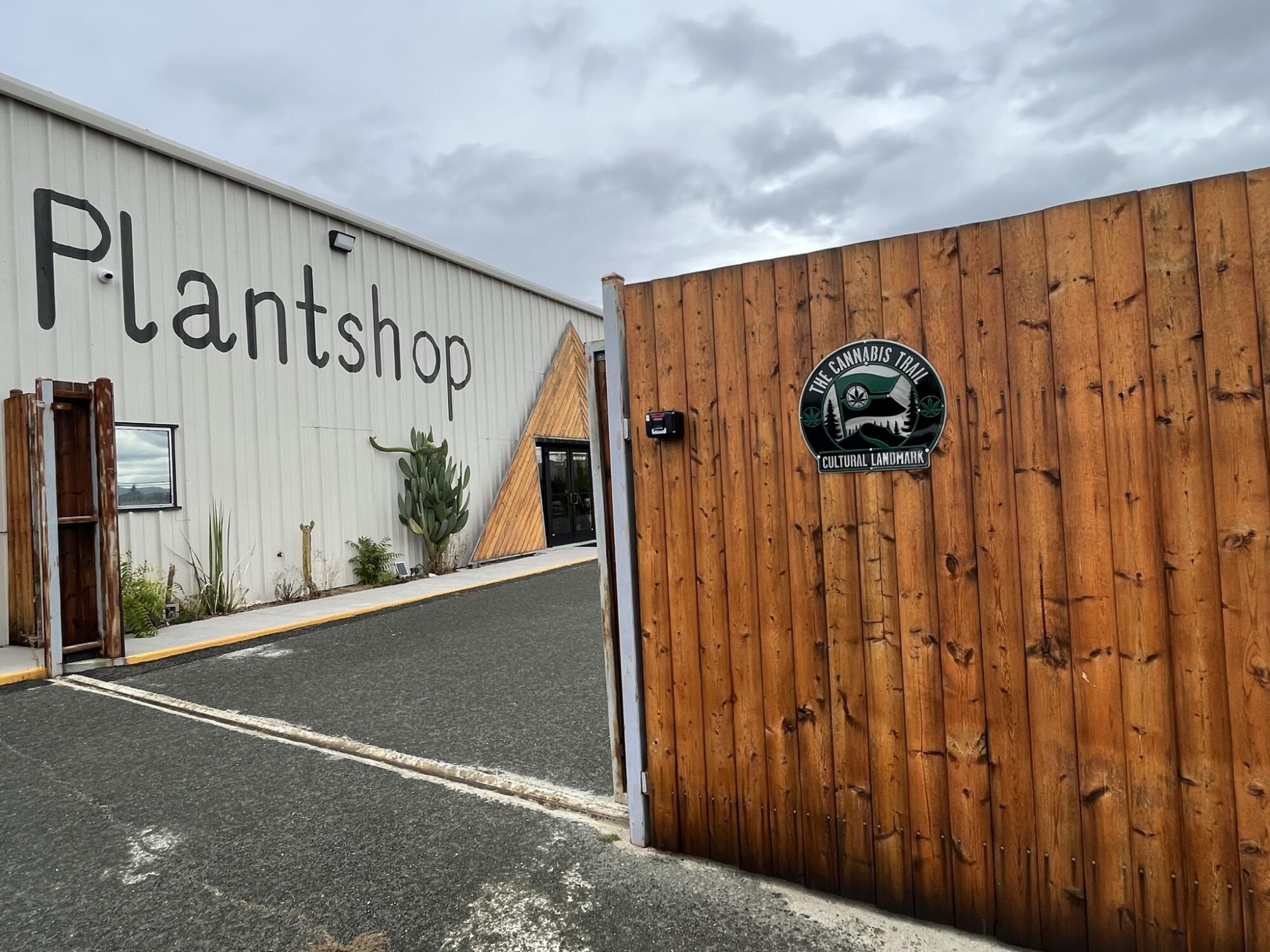
A Cannabis Trail cultural landmark plaque outside the Plantshop cannabis dispensary in Ukiah.
(Adam Tschorn / Los Angeles Times)
“Since leisure-use cannabis legalization, Mendocino County tourism has seen a constant uptick in visitors, about 60% more annually since 2017 [based on Transient Occupancy Tax collections],” Jimenez said. “As travelers become more educated, they want to move past the lounges and dispensaries to an authentic place of source. … This growth has spurred a new co-op between Visit Oakland, Visit Mendocino County and Humboldt County Visitors Bureau [focusing] on the Cannabis Trail.”
Watch hash get made at Heritage Hash Co.
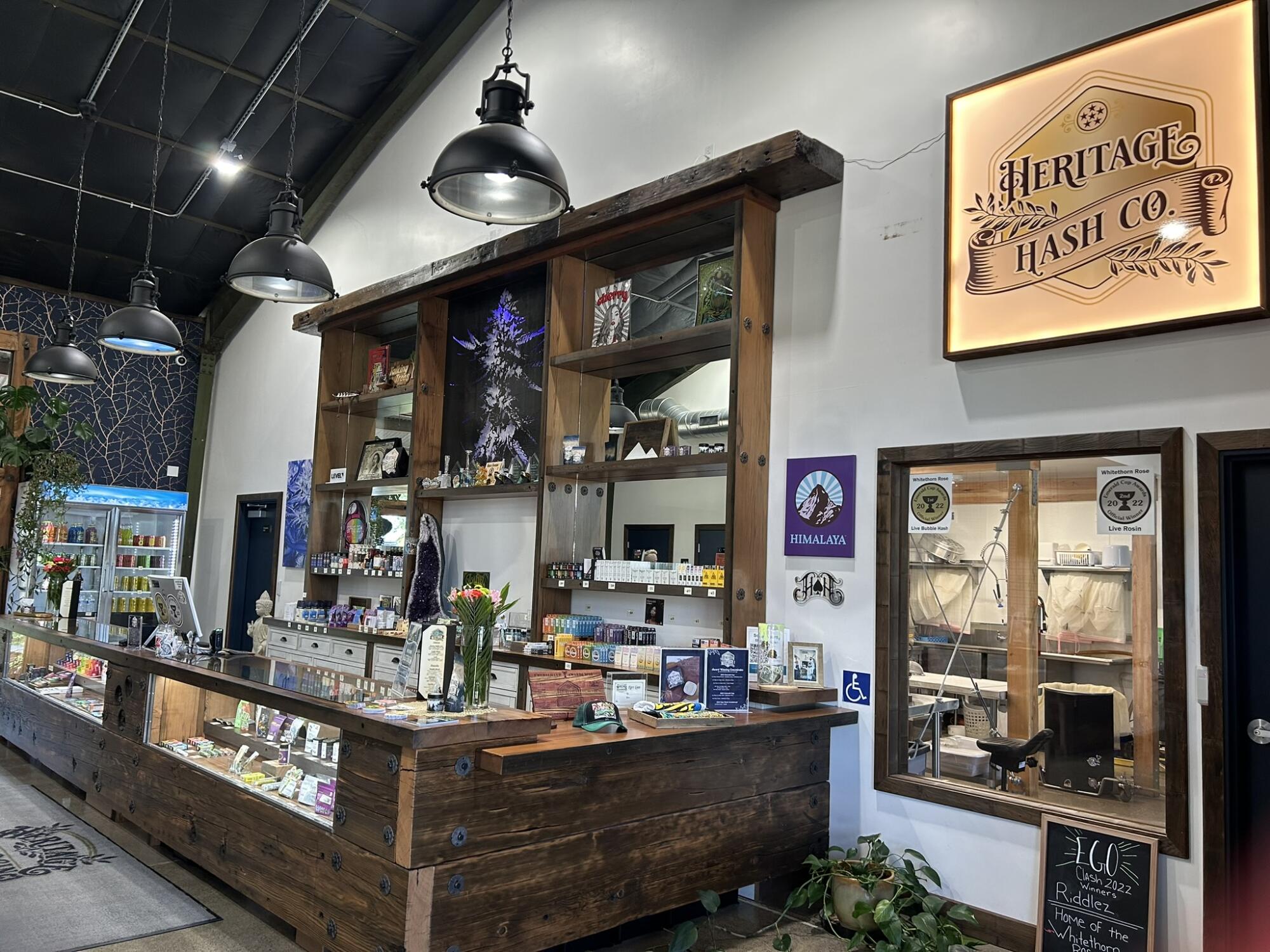
The Heritage Hash Co. dispensary in Ukiah has a window, far right, that allows customers to see hash being made by hand on-site. And just like in the wine-making process, hash-making involves very large stainless steel vats.
(Ashley Jones)
One of the fun things about touring a winery is getting to see some of that behind-the-scenes magic before you hit the tasting room; the immense stainless steel vats, the wooden barrels stacked floor to ceiling and the bottles clattering along an assembly line.
Mendocino’s weed country has its own version of that — kind of — at Heritage Hash Co. (1076 Cunningham St., Ukiah, heritage-mendocino.com). That’s where, inside a corrugated metal and weathered wood building, you’ll find a full-service multi-brand dispensary heavy on local wares. That’s where you’ll also find a square, wood-framed window that allows you to watch solventless hash being made by hand on-site in what looks like a cross between an industrial kitchen and Willy Wonka’s chocolate factory. Only instead of Oompa Loompas, it’s white-coated hash makers stirring cauldrons with comically large paddles, squeezing rosin in presses and pulling gooey strips of freshly made concentrate like saltwater taffy. (And, yes, just in case you were curious, there are plenty of immense stainless steel vats involved here too.)
And because Heritage, which bills itself as the world’s first public hashery, happens to also be permitted for on-site consumption, you can lean further into the tasting-room vibe by buying some of what the brand makes (extracts that range from $25 to $65 a gram) behind that magical window and trying it before you head out. (But only if someone else is behind the wheel.)
Throw a weed-friendly wedding at Yokayo Ranch
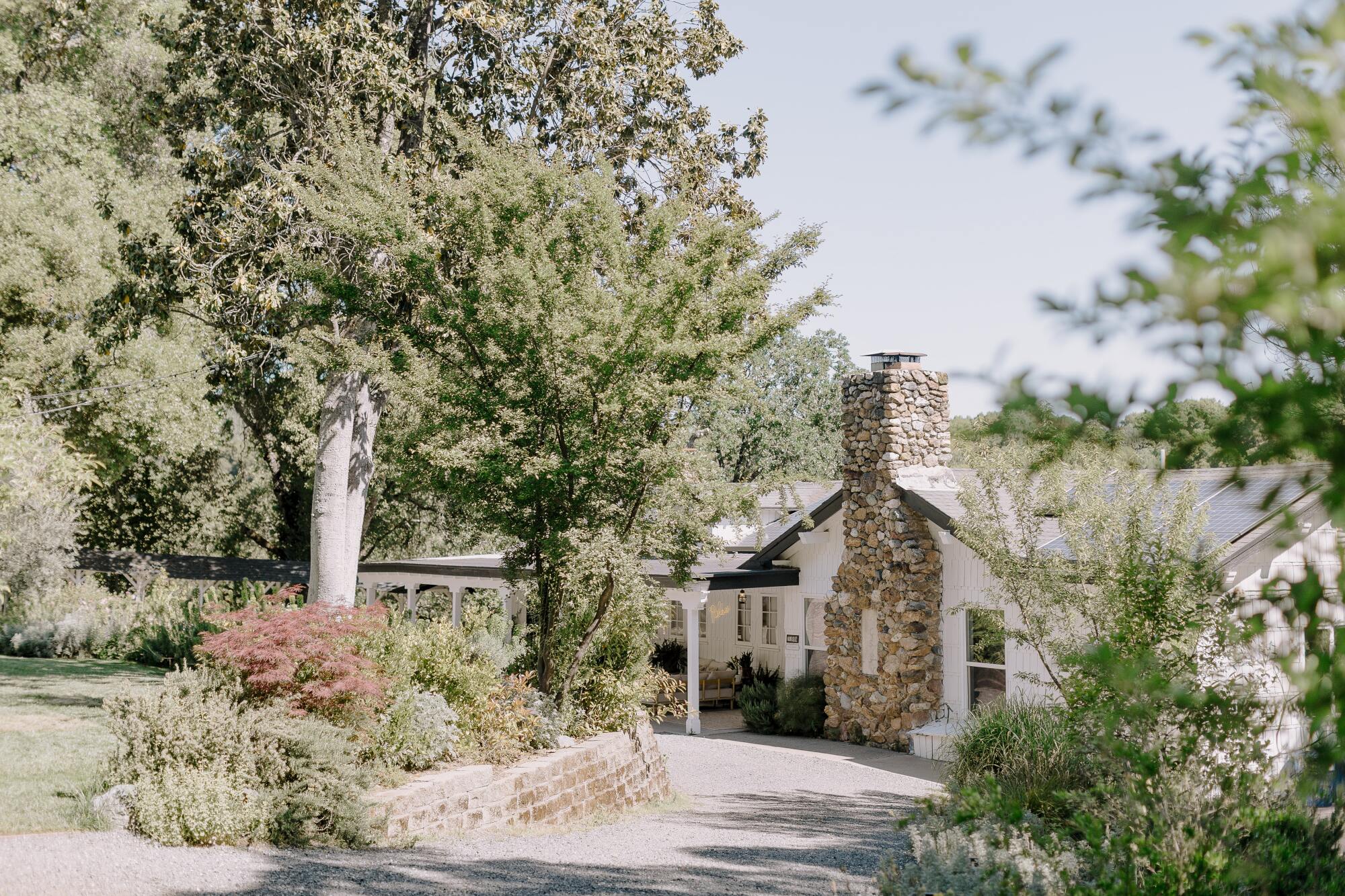
Ukiah’s Yokayo Ranch, which has been catering to the cannabis-friendly wedding crowd since 2019, is right next door to Mendocino Grasslands, a working weed farm.
(Gretchen Gause)
If your dream wedding involves saying “I do,” complete with a joint-rolling bar at the reception and a tour of the working weed farm next door, you’d be hard pressed to find a better setup than the one at Yokayo Ranch (800 Hensley Creek Road, Ukiah, yokayoranch.com). That’s where Rachel Powell has been booking nug-filled nuptials along with other weed-friendly events since deciding to embrace the cannabis tourism culture in 2019.
“We get people from all over,” Powell said. “But most of our clients are from San Francisco and L.A. and they’re much more interested in the cannabis [aspect]. We realized that it can really play to our strengths. For example, a lot of our people want to have cannabis bars versus alcohol [bars].”
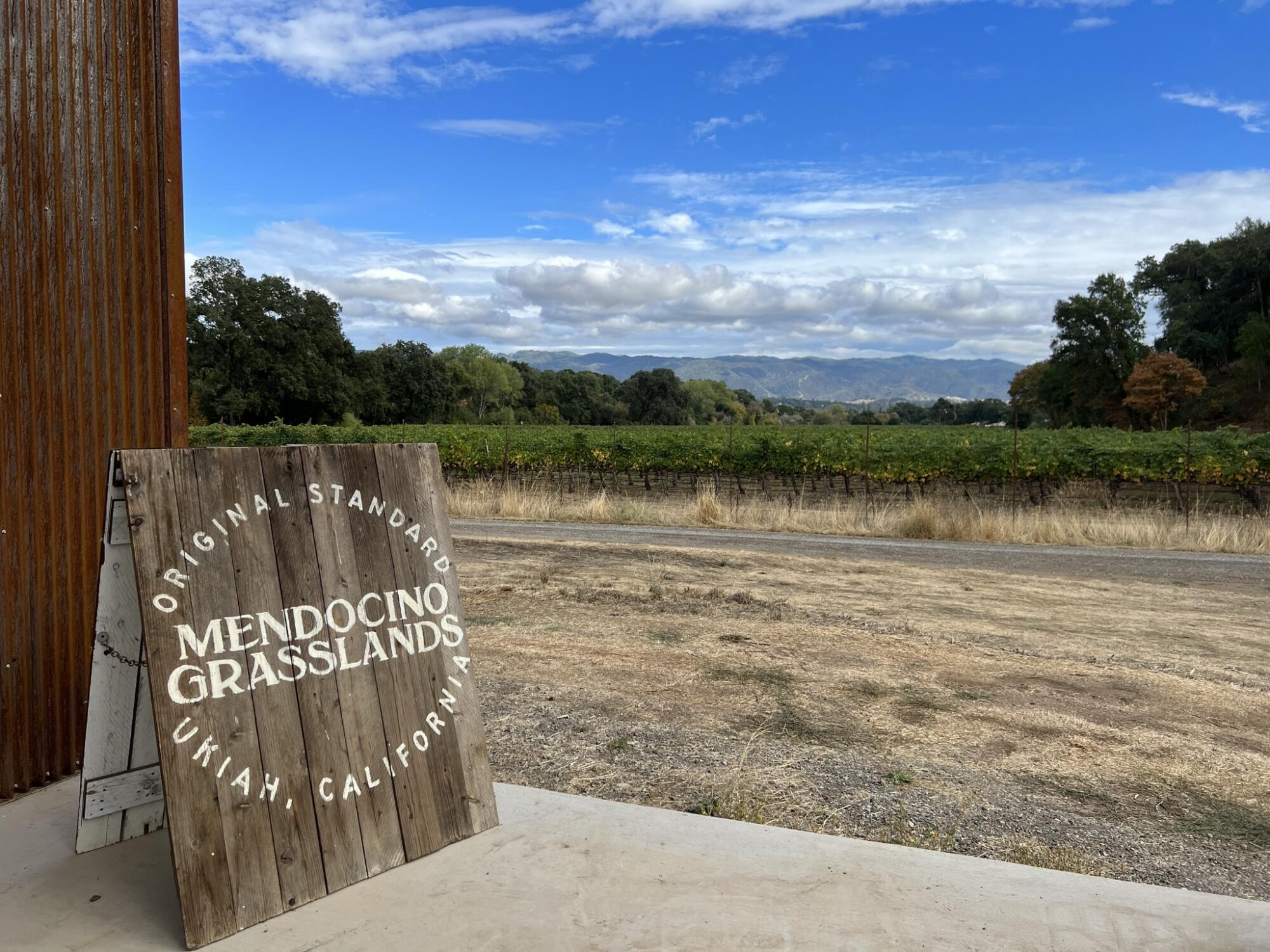
A field of grapevines viewed from Mendocino Grasslands, a working cannabis farm adjacent to Yokayo Ranch.
(Adam Tschorn / Los Angeles Times)
The property, which can accommodate about 45 overnight guests, consists of a 1920s-era main house, a cluster of cabins, nine glamping tents (each with a queen bed) and an outdoor ceremony space, all on a hillside high above Mendocino Grasslands. That’s the neighboring weed farm run by Powell’s brother, Ian. “When people come to stay for a wedding, we let them know there’s also a farm and we’d be happy to give them a farm tour,” she said. “And every group wants a farm tour.”
The brother-sister duo are hoping to eventually expand the farm-tour offerings to the general public. Right now, they’re mostly arranged for guests who are renting the Yokayo Ranch venue. “We’d like to offer tours that can be booked directly through Mendocino Grasslands,” Powell said. “And they would end with a farm dinner where people break bread in this really beautiful place where they’re surrounded by food, flowers and cannabis — all of these things that come from the ground.”
She added that the ultimate goal is to source everything for these meals (“Right down to the quinoa”) from within 25 miles of the farm. Wedding event packages, which include two nights of lodging for up to 29 people, start at around $20,000. If you’re not tying the knot but want to rent the whole place, you and your buds can plan on $2,400 to $3,500 per night with a two-night minimum.
Make your way to the Madrones
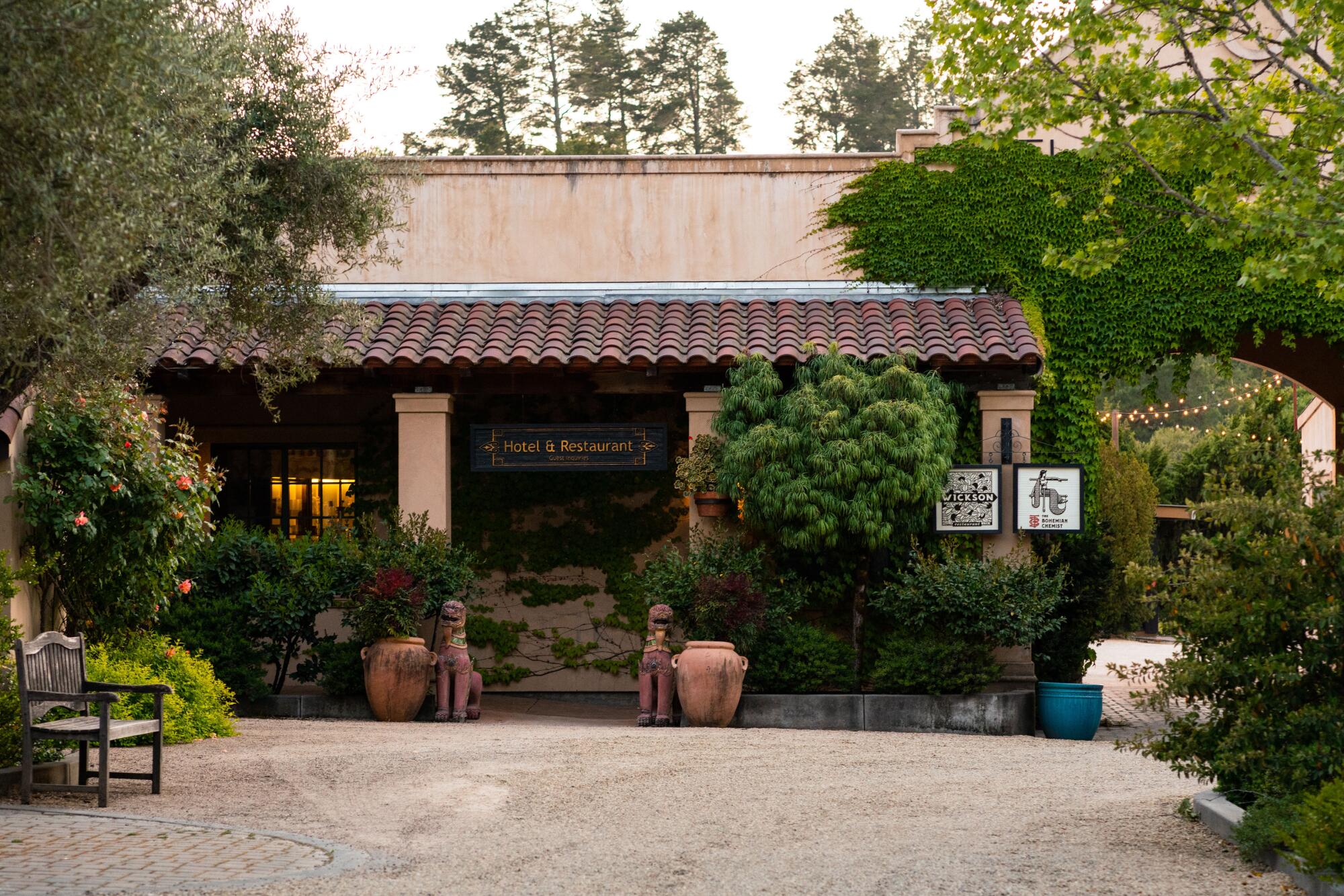
The Madrones in Philo, Calif., includes a hotel, a restaurant and the only licensed cannabis dispensary for miles around.
(Nikolas Zvolensky)
If you’ve got the bandwidth to visit only a single Mendocino County destination — or simply want to see what a fully realized weed-country-is-the-new-wine-country world can look like — blaze a trail down the Anderson Valley Highway to the Madrones with its on-site dispensary (9000 Highway 128, Philo, themadrones.com and thebohemianchemist.com).
A Mediterranean-meets-rustic-California compound bordered by a vineyard on two sides and dense forest on another, it’s the creation of partners (in business and life), Jim Roberts and Brian Adkinson. The boutique property includes a nine-room hotel (rooms, which accommodate two to four people each, start at $285), an on-site restaurant specializing in wood-fired fare (the Wickson) and two winery tasting rooms (Long Meadow Ranch and Wentworth Vineyards). A bottle cork’s toss down the road is another cluster of cabins and a wedding venue surrounded by redwood trees (the Brambles). Also, keep a look out for the ghost-white cat named Blanche roaming the grounds.
What makes the place of special interest is a tiny shop just to the right of the front door. Called the Bohemian Chemist, it’s a dispensary with the vibe of an Art Deco apothecary. Its glass and wooden cabinets and display cases are stocked with cannabis products and accouterments, both heavy on the local offerings. The shop’s namesake brand is sourced (mostly) from the owners’ Sugar Hill Farm just down the road; uncommon cultivars of sun-grown herb with names like Swazi Gold or Big Sur Holy Weed that even the most seasoned weed head probably hasn’t laid eyes (or lungs) on.
Its focus on rare cultivars has earned it a cultural landmark stop on the Cannabis Trail.
Other local brands on the shelves crammed with bell jars and vintage microscopes include packets of Anderson Valley Reserve flower, hash and live rosin badder from Heritage Hash Co. Locally made paraphernalia options include glass pipes from CoolHandSuuze and an exclusive edition of the Proto Pipe, the Swiss Army knife of pot pipes, made just about 50 miles up the road in Willits.
Customers who avail themselves of the shop’s cannabis can decamp to a small outdoor patio space just off the hotel’s gift shop and consume their locally grown goods while gazing out at the rows of grapes in Goldeneye’s vineyard next door. If your visit happens to fall between late May and late October, this is where you’ll find a seasonal third-Sunday-of-the-month cannabis farmers marketplace offering a showcase local legacy brands. (The full calendar and additional information can be found on the Madrones’ website.)
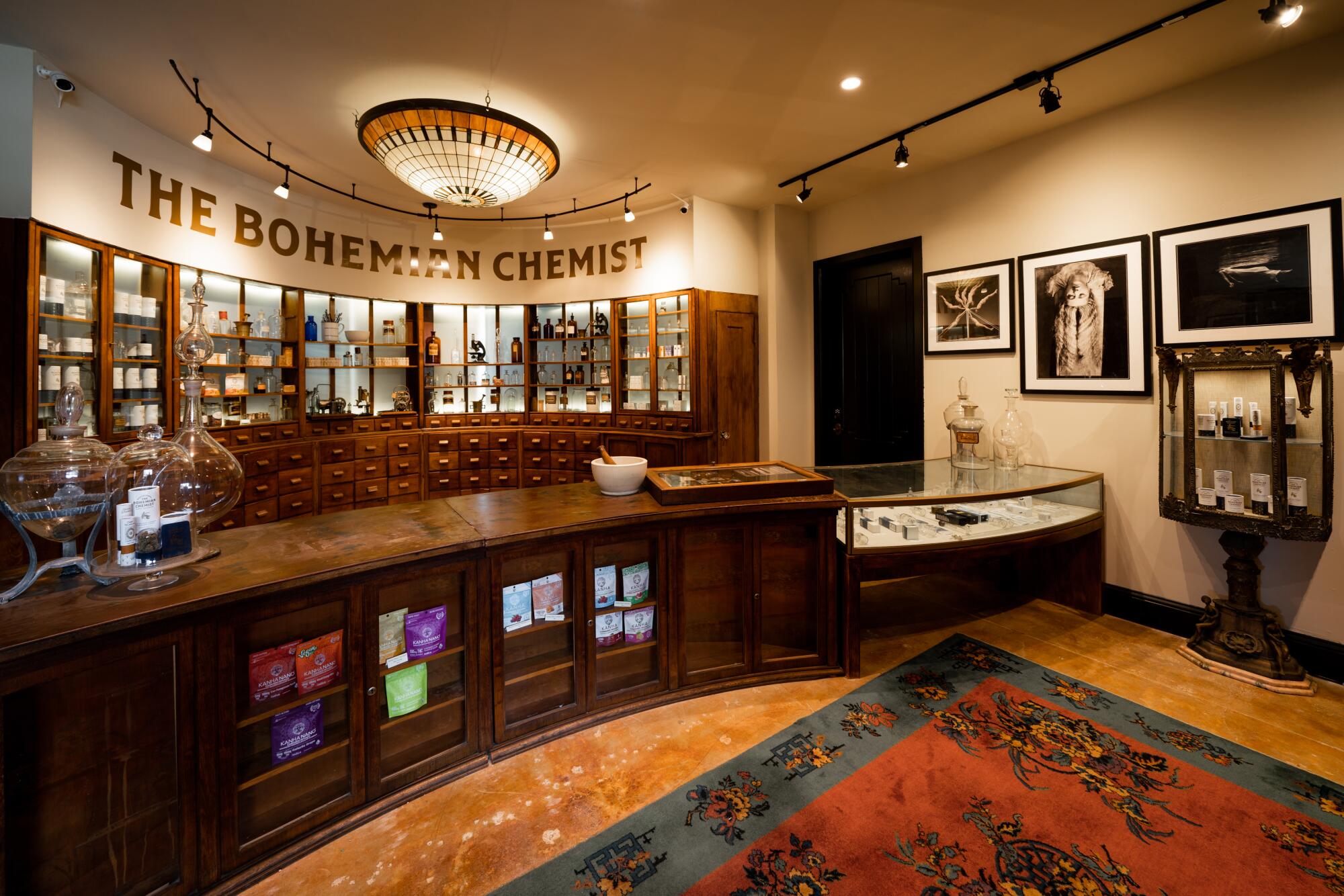
The Bohemian Chemist cannabis dispensary in Philo, Calif.
(Nikolas Zvolensky)
Roberts and Adkinson, who had been growing cannabis legally on their farm since 2016 (under the state’s pre-Prop. 64 medical marijuana law), opened the hotel property in 2010 and then the dispensary in June 2020 after being directly inspired by the wine-tourism business model.
“The retail part stemmed from the fact that we would have visitors who wanted to purchase cannabis, and we’d have to send them up to Ukiah,” Adkinson said.
“We had this crop growing,” added Roberts. “And we’re thinking, ‘What’s going to be the best way to actually get it to market?’ And we looked around at all these little wineries that are on our property and thought the best model would be to do something like they did. They sell [wine] at the tasting rooms. They have [wine] clubs and they have bottle shops. We knew that those three pillars provide a pretty strong foundation for a small winery, and we figured the same thing could happen with cannabis. So we got a micro-business license that allowed us to do all three of those things.”
The couple says the cannabis side of their business isn’t immune from the challenges facing the rest of the state’s legal weed business such as regulations, high taxes and a thriving illicit market. But approaching their business like the small wineries that surround them has paid off.
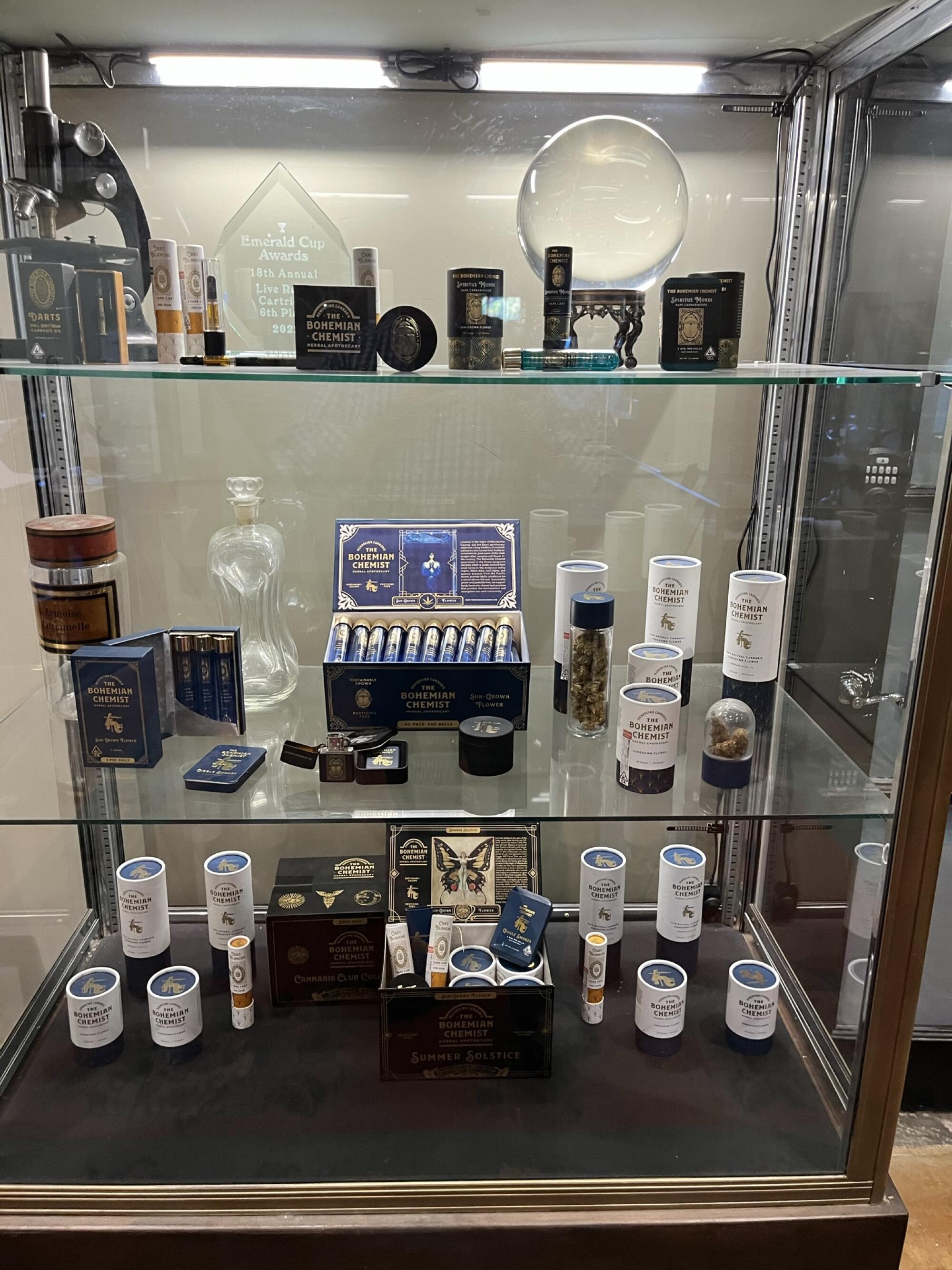
A glass case at the Bohemian Chemist apothecary is a showcase for the brand’s cannabis products, which are grown in a nearby part of the Anderson Valley.
(Adam Tschorn / Los Angeles Times)
“We’re not exactly making a killing,” Roberts said. “But [2023] was a hard hotel year because of all the weather incidents, and the cannabis business actually floated the hotel business. And it had been the other way around as a startup.”
With almost four years under their belt of running the only dispensary in Anderson Valley, the couple has discovered that catering to wine country and weed country visitors has a certain synergy, specifically that their best sales day of the year isn’t on 4/20 or the day before Thanksgiving. It’s during the annual Anderson Valley Pinot Noir Festival the third weekend of May each year.
“It’s typically something like this,” Roberts said. “A woman will come into the Bohemian Chemist and say, ‘My husband loves wine but I don’t really care for it that much. But now we can both be happy because I love cannabis.’”

Lifestyle
L.A. Affairs: I loved someone who felt he couldn’t be fully seen with me
He always texted when he was outside. No call, no knock. It was just a message and then the soft sound of my door opening. He moved like someone practiced in disappearing.
His name meant “complete” in Arabic, which is what I felt when we were together.
I met him the way you meet most things that matter in Los Angeles — without intending to. In our senior year at a college in eastern L.A. County, we were introduced through mutual friends, then thrown together by the particular gravity of people who recognized something in each other. He was a Muslim medical student, conservative and careful and funny in the dry, precise way of someone who has always had to choose his words. I was loud where he was quiet, messy where he was disciplined. I was out. He was not.
I understood, or thought I did. I thought that I couldn’t get hurt if I was completely conscious throughout the endeavor. Los Angeles has a way of making you feel like the whole world shares your freedoms — until you realize the city is enormous, and not all of it belongs to you in the same way.
For months, our world was confined to my apartment. He would slip in after dark, and we’d stay up late talking about his family in Iran, classical music and the particular pressure of being the son someone sacrificed everything to bring here. He told me things he said he’d never told anyone, and I believed him.
The orange glow from my Nesso lamp lit his face while the indigo sky pressed against the window behind him. In our small little world, we were safe. Outside was another matter.
On our first real date, I took him to the L.A. Phil’s “An Evening of Film & Music: From Mexico to Hollywood” program. I told him they were cheap seats even though they were the first row on the terrace. He was thrilled in the way only someone who doesn’t expect to be delighted actually gets delighted — fully, without guarding it. I put my arm around his shoulders. At some point, I shifted and moved it, and he nudged it back. He was OK with PDA here.
I remember thinking that wealth is a great barrier to harm and then feeling silly for extrapolating my own experience once again. Inside Walt Disney Concert Hall, we were just two people in love with the same music.
Outside was still another matter.
In February, on Valentine’s Day, he took me to a Yemeni restaurant in Anaheim. We hovered over saffron tea surrounded by other young Southern Californians, and we looked like friends. Before we went in, we sat in the parking lot of the strip mall — signs in Arabic advertising bread, coffee, halal meats, the Little Arabia District — hand in hand. I leaned over to kiss him.
“Not here,” he said. His eyes shifted furtively. “Someone might see.”
I understood, or told myself I did, but I was saddened. Later, after the kind of reflection that only arrives in the wreckage, I would understand something harder: I had been unconsciously asking him to choose, over and over, between the people he loved and the person he loved. I had a long pattern of choosing unavailable men, telling myself it was because I could handle the complexity. The truth was more embarrassing. I thought that if someone like him chose me anyway — chose me over the weight of societal expectations — it would mean I was worth choosing. It took me a long time to see how unfair that was to him and to me.
We went to the Norton Simon Museum together in November, on the kind of gray Pasadena day when the 210 Freeway roars in the background like white noise. He studied for the MCAT while I wrote a paper on Persian rugs. In between practice problems, he translated ancient Arabic scripts for me. I thought, “We make a good team.” Afterward, we walked through the galleries and he didn’t let go of my arm.
That was the version of us I kept returning to — when the ending came during Ramadan. It arrived as a spiritual reflection of my own. I texted: “Does this end at graduation — whatever we are doing?”
He thought I meant Ramadan. I did not mean Ramadan.
“I care about you,” he wrote, “but I don’t want you to think this could work out to anything more than just dating. I mean, of course, I’ve fantasized about marrying you. If I could live my life the way I wanted, of course I would continue. I’m just sad it’s not in this lifetime.”
I was in Mexico City when these texts were exchanged. That night I flew to Oaxaca to clear my head and then, after less than 24 hours, flew back to L.A. No amount of vacation would allow me to process what had just happened, so I threw myself back into work.
My therapist told me to use the conjunction “and” instead of “but.” It happened, and I am changed. The harm I caused and the love I felt. The beauty of what we made and the impossibility of where it could go. She gave me a knowing smile when I asked if it would stay with me forever. She didn’t answer, which was the answer.
I think about the freeways now, the way Joan Didion called them our only secular communion. When you’re on the ground in Los Angeles, the world narrows to the few blocks around you. Get on the freeway and you understand the whole body of the city at once: the arteries, the pulse, the scale of the thing.
You understand that you are a single cell in something enormous and moving. It is all out of your control. I am in a lane. The lane shaped how I drive. He was simply in a different lane, and his lane shaped him, and those two facts can coexist without either of us being the villain of the sad story.
He came like a secret in the night, and he left the same way. What we made in between was real and complicated and mine to hold forever, hoping we find each other in the next life.
The author lives in Los Angeles.
L.A. Affairs chronicles the search for romantic love in all its glorious expressions in the L.A. area, and we want to hear your true story. We pay $400 for a published essay. Email LAAffairs@latimes.com. You can find submission guidelines here. You can find past columns here.
Lifestyle
The Nerve Center of This Art Fair Isn’t Painting. It’s Couture.
The art industry is increasingly shaped by artists’ and art businesses’ shared realization that they are locked in a fierce struggle for sustained attention — against each other, and against the rest of the overstimulated, always-online world. A major New York art fair aims to win this competition next month by knocking down the increasingly shaky walls between contemporary art and fashion.
When visitors enter the Independent art fair on May 14, they will almost immediately encounter its open-plan centerpiece: an installation of recent couture looks from Comme des Garçons. It will be the first New York solo presentation of works by Rei Kawakubo, the brand’s founder and mastermind, since a lauded 2017 survey exhibition at the Metropolitan Museum of Art’s Costume Institute.
Art fairs have often been front and center in the industry’s 21st-century quest to capture mindshare. But too many displays have pierced the zeitgeist with six-figure spectacles, like Maurizio Cattelan’s duct-taped banana and Beeple’s robot dogs. Curating Independent around Comme des Garçons comes from the conviction that a different kind of iconoclasm can rise to the top of New York’s spring art scrum.
Elizabeth Dee, the founder and creative director of Independent, said that making Kawakubo’s work the “nerve center” of this year’s edition was a “statement of purpose” for the fair’s evolution. After several years at the compact Spring Studios in TriBeCa, Independent will more than double its square footage by moving to Pier 36 at South Street, on the East River. Dee has narrowed the fair’s exhibitor list, to 76, from 83 dealers in 2025, and reduced booth fees to encourage a focus on single artists making bold propositions.
“Rei’s work has been pivotal to thinking about how my work as a curator, gallerist and art fair can push boundaries, especially during this extraordinary move toward corporatization and monoculture in the art world in the last 20 years,” Dee said.
Kawakubo’s designs have been challenging norms since her brand’s first Paris runway show in 1981, but her work over the last 13 years on what she calls “objects for the body” has blurred borders between high fashion and wearable sculpture.
The Comme des Garçons presentation at Independent will feature 20 looks from autumn-winter 2020 to spring-summer 2025. Forgoing the runway, Kawakubo is installing her non-clothing inside structures made from rebar and colored plastic joinery.
Adrian Joffe, the president of both Comme des Garçons International and the curated retailer Dover Street Market International (and who is also Kawakubo’s husband), said in an interview that Kawakubo’s intention was to create a sculptural installation divorced from chronology and fashion — “a thing made new again.”
Every look at Independent was made in an edition of three or fewer, but only one of each will be for sale on-site. Prices will be about $9,000 to $30,000. Comme des Garçons will retain 100 percent of the sales.
Asked why she was interested in exhibiting at Independent, the famously elusive Kawakubo said via email, “The body of work has never been shown together, and this is the first presentation in New York in almost 10 years.” Joffe added a broader philosophical motivation. “We’ve never done it before; it was new,” he said. Also essential was the fair’s willingness to embrace Kawakubo’s vision for the installation rather than a standard fair booth.
Kawakubo began consistently engaging with fine art decades before such crossovers became commonplace. Since 1989, she has invited a steady stream of contemporary artists to create installations in Comme des Garçons’s Tokyo flagship store. The ’90s brought collaborations with the artist Cindy Sherman and performance pioneer Merce Cunningham, among others.
More cross-disciplinary projects followed, including limited-release direct mailers for Comme des Garçons. Kawakubo designs each from documentation of works provided by an artist or art collective.
The display at Independent reopens the debate about Kawakubo’s proper place on the continuum between artist and designer. But the issue is already settled for celebrated artists who have collaborated with her.
“I totally think of Rei as an artist in the truest sense,” Sherman said by email. “Her work questions what everyone else takes for granted as being flattering to a body, questions what female bodies are expected to look like and who they’re catering to.”
Ai Weiwei, the subject of a 2010 Comme des Garçons direct mailer, agreed that Kawakubo “is, in essence, an artist.” Unlike designers who “pursue a sense of form,” he added, “her design and creation are oriented toward attitude” — specifically, an attitude of “rebellion.”
Also taking this position is “Costume Art,” the spring exhibition at the Costume Institute. Opening May 10, the show pairs individual works from multiple designers — including Comme des Garçons — with artworks from the Met’s holdings to advance the argument made by the dress code for this year’s Met gala: “Fashion is art.”
True to form, Kawakubo sometimes opts for a third way.
“Rei has often said she’s not a designer, she’s not an artist,” Joffe said. “She is a storyteller.”
Now to find out whether an art fair sparks the drama, dialogue and attention its authors want.
Lifestyle
They set out to elevate karaoke in L.A. — and opened a glamorous lounge that pulls out all the stops
Brothers Leo and Oliver Kremer visited karaoke spots around the globe and almost always had the same impression.
“The drinks weren’t always great, the aesthetics weren’t always so glamorous, the sound wasn’t always awesome and the lights were often generic,” says Leo, a former bassist of the band Third Eye Blind.
As devout karaoke fans, they wanted to level up the experience. So they dreamed up Mic Drop, an upscale karaoke lounge in West Hollywood that opens Thursday. It’s located inside the original Larrabee Studios, a historic 1920s building formerly owned by Carole King and her ex-husband, Gerry Goffin — and the spot where King recorded some of her biggest hits. Third Eye Blind band members Stephan Jenkins and Brad Hargreaves are investors of the new venue.
Inside the two-story, 6,300-square-foot venue with 13 private karaoke rooms and an electrifying main stage, you can feel like a rock star in front of a cheering audience. Want to check it out? Here are six things to know.
The Kremer brothers hired sculptor Shawn HibmaCronan to create an 8-foot-tall disco-themed microphone for their karaoke lounge.
1. Take your pick between a private karaoke experience or the main stage
A unique element of Mic Drop is that it offers both private karaoke rooms and a main stage experience for those who wish to sing in front of a crowd. The 13 private rooms range from six- to 45-person capacity. Each of the karaoke rooms are named after a famous recording studio such as Electric Lady, Abbey Road, Shangri La and of course, Larrabee Studios. There is a two-hour minimum on all rentals and hourly rates depend on the room size and day of the week.
But if you’re ready to take the center stage, it’s free to sing — at least technically. All you have to do is pay a $10 fee at the door, which is essentially a token that goes toward your first drink. Then you can put your name on the list with the KJ (karaoke jockey) who keeps the crowd energized throughout the night and even hits the stage at times.
Harrison Baum, left, of Santa Monica, and Amanda Stagner, 27, of Los Angeles, sing in one of the 13 private karaoke rooms.
2. Thumping, high sound quality was a top priority
As someone who toured the world playing bass for Third Eye Blind, top-tier sound was a nonnegotiable for Leo. “Typically with karaoke, the sound is kind of teeny, there’s not a lot of bass and the vocal is super hot and sitting on top too much,” he says. To combat this, he and his brother teamed up with Pineapple Audio, an audio visual company based in Chicago, to design their crisp sound system. They also installed concert-grade speakers and custom subwoofers from a European audio equipment manufacturer called Celto, and bought gold-plated Sennheiser wireless microphones, which they loved so much that they had an 8-foot-tall replica made for their main room. Designed by artist Shawn HibmaCronan, the “macrophone,” as they call it, has roughly 30,000 mirror tiles. “It spins and throws incredible disco light everywhere,” says Leo.
Karaoke jockeys Sophie St. John, 27, second from left, and Cameron Armstrong, 30, right, get the crowd involved with their song picks at Mic Drop.
3. A concert-level performance isn’t complete without good stage lighting and a haze machine
Each karaoke room features a disco ball and dynamic lighting that syncs up with whatever song you’re singing, which makes you feel like you are a professional performer. There’s also a haze machine hidden under the leather seats. Meanwhile, the main stage is concert-ready with additional dancing lasers and spotlights.
Brett Adams, left, of Sherman Oaks, and Patrick Riley of Studio City sing karaoke together inside a private lounge at Mic Drop.
4. The song selection is vast, offering classics and new hits
One of the worst things that can happen when you go to karaoke is not being able to find the song you want to sing. At Mic Drop, the odds of this happening are slim to none. The venue uses a popular karaoke service called KaraFun, which has a catalog of more than 600,000 songs (and adds 400 new tracks every month), according to its website. Take your pick from country, R&B, jazz, rap, pop, love duets and more. (Two newish selections I spotted were Raye’s “Where Is my Husband” and Olivia Dean’s “Man I Need,” which both released late last year.) In the private karaoke rooms, there’s also a fun feature on Karafun called “battle mode,” which allows you and your crew of up to 20 people to compete in real time. KaraFun also has an entertaining music trivia game, which I tested out with the founders and came in second place.
The design inspiration for Mic Drop was 1920s music lounges and 1970s disco culture, says designer Amy Morris.
5. The interiors are inspired by 1920s music lounges mixed with ‘70s disco vibes
A disco ball hangs from the ceiling.
If you took the sophisticated aesthetic of 1920s music lounges and mixed it with the vibrant and playful era of 1970s disco culture, you’d find Mic Drop.
When you walk into the lounge, the first thing you’ll see is a bright red check-in desk that resembles a performer’s dressing room with vanity lights, several mirrors and a range of wigs. “So much of karaoke is about getting into character and letting go of the day, so we had the idea to sell the wigs,” says Oliver. As you continue into the lounge, the focal point is the stage, which is adorned with zebra-printed carpet and dramatic, red velvet curtains. For seating, slide into the red velvet banquettes or plop onto a gold tiger velvet stool. Upstairs, you’ll find the intimate karaoke studios, which are decorated with red velvet walls and brass, curved doorways that echo the building’s deco arches, says Mic Drop’s interior designer, Amy Morris of the Morris Project.
Sarah Rothman, center, of Oakland, and friend Rachel Bernstein, left, of Los Angeles, wait at the bar.
6. You can order nontraditional karaoke bites as you wait for your turn to sing
While Mic Drop offers some of the food you’d typically find at a karaoke lounge such as tater tots, truffle popcorn and pizza, the venue has some surprising options as well. For example, a 57 gram caviar service (served with chips, crème fraîche and chives) and shrimp cocktail from Santa Monica Seafood. For their pizza program, the Kremer brothers teamed up with Avalou’s Italian Pizza Company, which is run by Louis Lombardi who starred in “The Sopranos.” He’s the brainchild behind my favorite dish, the Fuhgeddaboudit pizza, which is made with pastrami, pickles and mustard. It might sound repulsive, but trust me.
As for the cheeky cocktails, they are all named after famous musicians and songs such as the Pink Pony Club (a tart cherry pomegranate drink with vodka named after Chappell Roan), Green Eyes (a sake sour with kiwi and melon named after Green Day) and Megroni Thee Stallion (an elevated negroni named after Megan Thee Stallion).
-
Politics57 seconds agoTrump admin steps up next phase of effort to protect children’s health
-
Health7 minutes agoCarrie Ann Inaba shares her struggle to manage hidden, invisible illness: ‘It’s real’
-
Sports13 minutes agoOlympic legend Kaillie Humphries signs with activist sportswear brand XX-XY Athletics amid political rise
-
Technology19 minutes agoFCC router rule raises questions about future updates
-
Business25 minutes agoCalifornia’s jet fuel stockpile hits two-year low as war strangles oil supplies
-
Entertainment31 minutes agoStagecoach 2026: How to watch Friday’s livestream with Cody Johnson, Ella Langley, Bailey Zimmerman
-
Lifestyle37 minutes agoL.A. Affairs: I loved someone who felt he couldn’t be fully seen with me
-
Politics43 minutes agoContributor: Carlson’s cautious apology does little to repair Trumpism’s damage