Lifestyle
Let your freak flag fly at this wildly inclusive weekly L.A. skate party

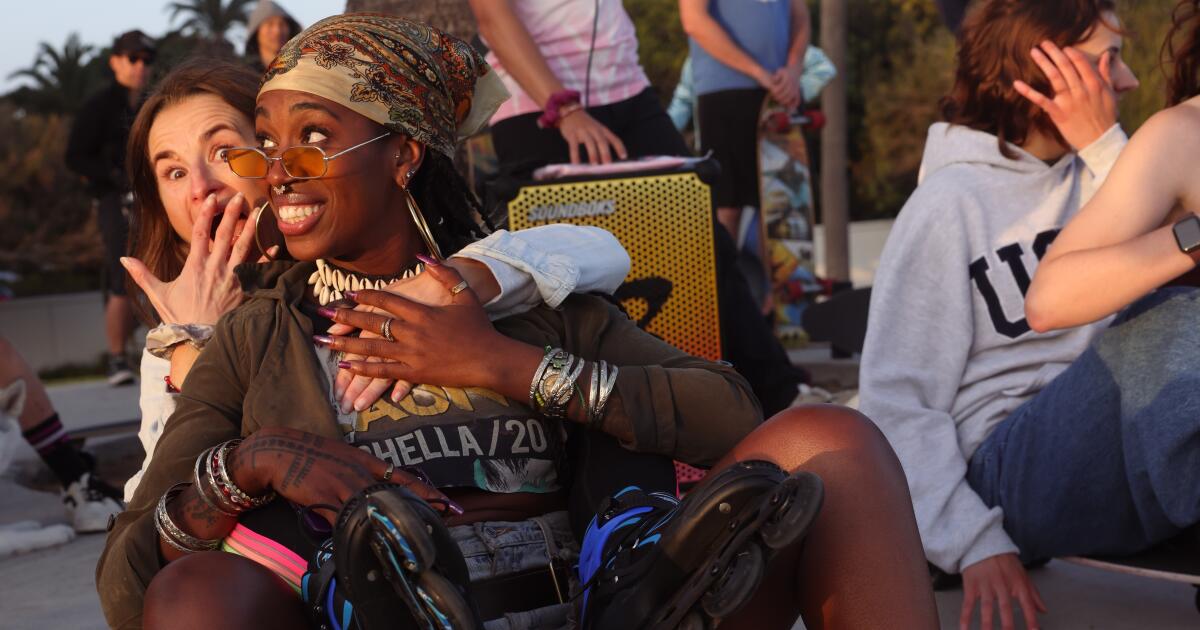
It’s a Tuesday night in mid-May, and dozens of people are rolling into a parking lot just south of the Santa Monica Pier. Most are on skateboards of all shapes and sizes. A few are on roller skates, scooters and bicycles. One dude rides in on a mountain bike armed with a toy gun that blows bubbles, enveloping the woman on skates he’s pulling behind him with a rope.
It feels like a party is about to start. The sun is still high in the sky and the breeze blows off the ocean. Gotye’s “Somebody That I Used to Know” is bumping from a knee-high amp as women, men and nonbinary folks congregate and coast on the pavement on their wheels of choice. Most are 20-somethings and 30-somethings.
A few minutes before 7 p.m., a lean 29-year-old with shoulder-length dirty blond hair, a backward turquoise ball cap and a pink tie-dye shirt, cuts the music and speaks into a microphone.
Brandon DesJarlais makes his way down the grassy hill during a meetup with Vibe Ride LA at Ocean View Park.
“Who’s living their best life? That’s what we’re here to do,” Brandon DesJarlais says to the crowd of 50 who are here for Vibe Ride, an event he created to skate, dance and connect with other people. Tonight they’ll travel together for about 1.7 miles to the Venice Skate Park, stopping along the way for bursts of revelry before turning around and heading back as the sun dips below the Pacific.
DesJarlais is a pro longboarder who created a nonprofit called Beyond the Board in 2021 to empower people and build community through skateboarding. His desire to share the joy of the sport tracks with the greater longboarding community’s reputation for being relaxed and inclusive — in part because the longboard’s shape makes learning the sport easier and less-trick-based.
“Longboarding is everything that’s not traditional street skating or vert skating,” said Don Tashman, the founder of L.A.-based longboard manufacturer Loaded Boards. “It’s inclusive. It’s diverse. It doesn’t have a defined clothing or culture or music. It is a catch-all … it’s a tool to spread stoke.”
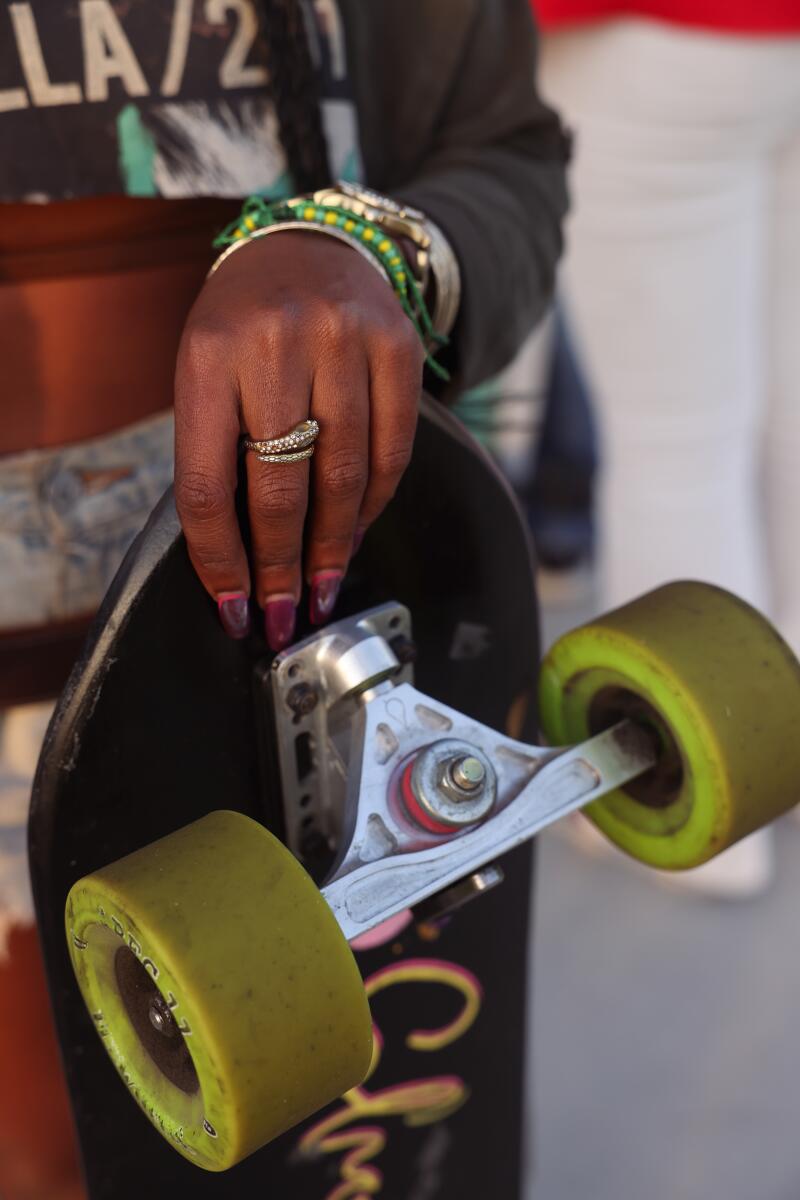
Shontel Anestasia holds onto her skateboard.
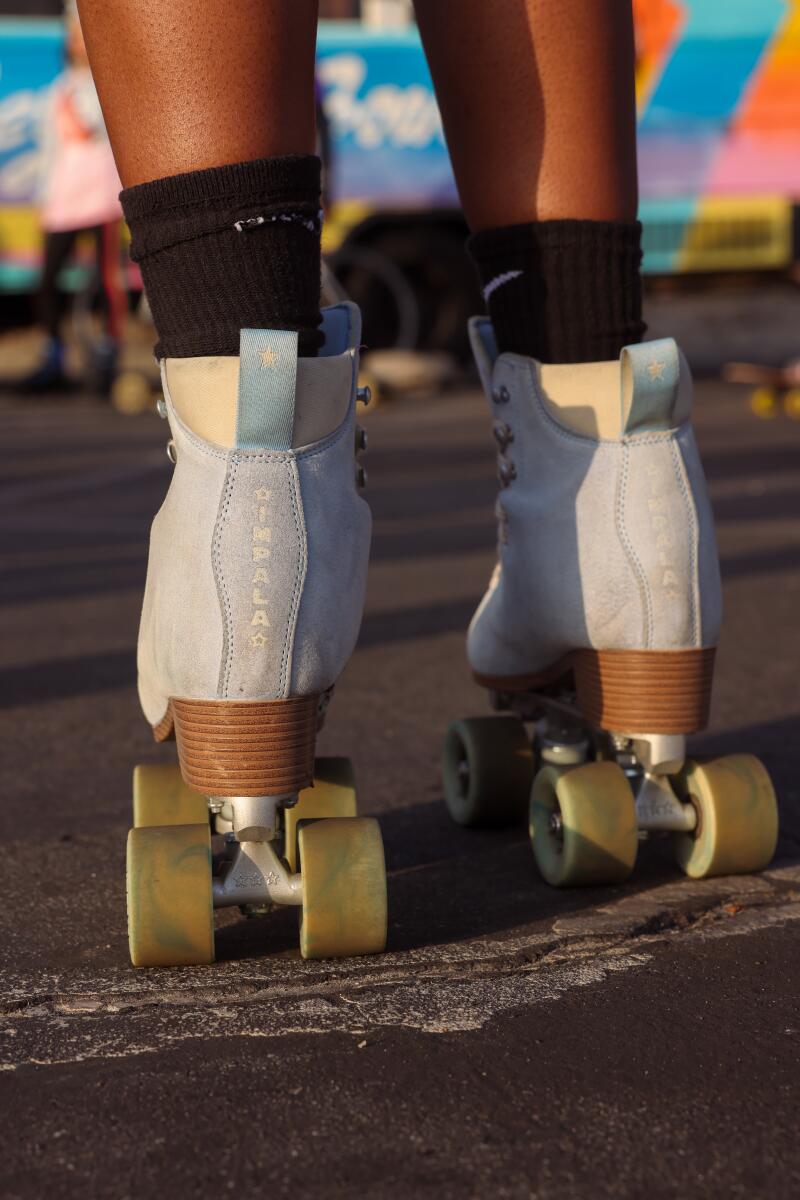
Kayla Drake stands in a circle for a meet and greet while wearing her roller skates.
Tonight DesJarlais acts as the DJ, emcee and Pied Piper of the event. He goes over the night’s itinerary before suggesting that the crowd form small groups for an icebreaker. All the while he stands in front of his pastel-painted bus, named the Shred Sled, which is reminiscent of the vehicle that Ken Kesey’s followers, known as the Merry Pranksters, used to travel the U.S. in the 1960s. (He’s even lived in the vehicle, both to save money and while completing three Beyond the Board national tours where he visited more than 25 states and hosted 250 events.)
After introductions, he passes the microphone to one of his co-organizers, Daniel Chiu. The health coach and event producer offers a short, guided meditation with just a smidge of woo and a few deep breaths before the group heads south.
Finally, DesJarlais leads the group to the bike path along the sand, with the amp resting on the front of his board, pumping out tunes like War’s “Low Rider,” Peaches & Herb’s “Shake Your Groove Thing” and Survivor’s “Eye of the Tiger.”
As they cruise along, the group spreads out. Most are on longboards. There are plenty of people who are new to skateboarding tonight, some of whom ride longboards provided by one of Beyond the Board’s sponsors, Landyachtz. Vibe Ride is a no-one-left-behind event with a sweep trailing the flock to ensure no one gets disconnected.
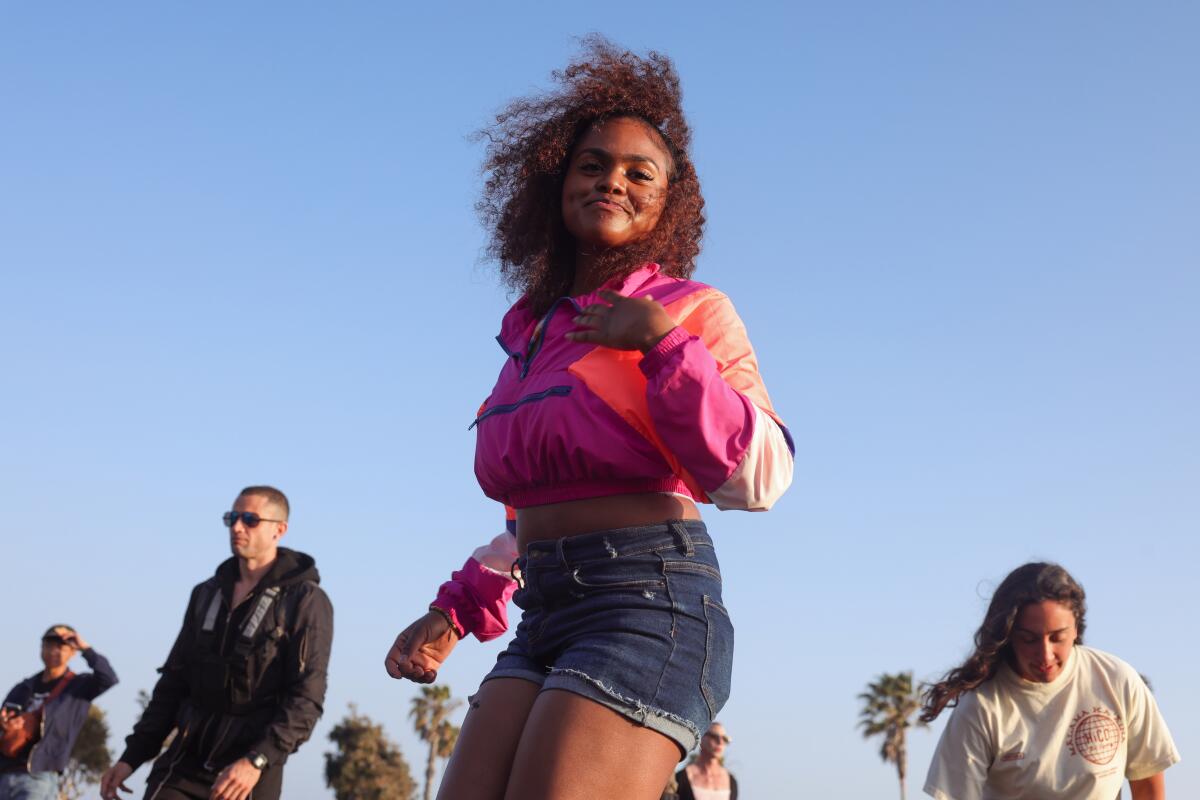
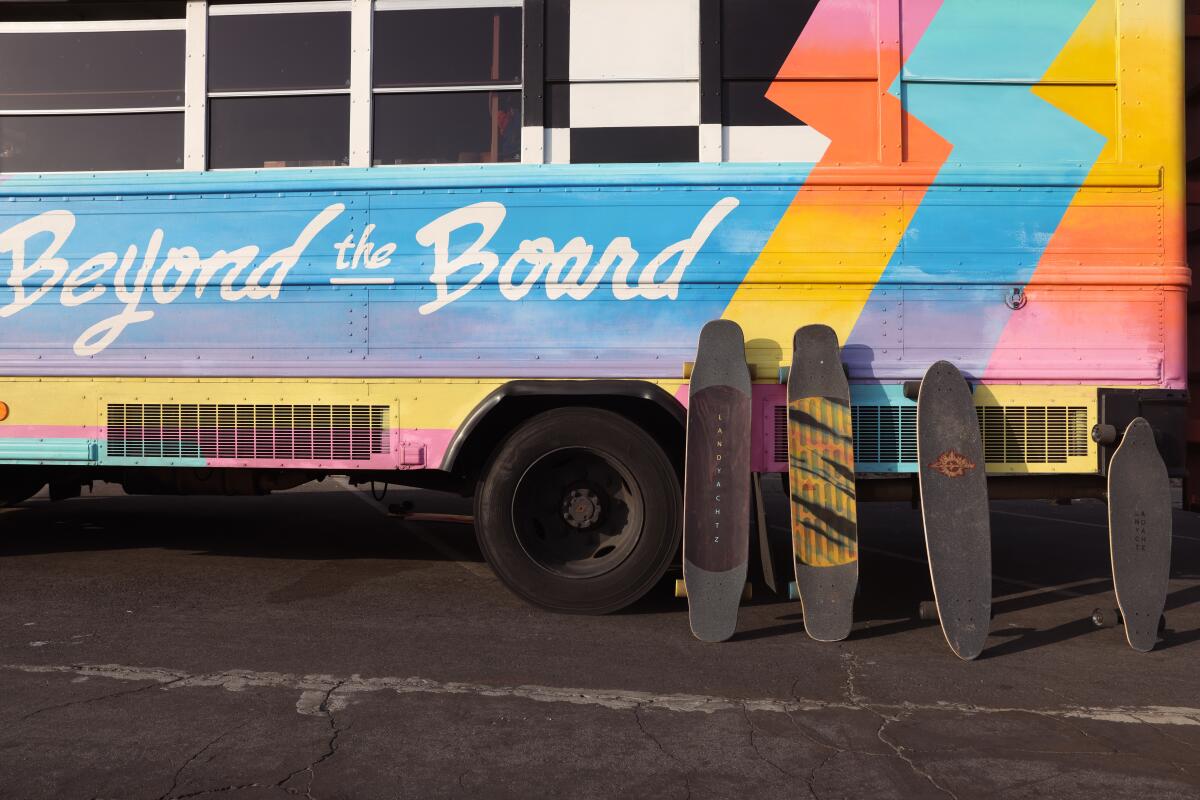
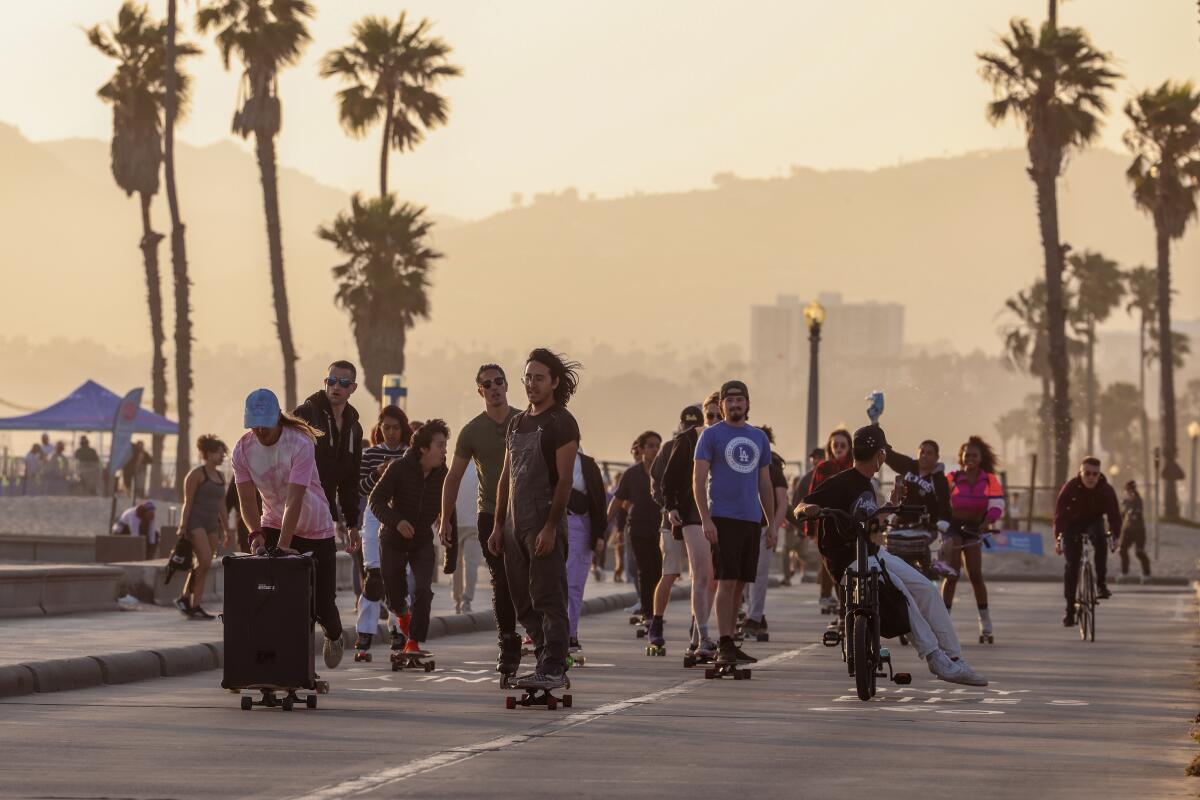
Kayla Drake rides her rollerskates with the group. Skateboards are lined up along a “Beyond the Board” bus. A group of mostly skateboarders ride along the boardwalk.
Many Vibe Riders simply head from point A to point B. Others make soulful turns, or “carves,” that recall an expert surfer riding a wave. A few groove up and down their boards as they roll, otherwise known as “dancing” (a popular style of longboarding).
The vibe tonight is especially social. Skaters chat as they glide. At one point, the group stops for a “hill bomb” — racing from the top of a small grass hill to the bottom. At the next, in front of the Adda and Paul Safran Senior Housing in Venice, the dance party kicks into overdrive. The Jackson 5’s “I Want You Back” blares from the amp, as a woman on the building’s third floor appears in a window to see what the commotion is about. Observing the party, she smiles and waves with both hands.
Even as the group embraces a carefree playfulness, DesJarlais is sure to lead by example. When he passes by a five-piece jazz band playing on the bike path, he cuts the music so as not to interrupt them. Participants look out for one another, calling out upcoming bicycles and sandy sections. When a Vibe Rider spots dog poop on the path, they fade back and block it, ensuring participants won’t ride over it.
The idea for the Vibe Ride came about during the early stages of the pandemic, when DesJarlais and Chiu met while skateboarding in Santa Monica. At this moment of intense isolation, the two came up with a shared goal: “To get people outdoors to connect with other people,” said Chiu.
The first official Vibe Ride was in January 2022. Only about 10 people showed up. But as the group connected with other skate-centric communities, including the inline and roller skate group the Skate Hunnies, its size and network began to grow.
In addition to the weekly Tuesday rides, the group also gathers for one-offs. DesJarlais estimates they’ve hosted more than 200 events. His dedication stretches beyond organizing and attending the rides. He’s even “flowed,” or given, folks longboards — on the condition that they ride them regularly.
One of those recipients is Vu Le, whom DesJarlais met 2 ½ years ago.
“The vibe is whatever you want it to be,” says Le, as his knee-length, burgundy silk robe flows behind him like a cape while skating down the bike path.
Josefina Chebaia first attended the Vibe Ride in April after a friend introduced her to the event. The Argentina-born artist was just learning to skateboard and loved how supportive the group was.
“There’s so much joy, so much happiness and so much healing,” she said. “Everyone feels that sense of belonging.”
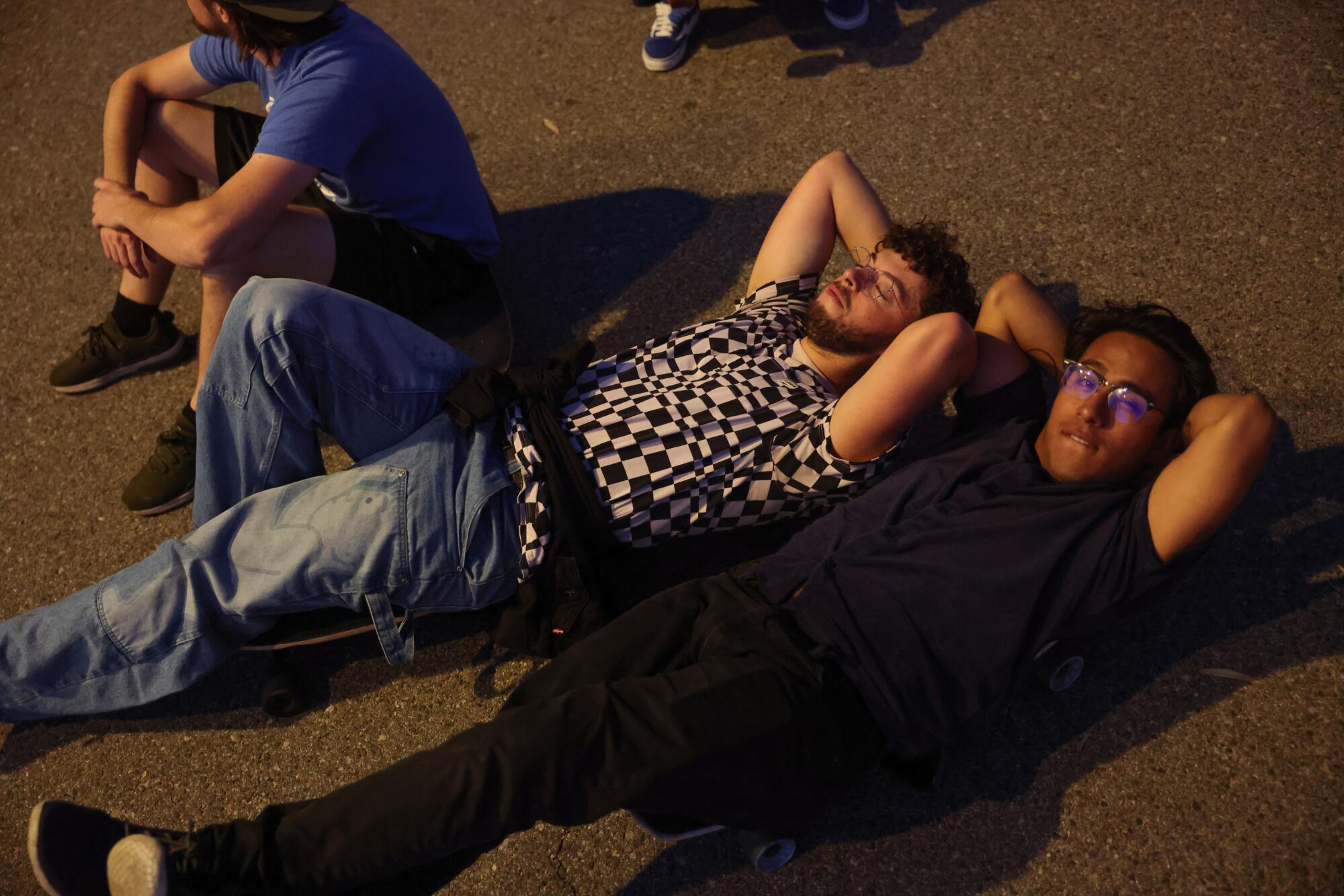
After a 3.4-mile group ride along the boardwalk, a group of folks with Vibe Ride LA meet back up at Lot 4 South to close out the night.
At the end of the ride, some people head home while others head toward the post-ride taco truck meetup. Chiu hangs back with his 7-month-old Husky, Serene, who trotted alongside him during the ride..
“If you want to find an open, welcoming community to skate with or learn to skate with and to do it by the beach, this is the place,” he says, before he and Serene drift off into the distance.

Lifestyle
John Cena wanted to step away from the WWE ring before he became ‘too slow for the show’ : Wild Card with Rachel Martin

A note from Wild Card host Rachel Martin: First a confession: I have never watched a WWE match in its entirety. Don’t get me wrong, I appreciate the athleticism and the performance, it’s just not my thing. But there is something about John Cena I’ve never been able to shake.
Yes, he is a wrestling legend, but he has built a career as an entertainer that transcends the ring. The first time I saw him lead a cast was the 2019 family movie “Playing with Fire” and his rapport with kids in that film didn’t seem like acting at all. The man contains multitudes!
He co-stars with Eric Andre in his newest film, “Little Brother.”

Xie Miao and Yang Enyou in The Furious.
Norachai Kajchapanont/Lionsgate
hide caption
toggle caption
Norachai Kajchapanont/Lionsgate
There have been some fantastic movies released this year, and we know you can’t see them all. So we’re recommending four recent movies we missed that you should add to your watchlist: The Furious, Tuner, She’s The He, and Heresy.
If you need a few more fun film recommendations, check out these episodes:
Fun movies you may have missed
Our favorite movies on Tubi
We debate the best movies to watch on an airplane
Connect with Pop Culture Happy Hour:
Letterboxd / Facebook
Our weekly newsletter
Support Pop Culture Happy Hour+

A tarp covers the facade of the John F. Kennedy Memorial Center for the Performing Arts in Washington, D.C., on June 13. A federal judge has asked the arts complex’s leadership to explain the purpose of the tarp and the surrounding scaffolding.
Alex Wroblewski/AFP via Getty Images
hide caption
toggle caption
Alex Wroblewski/AFP via Getty Images
On Wednesday, the federal judge overseeing the Kennedy Center lawsuit ordered the center to give him a status report on the center’s operation and programming within the next few weeks. Judge Christopher R. Cooper also said that the Kennedy Center must explain the purpose and status of the tarp and scaffolding that have been placed over the front of the arts complex, where until recently both President Trump and President John F. Kennedy’s names were both displayed.
In a directive issued last Tuesday, Judge Cooper had given Kennedy Center administrators three days to update him on the arts complex’s immediate plans regarding construction, programming and public access. Trump, who now serves as the center’s chairman, had announced July 5 as the date the venue would close for major renovations.

Last Friday, on Cooper’s due date, lawyers for the Kennedy Center filed a request asking for an extension. In that filing, Matt Floca, who was promoted as the center’s president and CEO in March, said that the Kennedy Center’s current management intends to present its board with “an array of options” for trustees to vote on at their next meeting on an unspecified date in mid-July.
According to Floca, the options are a complete closure for extensive renovations; a partial closure “enabling some continued public access and limited programming” while some renovations are undertaken; and “a highly limited series of phased closures to address only the center’s most serious infrastructure needs while scheduling and maintaining a full slate of programming.”
In his newest order, Cooper denied Floca’s request for an extension. And he mandated that the center file a status report within seven days of the center’s July board meeting or by July 31, whichever date is earliest. He also ruled that the report must “indicate the purpose for and status of the tarp and scaffolding,” which were erected by workers over the center’s front signage in the early morning hours of June 13.
When asked for comment Wednesday, the Kennedy Center pointed back to the documents its legal team submitted to the court.
The tarp and scaffolding on the center’s front portico went up after the Kennedy Center’s administration slow-walked the court-mandated removal of President Trump’s name from the front of the center and from all digital materials, which was supposed to happen no later than June 12. Workers removed the lettering overnight into the following morning, hours after the federal court’s original deadline, and covered the center’s sign with a tarpaulin.
As of Monday, the sign remains hidden from the public.

Trump’s name was scrubbed from all of the Kennedy Center’s digital content on June 4, the same day an email order to do so was issued by the complex’s legal team; NPR obtained this memo the day it was sent out to Kennedy Center staff.
These court orders are part of the ongoing lawsuit filed by Rep. Joyce Beatty, D-Ohio, against President Trump and the board of the Kennedy Center. Earlier this year, Cooper ruled that Beatty, an ex-officio member of the Kennedy Center board, must be allowed to participate in board meetings. NPR has asked Beatty if she plans to vote at the July board meeting, but did not receive an immediate response.
It would be very difficult for the Kennedy Center to revive a thriving programming lineup for the months ahead. Over the past year, many prominent artists canceled their planned appearances, citing the politicization of the venue. Most of the center’s programming staff have departed, either via layoffs or resignations. Unlike top administrators at other major performing arts venues around the country, Matt Floca has no experience in artistic direction, fundraising or arts administration; formerly, he was the center’s head of facilities, and he holds a bachelor’s degree in construction management.
Established artists who typically perform at the Kennedy Center generally have their touring schedules set at least a year in advance, if not multiple years ahead. In years past, the center has publicly announced its upcoming season in mid-spring for performances beginning in September and running through the following summer.

Currently, only a handful of outdoor free movie screenings of nostalgic favorites like The Princess Diaries and Clue appear on the center’s calendar of events, along with some participatory workshops for kids. In the past, the Kennedy Center presented over 2,000 arts and education events each year.
The center also recently became ensnarled in litigation with one of its longtime tenants and artistic partners. On June 12, the Washington National Opera, a company formerly in residence at the Kennedy Center, sued the complex for $17 million. It claims that the Kennedy Center had withheld “years’ worth of donor gifts, bequests and endowment funds” that had been intended specifically for the WNO.
-

 Rhode Island2 minutes ago
RI becomes first state to establish grocery self-checkout limits
-

 South-Carolina7 minutes ago
Spartanburg’s Riley Vaughn named Gatorade Girls Track and Field Player of Year in SC
-

 South Dakota14 minutes ago
South Dakota Supreme Court upholds Box Elder burglary, assault convictions
-

 Tennessee17 minutes ago
Middle Tennessee man facing 64-count indictment involving child sex crimes, police say
-

 Texas22 minutes ago
A Judge Issued a Rebuke to the Texas GOP’s Claims About the East Plano Islamic Center
-

 Utah29 minutes ago
Utah Royals FC Announce the Addition of Assistant Coach Jessie van den Broek to 2026 Coaching Staff | Utah Royals
-

 Vermont32 minutes ago
Record-setting CVU runner named Vermont’s top girls track and field athlete by Gatorade
-

 Virginia37 minutes ago
VA Spirits Board & VA Distillery Co. Commemorate America’s 250th with Exclusive Trio Pack

