Science
Will a diet that's good for the planet also help you live longer? Here's the evidence


A new study finds that the more people followed environmentally sustainable diets that emphasized nutrients from plants, the lower their risk of death from cancer, heart disease, Alzheimer’s disease and a variety of other causes.
(J.M. Hirsch / Associated Press)
Every time you scoop up a spoonful of overnight oats or sink your teeth into a cheeseburger, you’re eating for two — for the sake of your own health and the health of the planet.
Researchers estimate that about 30% of greenhouse gas emissions, 40% of land use and 70% of freshwater use is tied to the production of food. The strain will only grow as Earth’s population climbs toward the 10 billion mark by 2050.
Will it be possible to provide all those people with a nutritious diet in a way that’s environmentally sustainable?
That question prompted an international group of scientists to create a “planetary health diet” that’s heavy on plants — including vegetables, fruits, whole grains, nuts, legumes and unsaturated oils from sources like olives and canola — along with with modest amounts of dairy, poultry, fish and other foods derived from animals. It also allows for a little bit of red meat, refined grains and sugar. (You can even have a burger about once a week.)
If the whole world were to embrace a diet like this — along with adopting better agricultural practices and reducing food waste — greenhouse gas emissions would be cut roughly in half, the scientists calculated when they introduced their eating plan in 2019. They also projected that the number of premature deaths around the world would fall by up to 24%.
“That amounts to about 11 million deaths per year” that wouldn’t happen, said Dr. Walter Willett, a co-chair of the group known as the EAT-Lancet Commission.
Now Willett and his colleagues at Harvard University have checked their work against real-world data.
The Harvard team created a Planetary Health Diet Index, which quantifies the degree to which a person’s diet adheres to the goals put forth by the commission. There are 15 food groups, and people were scored on a 5-point or 10-point scale for each one. The maximum possible score was 140, which would signify perfect alignment with the ideal eating plan.
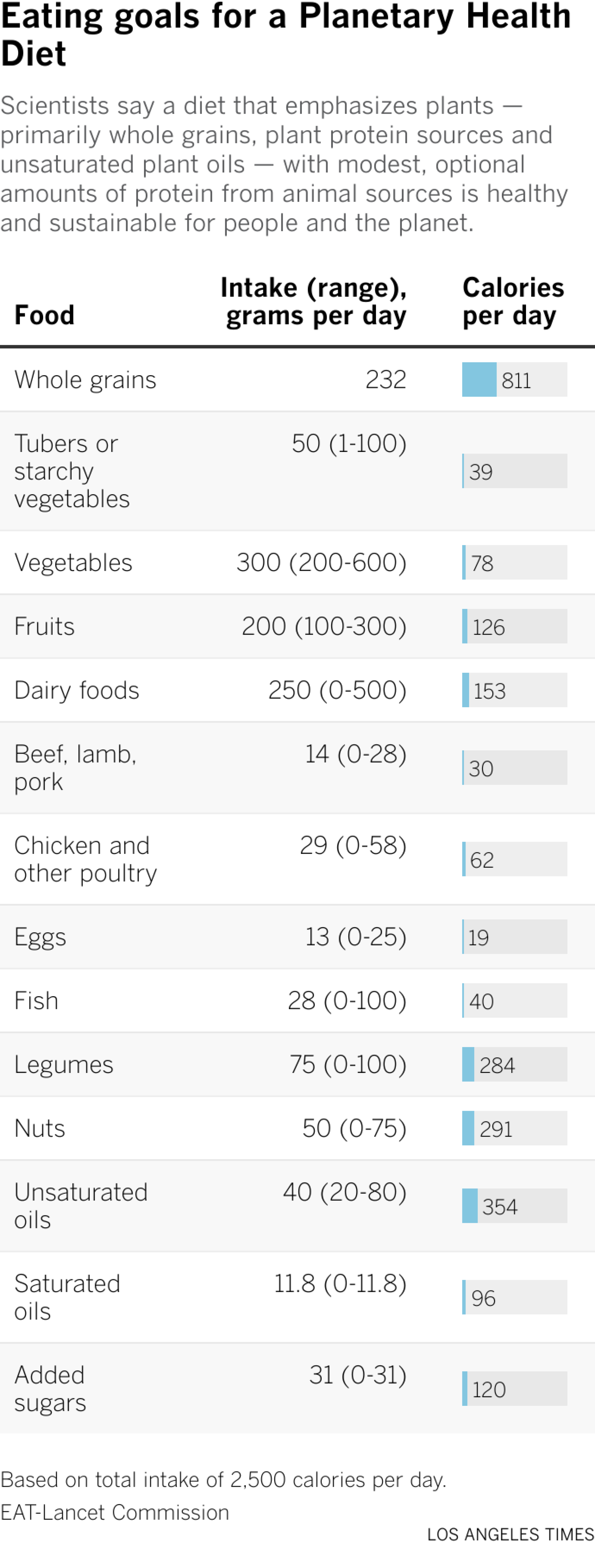
The researchers assigned PDHI scores to more than 200,000 people enrolled in the Nurses’ Health Study, the Nurses’ Health Study II and the Health Professionals Follow-up Study. All of the participants gave detailed information about their diets when they joined the studies in the 1970s and 80s, and they updated that information at least once every four years for more than two decades.
The women in the two Nurses’ Health Studies improved their diets over time: The average index score for participants in NHS1 increased from 75.7 in 1986 to 84.5 in 2010, while the average for women in NHS2 jumped from 70.4 in 1990 to 85.9 in 2015. However, the average score for men in HPFS held steady at around 78.
By the time the tracking periods came to an end in 2019, 54,536 people in the three studies had died.
The researchers hypothesized that the higher a person’s PDHI score, the lower their risk of being among the deceased. And after accounting for demographic factors such as age, race and neighborhood income as well as health issues like a family history of cardiovascular disease or cancer, that’s exactly what they found.
“We did see a very strong, very clear inverse relationship,” said Willett, a professor of epidemiology and nutrition at the Harvard T.H. Chan School of Public Health. “Right down the line, everything we looked at was lower for people who adhered most closely to the planetary health diet.”
Compared to the 20% of people with the lowest index scores, the 20% with the highest scores were 23% less likely to die for any reason during the study period. They were also 14% less likely to die of cardiovascular disease, 10% less likely to die of cancer, 47% less likely to die of a respiratory ailment, 28% less likely to die of a neurodegenerative disease such as Alzheimer’s, and 22% less likely to die of an infectious disease.
Among all the men and women, eating more whole grains, fruit, poultry, nuts, soy and unsaturated fats were each associated with a lower risk of death. On the other hand, eating more starchy vegetables like potatoes, red or processed meats, eggs, saturated fats, added sugar or sugar from fruit juices were each associated with a higher risk of death.
Willett and his collaborators also consulted a database that tallied the environmental impacts of various foods to see whether healthier diets were better for the planet. Compared to the diets of people with the lowest PDHI scores, the diets of those with the highest scores required 21% less fertilizer, 51% less cropland and 13% less water and produced 29% fewer greenhouse gas emissions.
Willett said he was “surprised by the strength of some of these findings,” adding that the relationship goes both ways. For instance, when fewer acres are farmed, there’s less particulate matter in the air, and when fewer animals are raised in close quarters, the risk of antibiotic resistance declines.
“There are lots of very important indirect effects on health that are mediated by a better environment,” he said.
The results were published Monday in the American Journal of Clinical Nutrition.
This isn’t the first study to link planetary health diets to a reduced risk of premature death — researchers have seen the connection in the United Kingdom and in Sweden. But the new work is the first to apply a more precise diet index to a large sample of Americans and use it to assess their risk of death.
That is an “important” advance, said Zach Conrad, a professor at William & Mary who specializes in nutritional epidemiology and food systems.
However, he said more work is needed to show that planetary health diets are as good for the Earth as they are for Earthlings.
“It has yet to be demonstrated that healthy diets are also more environmentally sustainable,” said Conrad, who was not involved in the new study. “It is important that we move away from inferring a link between diet quality and sustainability, and instead move toward measuring it.”


new video loaded: NASA Announces Artemis III Crew
transcript
transcript
NASA Announces Artemis III Crew
NASA announced the crew of Artemis III mission, which will fly to low-Earth orbit to test rendezvous and docking maneuvers with one or two lunar landers.
-
“I am excited to welcome you as the next crew in the Artemis journey to successfully return to the moon — this time to stay.” “I’m honored by the role that I’ve been given. I’m also very humbled by the task in front of us. But first and foremost, I’m grateful.” “So with that, the Artemis II crew, comrade, hands you the baton. You got the controls.” “As you know, we had a significant anomaly at our Launch Complex 36A on May 28. We’ve redoubled our efforts and are moving forward.”
By Alisa Shodiyev Kaff
June 9, 2026
Science
Santa Monica Mountains’ last steelhead trout survived the Palisades fire — and even had babies

Scientists feared the Santa Monica Mountains’ last remaining steelhead trout were dead, smothered by debris flows unleashed by the Palisades fire.
But the endangered fish surprised them: A team of biologists recently spotted 30 of the rare trout — and 21 babies — in Topanga Creek.
“There was a lot of happy dancing in the creek,” said Rosi Dagit, principal conservation biologist for the Resource Conservation District of the Santa Monica Mountains, which works with public and private landowners to conserve natural resources.
That’s because the steelhead here are endangered, at both the state and federal levels. Once, they swam in most streams of the Santa Monicas, but their numbers plummeted amid overfishing and coastal development. Increasingly frequent wildfire has further stressed their habitat. Topanga Creek, a biodiversity hot spot, is home to their last known population in the mountains that stretch from the Hollywood Hills to Point Mugu in Ventura County.
The trout that were spotted, including this one, are part of a distinct Southern California population that’s listed as endangered at the state and federal levels.
(RCDSMM Stream Team)
The California Department of Fish and Wildlife spearheaded a complex mission to rescue trout threatened by the Palisades fire that sparked in January 2025.
Time was of the essence. The fire hadn’t yet been fully contained. But rain was on the way, which would sweep massive amounts of sediment from the denuded hillsides into the water. Fish are often killed this way.
Crews stunned the fish with electricity, scooped them up in buckets, trucked them to a hatchery and ultimately moved them to Arroyo Hondo Creek in Santa Barbara County.
Within days, Topanga Creek was choked with mud. Some assumed the fish left behind were goners.
But in March, the conservation district’s team found four. The following month, when water conditions were clearer, they saw more.
“These fish continue to amaze me,” said Kyle Evans, environmental program manager for the state Department of Fish and Wildlife, who had seen the damage to the creek. “I had seen populations get wiped out in similar situations. So when I heard, I was thrilled.”
Evans surmises the fish that survived were in an area of the creek where less charred material and sediment were swept in.
“These fish likely hunkered down, were hiding under some rocks or places to try to get away from the main concentration of flow,” he said. “And luckily they weren’t buried.”
The ones that were spotted were fairly small, around 6 to 14 inches. Rainbow trout and steelhead trout are the same species, but with different lifestyles. If the fish remain in freshwater, they’ll be considered rainbows. However, they can migrate to the ocean and become steelhead, where they typically grow larger before returning to their natal waters to spawn.
Topanga Creek hasn’t fully recovered from the damage it sustained, but scientists say it’s looking better. Surveys last year were “so depressing,” Dagit said, with very few animals, and stretches that were essentially transformed into flat roads from all the sediment buildup. Some of the riparian canopy burned right down to the creek.
Then came 32 inches of rain over the last nine months, scouring out and moving sediment, creating deeper pools. Dagit said they recently found newt egg masses for the first time in years, as well as a few adult newts and many frogs. Plants that provide cover are starting to recover.
She provided photos comparing certain pools last year and this year, some dramatically transformed. In September 2025, the Shrine Pool could have been an overgrown hiking trail. This April, it was filled with shallow water.

The Shrine Pool in September 2025, left, and the same location in April 2026, right, with RCDSMM’s Isaac Yelchin donning a wetsuit.
(RCDSMM Stream Team)
Topanga Creek is home to another endangered fish, the small but hardy northern tidewater goby, often described as cute. Not long before the trout operation, Dagit led a rescue of hundreds of these fish too. Many were repatriated to the lagoon at the mouth of the creek in a moving ceremony last June.
There’s still the matter of what to do with the trout that were moved to Santa Barbara County last year. Evans would like to bring them home to the Santa Monicas at some point, but isn’t sure if it will happen. On one hand, they could bolster the small, genetically isolated surviving population. On the other, they might inadvertently bring in a disease or bacteria. There is some time to decide. Evans estimates the creek still needs to recover for two to three more years.
For now, the fish are functioning fine in their adopted creek. Experts worried the trauma wrought by the move would disrupt their spawning process, but they had babies that spring. This year, they spawned again.

The Pacifica Municipal Pier was shut down and taped off Thursday after city workers noticed cracks running through the landmark structure and concrete chunks falling into the ocean.
It’s just one of many coastal California structures that have recently crumbled under pressure from a rising and relentless ocean.
Officials from the small, beach city south of San Francisco said the pier was closed due to “cracking, separation, and displacement of the concrete walkway and structural elements.”
It will stay closed while structural engineers asses its safety.
Photos taken by city employees show a wide crack that runs from top to bottom and across the structure as well. Other photos show a large horizontal crack under the foundation of a small restaurant on the pier, the Chit Chat Cafe.
The cafe was also shut down.
This is not the first time the 53-year-old pier has shown signs of stress. In 2021, part of it was shut down after handrails along the edge collapsed. And in 2023, after a series of storms pummeled the Central California coast, damaging parts of the pier, the structure was partially closed for more than year.
Those same storms caused extensive damage in Aptos and Capitola, 70 miles south, where piers and waterfront infrastructure were swept away or damaged.
In 2024, a 150- to 180- foot section of the Santa Cruz wharf was ripped off by powerful waves.
At least 10 of the state’s dozens of coastal public piers were closed for part or all of 2024 due to structural damage sustained in winter storms since 2022. At least five others have longer-term upgrades planned to address structural issues.
“These things are costly to maintain,” said Zach Plopper, senior environmental director at Surfrider. “They are a part of our California coastal culture in many ways, but we’re going to need to reckon with, one, the state that they’re in, and two, the continuous and worsening threats they’re going to experience,”
He said most of the piers were constructed in the early 1900s, and they weren’t built to withstand decades of rough seas, storms and rising sea level.
“With this incoming El Niño, which is forecasted to be significant, and this marine heat wave we’re in the midst of, we’re kind of in uncharted waters as far as what this winter could bring in terms of storms and swells to the California coast, and we’re likely going to see a lot more damage,” he said. “Not just piers, but roads and other coastal infrastructure up and down the state.”
There was no storm in Pacifica earlier this week, so no single event could be blamed for the destruction.
However, a 2025 report from an outside engineering firm, GHD, found that several sections of the pier were in “poor” or “serious” condition, and they recommended closure before anticipated storms or events that could “subject the piles to high winds, swells and large waves.”
The firm found several areas of the pier where concrete was missing and rebar was exposed and corroding.
“The pier has continued to experience high winds and large waves in a harsh marine environment,” the engineers wrote in the report, noting that continuous exposure to seawater or marine spray was “detrimental” to the structure.
A 2023 city report estimated it would cost $19 million to repair.
That same year, a state law was enacted to require local governments along the California coast to plan for sea level rise in the coming decades.
Sea level has risen some 8 inches, on average, along the coast in the past 150 years, Plopper said, and researchers anticipate another foot in the next 25 years.
“We’re going to see profound shifts on our coastline, none that we have ever experienced before, and building static structures on the coast just doesn’t work all that well,” he said. “We’re going to have to make some really hard decisions.”
-

 News2 minutes ago
Video: Graham Platner Wins Maine Senate Primary
-

 Politics7 minutes ago
Video: Life Inside an ICE Detention Facility
-
 Lifestyle37 minutes ago
What makes a song a ‘millennial song’ : It’s Been a Minute
-

 Technology47 minutes ago
Microsoft is disabling Office 2019 for Mac next month
-

 World52 minutes ago
Iran accelerates execution campaign against anti-regime activists amid internet censorship
-

 Politics59 minutes ago
Top takeaways from the primary elections in Maine and South Carolina: ‘Movement about us’
-

 Health1 hour ago
Flying with cannabis? TSA’s new guidance comes with a major health warning
-

 Sports1 hour ago
Jordan Staal’s two-goal night lifts Hurricanes past Golden Knights, evening Stanley Cup Final series

